

Avatr put the 2026 Avatr 06 on sale in China on 15 October 2026 as a two-model range: the Max EREV (extended-range electric vehicle) and the Max BEV (battery electric vehicle). Both are single-motor rear-drive sedans with Huawei's Qiankun ADS 5 driver-assistance system as standard, and Avatr president Chen Zhuo announced the launch on Weibo without a launch event. The Max EREV has a 231 kW motor (about 310 hp), a 32.3 kWh battery, 230 km of CLTC electric range and 1,190 km CLTC combined range, and its guide price is CNY 219,900 ($32,800). The Max BEV has a 252 kW motor (about 338 hp), a 75.46 kWh battery and 650 km of CLTC range, at CNY 229,900 ($34,290). Orders placed from 15 to 31 October 2026 qualify for a limited-time offer that brings the prices down to CNY 205,900 ($30,710) and CNY 215,900 ($32,200). Prices are converted at 1 USD = 6.7048 CNY, the ECB rate of 6 October 2026.
Performance & Specs
Both versions of the 2026 Avatr 06 use one electric motor on the rear axle. In the Max EREV (range-extender electric car) the motor is rated at 231 kW, about 310 hp (231 kW x 1.341), and Avatr's model page calls this the hybrid peak electric drive power. Behind it sits a 1.5-litre turbocharged range extender rated at 115 kW (about 154 hp) that runs only as a generator, so that figure is not power at the wheels. The Max EREV accelerates from 0 to 100 km/h in 6.6 seconds, and Avatr's page says the time with a depleted battery is only 0.1 seconds slower. Avatr quotes a WLTC fuel consumption of 5.36 L/100 km with a depleted battery on 92-octane petrol, and Chinese outlets list a 45-litre fuel tank.
The Max BEV raises the motor to 252 kW, about 338 hp, and cuts the 0-100 km/h time to 6.1 seconds. It is built on an 800-volt silicon carbide platform with a CATL Shenxing battery of 75.46 kWh and a CLTC range of 650 km. Dividing 75.46 kWh by 650 km gives about 11.6 kWh/100 km at the battery, a battery-to-wheel figure on the generous CLTC cycle, so real-world range will be lower. For the EREV, 32.3 kWh over 230 km works out to about 14.0 kWh/100 km. Torque and top speed have not been published for the 2026 lineup in the sources read, so neither is stated here, and the dual-motor all-wheel-drive version is no longer offered.

| Powertrain | EREV, 1.5T range extender + single rear motor (RWD) |
|---|---|
| Power | 231 kW (310 hp) electric drive |
| Torque | Not published |
| 0–100 km/h | 6.6 s |
| Battery | 32.3 kWh LFP (CATL) |
| Range | 230 km EV / 1,190 km combined (CLTC) |
| POWERTRAIN TYPE | EREV (Max EREV) and BEV (Max BEV), both single rear motor |
|---|---|
| HORSEPOWER | 231 kW (310 hp) EREV; 252 kW (338 hp) BEV |
| ACCELERATION | 0-100 km/h in 6.6 s (EREV); 6.1 s (BEV) |
| TOP SPEED | Not published |
| DRIVETRAIN | RWD (both versions) |
| BATTERY | 32.3 kWh LFP, CATL (EREV); 75.46 kWh CATL Shenxing (BEV) |
| ELECTRIC RANGE | 230 km (EREV, CLTC); 650 km (BEV, CLTC) |
| COMBINED RANGE | 1,190 km (EREV, CLTC); not applicable to the BEV |
Dimensions & Practicality

| Length | 4,855 mm |
|---|---|
| Width | 1,960 mm |
| Height | 1,467 mm |
| Wheelbase | 2,940 mm |
| Boot | 416 L / 1,266 L seats folded |
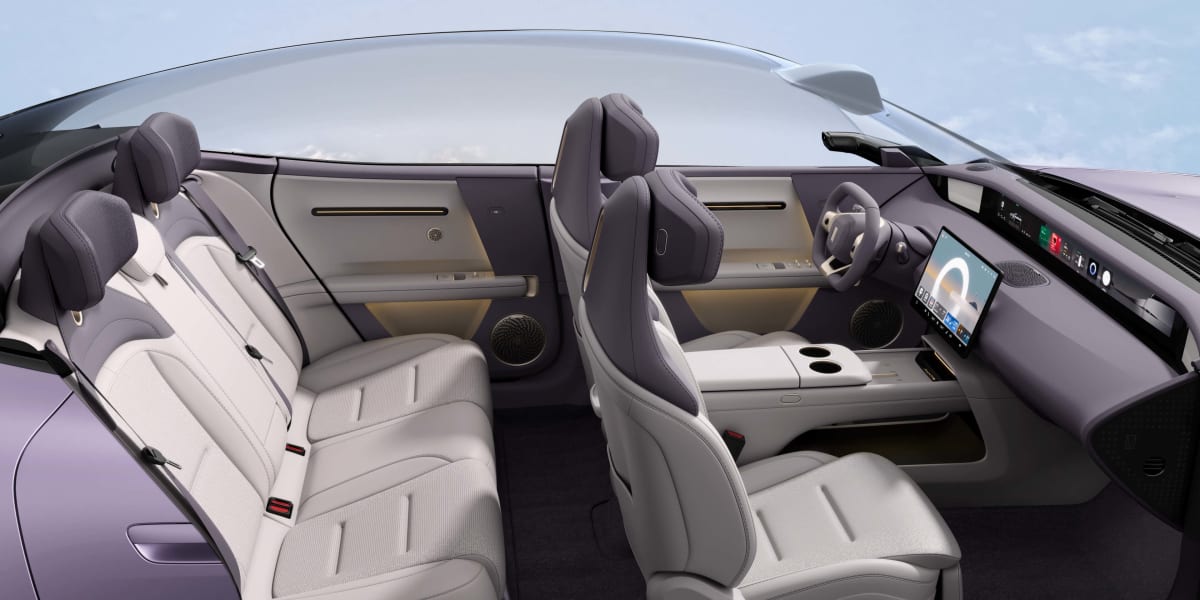
The Avatr 06 is a five-seat, four-door fastback with a large rear hatch, and it measures 4,855 mm long, 1,960 mm wide and 1,467 mm high on a 2,940 mm wheelbase. Those dimensions are the same for both the Max EREV and the Max BEV. Avatr's model page lists a 416 L boot that grows to 1,266 L with the rear seats folded, and a 70 L front trunk, although the page does not say whether the front trunk applies to both powertrains. Front head room is 990 mm and rear head room is 956 mm, and the panoramic glass roof covers 1.46 square metres. The long wheelbase and 1.46 square metres of glass roof give the cabin an airy, lounge-like layout for a sedan of this size.
| LENGTH | 4,855 mm |
|---|---|
| WIDTH | 1,960 mm |
| HEIGHT | 1,467 mm |
| WHEELBASE | 2,940 mm |
| CARGO VOLUME | 416 L (1,266 L seats folded) |
| FRUNK | 70 L (listed by Avatr; powertrain not specified) |
| SEATS | 5 |
Charging & Battery
The two versions have very different battery systems. The Max BEV carries a 75.46 kWh CATL Shenxing pack on an 800-volt platform with a peak charge rate of 5C, and CnEVPost reports that it charges from 30 to 80 percent in under 10 minutes and from 0 to 80 percent in under 17 minutes. Avatr's own page repeats the under-10-minute figure for 30 to 80 percent. A footnote on the page gives 72.88 kWh as the capacity measured at 1C discharge, so the 75.46 kWh figure is the nominal capacity. The Max EREV uses a smaller 32.3 kWh lithium iron phosphate (LFP) battery from CATL on a 400-volt platform, with 31.7 kWh given as the 1C figure, and Chinese outlets quote a fast-charge time of about 15 minutes without stating the state-of-charge window. Both versions can discharge externally at 3.3 kW, and Avatr says the pack has an IP68 rating with multi-layer thermal protection.
| BATTERY | 32.3 kWh LFP (EREV); 75.46 kWh CATL Shenxing (BEV) |
|---|---|
| VOLTAGE | 400 V (EREV); 800 V silicon carbide (BEV) |
| DC FAST CHARGING | BEV: 5C peak; EREV: peak power not stated |
| DC 30-80% TIME | Under 10 min (BEV); about 15 min reported (EREV) |
| DC 0-80% TIME | Under 17 min (BEV, CnEVPost) |
| EXTERNAL DISCHARGE | 3.3 kW (both versions) |
Design & Interior
The exterior keeps the low, wide fastback shape, with a slim light bar across the nose, a mesh-pattern lower intake and a black roof option on some paint colours. Avatr lists six exterior colours: black, grey, purple, white with a black roof, smoke purple with a black roof and red with a black roof. The one visible change is at the doors, where the handles are now semi-concealed rather than fully hidden. Inside the car there is a new mechanical emergency release, which Chinese outlets link to the safety debate over fully hidden handles. The cabin is built around a 35.4-inch 4K panoramic screen, a 15.6-inch floating central display and two 6.7-inch screens that show the camera feeds from the exterior mirrors.
The seats are trimmed in Nappa leather, and the front pair are zero-gravity seats with 14-way power adjustment, heating, ventilation and massage on Avatr's model page. The order-window package includes a free upgrade to zero-gravity front seats, which Avatr values at CNY 20,000 ($2,980). Other cabin items include a double-layer silvered panoramic roof, a nano water-ion air-conditioning system and a premium audio system, which CnEVPost says is from Meridian. One outlet reports that the speaker count has been cut from 25 to 16, but that number was not confirmed by Avatr. The same outlets say the camera-based exterior mirrors and power-operated front doors may be options on some builds, so buyers should check the configuration sheet.

Technology & Features
The cabin runs HarmonySpace 5, Huawei's HarmonyOS-based car software, and Chinese reports add a hybrid large-model voice assistant. The 15.6-inch central screen floats above the console, and the 35.4-inch panoramic screen carries the driver information and shows driving-assistance visuals. Huawei's ADS 5 is the main technology story for 2026 because it is now standard on both versions and no longer depends on which trim the buyer picks. The system supports navigation-assisted driving, roaming cruise assist and a function that navigates to an individual charging space inside a car park. Avatr says the ADS function is a driver-assistance feature that depends on over-the-air updates, and the driver stays responsible for the car at all times.
Safety & ADAS
ADS 5 on the 2026 Avatr 06 uses one 192-line LiDAR with a maximum detection range of 250 m, three millimetre-wave radars that Avatr's page describes as 4D, 12 ultrasonic sensors and 11 cameras, for 27 sensors in total. Huawei's CAS 5.0 collision-avoidance system adds forward, lateral and rear protection and now detects objects in the vertical direction as well, according to the reports. Passive safety includes nine airbags, a body with more than 34 percent hot-formed steel up to 2,000 MPa, a C-NCAP five-star rating, a die-cast aluminium floor and a Continental second-generation brake-by-wire system. Avatr's page also states that the battery pack is rated IP68 and sits behind five layers of underbody armour.
| ADAS LEVEL | L2+ driver assistance (Huawei Qiankun ADS 5, driver remains responsible) |
|---|---|
| ADAS FEATURES | Navigation-assisted driving, roaming cruise assist, CAS 5.0 collision avoidance, all-road adaptive AEB, parking-level charging navigation |
| SENSORS | 1 LiDAR (192 lines), 3 millimetre-wave radars, 12 ultrasonic sensors, 11 cameras |
| PASSIVE SAFETY | 9 airbags, C-NCAP five stars, 34% hot-formed steel up to 2,000 MPa |
What's New for the 2026 Model Year
The 2026 lineup is much simpler than the one that went on sale in April 2025, which had five trims at CNY 209,900 to 279,900 ($31,310 to $41,750). Avatr now sells only the two Max versions, and the entry-level trim and the dual-motor all-wheel-drive top version have gone. ADS 5 replaces the split between a cheaper system without LiDAR and the higher-end system, so every buyer gets the 192-line LiDAR and the upgraded radar. The guide price of the cheapest version rises by CNY 10,000 ($1,490) to CNY 219,900, but the limited-time price of CNY 205,900 is below the CNY 209,900 at which the 2025 car started.
The batteries are described as larger: CnEVPost lists the BEV at 75.46 kWh against 72.88 kWh and the EREV at 32.3 kWh against 31.7 kWh. Avatr's own footnotes show those older numbers as the 1C-discharge capacities of the same packs, so part of the gain is a change in how capacity is stated rather than a new pack. Chinese outlets report that the dual-chamber air suspension and the CDC adaptive dampers of the earlier Max trim are no longer fitted, and that the halo screen at the front has been dropped. Avatr's published chassis description lists only front double-wishbone and rear multi-link suspension with brake-by-wire, which is consistent with those reports, but one outlet quotes the Avatr president mentioning air suspension at the launch, so the final equipment list should be checked with a dealer.
Available Versions
| VERSION | POWER | TORQUE | 0-100 | TOP SPEED | DRIVETRAIN | BATTERY | EV RANGE | COMBINED RANGE | PRICE | KEY DIFFERENCES |
|---|---|---|---|---|---|---|---|---|---|---|
| Max EREV | 310 hp | — | 6.6s | — | RWD | 32.3 kWh | 230 km | 1,190 km | $32,800 (CNY 219,900) | EREV, 231 kW motor, 1.5T range extender, 400 V; limited-time CNY 205,900 ($30,710) |
| Max BEV | 338 hp | — | 6.1s | — | RWD | 75.46 kWh | 650 km | — | $34,290 (CNY 229,900) | BEV, 252 kW motor, 800 V, 5C; limited-time CNY 215,900 ($32,200) |
Pricing & Availability
The 2026 Avatr 06 went straight on sale on 15 October 2026 and no separate pre-sale price was announced. The guide prices are CNY 219,900 ($32,800) for the Max EREV and CNY 229,900 ($34,290) for the Max BEV. Customers who place an order between 15 and 31 October 2026 get a limited-time package worth up to CNY 58,000 ($8,650), which the headline prices of CNY 205,900 ($30,710) and CNY 215,900 ($32,200) reflect. The package includes a CNY 14,000 ($2,090) deposit-based cash benefit, a free zero-gravity seat upgrade worth CNY 20,000 ($2,980), a voucher for the CNY 21,000 ($3,130) ADS Max package and up to CNY 3,000 ($450) off the exterior colour. It also includes zero-interest financing, either for the first year or for the first two years of a five-year loan, and a lifetime warranty on the battery, drive motor and electronic control system for the first owner.
The CNY 205,900 and CNY 215,900 prices are not list prices, and after 31 October the price returns to the guide price unless Avatr extends the offer. Avatr's own site shows CNY 219,900 as the national suggested retail price on the 06 page, while a navigation card elsewhere on the site shows CNY 229,900, which matches the BEV's guide price. The car is sold in China only for now. Avatr has said it will start European sales in 2027 in Norway and Spain with the 06T estate and 07L SUV first, and the 06 sedan has not been named for that launch.
How It Compares
Against the Xpeng P7+ REV, the Avatr 06 Max EREV gives more electric power at 310 hp against 241 hp, but it has the smaller battery and a shorter electric range of 230 km against 430 km, and its 1,190 km combined CLTC range is below the Xpeng's 1,550 km. The Xpeng also costs about $6,100 less at $26,700, so the Avatr's argument rests on Huawei's ADS 5 with LiDAR as standard and a cabin with three screens. In the BEV class, the Max BEV at $34,290 offers 650 km of CLTC range, which trails the BYD Han L EV's up to 701 km and the ZEEKR 007GT's up to 905 km. The Han L EV starts at $32,560 with 671 hp in its single-motor rear-drive form and reaches up to 1,086 hp in the all-wheel-drive flagship, while the 007GT starts at $30,400 at its CNY 203,900 list price ($28,400 with its limited-time discount) with 422 hp. The Avatr's 338 hp is a modest figure next to both, and with the reported dropping of the all-wheel-drive version there is no higher-output option in the range. Rival dollar figures use the exchange rates of our own articles on those cars, so they may differ slightly from the 6.7048 rate used for Avatr. All figures are China-market CLTC ranges and prices from our own articles on those cars.
- Huawei ADS 5 with a 192-line LiDAR is standard on both versions, with the full 27-sensor suite
- Choice of EREV with 1,190 km CLTC combined range or BEV with 650 km CLTC and 800 V, 5C charging (30-80% in under 10 minutes)
- Long 2,940 mm wheelbase and a three-screen cabin, zero-gravity seats available and a limited-time price from CNY 205,900 ($30,710)
- Only 230 km of CLTC electric range in the EREV and 338 hp at most, behind rivals such as the Xpeng P7+ REV (430 km EV) and BYD Han L EV (up to 1,086 hp)
- Chinese outlets report the air suspension and CDC dampers are no longer fitted (reported, not confirmed by Avatr), and the dual-motor all-wheel-drive version is no longer offered
The 2026 Avatr 06 is a simpler and better-equipped proposition than a five-trim range: two Max versions, Huawei ADS 5 with LiDAR on every car, and a limited-time price that starts at CNY 205,900 ($30,710). The Max EREV, with 1,190 km of CLTC range, is the one for buyers who want to drive long distances without relying on fast chargers, while the Max BEV suits those who want 5C charging and 650 km CLTC. The trade-offs are the shorter electric range of the EREV, the reported loss of air suspension, the absence of all-wheel drive, and rivals that now offer more range for less money. It remains a strong choice for anyone who values Huawei's driver-assistance system above everything else.