
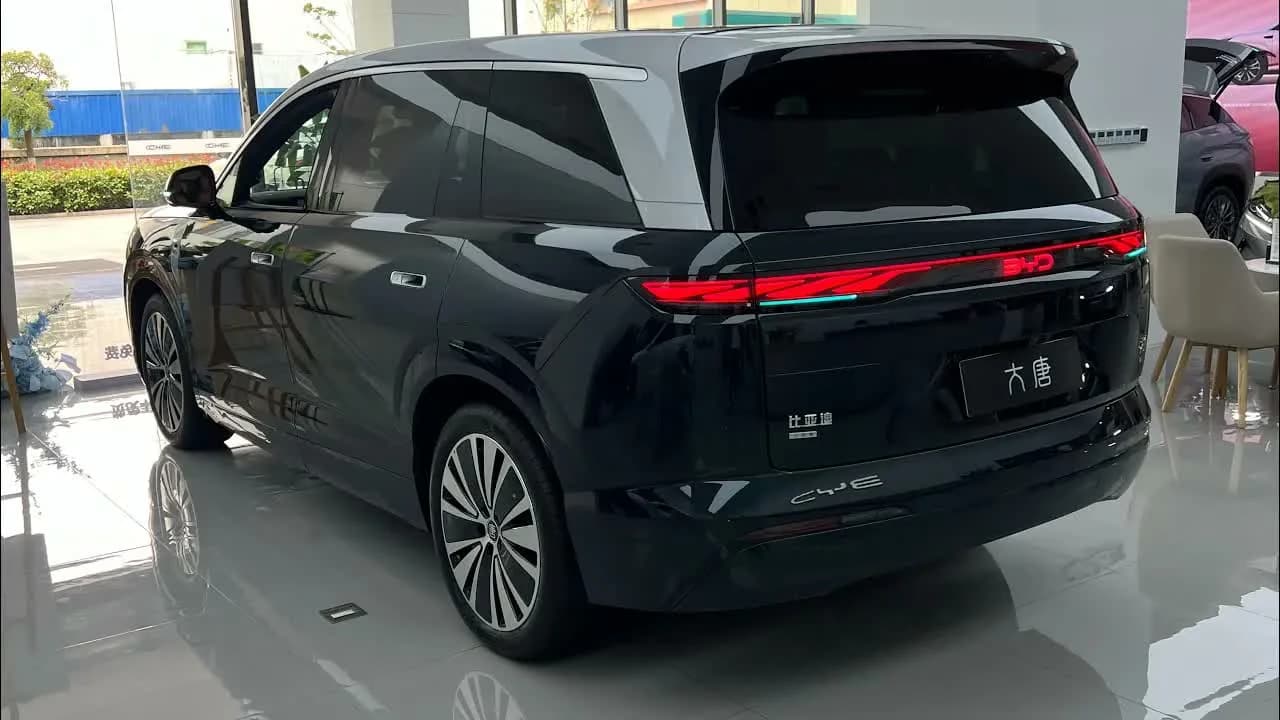
The 2026 BYD Great Tang (大唐 / “Da Tang”, also marketed as Big Tang or Datang) has now appeared on China’s dealer showroom floors as deliveries roll out from the April 24, 2026 pre-sale launch. Pricing officially holds at ¥250,000-¥320,000 ($37,000-$46,400), but the in-showroom reviewer points to an important market dynamic: Xpeng has already cut pricing on the competing G9 trim level, and BYD is likely to respond with promotional discounts within Q3 2026 to maintain the Great Tang’s value position. This hands-on walkaround focuses on three details that the pre-launch coverage from April and May couldn’t confirm: the 3rd-row space is meaningfully more usable than the Tang L sibling (the reviewer specifically notes that he “never sits in Tang L’s third row” but the Great Tang’s third row delivers proper adult-passenger space), the ~240 L frunk capacity (more generous than initial ~170 L estimates), and the tan/cognac Nappa cabin with embossed “唐” (Tang) Chinese-character emblem on the steering wheel airbag cover — a design signature that visually distinguishes the Great Tang from every other BYD product currently in production.
Performance & Specs
Like the prior two freshmotors articles covering the Great Tang, the headline powertrain story remains the same: BYD’s e-Platform 4.0 dual-motor architecture with single-motor RWD entry trim (300 kW / 402 hp / 0-100 in ~6.5 s) and dual-motor AWD top trim (585 kW / 784 hp / 0-100 in 3.9 s). The 130.15 kWh 2nd-generation Blade LFP battery delivers 950 km of CLTC range on the RWD configuration, dropping to approximately 880 km on the AWD trim. The reviewer’s in-showroom unit demonstrates the same 1,000-volt SiC architecture supporting BYD’s 1,000A Megawatt Flash Charge capability — 5-90% in approximately 9 minutes on compatible 1000A stations. A PHEV variant is now confirmed for Q4 2026 / Q1 2027 launch with 342 km EV-only CLTC range and approximately 1,600 km combined range, positioning the future PHEV between the BEV trims and the more luxurious Denza N9 sibling.

| POWERTRAIN TYPE | BEV — single-motor RWD or AWD dual-motor |
|---|---|
| HORSEPOWER (RWD) | 402 hp (300 kW) |
| HORSEPOWER (AWD) | 784 hp (585 kW) |
| 0-100 KM/H (AWD) | 3.9 s |
| 0-100 KM/H (RWD) | ~6.5 s |
| TOP SPEED | 220 km/h |
| BATTERY | 130.15 kWh 2nd-gen Blade LFP |
| EV RANGE (RWD) | 950 km (CLTC) |
| EV RANGE (AWD) | ~880 km (CLTC) |
| HV ARCHITECTURE | 1,000 V SiC |
| UPCOMING PHEV (Q4 2026 / Q1 2027) | 342 km EV CLTC / ~1,600 km combined |
Dimensions & Practicality

| Length | 5,302 mm |
|---|---|
| Width | 1,999 mm |
| Height | 1,800 mm |
| Wheelbase | 3,130 mm |
| Ground clearance | ~160 mm |
At 5,302 mm long on a 3,130 mm wheelbase, the Great Tang is BYD’s largest passenger SUV currently in production. The reviewer specifically calls out the third-row practicality difference vs the Tang L sibling: where Tang L’s third row is “cramped for adults, fine for children only,” the Great Tang’s 3rd row offers proper leg + head space for adult passengers. This is the single most important practical differentiator that justifies the $4,800-$11,000 price gap vs the Tang L family. Cargo measures approximately 400 L with all 3 rows up (estimated), 1,100 L with the 3rd row folded, and 1,800 L with both the 2nd and 3rd rows folded (reviewer-confirmed on camera). The reviewer’s hands-on estimate of the front frunk capacity is approximately 240 liters — meaningfully larger than initial ~170 L estimates from pre-launch coverage. 21-inch turbine-style alloys with 265/45 R21 Goodyear tires are standard.
| LENGTH | 5,302 mm |
|---|---|
| WIDTH | 1,999 mm |
| HEIGHT | 1,800 mm |
| WHEELBASE | 3,130 mm |
| CARGO (3rd folded) | ~1,100 L |
| CARGO (max, 2nd + 3rd folded) | 1,800 L |
| FRUNK | ~240 L (reviewer hands-on estimate) |
| SEATING | 6 (2+2+2 captain) or 7 (2+3+2) |
| WHEELS / TIRES | 21″ / 265/45 R21 Goodyear |
| 3RD ROW ADULT USABILITY | Yes (reviewer-verified, unlike Tang L) |
Charging & Battery
The Great Tang continues to use BYD’s portfolio-flagship 1,000-volt SiC inverter architecture with the 1,000A Megawatt Flash Charge capability that’s being rolled out portfolio-wide across the Leopard 7 EV, Denza Z9 GT, and the upcoming Denza N9 Flash Charge Edition. The 130.15 kWh 2nd-generation Blade LFP battery completes a 5-90% top-up in approximately 9 minutes on a compatible 1,000A station, with peak DC power approaching 1 MW. AC charging on the 11 kW onboard charger replenishes the full pack overnight in approximately 12 hours. The reviewer also confirms BYD’s closed-loop charging-station infrastructure deployment is on track for 5,000+ compatible 1000A stations by end of 2026. The PHEV variant launching Q4 2026 / Q1 2027 will share the same architecture with a smaller LFP pack + 1.5T or 2.0T petrol generator, expected to deliver 342 km EV CLTC plus 1,600 km combined.
| BATTERY | 130.15 kWh 2nd-gen Blade LFP |
|---|---|
| HV ARCHITECTURE | 1,000 V SiC |
| AC CHARGING | 11 kW |
| DC FAST CHARGING | 1,000 A peak (Megawatt Flash Charge) |
| DC 5-90% TIME | ~9 min on compatible 1000A station |
| AC FULL CHARGE | ~12 hours |
| STATION COVERAGE TARGET | 5,000+ Megawatt stations by end of 2026 |
Design & Interior — The Hands-On Details
The Great Tang’s exterior is BYD’s most ambitious passenger-SUV design to date. The reviewer’s walkaround unit is finished in gloss black with a body-color rear quarter — the long roof-line flowing into the sloped tailgate gives the 5,302 mm body a more aerodynamic silhouette than the boxy Tang L sibling. The full-width connected LED tail-light bar with cyan-green ADAS-engaged status indicators wraps across the tailgate, with the “BYD” wordmark at center and the “大唐” (Great Tang) Chinese plate prominent below. The front fascia is the same as the pre-launch coverage: closed-grille EV-mode signature with the central diamond emblem, full-width LED daytime running light bar, and slim matrix LED headlamps. Inside, the cabin is where the Great Tang separates itself from every other BYD product. The reviewer’s walkaround unit features a tan/cognac Nappa leather + dark grey wood-grain dashboard two-tone treatment, with the wood-grain inserts running across the dashboard and door cards in a striking horizontal pattern. The most visually distinctive element: the tan Nappa leather-wrapped steering wheel with the embossed “唐” (Tang) Chinese character on the airbag cover — a design signature that no other BYD or Denza product uses, marking the Great Tang as the family flagship.
Pricing Reality Check — Where The Number Is Heading
The reviewer specifically references the broader Chinese premium-SUV market dynamics: Xpeng has already reduced pricing on the competing G9 trim level, and the reviewer expects BYD to respond with promotional discounts on the Great Tang within Q3 2026. Official pre-sale pricing remains ¥250,000-¥320,000 ($37,000-$46,400), but expect ¥10,000-¥20,000 ($1,500-$3,000) of dealer-side incentive cushion as Xpeng / Li Auto / NIO competitive pressure intensifies. The reviewer notes that for buyers shopping the “luxury 6-seater” category — Li L9, Huawei M9, NIO ES8/ES9, BYD Datang, and Xpeng GX9 — the Xpeng GX is increasingly attractive at its discounted price point. But for buyers who specifically want BYD’s vertically-integrated battery + ADAS + charging-network ecosystem at a sub-$50,000 entry, the Great Tang remains the value pick of the segment.
Technology & Features
The Great Tang runs BYD’s flagship DiLink 150 cockpit: a 17.3-inch rotating central touchscreen + 12.3-inch driver instrument cluster + AR-HUD on Max and Ultra trims + dual rear-cabin entertainment screens on the 6-seater captain configuration. The cockpit runs on a Qualcomm Snapdragon 8295P SoC. Full English-language UI is available out-of-the-box. Dual 50W wireless chargers sit ahead of the gear selector. The 6-seat captain’s chair configuration adds rear-cabin tray tables (3 kg rated), integrated USB-C ports, an integrated rear refrigerator in the center armrest, and reclining captain’s chairs with ottoman footrests. The reviewer’s walkaround also confirms NFC card key support for tap-to-unlock + tap-to-start operation, and the optional “Lucky” electric doors (electric latch on all four doors) on the top Long Range Ultra AWD trim. The HUD displays speed, navigation, and ADAS status across the windshield.
Safety & ADAS
| ADAS LEVEL | L2+ (God’s Eye B / DiPilot 300) |
|---|---|
| LiDAR | Optional on Long Range Ultra AWD trim |
| RADARS | 3 mmWave (4D radar on top trim) |
| CAMERAS | 11 HD |
| ULTRASONIC | 12 |
| ADAS FEATURES | Highway NOA, Urban NOA (with LiDAR), AEB, ACC, LKA, BSM, RCTA, 360° camera, valet parking |
Available Versions
| VERSION | POWERTRAIN | BATTERY | RANGE (CLTC) | 0-100 | PRICE | KEY DIFFERENCES |
|---|---|---|---|---|---|---|
| Standard RWD | BEV Rear-Motor | 130 kWh | 950 km | ~6.5 s | $37,000 | Entry trim, 7-seat 2+3+2 only, no LiDAR |
| Long Range RWD | BEV Rear-Motor | 130 kWh | 950 km | ~6.5 s | ~$40,000 | 6-seat captain option, AR-HUD, NFC key, tan Nappa |
| Long Range Max AWD | BEV Dual-Motor | 130 kWh | ~880 km | 3.9 s | ~$43,000 | 784 hp AWD, optional air suspension, optional Lucky doors |
| Long Range Ultra AWD | BEV Dual-Motor | 130 kWh | ~880 km | 3.9 s | $46,400 | Top trim: LiDAR + air suspension + Lucky doors + full feature set |
| PHEV (Q4 2026 / Q1 2027) | PHEV TBA layout | TBA | 342 km EV / ~1,600 km combined | TBA | TBA | Upcoming PHEV variant declared, exact specs pending |
Pricing & Availability
The 2026 BYD Great Tang pre-sales opened April 24, 2026 with the four-trim BEV lineup priced at ¥250,000-¥320,000 ($37,000-$46,400). Deliveries began in May 2026 to first-tier Chinese cities. The reviewer specifically notes that full dealer authorization and export channels are still being finalized — broker networks like the YouTube reviewer’s team are not yet authorized to export Great Tang as of late May 2026. Expect grey-import / parallel-import availability via Kazakhstan, Russia, and select Middle East markets starting Q3 2026; official European Denza-branded distribution likely follows in 2027.
How It Compares
The reviewer’s direct in-showroom comparison highlights the Great Tang’s sweet-spot positioning: $6,000-$28,000 cheaper than Li L9 / Huawei M9 / NIO ES8 / ES9 / Denza N9 while offering substantially more range (950 km vs 620-635 km on BEV rivals), more power on the top trim (784 hp), and meaningfully more usable 3rd-row space than the Tang L sibling. The Xpeng G9 at its post-discount pricing is the closest BEV-only rival, but G9 only offers 702 km CLTC and lacks the 6-seat captain configuration that Long Range trims of Great Tang provide. For buyers prioritizing 3rd-row adult usability + 950 km BEV range + sub-$50k entry, the Great Tang has zero direct competitors as of May 2026.
- Genuinely usable 3rd row for adults — reviewer-verified vs Tang L sibling (children-only)
- 950 km CLTC range from 130.15 kWh 2nd-gen Blade LFP — segment-leading
- ~240 L frunk (reviewer hands-on, more generous than initial estimates)
- 1,000A Megawatt Flash Charge: 5-90% in ~9 min on compatible station
- 3.9 s 0-100 (AWD top trim) — sports-sedan acceleration in a 5,302 mm 7-seater
- Tan Nappa cabin + “唐” embossed steering wheel + Lucky doors + NFC key (top trim)
- $6-28k cheaper than Li L9 / NIO ES9 / Denza N9 with comparable luxury content
- Likely Q3 2026 promotional price-cuts incoming as Xpeng pressure intensifies (good for buyers, bad for early reservation holders)
- LiDAR is optional only on the Long Range Ultra AWD trim — not standard segment-wide
- 2,500-2,650 kg curb weight — expect 20% real-world range drop on highway
- 1,000A Megawatt Flash Charge stations are BYD-exclusive (coverage limited outside major cities)
- No export markets officially confirmed for 2026 — broker / grey-import only via Kazakhstan, Russia, MENA
- Top trim approaching $46,400 sits close to Denza N9 territory — consider sibling comparison
The 2026 BYD Great Tang continues to be the segment’s most aggressive value play in the Chinese ultra-luxury 7-seater BEV flagship space. This hands-on walkaround confirms three details that the April-May 2026 pre-launch coverage could not: the third row is genuinely usable for adults (the single most important practical differentiator vs the Tang L sibling), the frunk capacity is closer to 240 L than initial 170 L estimates, and the tan Nappa cabin with the “唐” embossed steering wheel is a flagship-tier design signature that no other BYD product currently uses. The reviewer’s pricing-trend observation matters: expect ¥10,000-¥20,000 of dealer-side incentives within Q3 2026 as Xpeng G9 pricing competition intensifies. For Chinese first-tier-city families shopping the Li L9 / Huawei M9 / NIO ES8 segment with a $40-50k budget and specifically needing the third row for occasional adult use, the Great Tang is now the segment’s clear value pick — and the pricing trend suggests waiting 60-90 days for promotional discounts is a smart move if delivery timing allows.