
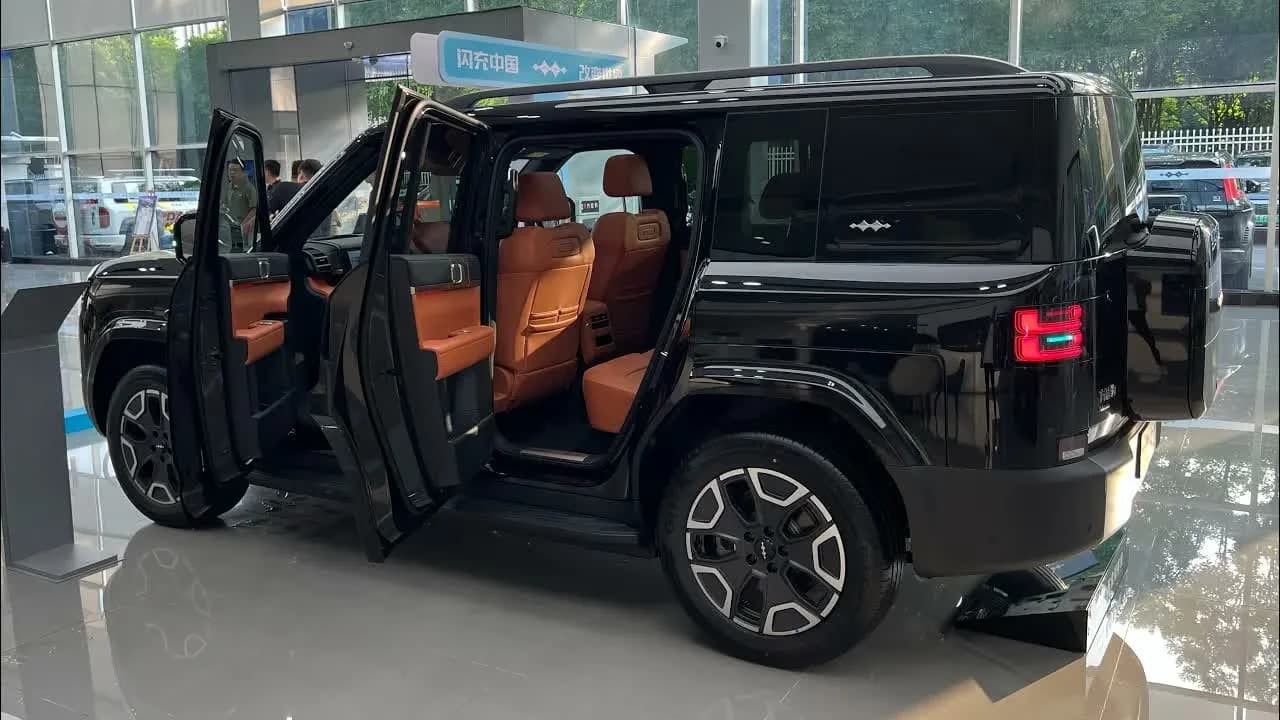
On April 29, 2026, BYD’s Fangchengbao brand added a battery-electric version to its best-selling boxy SUV: the Tai 7 EV Flash Charging Edition, known in English-language coverage as the Titanium 7 EV and listed by some exporters, including the reviewer’s channel, as the Leopard 7. It starts at 199,800 yuan (about $29,800 at 6.70 yuan to the dollar) for a 92 kWh, 675 km rear-drive trim, and rises to 209,800 yuan (about $31,300) for the 755 km version with a 105.7 kWh second-generation Blade Battery. A 30,000-yuan (about $4,500) package adds dual-motor all-wheel drive and the God’s Eye B LiDAR system, taking the top trim to 239,800 yuan (about $35,800) with 515 kW (700 PS / 691 hp) and a 4.5-second 0-100 km/h time. The headline feature is charging: BYD says the battery goes from 10% to 70% in 5 minutes and from 10% to 97% in 9 minutes on its new flash chargers. The body is the same 4,999 mm five-seater that has taken the Tai 7 past 210,000 cumulative sales in about eleven months, and the EV adds a 201-liter electric frunk.
Performance & Specs
The rear-drive trims use a single 300 kW (408 PS / 402 hp) rear motor with 365 Nm of torque. BYD’s published figures give 7.3 seconds from 0-100 km/h on the 92 kWh car and 7.5 seconds on the heavier 755 km car. The 30,000-yuan package adds a 215 kW front motor for a combined 515 kW (700 PS / 691 hp) and 675 Nm, which BYD rates at 4.5 seconds to 100 km/h. Top speed is 240 km/h according to the MIIT filing. All trims use BYD’s second-generation Blade Battery (LFP chemistry): 92 kWh on the 675 km rear-drive trim and 105.7 kWh on the 755 km rear-drive trim. The all-wheel-drive trim is rated at 675 km CLTC on a pack of about the same 105.7 kWh size, so the extra motor costs it roughly 80 km of range against the rear-drive flagship. On the rear-drive cars that works out to about 14 kWh/100 km battery-to-wheel on the CLTC cycle. Suspension is double-wishbone at the front and five-link at the rear with DiSus-C intelligent damping, and the all-wheel-drive trim adds four-piston brake calipers.

| Powertrain | Single-motor RWD or dual-motor AWD BEV |
|---|---|
| Power | 300 kW (402 hp) RWD / 515 kW (691 hp) AWD |
| Torque | 365 Nm RWD / 675 Nm AWD |
| 0–100 km/h | 7.3–7.5 s RWD / 4.5 s AWD |
| Battery | 92 kWh or 105.7 kWh LFP |
| Range | 675–755 km CLTC |
| POWERTRAIN TYPE | BEV — single-motor RWD or dual-motor AWD |
|---|---|
| HORSEPOWER | 402 hp (300 kW) RWD / 691 hp (515 kW) AWD |
| TORQUE | 365 Nm RWD / 675 Nm AWD |
| ACCELERATION | 7.3 s (675 km RWD) / 7.5 s (755 km RWD) / 4.5 s (AWD) |
| TOP SPEED | 240 km/h |
| DRIVETRAIN | RWD or AWD |
| BATTERY | 92 kWh or about 105.7 kWh LFP Blade (2nd-gen) |
| ELECTRIC RANGE | 675 km (RWD) / 755 km (RWD) / 675 km (AWD), CLTC |
Dimensions & Practicality

| Length | 4,999 mm |
|---|---|
| Width | 1,995 mm |
| Height | 1,865 mm |
| Wheelbase | 2,920 mm |
| Ground clearance | 210 mm |
| Approach / Departure | 24° / 25° |
| Wading depth | 600 mm |
The EV shares its unibody, five-seat body with the plug-in hybrid: 4,999 mm long, 1,995 mm wide and 1,865 mm tall on a 2,920 mm wheelbase, with approach and departure angles of 24 and 25 degrees, about 210 mm of ground clearance and a 600 mm wading depth. The reviewer measured about 1,000 L of cargo space behind the second row and about 1,900 L with the second row folded down by hand, close to BYD’s published maximum of 1,880 L. The EV also gains a 201-liter electric frunk that the plug-in hybrid does not have, and the tailgate carries a small storage box that the reviewer says holds up to 3 kg. Rear-seat space is generous, with enough leg and head room in the second row.
| LENGTH | 4,999 mm |
|---|---|
| WIDTH | 1,995 mm |
| HEIGHT | 1,865 mm |
| WHEELBASE | 2,920 mm |
| GROUND CLEARANCE | about 210 mm |
| APPROACH / DEPARTURE | 24° / 25° |
| WADING DEPTH | 600 mm |
| CARGO VOLUME | about 1,000 L (1,880 L seats folded) |
| FRUNK | 201 L |
| SEATS | 5 |
Charging & Battery
BYD’s second-generation Blade Battery and its flash-charging network are the reason this car exists. On BYD’s new flash chargers, which deliver up to 1,500 kW per gun at up to 1,000 V, BYD says the pack charges from 10% to 70% in 5 minutes and from 10% to 97% in 9 minutes at normal temperature. At -30°C, charging from 20% to 97% takes about 3 minutes longer than at normal temperature, or roughly 12 minutes. The 1,500 kW figure describes the charger, not the car: BYD has not published the Titanium 7 EV’s own peak charging power, so real-world times depend on the station. The reviewer, who quotes 8 to 9 minutes for roughly 80%, points out separate slow and fast charging ports. BYD says it completed 4,239 flash-charging stations in the first two months of 2026 alone and is aiming for 20,000 this year, so the network will matter as much as the car. BYD has not published an AC charging time; the reviewer estimated 10 to 12 hours for a full charge.
| BATTERY | 92 kWh (675 km RWD) or 105.7 kWh (755 km RWD) LFP Blade |
|---|---|
| CHARGER OUTPUT (BYD flash charger) | up to 1,500 kW per gun |
| DC 10-70% TIME | 5 minutes |
| DC 10-97% TIME | 9 minutes |
| COLD-WEATHER 20-97% (-30°C) | about 12 minutes |
| AC CHARGING | Not published (reviewer estimate: 10–12 h) |
Design & Interior
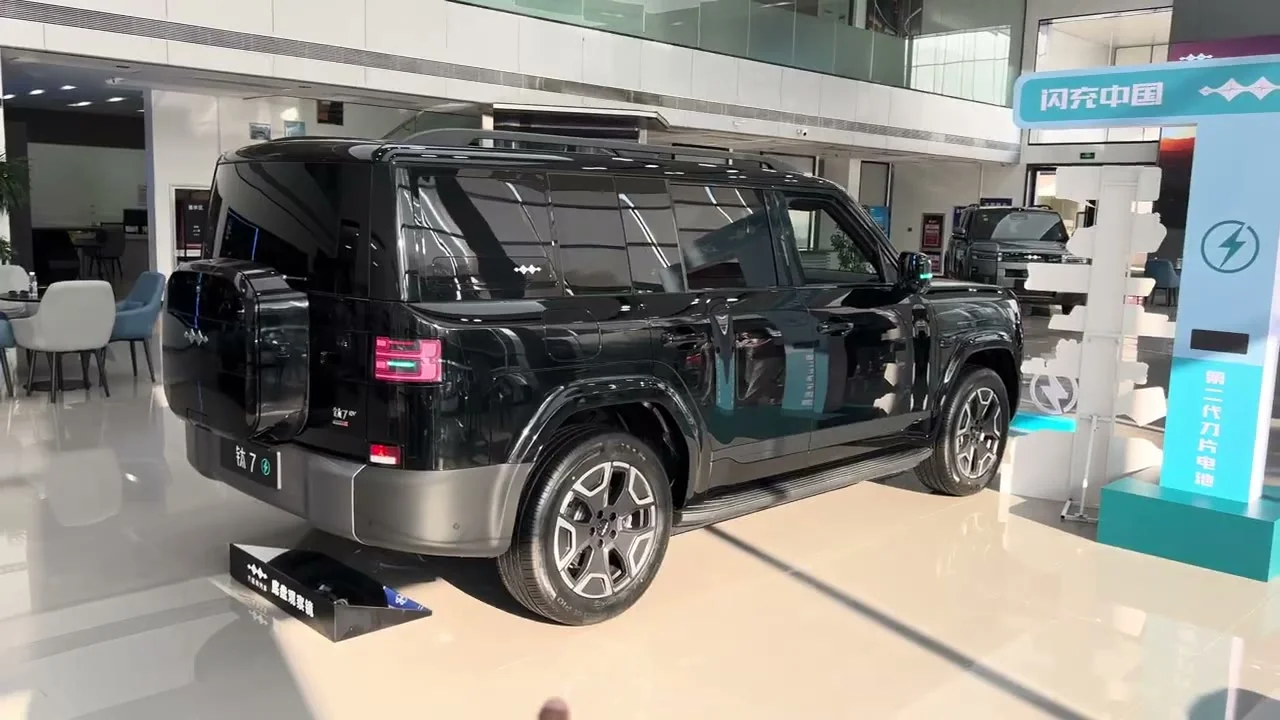
The exterior is a slab-sided, Defender-inspired box: a vertical greenhouse, roof rails, fixed door handles rather than flush ones, and a rear-mounted spare-wheel-style housing with a full-width LED tail-light strip and a side-opening tailgate. The front end carries LED lighting and a 360-degree camera. Inside, the showroom car wore tan and orange leather on the seats and door cards, and the second row has a center armrest box with an integrated refrigerator. Other details the reviewer pointed out include a head-up display, a leather-wrapped, fully adjustable steering wheel, a wireless charging pad, a sunglasses box, a sun-visor mirror with a light and a large panoramic glass roof with a sunshade. BYD’s spec sheet lists a 14-speaker audio system on the rear-drive trims and a 20-speaker Devialet system on the all-wheel-drive trim.
Technology & Features
The cabin is built around what BYD calls a seven-screen interconnected system, whose headline pieces are a 15.6-inch central touchscreen, a 12.3-inch driver cluster and a 26-inch windshield head-up display. On the reviewer’s car the interface could be switched to English, with menus for vehicle, light, energy, drive, ADAS, display, audio and voice settings. The reviewer noted that this brand-new model cannot yet be exported through his channel. Automatic parking assist and a 360-degree camera are fitted, and the energy page includes a smart-charging scheduler.
Safety & ADAS
Every trim carries God’s Eye C, BYD’s camera-and-radar driver-assistance suite. The LiDAR-based God’s Eye B system is bundled into the 30,000-yuan (about $4,500) all-wheel-drive package and can be added to the rear-drive trims for 12,000 yuan (about $1,800). BYD has not published a full sensor count for the EV.
| ADAS LEVEL | L2 (God’s Eye C) / L2+ with LiDAR (God’s Eye B) |
|---|---|
| LiDAR | God’s Eye B: included with AWD package, +12,000 yuan on RWD |
| ADAS FEATURES | Automatic parking assist, 360° camera |

Available Versions
| VERSION | POWER | TORQUE | 0-100 | TOP SPEED | DRIVETRAIN | BATTERY | EV RANGE | COMBINED RANGE | PRICE | KEY DIFFERENCES |
|---|---|---|---|---|---|---|---|---|---|---|
| 675KM RWD Flash Charging | 402 hp | 365 Nm | 7.3s | 240 km/h | RWD | 92 kWh | 675 km | — | $29,800 | Entry trim, 199,800 yuan; God’s Eye C standard |
| 755KM RWD Flash Charging | 402 hp | 365 Nm | 7.5s | 240 km/h | RWD | 105.7 kWh | 755 km | — | $31,300 | Longest range, 209,800 yuan; LiDAR +12,000 yuan |
| 675KM AWD Flash Charging | 691 hp | 675 Nm | 4.5s | 240 km/h | AWD | about 105.7 kWh | 675 km | — | $35,800 | Flagship, 239,800 yuan; dual motor, God’s Eye B, 20-speaker audio |
Pricing & Availability
The Titanium 7 EV went on sale in China on April 29, 2026 at 199,800 yuan (about $29,800) for the 675 km rear-drive trim, 209,800 yuan (about $31,300) for the 755 km rear-drive trim and 239,800 yuan (about $35,800) for the 675 km all-wheel-drive trim, all converted at 6.70 yuan to the dollar. Pre-orders opened in mid-March 2026, and initial deliveries were expected to start in mid-May. The plug-in hybrid version of the same body, which launched in September 2025, passed 200,000 cumulative Tai 7 sales about ten months after launch and delivered 27,320 units in July 2026 alone across both powertrains. The EV is a China-market car: the reviewer says it cannot yet be exported through his channel, and as of September 2026 BYD has not confirmed export of the electric version. The plug-in hybrid is being sold abroad as the BYD Ti7, with the UK and the Middle East reported as markets.
How It Compares
The closest comparison is the plug-in hybrid version of the same car. It starts about $3,000 lower at roughly $26,800, keeps a petrol engine for trips of more than 1,300 km and has the same 4,999 mm body, but it has no frunk and takes far longer to charge. The EV counters with 402 hp on the rear-drive trims, 691 hp with all-wheel drive and the flash-charging capability. GWM’s Tank 300 Hi4-T, refreshed in July 2026 and priced from 249,800 yuan (about $37,300), costs roughly $7,500 more than the entry EV. It offers 105 km of WLTC electric range and 913 km in total from a 2.0-liter turbo plus a 174 hp motor. For buyers who want a boxy five-seater that plugs into a fast charger rather than relying on a petrol engine, the Titanium 7 EV is the cheaper of the two, and boxy five-seat battery-electric SUVs at this price are still rare.
- 10-70% in 5 minutes and 10-97% in 9 minutes on BYD’s flash chargers
- Up to 755 km CLTC range from a 105.7 kWh Blade LFP pack
- 691 hp and 4.5 s 0-100 km/h on the all-wheel-drive trim
- 201 L electric frunk, about 1,000 L boot and five seats from about $29,800
- The 5-minute charge needs BYD’s own flash chargers, and the car’s peak charging power is not published
- The all-wheel-drive trim is rated at 675 km, 80 km below the rear-drive flagship, and CLTC figures run optimistic
- Unibody construction and a 24-degree approach angle make it more soft-roader than the body-on-frame Leopard 5 and 8
- China-only for now, with no confirmed export of the EV
The Titanium 7 EV takes the Tai 7’s best-selling boxy body and gives it the strongest charging story in its price bracket: 10-70% in 5 minutes and 10-97% in 9 minutes on BYD’s flash chargers, with 675 to 755 km of CLTC range and prices from about $29,800. The rear-drive trims are the sensible buys, and the 755 km car is only about $1,500 more. The all-wheel-drive trim at about $35,800 is the one to pick for 691 hp and 4.5-second acceleration. The trade-offs are real: the fastest charging depends on BYD’s own network, the car is China-only for now, and it is a road-biased SUV rather than a rock crawler. For buyers in China who want a spacious boxy EV with fast charging, it is one of very few options at this price.