
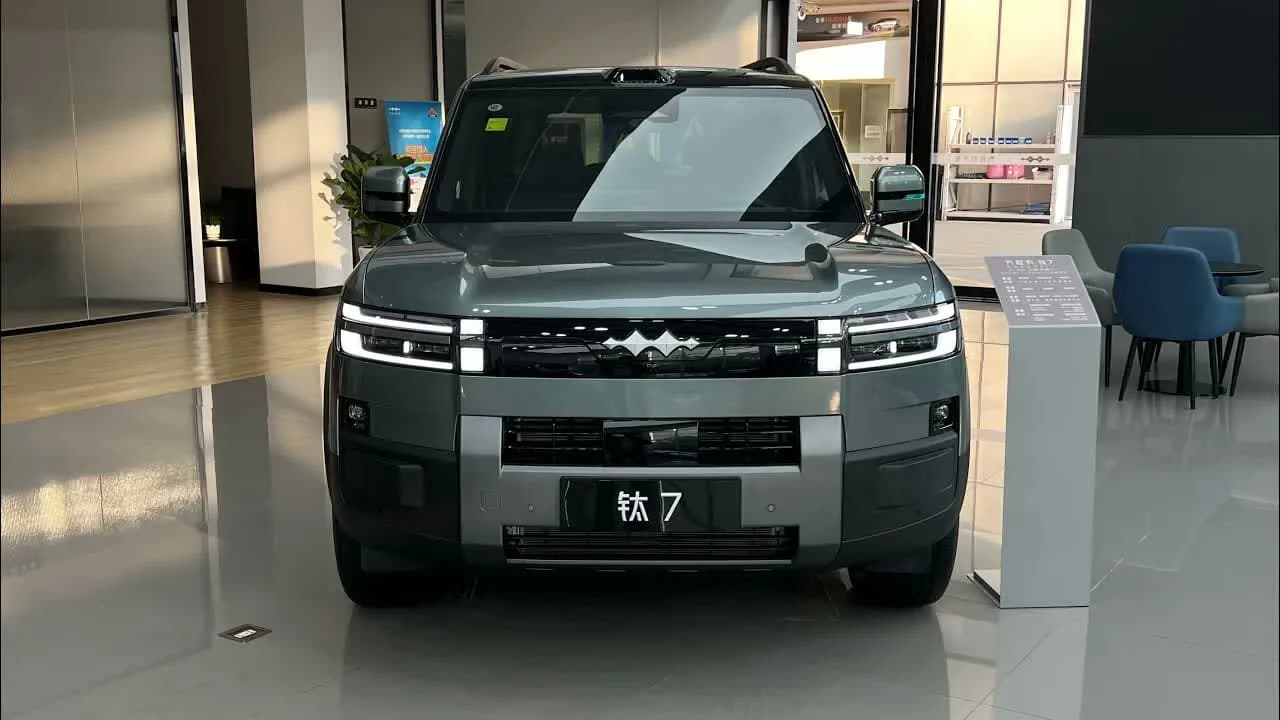
Just five weeks after BYD launched the BEV version of the Fang Cheng Bao Leopard 7 (Tai 7) with 1,500 kW Megawatt Flash Charging, attention returns to the original PHEV variant that started the nameplate in September 2025. The 2026 Leopard 7 PHEV remains the affordability anchor of the lineup at ¥179,800 ($25,300) for the entry trim, scaling to ¥219,800 (~$31,000) for the top AWD trim with the 35.6 kWh battery. Combined CLTC range still hits 1,300 km thanks to a 60-liter petrol tank paired with the 1.5T four-cylinder generator and 268 hp electric system, while the new BEV variant alongside it pushes the same nameplate into 691 hp territory at $27,800 entry. The PHEV’s new BEV sibling validates the platform’s premium ambitions, but the PHEV remains the more affordable, road-trip-friendly choice for buyers who want Defender-style boxy looks without 1,000V charging-infrastructure dependencies. Confirmed in this refresh: full English-language UI at launch, integrated tan Nappa cabin, electric panoramic glass roof, and integrated rear refrigerator.
Performance & Specs
The Leopard 7 PHEV uses BYD’s DM 5.0 architecture: a 1.5L turbocharged four-cylinder engine producing 145 kW (195 hp) paired with a single electric motor for 2WD or front + rear motors for 4WD configurations. Total system output is 200 kW (268 hp) with 335 Nm of torque, accelerating the 2,100+ kg SUV from 0-100 km/h in approximately 8.5 seconds with a 190 km/h electronically governed top speed. Two battery sizes are offered: a 26.6 kWh Blade LFP pack for 135 km EV-only CLTC range (entry trim), and a 35.6 kWh Blade LFP pack for 200 km EV-only CLTC range (top trims). Combined CLTC range reaches 1,300 km via the 60-liter fuel tank, with extender-mode fuel economy rated at 5.9 L/100 km.

| POWERTRAIN TYPE | PHEV — 2WD (DM-i) or 4WD (DM-p) configurations |
|---|---|
| SYSTEM POWER | 268 hp (200 kW) |
| SYSTEM TORQUE | 335 Nm |
| 0-100 KM/H | ~8.5 s |
| TOP SPEED | 190 km/h |
| BATTERY OPTIONS | 26.6 kWh (135 km EV) or 35.6 kWh Blade LFP (200 km EV) |
| COMBINED RANGE | 1,300 km (CLTC) |
| FUEL TANK | 60 L |
| FUEL ECONOMY | 5.9 L/100 km (extender mode) |
| ENGINE | 1.5T 4-cylinder, 145 kW / 195 hp peak |
Dimensions & Practicality

| Length | 4,999 mm |
|---|---|
| Width | 1,995 mm |
| Height | 1,865 mm |
| Wheelbase | 2,920 mm |
| Ground clearance | 210 mm |
| Approach / Departure | 28° / 26° |
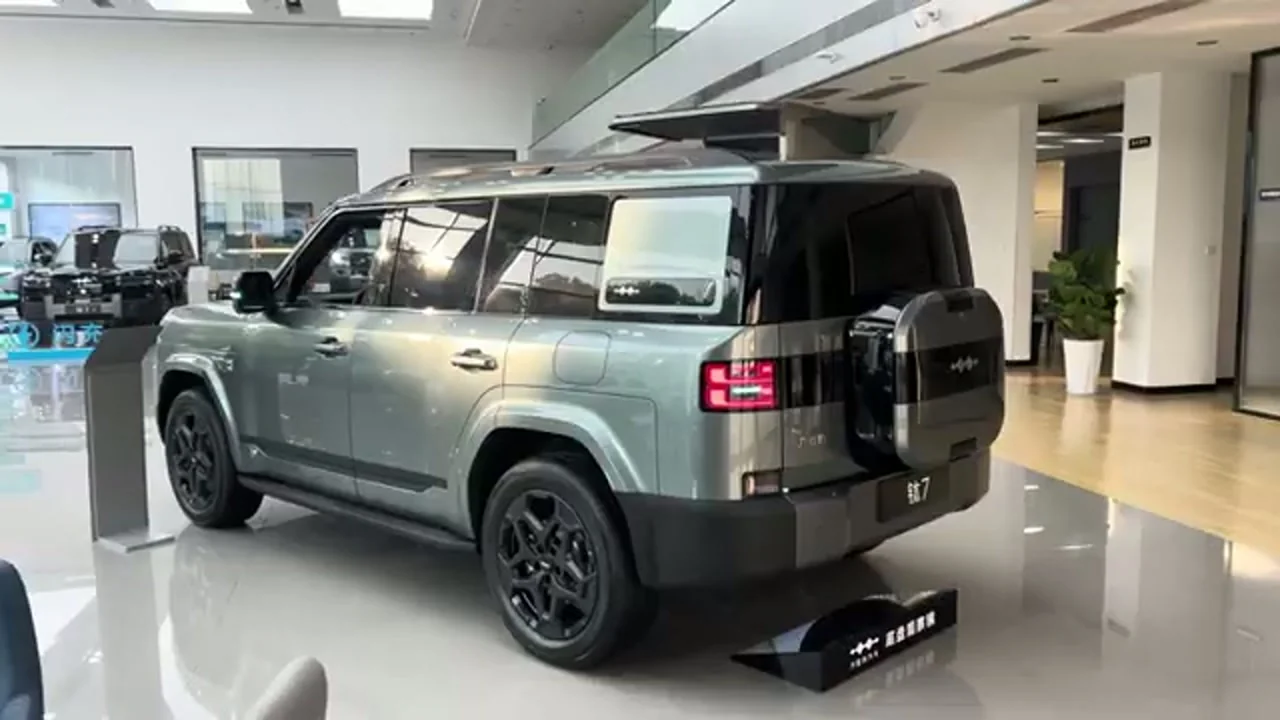
The PHEV shares the body with the new BEV variant: 4,999 mm long on a 2,920 mm wheelbase, with the same Defender-meets-G-Wagen silhouette, tailgate-mounted spare wheel, and chunky external bumpers. Ground clearance is 210 mm with 28-degree approach and 26-degree departure angles, plus 600 mm wading depth on AWD trims. Cargo measures 1,000 liters with the rear bench up, expanding to 1,900 liters with the second row folded — identical to the BEV sibling. The PHEV does not get the 201 L frunk that’s available on the BEV variant; that space is occupied by the 1.5T engine and its ancillaries. 20-inch wheels with 255/55 R20 Eco-harmony all-terrain tires are standard.
| LENGTH | 4,999 mm |
|---|---|
| WIDTH | 1,995 mm |
| HEIGHT | 1,865 mm |
| WHEELBASE | 2,920 mm |
| GROUND CLEARANCE | 210 mm |
| WADING DEPTH | 600 mm (AWD trims) |
| CARGO VOLUME | 1,000 L (1,900 L seats folded) |
| FRUNK | None (occupied by 1.5T engine) |
| SEATING | 5 |
| WHEELS / TIRES | 20″ / 255/55 R20 all-terrain |
Charging & Battery
The Leopard 7 PHEV uses BYD’s in-house Blade Battery LFP chemistry in both 26.6 kWh and 35.6 kWh capacities. AC charging on the 7 kW onboard charger replenishes the larger 35.6 kWh pack in approximately 5 hours; DC fast charging (max 80 kW peak) completes a 30-80% top-up in 15 minutes per BYD’s spec sheet. The reviewer notes 7-hour AC charging on the larger pack in real-world testing. The fuel tank holds 60 liters of 92-octane petrol, with extender-mode fuel consumption rated at 5.9 L/100 km after the battery is depleted — competitive for a 2,100 kg PHEV SUV with all-terrain tires.
| BATTERY | 26.6 / 35.6 kWh BYD Blade LFP |
|---|---|
| AC CHARGING | 7 kW |
| DC FAST CHARGING | ~80 kW peak |
| DC 30-80% TIME | ~15 min |
| AC FULL CHARGE (35.6 kWh) | ~5 hours |
Design & Interior
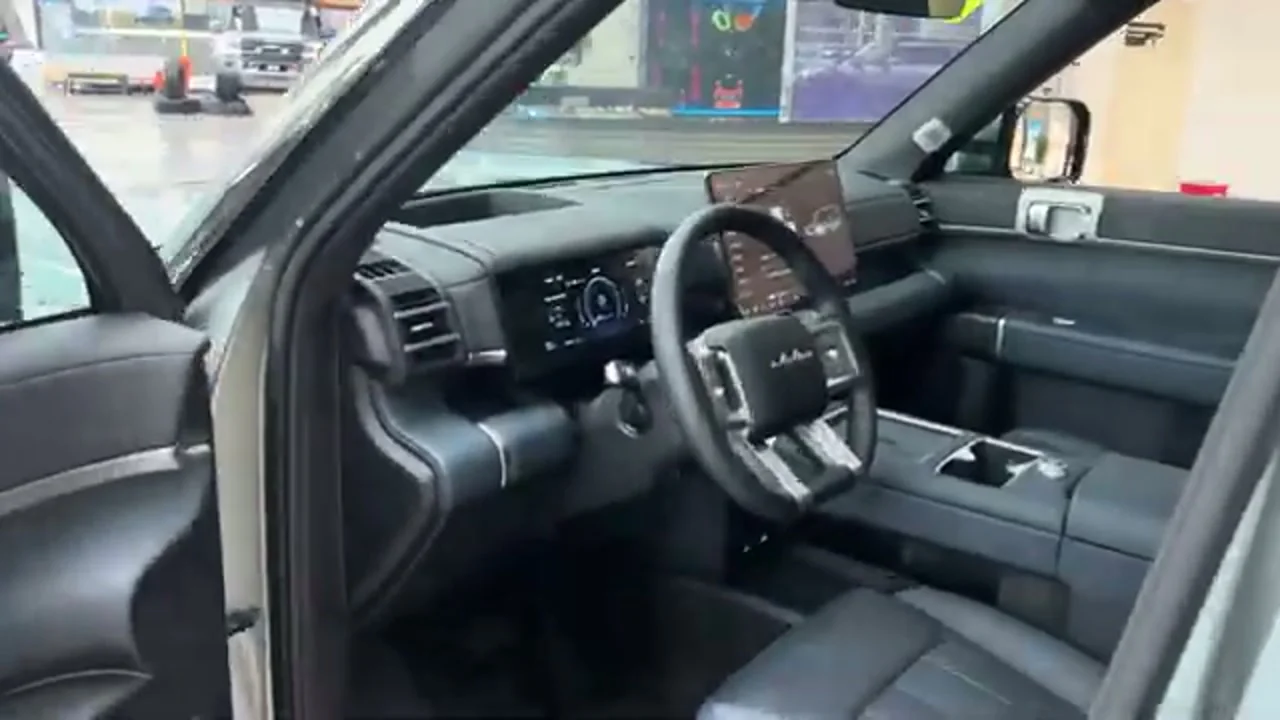
Exterior styling carries over identically from the BEV variant — same boxy Defender-inspired silhouette, tailgate-mounted full-size spare wheel, side-opening tailgate, and traditional chrome door handles. The grille pattern differs slightly: the PHEV uses a more aggressive vented grille with active flaps for engine cooling (vs the BEV’s closed-grille EV signature). LED daytime running lights span the full width of the front fascia in a connected light bar configuration. Inside, the reviewer’s walkaround highlights the tan/cognac Nappa leather two-tone cabin, panoramic glass roof with electric sunshade, integrated refrigerator in the rear armrest, and dual cupholders. Wireless charging is standard up front, and the central touchscreen runs BYD’s latest DiLink cockpit interface with confirmed English-language UI at launch.
Technology & Features
The PHEV runs BYD’s DiLink 100 cockpit with a Qualcomm Snapdragon 8295P SoC, central 15.6-inch rotating touchscreen, 12.3-inch driver instrument cluster, and AR-HUD on the Max and Ultra trims. ADAS is provided by BYD’s God’s Eye B Level 2+ system (DiPilot 100) — the LiDAR-equipped flagship version is reserved for the Ultra AWD trim. Standard ADAS features include AEB, ACC, LKA, BSM, RCTA, 360-degree camera with off-road transparent chassis view, and Highway NOA. The reviewer specifically confirms English-language interface available out-of-the-box on the central display — a meaningful upgrade over the Chinese-only Datang/Big Tang sibling.
Safety & ADAS
| ADAS LEVEL | L2+ (God’s Eye B / DiPilot 100) |
|---|---|
| LiDAR | Optional on Ultra AWD trim |
| RADARS | 3 mmWave |
| CAMERAS | 11 HD |
| ULTRASONIC | 12 |
| ADAS FEATURES | Highway NOA, AEB, ACC, LKA, BSM, RCTA, 360° camera + off-road transparent chassis |
Available Versions
| VERSION | POWERTRAIN | BATTERY | EV / COMBINED RANGE | PRICE | KEY DIFFERENCES |
|---|---|---|---|---|---|
| 135 km Pro 2WD | DM-i FWD | 26.6 kWh | 135 / 1,200 km | $25,300 | Entry trim, no LiDAR, base interior |
| 200 km Max 2WD | DM-i FWD | 35.6 kWh | 200 / 1,300 km | ~$27,700 | Longer EV range, AR-HUD, refrigerator |
| 190 km Max AWD | DM-p AWD | 35.6 kWh | 190 / 1,300 km | ~$29,500 | 4WD with Leopard Turn, lower EV range due to weight |
| 190 km Ultra AWD | DM-p AWD | 35.6 kWh | 190 / 1,300 km | ~$31,000 | Top trim, optional LiDAR, full kit |
Pricing & Availability
The 2026 Leopard 7 PHEV is on sale across mainland China at ¥179,800-¥219,800 ($25,300-$31,000), with the lineup unchanged from the September 2025 launch. Pre-orders for the AWD configurations were already strong before the BEV variant joined the lineup in April 2026. Export markets follow BYD’s broader Fang Cheng Bao distribution — Australia, Brazil, and select Middle East markets receive PHEV trims, with the BEV variant expected to follow in 2027. The reviewer notes BYD’s policy on export has been tightened, which has slowed grey-import flows for the most affordable trims.
How It Compares
The Leopard 7 PHEV continues to occupy a unique value position in the Chinese off-road SUV segment: roughly $15,000 cheaper than the more powerful Leopard 5 stablemate, $14,000 cheaper than the Tank 400 Hi4-T, and now $2,500 cheaper than the new Leopard 7 EV sibling for buyers who don’t need 1,500 kW DC charging infrastructure. The PHEV’s 1,300 km combined CLTC range is the strongest argument vs the EV variant for road-trip buyers in markets without dense fast-charging coverage. For Chinese domestic buyers in second-tier cities and rural areas where Megawatt Flash Charging stations are still rare, the PHEV remains the more practical Defender-style choice.
- $2,500 cheaper than the new Leopard 7 EV sibling at entry trim — same Defender-style body
- 1,300 km combined CLTC range — class-leading vs Tank 400 Hi4-T (1,000 km)
- 200 km EV-only mode covers daily commuting without burning fuel
- Full English-language UI confirmed at launch
- Tank-Turn / Leopard Turn maneuvering on AWD trims (3.3 m turning radius)
- Tan Nappa cabin + panoramic roof + integrated rear refrigerator on Max trims and above
- No frunk (vs 201 L on the BEV variant) — 1.5T engine occupies that space
- ~8.5 s 0-100 trails the BEV AWD’s 4.5 s for performance-focused buyers
- Only 80 kW DC peak charging vs 1,500 kW on the BEV variant
- Combustion engine still requires 10,000 km oil-change intervals
- Top trim with LiDAR + 4WD pushes pricing close to the BEV entry trim
The 2026 BYD Leopard 7 PHEV remains one of the strongest value plays in the sub-$30,000 Defender-style off-road SUV segment, and the recent addition of the BEV sibling has not changed that — it has only validated the platform. The PHEV continues to make sense for buyers in markets where DC fast-charging infrastructure is patchy, for road-trip use cases where the 1,300 km combined CLTC range eliminates range anxiety entirely, and for first-tier-city buyers who want a backup ICE powertrain just in case. The compromises — no frunk, slower 0-100, modest DC charging, ongoing oil-change service intervals — are exactly the price you pay for the segment’s most affordable Defender-style entry. For families who want a boxy off-road SUV under $30,000 with no range anxiety, the Leopard 7 PHEV remains the default pick.