

The BYD Seal sedan has been on sale in Europe since 2023, and for the 2026 model year it gets a practical rather than a dramatic update. The boot grows from 400 to 485 litres and gains two tether hooks, the front trunk grows from 53 to 72 litres, a driver monitoring system and a Bluetooth phone key arrive, and there are new 19-inch wheels, two new paint shades and a rearranged rear badge. The hardware underneath is unchanged: BYD's Blade LFP battery in 61.4 kWh or 82.5 kWh form, a 170 kW or 230 kW rear motor, or a 390 kW (530 PS, 523 hp) dual-motor all-wheel-drive Excellence that does 0-100 km/h in 3.8 seconds. UK orders were open by 26 February 2026 from £45,730, BYD Germany announced its version on 2 March 2026 with prices from €47,990, and in Israel the importer Shlomo Motors cut prices to ₪198,990 for the Design trim in March 2026. This article covers the global Seal sedan, not the separately named Seal 06 and Seal U models.
Performance & Specs
In Germany the Seal comes in three trims. The entry Comfort pairs a 61.4 kWh battery with a rear motor rated at 170 kW (231 PS, about 228 hp) and 380 Nm, good for 0-100 km/h in 7.5 seconds and a 220 km/h top speed. The Design keeps rear-wheel drive but moves to the 82.5 kWh battery and a 230 kW (313 PS, about 308 hp) motor with 360 Nm, which cuts the sprint to 5.9 seconds with a 180 km/h top speed. The Excellence adds a second motor and all-wheel drive, with 390 kW (530 PS, about 523 hp) and 670 Nm, 3.8 seconds to 100 km/h and the same 180 km/h limit. BYD's German brochure lists a permanent-magnet motor at the rear in every trim and an asynchronous motor at the front of the Excellence.
A note on units: PS is the metric horsepower, about 1.4 percent smaller than imperial hp, so 313 PS equals about 308 hp and 530 PS about 523 hp, which matches the 308 bhp and 523 bhp quoted by the UK press. Some outlets print 226 kW for the Design and 385 kW for the Excellence, but BYD Germany's brochure, EV Database and the 308 and 523 bhp quoted by the UK press all point to 230 kW and 390 kW, which is what this article uses; AUTO BILD also lists 231, 313 and 530 PS for the three trims. The car uses BYD's Cell-to-Body construction, which BYD Germany credits with a torsional stiffness of 40,500 Nm per degree, and the drag coefficient is 0.219 according to BYD's brochure. The kerb weight is 2,055 kg for the Design and 2,185 kg for the Excellence, so the car is no lightweight.

| Powertrain | Single-motor RWD BEV (rear permanent-magnet motor) |
|---|---|
| Power | 230 kW (313 PS / 308 hp) |
| Torque | 360 Nm |
| 0–100 km/h | 5.9 s |
| Battery | 82.5 kWh LFP (BYD figure) |
| Range | Up to 570 km WLTP |
| POWERTRAIN TYPE | BEV, rear-wheel drive (Comfort, Design) or dual-motor all-wheel drive (Excellence) |
|---|---|
| HORSEPOWER | Comfort 170 kW (231 PS / 228 hp); Design 230 kW (313 PS / 308 hp); Excellence 390 kW (530 PS / 523 hp) |
| TORQUE | 380 Nm; 360 Nm; 670 Nm |
| ACCELERATION | 0-100 km/h in 7.5 s; 5.9 s; 3.8 s |
| TOP SPEED | 220 km/h; 180 km/h; 180 km/h |
| DRIVETRAIN | RWD; RWD; AWD |
| BATTERY | 61.4 kWh; 82.5 kWh; 82.5 kWh (BYD Blade LFP) |
| ELECTRIC RANGE | 460 km; 570 km; 520 km (WLTP combined) |
Dimensions & Practicality

| Length | 4,800 mm |
|---|---|
| Width | 1,875 mm (2,150 mm with mirrors) |
| Height | 1,460 mm |
| Wheelbase | 2,920 mm |
| Boot / frunk | 485 L / 72 L |
The Seal is 4,800 mm long, 1,875 mm wide and 1,460 mm tall on a 2,920 mm wheelbase, with front and rear tracks of 1,620 mm and 1,625 mm. The main practical change for 2026 is cargo space: the boot is 485 litres, 85 more than before, and two hooks now hold loose items in place, while the front compartment under the bonnet grows by 19 litres to 72 litres, which BYD says is enough for a charging cable or even a cabin bag. EV Database lists a maximum boot volume of 1,440 litres with the rear seats folded, a figure BYD does not publish itself. BYD Germany lists an unbraked towing capacity of 750 kg, and the Design and Excellence get an electric tailgate that the Comfort does not.
| LENGTH | 4,800 mm |
|---|---|
| WIDTH | 1,875 mm (2,150 mm with mirrors) |
| HEIGHT | 1,460 mm |
| WHEELBASE | 2,920 mm |
| CARGO VOLUME | 485 L (400 L before 2026); 1,440 L seats folded (EV Database) |
| FRUNK | 72 L (53 L before 2026) |
| KERB WEIGHT | 2,055 kg (Design); 2,185 kg (Excellence), BYD Germany |
| TOWING | 750 kg unbraked (BYD Germany) |
Charging & Battery
All Seals use BYD's Blade battery with lithium iron phosphate chemistry, a 61.4 kWh pack in the Comfort and an 82.5 kWh pack in the Design and Excellence. BYD does not say whether the 82.5 kWh is gross or net, and EV Database lists a 84.0 kWh nominal figure for the same pack, so treat the BYD number as the headline capacity. DC charging peaks at 110 kW in the Comfort and 150 kW in the other two trims. BYD's German brochure quotes 37 minutes for 10-80% and 26 minutes for 30-80% in all three trims, which is a modest speed next to 800-volt rivals, since the pack's nominal voltage is 409.6 V for the Comfort and 550.4 V for the larger battery. AC charging is 11 kW three-phase, and BYD gives a full charge as roughly 6.5 hours for the Comfort and 8.6 hours for the larger battery.
The official WLTP combined consumption is 15.4 kWh/100 km for the Comfort, 16.6 for the Design and 18.2 for the Excellence. These are measured at the wall socket, so they sit above what battery capacity divided by range suggests: 82.5 kWh over 570 km is about 14.5 kWh/100 km at the battery, and the gap of roughly 13 percent is charging loss. WLTP ranges are 460 km (Comfort), 570 km (Design) and 520 km (Excellence). The UK press quotes the same figures in miles, 354 for the Design and 323 for the Excellence.
| BATTERY | 61.4 kWh (Comfort); 82.5 kWh (Design, Excellence), BYD Blade LFP |
|---|---|
| AC CHARGING | 11 kW three-phase |
| DC FAST CHARGING | 110 kW (Comfort); 150 kW (Design, Excellence) |
| DC 10-80% TIME | 37 min (30-80%: 26 min), BYD Germany |
| WLTP CONSUMPTION | 15.4 / 16.6 / 18.2 kWh/100 km (Comfort / Design / Excellence) |
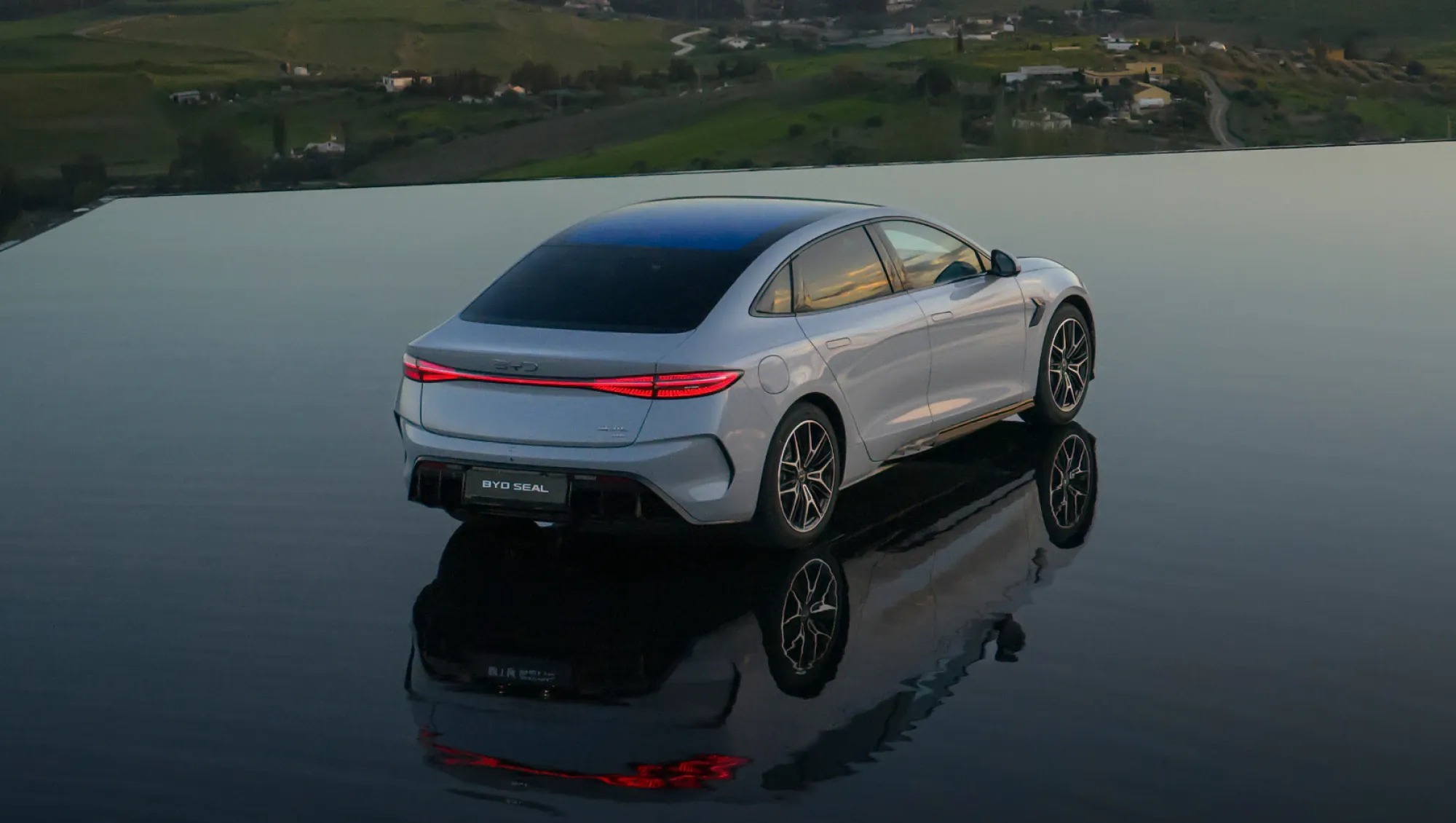
Design & Interior
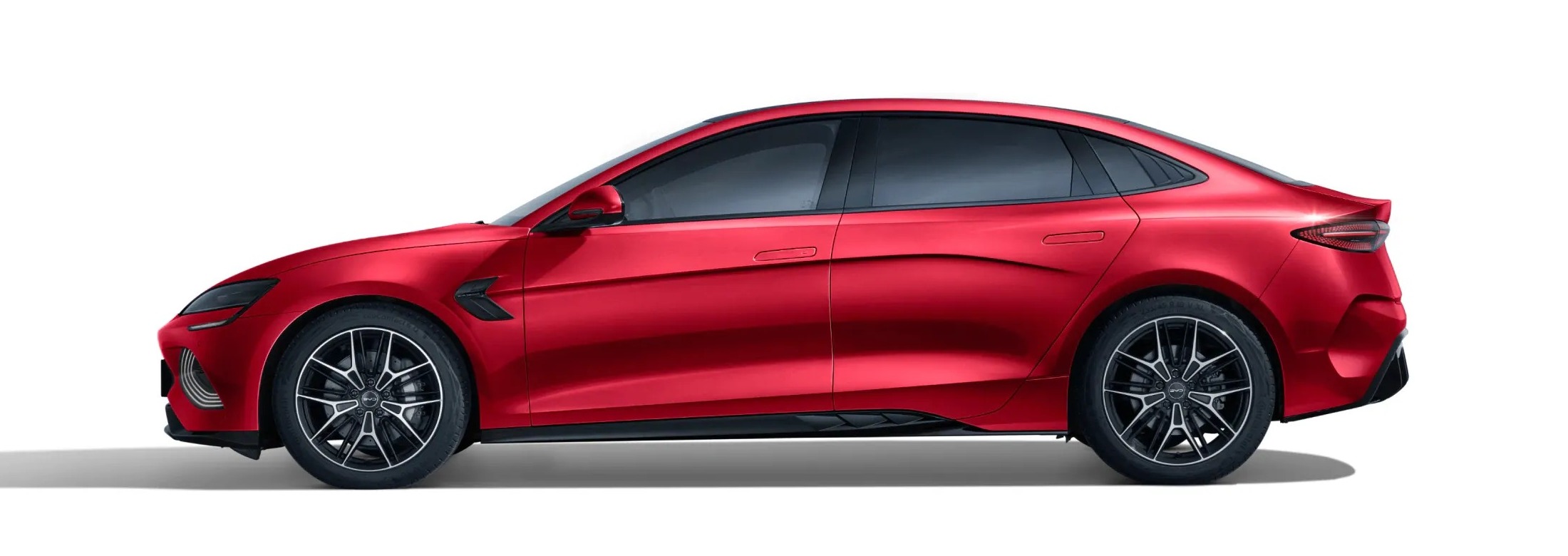
The 2026 Seal keeps its low, wide shape with a full-width LED light bar at the rear. The visible changes are small: the BYD logo moves to the top centre above the light bar, the SEAL name sits at the lower right of the boot lid, and a new 19-inch wheel design is available. BYD Germany names two new colours, Parkour Red and Shadow Purple, to add to Indigo Grey, Obsidian Black, Polar White and Atlantis Grey; BYD's German site and the UK launch call the new shades Ruby Red and Lavender Grey, so the names differ by market. The UK release also notes cleaner headrests without logos.
Inside, the cabin is built around a 15.6-inch central screen, a 10.25-inch digital cluster, quilted leather seats with blue ambient lighting and a crystal-style rotary gear selector. The equipment list includes a panoramic glass roof, a 12-speaker Dynaudio system, two 15 W wireless phone chargers, heated and ventilated front seats and a head-up display, which BYD's German brochure and the UK launch release list for the Excellence only. The Comfort trim, sold in Germany only among the markets covered here, drops the electric tailgate and some other equipment.
Technology & Features
The 15.6-inch screen runs BYD's infotainment with Apple CarPlay and Android Auto support and a voice assistant that answers to "Hi, BYD". BYD Germany's brochure lists an electrically rotating screen for all three trims and AUTO BILD describes it switching between portrait and landscape, while BYD UK's launch release calls the Design's screen fixed, so check the configuration you order. The smartphone key introduced for 2026 sits alongside two key fobs and an NFC key card, and BYD says its iTAC system allocates drive torque to individual wheels instead of simply cutting power, which matters most in the 390 kW all-wheel-drive version.
Safety & ADAS
The Seal's European equipment list includes automatic emergency braking, forward and rear collision warning, lane departure warning and lane keeping, a traffic jam assistant, traffic sign recognition, door-opening warning, a tyre pressure monitor, child presence detection and eCall. The 2026 update adds the driver monitoring system that BYD says detects attention in real time and meets the newest safety standards. Euro NCAP gave the Seal five stars in 2023 (89 percent adult occupant, 87 percent child occupant, 82 percent vulnerable road users and 76 percent safety assist), tested on the Design with the rating also applying to the Excellence AWD; this was before the 2026 update, whose changes have not been re-rated. Equipment varies by trim, so check the specification for the version you want, and BYD does not publish an automation level for the driver-assistance package in the brochure.
| ADAS LEVEL | Driver-supervised assistance (no automation level published by BYD) |
|---|---|
| ADAS FEATURES | AEB, forward and rear collision warning, lane keeping, traffic jam assist, traffic sign recognition, driver monitoring (new for 2026), child presence detection, eCall |
Available Versions
| VERSION | POWER | TORQUE | 0-100 | TOP SPEED | DRIVETRAIN | BATTERY | EV RANGE | COMBINED RANGE | PRICE | KEY DIFFERENCES |
|---|---|---|---|---|---|---|---|---|---|---|
| Comfort | 228 hp | 380 Nm | 7.5s | 220 km/h | RWD | 61.4 kWh | 460 km | — | €47,990 | 170 kW (231 PS), 110 kW DC peak, Germany only among the markets covered |
| Design | 308 hp | 360 Nm | 5.9s | 180 km/h | RWD | 82.5 kWh | 570 km | — | €49,990 | 230 kW (313 PS); £45,730 in the UK, NIS 198,990 in Israel |
| Excellence | 523 hp | 670 Nm | 3.8s | 180 km/h | AWD | 82.5 kWh | 520 km | — | €53,990 | 390 kW (530 PS), two motors; £48,730 in the UK, NIS 219,990 in Israel |
Pricing & Availability
In Germany BYD lists the Seal at €47,990 for the Comfort, €49,990 for the Design and €53,990 for the Excellence, according to BYD Germany's press release of 2 March 2026; German press reports that prices rose by about €1,000 per trim with the update (from €46,990, €48,990 and €52,990), and AUTO BILD's model page still shows the same list prices. BYD's own E-Bonus, which at launch brought the prices down to €31,990, €34,490 and €37,490 together with the maximum €6,000 state subsidy, was announced until 31 March 2026; no current offer could be confirmed, so check BYD Germany's site. BYD Germany also offers leasing through BYD Lease by Arval and financing through CA Auto Bank. In the UK the Design costs £45,730 and the Excellence £48,730, unchanged from the outgoing model, with orders open by 26 February 2026, a six-year or 93,750-mile vehicle warranty and an eight-year or 155,350-mile battery warranty.
In Israel the importer Shlomo Motors began selling the 2026 Seal in March 2026 in two trims, the rear-drive Design at ₪198,990 (down ₪20,000 from ₪218,990) and the dual-motor Excellence at ₪219,990 (down ₪16,000 from ₪235,990), according to the Israeli outlets Cartube and Queen of the Road. Israeli coverage quotes the same 82.5 kWh battery and 570 km and 520 km WLTP ranges, with the power given as roughly 312-313 and 530 horsepower, which are PS values. These are the March 2026 launch list prices, and the Carzone price list showed the same figures on 6 October 2026, but confirm the current price list with the importer.
How It Compares
The obvious European rival is the Tesla Model 3, and the numbers are not flattering to the Seal on efficiency. The rear-drive Model 3 Premium costs €44,990 in Germany with 235 kW (320 PS, about 315 hp) and up to 750 km WLTP from a 79 kWh net battery, compared with the Seal Design at €49,990, 230 kW (308 hp) and 570 km. The dual-motor Model 3 Premium AWD makes 324 kW (440 PS, about 434 hp), reaches 100 km/h in 4.4 seconds and is quoted at 660 km WLTP and €49,990, against the Seal Excellence at €53,990 with 523 hp, 3.8 seconds and 520 km. The Seal answers with more power in the top version and a richer standard equipment list, including a panoramic roof, a Dynaudio system and, on the Excellence, a head-up display. Tesla also sells a Standard rear-drive Model 3 from €36,990. The Model 3 has 594 litres of boot plus an 88-litre frunk against the Seal's 485 and 72 litres. Tesla's prices and ranges follow Tesla Germany's configurator and the ADAC catalogue in October 2026 (list prices before the delivery fee); power, 0-100 km/h times and boot figures come from ADAC.
- Bigger practical space for 2026: 485 L boot (up 85 L) and 72 L frunk (up 19 L) with no price increase in the UK
- Strong performance range: 230 kW (308 hp) RWD or 390 kW (523 hp) AWD with 0-100 km/h in 3.8 s
- Up to 570 km WLTP from an LFP Blade battery, with long standard equipment lists including panoramic roof and Dynaudio
- DC charging peaks at 150 kW (110 kW for the Comfort), with 37 minutes for 10-80%
- Consumption of 16.6-18.2 kWh/100 km WLTP and 2,055-2,185 kg kerb weight; a Model 3 Premium costs less in Germany and quotes up to 750 km WLTP
The 2026 Seal is a sensible update to a well-equipped electric sedan: more boot, a bigger frunk, driver monitoring and a phone key, with unchanged prices in the UK and a small rise in Germany. The Design, at 230 kW (308 hp) and 570 km WLTP, is the balanced pick, while the 523 hp Excellence is the one for performance. Slow-ish 150 kW charging and rivals that go further on a charge keep it from being a runaway winner. In Israel the March 2026 price cuts to ₪198,990 and ₪219,990 make it a more competitive choice than it was a year ago.