
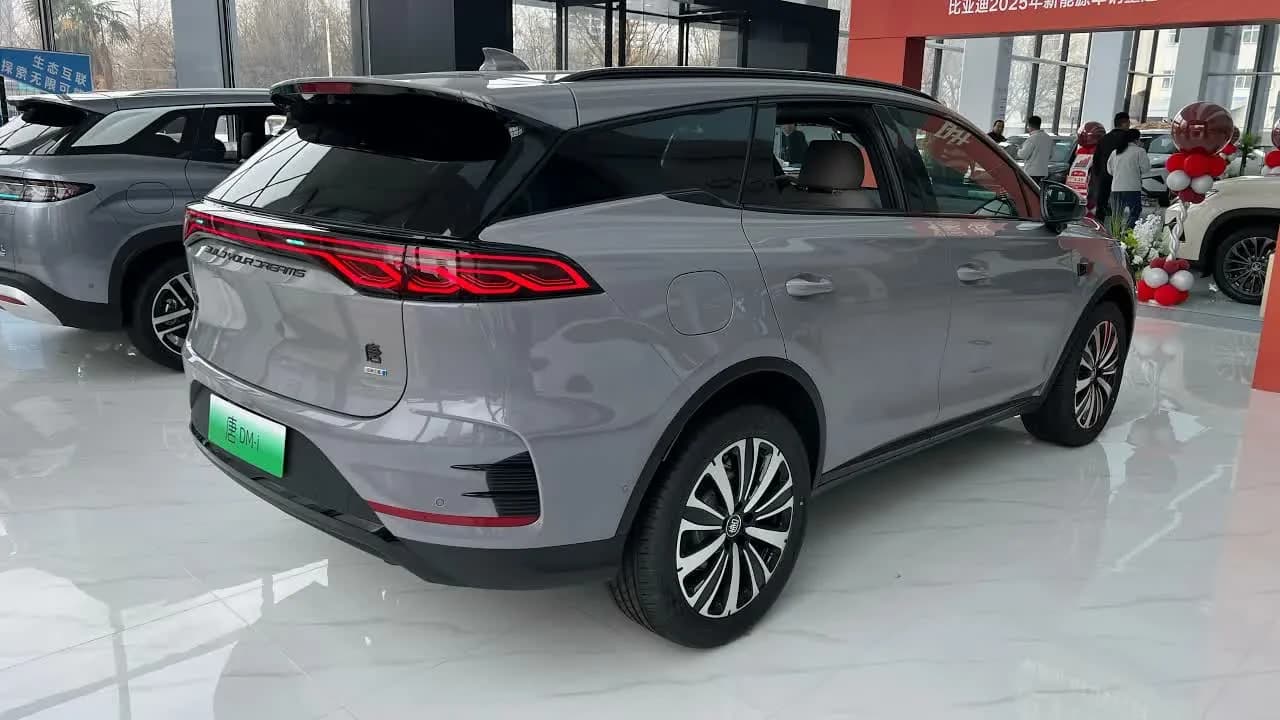
The 2026 BYD Tang DM-i is the efficiency-focused twin of the more performance-oriented Tang L DM-p — same family-SUV silhouette and 7-seat 2+3+2 layout, but with a 2WD (front-wheel-drive) single-motor architecture instead of the DM-p’s dual-motor AWD. The Tang DM-i “Intelligent Driving 175KM Long-Range Edition” launched September 16, 2025 and continues as the current 2026 model year offering, priced at ¥179,800-¥199,800 ($24,700-$27,440) across three trims. With BYD’s newest God’s Eye B ADAS stack standard, an optional roof-mounted LiDAR on the flagship trim, and 1,240 km combined CLTC range from the 26.6 kWh Blade pack plus 53-liter fuel tank, the Tang DM-i fills the affordable 7-seat PHEV slot in BYD’s lineup. This article disambiguates the model from the prior 2026-02-28 freshmotors composite article that conflated DM-i range figures with DM-p horsepower — the actual Tang DM-i specifications are documented below.
Performance & Specs
The Tang DM-i uses BYD’s 5th-generation DM-i architecture: a 1.5L turbocharged dedicated-hybrid engine producing 115 kW (154 hp) and 225 Nm, paired with a single front EHS200 electric motor producing 200 kW (268 hp) and 315 Nm through BYD’s electronic continuously-variable transmission (E-CVT). Total system output is approximately 200 kW (272 hp), accelerating the 2,130 kg seven-seater from 0-100 km/h in 7.9 seconds with a 200 km/h top speed. This is intentionally a 2WD-only configuration — buyers wanting AWD or supercar acceleration should look at the Tang L DM-p sibling. The 26.6 kWh Blade LFP pack delivers 175 km of pure-EV CLTC range, while the 53-liter petrol tank (92-octane) stretches combined CLTC range to 1,240 km with extender-mode fuel economy of 4.7 L/100 km.

| POWERTRAIN TYPE | PHEV 2WD (DM-i 5.0) |
|---|---|
| SYSTEM POWER | 272 hp (200 kW peak) |
| SYSTEM TORQUE | 315 Nm |
| 0-100 KM/H | 7.9 s |
| TOP SPEED | 200 km/h |
| BATTERY | 26.6 kWh BYD Blade LFP (175 km trims) / 21.5 kWh (115 km older trims) |
| EV-ONLY RANGE | 175 km (CLTC) |
| COMBINED RANGE | 1,240 km (CLTC) |
| FUEL TANK | 53 L (92-octane) |
| FUEL ECONOMY | 4.7 L/100 km (extender mode) |
| ENGINE | 1.5T dedicated-hybrid 4-cylinder, 115 kW |
| MOTOR | EHS200 front motor, 200 kW / 315 Nm |
Dimensions & Practicality

| Length | 4,870 mm |
|---|---|
| Width | 1,950 mm |
| Height | 1,725 mm |
| Wheelbase | 2,820 mm |
| Ground clearance | ~150 mm |
At 4,870 mm long on a 2,820 mm wheelbase, the Tang DM-i is smaller than its DM-p performance sibling (5,040 mm / 2,950 mm) and the new Datang flagship (5,302 mm / 3,130 mm). The reviewer notes the third row is appropriate for teenagers and children, with adult passengers fitting but with constrained kneeroom — this is typical for the mid-size 3-row PHEV class. Cargo measures 235 liters with all three rows up (modest), expanding to 940 liters with the third row folded and 1,655 liters with both second and third rows folded. There is no frunk — the 1.5T engine occupies the front compartment. Curb weight is approximately 2,130-2,180 kg depending on trim, with 20-inch GT-style alloys and 255/50 R20 tires standard.
| LENGTH | 4,870 mm |
|---|---|
| WIDTH | 1,950 mm |
| HEIGHT | 1,725 mm |
| WHEELBASE | 2,820 mm |
| CARGO VOLUME (all up) | 235 L |
| CARGO VOLUME (3rd folded) | 940 L |
| CARGO VOLUME (max, 2nd+3rd folded) | 1,655 L |
| FRUNK | None |
| SEATING | 7 (2+3+2) |
| WHEELS / TIRES | 20″ / 255/50 R20 |
| CURB WEIGHT | 2,130-2,180 kg |
Charging & Battery
The 26.6 kWh Blade LFP pack uses BYD’s in-house cell-to-pack design with 114.9 Wh/kg energy density — the lower density vs ternary lithium is the trade-off for LFP’s superior thermal stability and cycle life. AC charging on the 7 kW onboard charger replenishes the pack in approximately 3 hours; DC fast charging at peak ~80 kW completes a 30-80% top-up in 10-15 minutes per the reviewer’s walkaround. Combined CLTC range hits 1,240 km via the 53-liter fuel tank, with WLTC hybrid-mode consumption rated at approximately 1.0 L/100 km combined (with frequent charging) and 4.7 L/100 km in pure extender mode after the battery is depleted. The older 115 km trims still on sale use the smaller 21.5 kWh Blade pack for approximately ¥154,800 ($22,740) entry.
| BATTERY (175 km trims) | 26.6 kWh BYD Blade LFP |
|---|---|
| BATTERY (115 km trims) | 21.5 kWh BYD Blade LFP |
| AC CHARGING | 7 kW |
| DC FAST CHARGING | ~80 kW peak |
| DC 30-80% TIME | 10-15 min |
| AC FULL CHARGE | ~3 hours |
Design & Interior
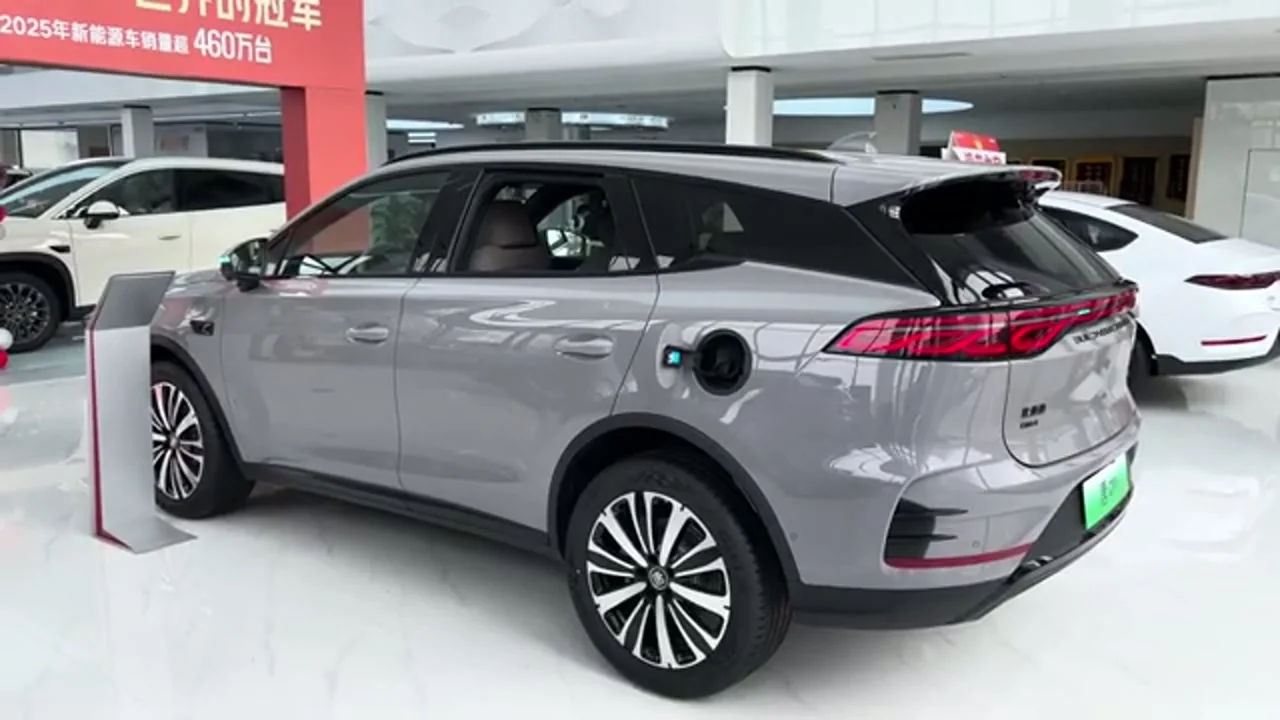
The Tang DM-i exterior carries forward BYD’s “Dragon Face” design language refreshed for 2025: a horizontal front grille with chrome accent strip, vertically arranged matrix LED headlamps, and a connected LED rear tail-light bar with “FULFILL YOUR DREAMS” lettering integrated into the light signature. The reviewer’s showroom unit is finished in cement grey with a black contrast roof and 20-inch dual-tone alloys. Inside, the cabin uses synthetic leather on the seats (Premium and Premium+ trims) or Nappa leather on the LiDAR Flagship trim, with a soft-touch dashboard and contrast-color stitching. The 15.6-inch central touchscreen rotates between portrait and landscape orientations on user demand. The reviewer confirms full English-language UI at launch on all trims — a critical feature for export buyers. A panoramic glass roof with electric sunshade is standard on Premium+ and LiDAR Flagship trims; the base Premium trim uses a fixed glass panel.
Technology & Features
The Tang DM-i runs BYD’s DiLink 100 cockpit — a level below the DiLink 150 used on the Tang L DM-p and Datang siblings. The central touchscreen is the same 15.6-inch rotating panel, but the cockpit SoC is BYD’s proprietary 6 nm D100 chip (~136K DMIPS) instead of the Snapdragon 8295P. Connectivity supports Apple CarPlay and Android Auto, with the reviewer confirming English-language UI works as the primary interface language on demand. God’s Eye B ADAS is provided via DiPilot 100 on base trims, upgrading to DiPilot 300 with optional roof-mounted LiDAR + Orin-X (254 TOPS) compute on the LiDAR Flagship trim. Standard ADAS features include AEB, ACC, LKA, BSM, RCTA, 360-degree camera, and tire-blowout stability control up to 190 km/h. The flagship trim adds Highway NOA and Urban NOA with full lane-change pilot and intersection navigation.
Safety & ADAS
| ADAS LEVEL | L2+ (God’s Eye B / DiPilot 100 base, DiPilot 300 with LiDAR Flagship) |
|---|---|
| LiDAR | Optional on LiDAR Flagship trim only |
| ORIN COMPUTE | Orin-N (84 TOPS) base / Orin-X (254 TOPS) flagship |
| RADARS | 3 mmWave (4D on flagship) |
| CAMERAS | 11 HD |
| ULTRASONIC | 12 |
| ADAS FEATURES | AEB, ACC, LKA, BSM, RCTA, 360° camera, tire-blowout stability (190 km/h) |

Available Versions
| VERSION | POWERTRAIN | BATTERY | EV / COMBINED RANGE | 0-100 | PRICE | KEY DIFFERENCES |
|---|---|---|---|---|---|---|
| 175 Premium | DM-i 2WD | 26.6 kWh | 175 / 1,240 km | 7.9 s | $24,700 | Entry trim, DiPilot 100, no panoramic roof |
| 175 Premium+ Dynaudio | DM-i 2WD | 26.6 kWh | 175 / 1,240 km | 7.9 s | $26,070 | Dynaudio + panoramic roof + Nappa interior |
| 175 LiDAR Flagship | DM-i 2WD | 26.6 kWh | 175 / 1,240 km | 7.9 s | $27,440 | Roof-mounted LiDAR + DiPilot 300 + Orin-X + Urban NOA |
| 115 km (older trims) | DM-i 2WD | 21.5 kWh | 115 / 1,150 km | 7.9 s | ~$22,740 | Older 2024-spec trims still in stock |
Pricing & Availability
The Tang DM-i 175KM Long-Range Edition launched September 16, 2025 and is on sale across mainland China at ¥179,800-¥199,800 ($24,700-$27,440). The older 115 km Blade-pack trims continue at ¥154,800-¥174,800 (~$22,740-$25,680) while inventory remains. No formal 2026 model year refresh has been announced; the lineup continues unchanged into 2026 while BYD focuses headline attention on the new Datang flagship and the upcoming Tang L 2026 facelift. The reviewer notes BYD’s export policy is currently restrictive on Tang DM-i in particular — grey-import / parallel channels via broker networks are the primary export route as of May 2026.
How It Compares
The Tang DM-i’s direct competitive position is unique within BYD’s own portfolio: it’s the only 7-seat PHEV at sub-$28,000 with optional LiDAR. The Geely Galaxy M7 undercuts it on price by $8,000+ but only seats five; the AITO M7 EREV sits $10,000-$20,000 higher with the Huawei ADS halo. The Tang L DM-p sibling offers 272 hp more (544 vs 272) and adds AWD for $7,000-$10,000 more — that’s the natural upgrade path for buyers wanting performance. For Chinese families specifically prioritizing 7-seat practicality + 1,200+ km combined range + standard L2+ ADAS at the lowest sticker, the Tang DM-i remains the segment’s default value pick.
- $24,700 entry — only sub-$28k 7-seat PHEV with optional LiDAR
- 1,240 km combined CLTC range from 26.6 kWh Blade + 53 L tank
- 175 km pure-EV CLTC covers most daily commutes without burning fuel
- God’s Eye B ADAS with Highway + Urban NOA on LiDAR Flagship trim
- Full English-language UI confirmed at launch — export-friendly
- 15.6″ rotating central touchscreen + tire-blowout stability up to 190 km/h
- 2WD only — no AWD option (look at Tang L DM-p for that)
- 7.9 s 0-100 trails Geely Galaxy M7’s 234 hp by very little margin
- 3rd row tight for adults — teenagers and children only on long trips
- BYD direct export restrictions limit grey-import availability
- D100 cockpit SoC (proprietary 6nm) less powerful than Snapdragon 8295P on Tang L sibling
- No frunk — 1.5T engine occupies that space
The 2026 BYD Tang DM-i is the affordability anchor of BYD’s mid-size 7-seat PHEV lineup, positioned squarely between the ¥160k Geely Galaxy M7 (smaller 5-seater) and the ¥230k+ Tang L DM-p performance sibling. The combination of 1,240 km combined CLTC range, 175 km pure-EV mode, optional LiDAR on the ¥199.8k flagship, and full English UI makes it the segment’s default value pick for families who specifically want the 7-seat 2+3+2 layout at sub-$28,000. The compromises — 2WD only, tight 3rd row for adults, D100 cockpit chip vs Snapdragon — are exactly the cost-down decisions that allow the ¥179,800 entry to exist. For buyers shopping the Geely M7 / Voyah Free / smaller AITO M7 segment but specifically needing the third row, the Tang DM-i is the obvious answer.