
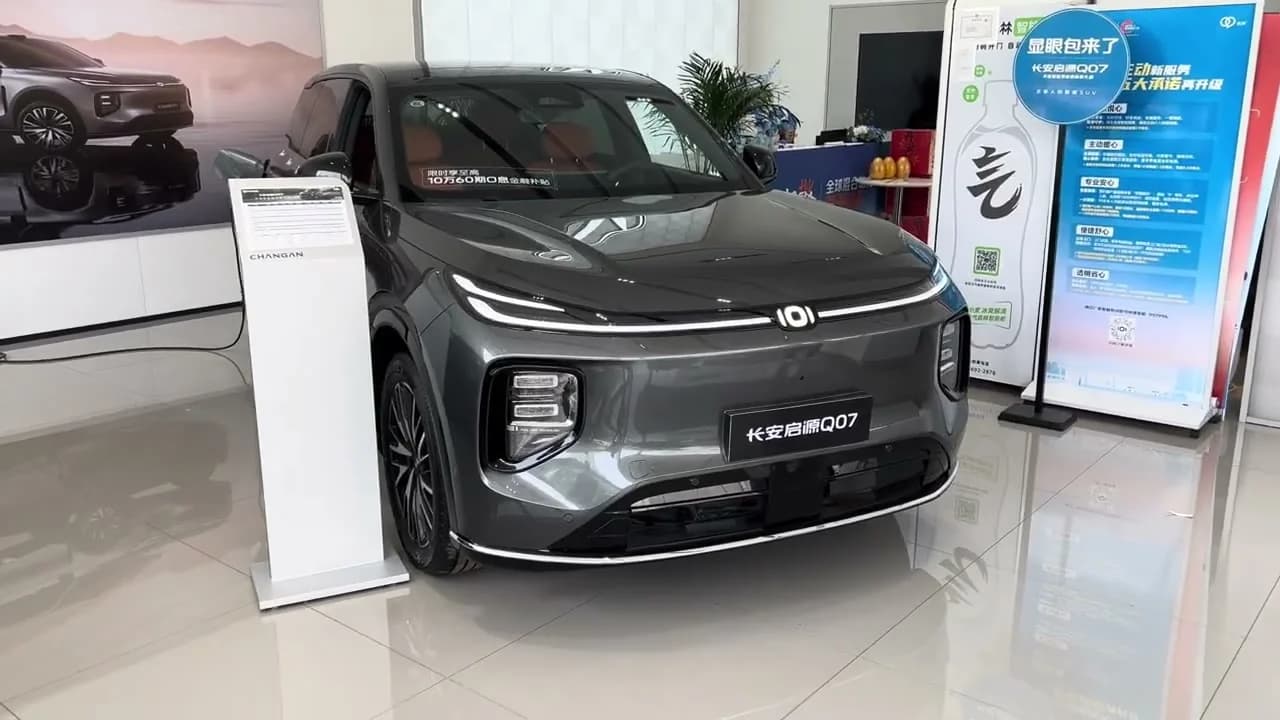
The 2026 Changan Qiyuan Q07 (长安启源 Q07) is the new mid-size plug-in hybrid SUV from Changan’s Qiyuan (“Origin”) sub-brand, slotting between the smaller Q05 and the larger 7-seat Q09 in a lineup pitched squarely at value-conscious Chinese family buyers. Built around Changan’s Smart Blue Whale 3.0 hybrid platform — the same architecture that anchors the well-regarded Qiyuan A07 sedan — the Q07 pairs a 1.5-liter turbocharged engine with a 165 kW front-mounted electric drive unit to deliver up to 215 km of pure-electric range, a class-leading 1,400 km combined range, and a 7.6-second 0-100 km/h sprint. With a starting price of just ¥129,800 (~$19,000), the Q07 is one of the most aggressively priced mid-size PHEV SUVs on the Chinese market, undercutting BYD’s Song L DM-i and Geely’s Galaxy L7 by a meaningful margin.
Performance & Specs

| Engine | 1.5T (110 kW) |
|---|---|
| Front motor | Permanent magnet synchronous |
| Battery | 31.7 kWh LFP |
| Drivetrain | Front-wheel drive |
| Architecture | Smart Blue Whale 3.0 |
The Q07 uses a parallel-series plug-in hybrid layout: the 1.5-liter turbocharged engine, rated at 110 kW peak, primarily acts as a generator to keep the LFP traction battery topped up but can also directly drive the front wheels via an E-CVT for highway-speed efficiency. A single permanent-magnet synchronous front motor delivers a peak system output of 165 kW (~221 hp) and 550 Nm of torque, sending all power to the front wheels. Performance is honest rather than dramatic — 0-100 km/h takes 7.6 seconds and top speed is electronically limited to 180 km/h — but the powertrain’s real party trick is a remarkable 3.9 L/100 km combined fuel economy figure, helping the Q07 stretch to 1,400 km between fill-ups when the battery is also topped up.
| POWERTRAIN TYPE | PHEV FWD (Smart Blue Whale 3.0) |
|---|---|
| SYSTEM POWER | 165 kW (~221 hp) |
| ENGINE | 1.5L Turbocharged (110 kW) |
| SYSTEM TORQUE | 550 Nm |
| 0-100 KM/H | 7.6 s |
| TOP SPEED | 180 km/h |
| BATTERY | 21.5 / 31.7 kWh LFP |
| EV RANGE (CLTC) | 145 / 215 km |
| COMBINED RANGE (CLTC) | 1,400 km |
| FUEL CONSUMPTION | 3.9 L/100 km |
Dimensions & Practicality

| Length | 4,837 mm |
|---|---|
| Width | 1,920 mm |
| Height | 1,690 mm |
| Wheelbase | 2,905 mm |
| Seat layout | 2+3 (5 seats) |
At 4,837 mm long with a 2,905 mm wheelbase, the Q07 is competitive with mid-size segment rivals like the Tesla Model Y (4,750 mm) and BYD Song L (4,840 mm), while the 1,690 mm height keeps it lower and more wagon-like than the boxier WEY Lanshan. The 5-seat 2+3 cabin offers genuinely generous rear legroom and a flat-floor design free of a transmission tunnel. Cargo space is rated at 763 liters with the rear seats up — competitive with the Tesla Model Y (854 L) and the BYD Song L — and expands to over 1,800 liters with the 60/40 split bench folded. ISOFIX with top-tether anchors are fitted to the outboard rear seats, and a power tailgate with hands-free open is standard from the second trim level upward.
| LENGTH | 4,837 mm |
|---|---|
| WIDTH | 1,920 mm |
| HEIGHT | 1,690 mm |
| WHEELBASE | 2,905 mm |
| CURB WEIGHT | 1,935 kg |
| SEAT LAYOUT | 5 (2+3) |
| CARGO CAPACITY | 763 L (seats up) |
Charging & Battery
Changan offers the Q07 with two CATL Freevoy lithium iron phosphate (LFP) battery options. The entry Pro trim uses a smaller 21.5 kWh pack good for 145 km of pure-electric CLTC range, while Max and Ultra trims step up to a larger 31.7 kWh pack delivering 215 km CLTC. Both feed the 1.5T-plus-front-motor Smart Blue Whale 3.0 system for the same 1,400 km combined range when paired with a full fuel tank. DC fast charging refills the battery from 30% to 80% in roughly 12 minutes at compatible stations, while a standard AC home wallbox completes a full charge overnight. Battery-to-wheel consumption sits around 14.7 kWh/100 km (CLTC) in pure-EV mode, and the LFP chemistry comes with the standard 8-year/160,000 km battery warranty.
| BATTERY | 21.5 kWh (Pro) / 31.7 kWh (Max, Ultra) LFP |
|---|---|
| EV RANGE (CLTC) | 145 km (Pro) / 215 km (Max, Ultra) |
| COMBINED RANGE (CLTC) | 1,400 km |
| DC FAST CHARGING | 30–80% in ~12 min |
| AC HOME CHARGING | ~6 h full |
| EV CONSUMPTION | ~14.7 kWh/100 km (CLTC) |
Design & Interior
The Q07 wears the cleaner, more horizontally-oriented design language now characteristic of Changan’s Qiyuan sub-brand. The closed front end is dominated by a slim full-width LED light bar and a large horizontal “O” brand emblem, with split lower lighting clusters that house the LED daytime running signature. The flush door handles, painted lower body trim, and 19-inch alloys give the car a more premium look than its price tag suggests. At the rear, a full-width red LED light bar with C-shaped corner elements and a backlit “启源 / Qiyuan” brand wordmark deliver a high-tech nighttime signature. Inside, the Q07 punches above its segment with a cognac-tone leatherette cabin, deeply quilted seat backs, panoramic glass roof, and a mostly button-free dashboard dominated by the central infotainment display. Even the entry trim includes ambient lighting, dual-zone climate, and a wireless charging pad. Top trims add Nappa-grade leather, ventilated & heated front seats, electric driver’s memory, and a Sony-tuned 14-speaker premium audio system.
Technology & Features
The Q07’s digital cockpit is anchored by a large central touchscreen (with the bright pink Quick Controls panel visible in the showroom walkthrough) running Changan’s in-house infotainment platform on 16 GB of vehicle memory. The system supports OTA software updates, smartphone mirroring, voice control, and a digital key. ADAS calculations are handled by the Horizon Journey J6M autonomous driving chip — a relatively recent silicon choice from Horizon Robotics that enables the Q07’s “Sky Hub Driver Assistance Laser” (天枢智驾) suite. Standard equipment across the lineup includes adaptive cruise, lane centering, blind-spot monitoring, and a 360-degree surround-view camera; higher trims unlock highway Navigation-on-Autopilot functionality.
Safety & ADAS
Even in entry trim, the Q07 ships with a comprehensive L2 ADAS suite: Automatic Emergency Braking (AEB), Adaptive Cruise Control (ACC), Lane Keep Assist (LKA), Blind Spot Monitor (BSM), Rear Cross-Traffic Alert/Brake, and a 360-degree surround-view camera. Top trims add highway Navigation-on-Autopilot, automatic parking with parking-spot memory, and a Driver Monitoring System. Passive safety is handled by Changan’s high-strength steel body shell, full-row curtain airbags, and ISOFIX with top-tether anchors visible in the rear cargo area.
| ADAS LEVEL | L2 (top trims add highway NoA) |
|---|---|
| ADAS FEATURES | AEB, ACC, LKA, BSM, RCTA, 360° Camera, Auto Park |
| AIRBAGS | Front, side, full curtain |
| CHILD SEAT | ISOFIX + top-tether (outboard rear) |
Available Versions
| VERSION | POWERTRAIN | EV RANGE | BATTERY | SEATS | PRICE |
|---|---|---|---|---|---|
| Q07 Pro | 1.5T PHEV FWD | 145 km CLTC | 21.5 kWh LFP | 5 | ¥129,800 (~$19,000) |
| Q07 Max | 1.5T PHEV FWD | 215 km CLTC | 31.7 kWh LFP | 5 | ¥145,800 (~$21,300) |
| Q07 Ultra | 1.5T PHEV FWD | 215 km CLTC | 31.7 kWh LFP | 5 | ¥156,800 (~$22,900) |
Pricing & Availability
The 2026 Changan Qiyuan Q07 lineup currently spans nine trim and color combinations, with prices running from ¥129,800 (~$19,000) for the entry Pro to roughly ¥156,800 (~$22,900) for the top Ultra trim with the larger battery and higher-specification ADAS package. Customer deliveries have started across China, with the Q07 sold through Changan’s expanding Qiyuan-branded retail network. The Qiyuan brand is currently China-domestic only, though Changan has confirmed that Qiyuan models are scheduled to expand into Southeast Asia, the Middle East, and Latin America during 2026-2027 as part of the parent group’s broader international push. Standard warranty coverage runs to 3 years/100,000 km on the vehicle and 8 years/160,000 km on the battery.
How It Compares
The Q07 plays in one of the most ferocious price brackets in the Chinese auto market — the ¥130,000-160,000 mid-size PHEV SUV segment is where BYD Song L DM-i, Geely Galaxy L7, and Leapmotor C10 fight for volume daily. The Galaxy L7 is the cheapest of this group at roughly $15,500 and is hard to beat on outright value, but its 120 kW system feels less brisk than the Q07’s 165 kW. BYD’s Song L DM-i offers the deepest dealer network and famous reliability but its 125 km EV range is well short of the Q07’s 215 km. The Leapmotor C10 REEV most directly challenges on EV range (210 km) but is meaningfully more expensive at the entry level. Where the Q07 distinguishes itself is the combination of a sub-$20,000 entry price, segment-leading 215 km EV range, and 1,400 km total range — on paper the most well-balanced of these four for the Chinese family buyer who drives mostly local but takes occasional long trips.
- Aggressive $19,000 entry price — among the cheapest mid-size PHEV SUVs in China
- Class-leading 215 km of pure-electric CLTC range from the 31.7 kWh LFP battery
- 1,400 km combined range covers cross-country trips with confidence
- Modern Smart Blue Whale 3.0 architecture with 12-minute fast charging
- Generous 763 L cargo capacity beats the Tesla Model Y by a margin
- Front-wheel drive only — no AWD option in the lineup
- 7.6-second 0-100 km/h is honest but not quick for a 2026 PHEV
- Currently China-only — international launch dates still TBA
The 2026 Changan Qiyuan Q07 is the kind of car that explains why Western automakers are nervous about Chinese competitors. For roughly $19,000, you get a comfortable 4,837 mm mid-size SUV, 215 km of pure-electric range, 1,400 km combined range, a modern Smart Blue Whale 3.0 powertrain, and a digital cabin that feels a tier above the price. It isn’t the fastest car in this segment, and FWD-only will disappoint enthusiasts, but for the family buyer who wants electric daily driving with a stress-free road-trip safety net, the Q07 is one of the most rationally-priced choices on the Chinese market right now.