
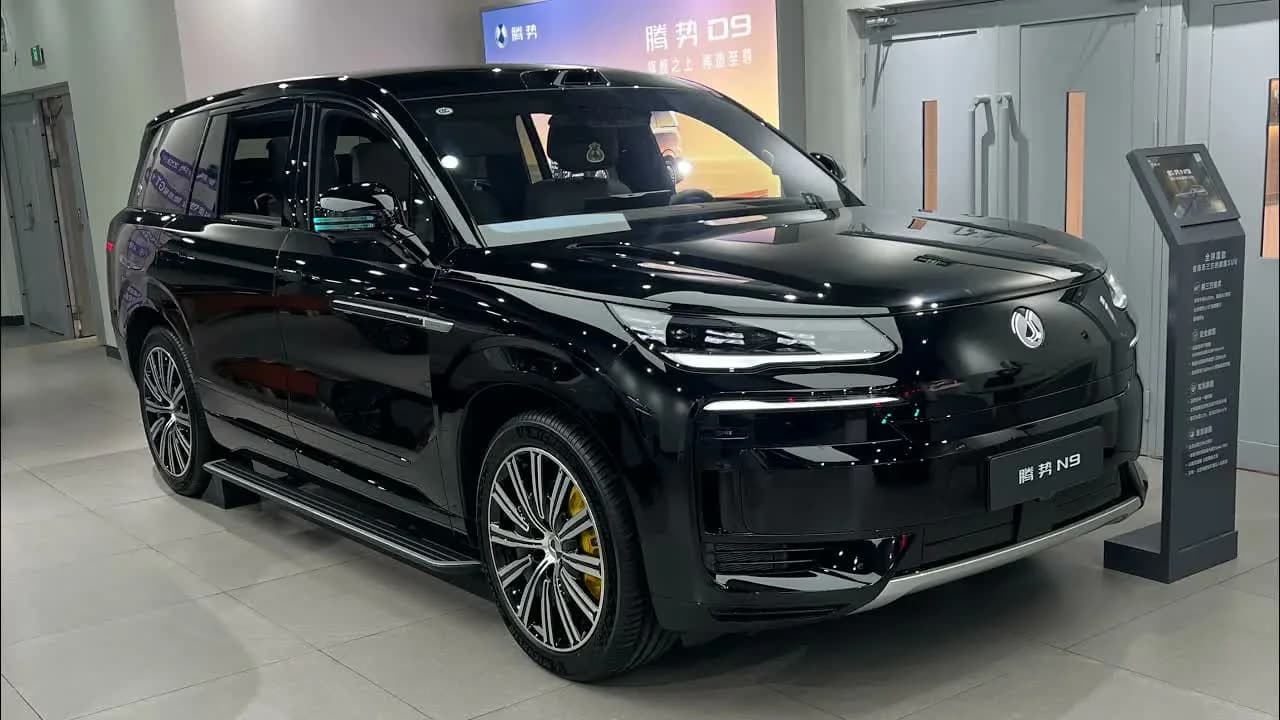
The 2026 Denza N9 is BYD's flagship six-seat plug-in hybrid SUV, and one of the most aggressively priced 900-plus-horsepower family haulers on sale in China. A tri-motor system delivers 680 kW (912 hp) and 1,035 Nm, a 2.0T turbocharged petrol engine provides the backup power, and the 2026 model-year lineup, on sale since September 17, 2025, spans CNY 389,800-CNY 449,800 (about $58,200-$67,100) across three trims. On May 18, 2026 Denza added the Flash Charge Edition: a 75.26 kWh second-generation Blade Battery, 420 km of CLTC electric range, 1,520 km combined and a 10-70% charge in about five minutes, priced at CNY 409,800-CNY 469,800 (about $61,200-$70,100). The N9 first launched in China in March 2025. This guide covers both the standard car and the Flash Charge Edition.
Performance & Specs
The Denza N9 uses BYD's e³ tri-motor platform. A 2.0T BYD479ZQA four-cylinder engine (152 kW, or 207 PS and about 204 hp, with 325 Nm; BYD quotes 44.13% thermal efficiency) works with a 200 kW (268 hp) front motor rated at 315 Nm and two 240 kW (322 hp) rear motors rated at 360 Nm each. Combined electric output is 680 kW (912 hp) with 1,035 Nm of torque, enough for 0-100 km/h in 3.9 seconds on the standard car and 3.7 seconds on the Flash Charge Edition, with a 230 km/h top speed. Curb weight for the standard car is 3,130-3,245 kg depending on trim. The standard car carries a 46.99 kWh Blade LFP battery rated at 230 km of CLTC electric range and 1,330 km combined after BYD's over-the-air long-range mode (the launch rating was 202 km and 1,302 km). The Flash Charge Edition's 75.26 kWh Blade Battery 2.0 lifts the CLTC electric range to 420 km and the combined range to 1,520 km, which is 190 km more EV range for 60% more battery capacity.

| Powertrain | PHEV, tri-motor AWD |
|---|---|
| Power | 680 kW (912 hp) |
| Torque | 1,035 Nm |
| 0–100 km/h | 3.9 s (3.7 s Flash Charge) |
| Battery | 46.99 kWh (75.26 kWh Flash Charge) |
| Range | 230 km EV / 1,330 km total (420 / 1,520 km Flash Charge) |
| POWERTRAIN TYPE | PHEV — tri-motor AWD (e³ platform) |
|---|---|
| SYSTEM POWER | 912 hp (680 kW) |
| SYSTEM TORQUE | 1,035 Nm |
| 0-100 KM/H | 3.9 s (Standard) / 3.7 s (Flash Charge) |
| TOP SPEED | 230 km/h |
| BATTERY (STANDARD) | 46.99 kWh Blade LFP |
| BATTERY (FLASH CHARGE) | 75.26 kWh Blade Battery 2.0 |
| EV RANGE | 230 km (Standard) / 420 km (Flash Charge), CLTC |
| COMBINED RANGE | 1,330 km (Standard) / 1,520 km (Flash Charge), CLTC |
| FUEL TANK | 70 L (92-octane) |
| FUEL ECONOMY | ~6.3 L/100 km (battery depleted) |
| ENGINE | 2.0T BYD479ZQA, 152 kW (207 PS / 204 hp), 325 Nm |
Dimensions & Practicality

| Length | 5,258 mm |
|---|---|
| Width | 2,030 mm |
| Height | 1,830 mm |
| Wheelbase | 3,125 mm |
| Ground clearance | up to 222 mm (air suspension raised) |
At 5,258 mm long on a 3,125 mm wheelbase, the N9 is almost exactly the size of the Li Auto L9 (5,255 mm long, 3,125 mm wheelbase). The cabin is a 2+2+2 layout with individual second-row captain's chairs, and the reviewer says the third row has enough leg space and headroom for adults, and that the third-row seats can be adjusted. Cargo is the trade-off: 351 liters with all three rows up, growing to roughly 1,100-1,140 liters with the third row folded, and there is no frunk. The car rides on 22-inch wheels with 275/45 R22 tyres, and rear-wheel steering brings the turning radius down to 4.65 meters, which helps a lot for a car this long. Curb weight of the standard car is 3,130 kg for the lighter trims and 3,245 kg for the fully equipped ones, with a 3,760 kg gross weight.
| LENGTH | 5,258 mm |
|---|---|
| WIDTH | 2,030 mm |
| HEIGHT | 1,830 mm |
| WHEELBASE | 3,125 mm |
| CARGO VOLUME | 351 L (up to 1,140 L with the third row folded) |
| FRUNK | None |
| SEATING | 6 (2+2+2 captain's chairs) |
| WHEELS / TYRES | 22-inch / 275/45 R22 |
| TURNING RADIUS | 4.65 m (rear-wheel steering) |
| CURB WEIGHT | 3,130-3,245 kg (standard car) |
| GROSS WEIGHT | 3,760 kg |
Charging & Battery
The standard N9's 46.99 kWh Blade LFP pack accepts up to 100 kW of DC fast charging, which takes it from 30% to 80% in about 19 minutes. The Flash Charge Edition is the headline change: its 75.26 kWh Blade Battery 2.0 charges from 10% to 70% in about five minutes and from 10% to 97% in about nine minutes on BYD's flash-charging network, and Denza says a -30°C charge adds only about three minutes. BYD had built more than 6,000 flash-charging stations by May 2026 and is targeting about 20,000 by the end of the year, so the five-minute figure depends on finding one of those sites rather than a generic public charger. The peak charging power for the Flash Charge Edition was not stated in the launch material we reviewed, so we do not quote one. A 70-liter tank of 92-octane petrol backs up the battery, and the 2.0T engine is rated at about 6.3 L/100 km once the pack is depleted.
| BATTERY (STANDARD) | 46.99 kWh Blade LFP |
|---|---|
| BATTERY (FLASH CHARGE) | 75.26 kWh Blade Battery 2.0 |
| DC FAST CHARGING (STANDARD) | 100 kW peak / 30-80% in ~19 min |
| DC FAST CHARGING (FLASH CHARGE) | 10-70% in ~5 min / 10-97% in ~9 min |
| COLD-WEATHER CHARGING (FLASH CHARGE) | -30°C adds ~3 min |
Design & Interior
The Denza N9's exterior is restrained for a 912 hp flagship: a full-width LED light bar wraps across the closed front fascia above vertically segmented headlights, and the Denza diamond emblem sits on the grille and the tailgate. The reviewer's walkaround car is finished in black. Inside, all trims have heated, ventilated and massage functions in the front and second-row seats; the second trim adds a zero-gravity front passenger seat and Nappa leather, and the top trim adds heating for the third row. The Flash Charge Edition adds exclusive 22-inch mirror-forged wheels, real wood trim and a suede headliner. A dual-layer refrigerator sits in the center armrest, dual 50W wireless charging pads are fitted, and the second-row chairs fold out tray tables. The second trim and above carry a 17.3-inch ceiling screen for rear passengers.
Technology & Features
The cockpit is built around a 17.3-inch 2.5K central touchscreen, a 13.2-inch 2.5K passenger screen, a 13.2-inch 2.5K instrument cluster and a 50-inch AR-HUD. The audio system is a Devialet unit with 20 speakers on the entry trim and 26 speakers on the flagship. The reviewer confirms that an English-language interface is available on the central touchscreen. The N9 also gets over-the-air updates, which is how the standard car picked up its 230 km electric-range rating.
Safety & ADAS
The standard N9 uses God's Eye B (DiPilot 300): one roof-mounted 128-line LiDAR, five millimeter-wave radars, 12 ultrasonic sensors and 12 cameras on the entry trim (up to 15 on the flagship), all processed by an Nvidia Orin X chip with 254 TOPS. BYD lists map-free urban navigation and parking-space-to-parking-space assistance for the 2026 model year. The Flash Charge Edition upgrades to God's Eye 5.0, which adds reinforcement learning to the driving assistance. Both versions are Level 2+ systems that need constant driver supervision.
| ADAS LEVEL | L2+ (God's Eye B; Flash Charge Edition uses God's Eye 5.0) |
|---|---|
| LiDAR | 1 × 128-line roof-mounted |
| RADARS | 5 millimeter-wave |
| CAMERAS | 12 (entry trim) to 15 (flagship) |
| ULTRASONIC | 12 |
| COMPUTE | Nvidia Orin X (254 TOPS) |
| ADAS FEATURES | Map-free urban navigation, highway navigation assist, automatic parking, parking-space-to-parking-space assist |
Available Versions
| VERSION | POWER | TORQUE | 0-100 | TOP SPEED | DRIVETRAIN | BATTERY | EV RANGE | COMBINED RANGE | PRICE | KEY DIFFERENCES |
|---|---|---|---|---|---|---|---|---|---|---|
| Honor (2026) | 912 hp | 1,035 Nm | 3.9 s | 230 km/h | AWD | 46.99 kWh | 230 km | 1,330 km | ~$58,200 (CNY 389,800) | Entry trim, 20-speaker audio, 12 cameras |
| Excellence (2026) | 912 hp | 1,035 Nm | 3.9 s | 230 km/h | AWD | 46.99 kWh | 230 km | 1,330 km | ~$61,200 (CNY 409,800) | Adds zero-gravity front passenger seat, Nappa leather, 17.3-inch ceiling screen |
| Flagship (2026) | 912 hp | 1,035 Nm | 3.9 s | 230 km/h | AWD | 46.99 kWh | 230 km | 1,330 km | ~$67,100 (CNY 449,800) | 26-speaker audio, matrix LED headlights, heated third row, 15 cameras |
| Flash Charge Honor | 912 hp | 1,035 Nm | 3.7 s | 230 km/h | AWD | 75.26 kWh | 420 km | 1,520 km | ~$61,200 (CNY 409,800) | Entry Flash Charge trim: Blade Battery 2.0, flash charging, God's Eye 5.0, 22-inch mirror-forged wheels, real wood and suede trim |
| Flash Charge Excellence | 912 hp | 1,035 Nm | 3.7 s | 230 km/h | AWD | 75.26 kWh | 420 km | 1,520 km | ~$65,600 (CNY 439,800) | Middle Flash Charge trim |
| Flash Charge Flagship | 912 hp | 1,035 Nm | 3.7 s | 230 km/h | AWD | 75.26 kWh | 420 km | 1,520 km | ~$70,100 (CNY 469,800) | Top Flash Charge trim |
Pricing & Availability
The standard 2026 Denza N9 is on sale across mainland China at CNY 389,800 (about $58,200), CNY 409,800 (about $61,200) and CNY 449,800 (about $67,100). The Flash Charge Edition launched on May 18, 2026 at CNY 409,800 (about $61,200), CNY 439,800 (about $65,600) and CNY 469,800 (about $70,100), so the entry Flash Charge trim costs the same as the standard middle trim and CNY 20,000 (about $3,000) more than the standard entry car. All N9 trims are six-seat 2+2+2 layouts. As of September 2026 Denza sells the N9 officially in China only and has not announced a launch in Europe or North America. USD figures use a fixed rate of CNY 6.70 to the dollar.
How It Compares
The N9 offers 912 hp against 563 hp for the Li Auto L9 Livis (CNY 509,800, about $76,100) and 667 hp for the entry AITO M9 EREV (CNY 479,800, about $71,600). The entry N9 is about $17,900 below the L9 Livis and about $13,400 below the M9 entry, and even the Flash Charge Flagship at about $70,100 sits under both. The trade-off is combined range: 1,330 km on the standard N9 and 1,520 km on the Flash Charge Edition, against 1,650 km for the L9 Livis and up to 1,405 km for the M9. The Flash Charge Edition's 420 km of electric range matches the L9 and sits at the top of the M9's 340-422 km band. The BYD Da Tang EV (CNY 239,900-CNY 309,900, about $35,800-$46,300) is the pure-electric seven-seat sibling with up to 950 km of range, but it has no petrol backup and 128 fewer horsepower than the N9.
- 912 hp and 1,035 Nm from a tri-motor system, with 0-100 km/h in 3.9 s (3.7 s Flash Charge)
- About $13,000-$18,000 below the entry L9 Livis and AITO M9 while offering far more power
- Flash Charge Edition: 420 km of CLTC electric range and a 10-70% charge in about 5 minutes
- Standard DiSus-A air suspension, 4.65 m turning radius and usable third-row space for adults
- Deep comfort kit: heated, ventilated and massage seats, a refrigerator and a 50-inch AR-HUD
- 3,130-3,245 kg curb weight on the standard car, so real-world highway range will fall well short of the CLTC numbers
- No frunk and only 351 L of cargo with all three rows up
- Flash charging depends on BYD's own network of more than 6,000 stations
- Combined range trails the L9 Livis (1,650 km) even on the Flash Charge Edition (1,520 km)
The 2026 Denza N9 is the strongest power-per-dollar argument in China's six-seat flagship class: 912 hp, sub-4-second acceleration and up to 1,520 km of combined range from about $58,200, while the Li Auto L9 Livis and AITO M9 both cost more and make less power. The Flash Charge Edition fixes the standard car's biggest weakness, its 230 km electric range, and adds a five-minute charging headline for about $3,000 more at the entry point. The compromises are heavy curb weight, 351 L of boot space with three rows up and no frunk, and a flash-charging network that is still being built. For families who want maximum performance in a big six-seater with a petrol backup, the N9 is hard to beat on price.