
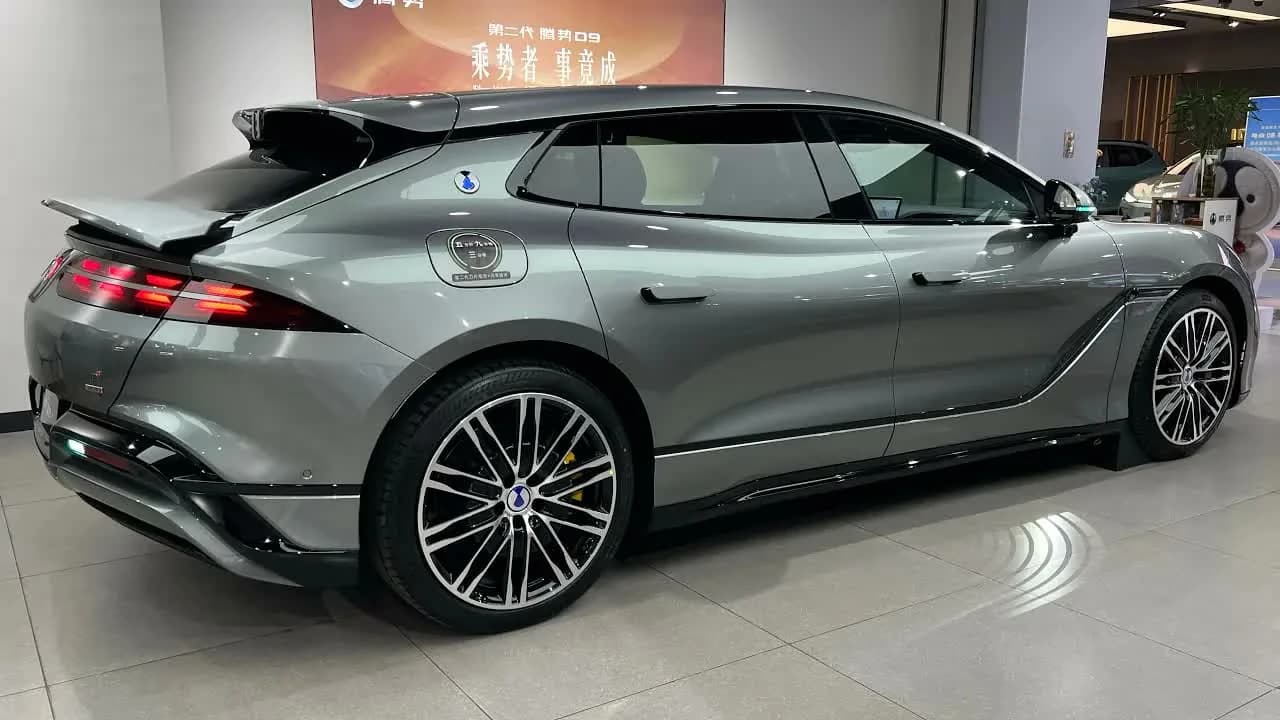
The 2026 Denza Z9 GT PHEV is the plug-in hybrid sibling to the BEV shooting brake we covered earlier this week — same body, same e³ tri-motor AWD platform, but with a 2.0T petrol generator instead of the BEV variant’s pure-electric long-range battery. Following the March 5, 2026 refresh, the PHEV variant nearly doubled both its battery (38.5 → 63.82 kWh BYD Blade LFP) and its EV-only range (201 → 401 km CLTC), with combined CLTC range climbing to 1,301 km via the petrol tank. In China the PHEV is sold in two trims: ¥309,800 ($45,500) for the entry trim and ¥339,800 ($49,900) for the flagship trim. The reviewer’s walkaround unit features burgundy/wine-red Nappa leather interior, the 17.3-inch central display with English UI confirmed, and BYD’s Megawatt Flash Charge technology.
Performance & Specs
The Z9 GT PHEV uses BYD’s e³ tri-motor platform with DM 5.0 control stack: a 2.0T turbocharged four-cylinder engine producing 152 kW (204 hp), paired with a front motor + dual rear motors for a combined 640 kW (858 hp) total system output. The shooting brake accelerates from 0-100 km/h in 3.6 seconds with a 230 km/h electronically governed top speed. The 63.82 kWh Blade LFP pack delivers 401 km of EV-only CLTC range (up from 201 km on the prior model year). With the battery depleted, fuel consumption is quoted at 6.2 L/100 km, and combined CLTC range reaches 1,301 km.

| POWERTRAIN TYPE | PHEV — tri-motor AWD (e³ platform, DM 5.0) |
|---|---|
| SYSTEM POWER | 858 hp (640 kW) |
| 0-100 KM/H | 3.6 s |
| TOP SPEED | 230 km/h |
| BATTERY | 63.82 kWh BYD Blade LFP |
| EV-ONLY RANGE | 401 km (CLTC) |
| COMBINED RANGE | 1,301 km (CLTC) |
| FUEL ECONOMY | 6.2 L/100 km (battery depleted) |
| ENGINE | 2.0T 4-cylinder, 152 kW / 204 hp |
Dimensions & Practicality

| Length | 5,195 mm |
|---|---|
| Width | 1,990 mm |
| Height | 1,500 mm |
| Wheelbase | 3,125 mm |
The Z9 GT PHEV shares the same shooting-brake body as the BEV sibling: 5,195 mm long on a 3,125 mm wheelbase, with a low 1,500 mm overall height. The shooting-brake design is specifically optimized to make the rear cargo bay more practical than a traditional 4-door sedan equivalent. Unlike the BEV sibling, the PHEV variant has no front frunk — the 2.0T engine occupies that space. 21-inch turbine alloys with staggered tire setup (255/40 R21 front + 275/40 R21 rear) are standard, with yellow Brembo calipers on the reviewer’s walkaround unit. The reviewer notes the PHEV variant has the same active suspension hardware as the BEV but tuned slightly differently for the heavier configuration.
| LENGTH | 5,195 mm |
|---|---|
| WIDTH | 1,990 mm |
| HEIGHT | 1,500 mm |
| WHEELBASE | 3,125 mm |
| FRUNK | None (2.0T engine occupies front) |
| WHEELS / TIRES | 21″ / 255/40 R21 front + 275/40 R21 rear |
| BRAKES (REVIEWER UNIT) | Brembo perforated rotors |
| SUSPENSION | DiSus dual-chamber air with CDC variable dampers (standard) |
Charging & Battery
The Z9 GT PHEV’s 63.82 kWh Blade LFP pack supports BYD’s Megawatt Flash Charge technology, a major upgrade for the plug-in hybrid. Flash Charging works at compatible Flash Charge stations, which are still being rolled out across major Chinese cities. The petrol engine extends combined CLTC range to 1,301 km.
| BATTERY | 63.82 kWh BYD Blade LFP |
|---|---|
| DC FAST CHARGING | Megawatt Flash Charging (compatible stations) |
Design & Interior
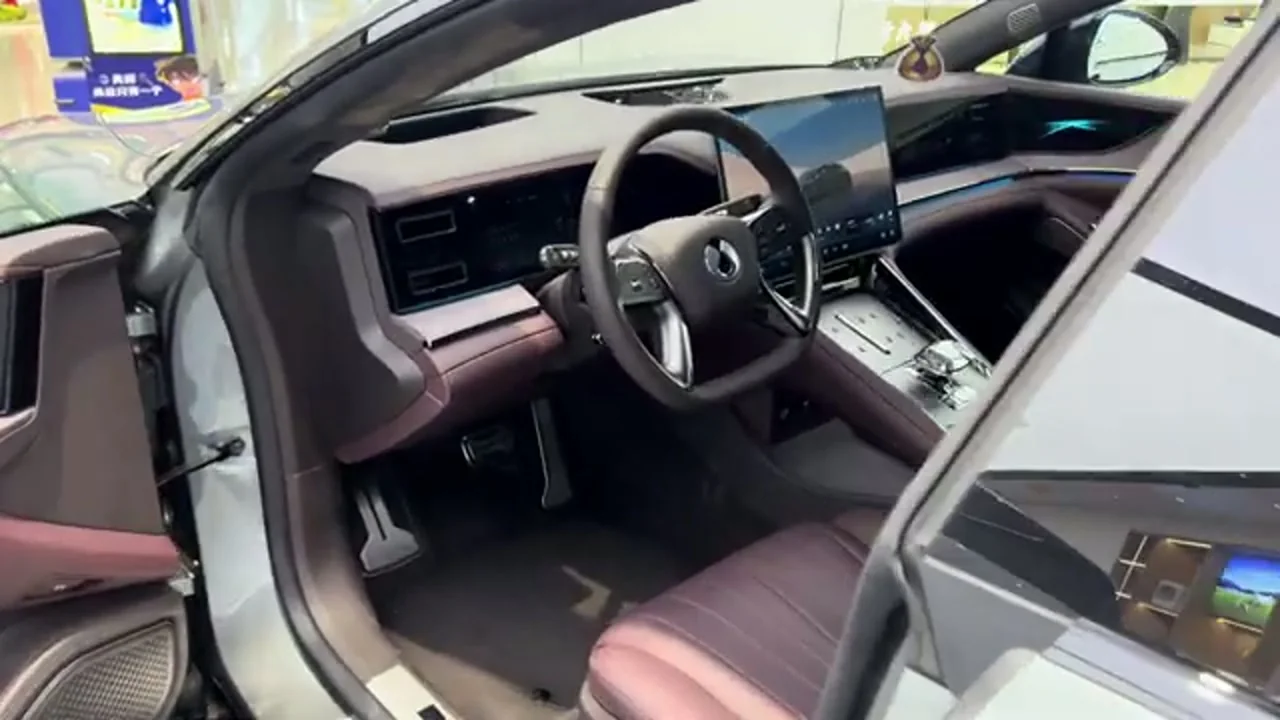
The Z9 GT PHEV exterior is essentially identical to the BEV sibling: a 5,195 mm shooting-brake silhouette with active rear spoiler, full-width connected LED tail-light bar with central Denza diamond emblem, frameless side windows, and a sloping greenhouse that visually echoes Porsche Taycan Sport Turismo. The reviewer’s walkaround unit is finished in granite grey with 21-inch turbine-style alloys and yellow Brembo brake calipers visible. Inside, the cabin features a burgundy/wine-red Nappa leather + brown wood-grain two-tone treatment on the reviewer’s walkaround unit (the reviewer notes “the interface is in Chinese but soon switching to English with a single tap” on the central touchscreen). The dashboard houses the 17.3-inch central touchscreen plus dual 13.2-inch 2.5K displays for the driver instrument cluster and front passenger entertainment screen, with an integrated AR-HUD spanning the windshield. The reviewer specifically confirms 360-degree rotation parking maneuver capability via the rear-wheel-steering hardware.
Technology & Features
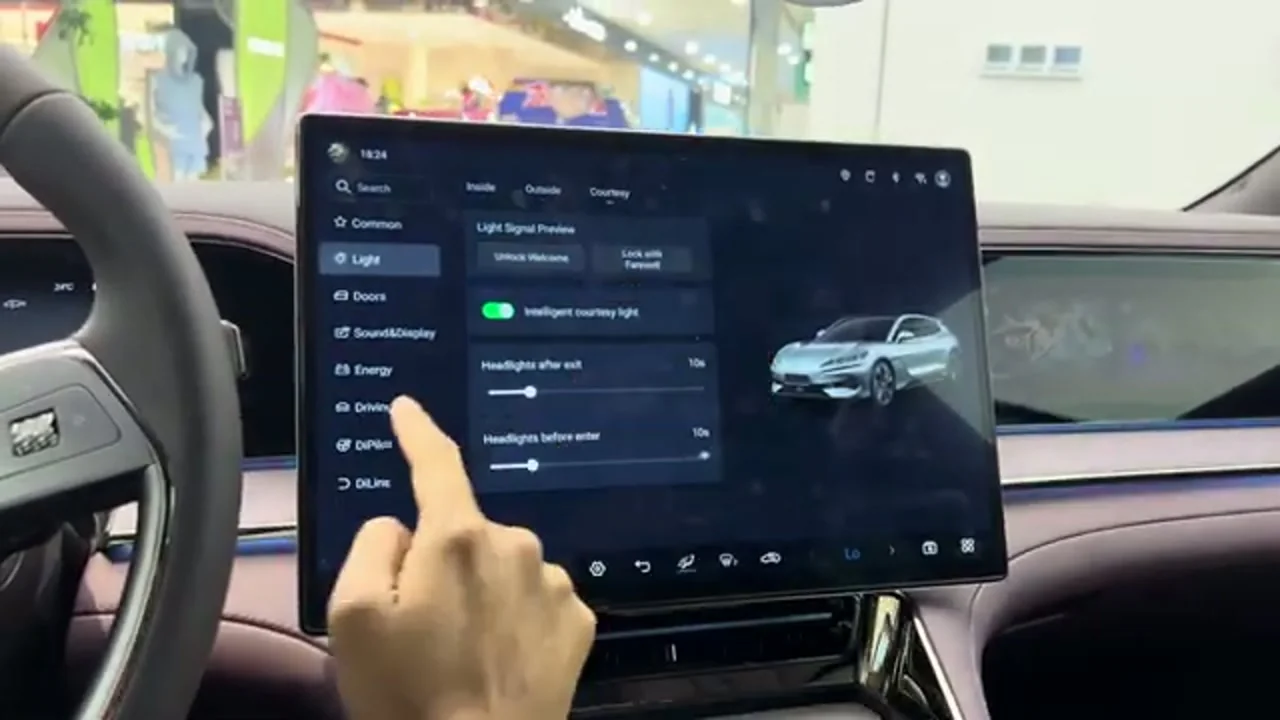
The Z9 GT PHEV runs BYD’s flagship DiLink cockpit supporting 10-screen linkage across the cabin: 17.3-inch central + 13.2-inch driver + 13.2-inch passenger + AR-HUD + rear-cabin displays. The audio system features 26 speakers on the Ultra trim with Devialet-tuned premium audio. Wireless charging is dual-pad up front (50W). The reviewer confirms full English-language UI available via a single language-toggle setting, plus Apple CarPlay and Android Auto wireless support. HUAWEI HiCar integration provides cross-device handoff for Huawei phone owners. The cockpit also supports drive-mode selection including dedicated Snow mode and Sand mode for varying terrain conditions.
Safety & ADAS
| ADAS LEVEL | L2+ (God’s Eye B 5.0 / DiPilot 300) |
|---|---|
| LiDAR | Roof-mounted LiDAR |
| ADAS FEATURES | Highway NOA, Urban NOA, AEB, ACC, LKA, BSM, RCTA, 360° camera, 360° rotation parking, valet park with route memory, 3-wheel emergency driving |
The Z9 GT PHEV ships with God’s Eye B 5.0 (DiPilot 300 generation 5.0) as its ADAS stack, with the LiDAR moved to a roof-mounted position at the top of the windshield. The reviewer specifically demos 360-degree rotation parking maneuver capability and the 3-wheel emergency driving feature — the latter allows the vehicle to continue driving stably even with one wheel inoperable, a unique safety capability inherited from BYD’s tri-motor architecture.
Available Versions
| VERSION | BATTERY | EV / COMBINED RANGE | 0-100 | PRICE | KEY DIFFERENCES |
|---|---|---|---|---|---|
| Z9 GT PHEV Entry | 63.82 kWh | 401 / 1,301 km | 3.6 s | ¥309,800 (~$45,500) | Entry PHEV trim; dual-chamber air suspension, CDC dampers and rear-wheel steering standard |
| Z9 GT PHEV Flagship | 63.82 kWh | 401 / 1,301 km | 3.6 s | ¥339,800 (~$49,900) | Top PHEV trim |
Pricing & Availability
The 2026 Denza Z9 GT PHEV refresh launched in China on March 5, 2026. The PHEV is offered in two trims: ¥309,800 ($45,500) and ¥339,800 ($49,900). The BEV variant of the same nameplate (covered separately by freshmotors on 2026-05-15) starts at ¥269,800 ($39,600) and extends to ¥369,800 ($54,300). Denza has also begun launching the Z9 GT in Europe.
How It Compares
The Z9 GT PHEV occupies a unique slot in the global premium shooting-brake market: 858 hp tri-motor PHEV performance at roughly 25% of the price of a Porsche Panamera Turbo S E-Hybrid Sport Turismo, with substantially more EV-only range (401 km vs 88 km) and the petrol-engine flexibility the BEV sibling lacks. Within BYD’s own portfolio, the Z9 GT PHEV bridges the gap between the BEV sibling ($39,600 entry, 1,036 km BEV CLTC) and the more luxurious Denza N9 SUV PHEV ($54,200+ entry, 912 hp tri-motor). The pending Xiaomi SU7 Touring (BEV-only shooting brake) is the most direct future rival but isn’t yet on sale and will lack PHEV petrol-engine flexibility. For buyers wanting tri-motor shooting-brake performance + 401 km daily-EV mode + petrol backup for road trips at sub-$50k, the Z9 GT PHEV has no current direct competitor.
- 858 hp tri-motor AWD with 3.6 s 0-100 — supercar acceleration in a shooting brake
- EV-only range doubled to 401 km CLTC vs prior PHEV’s 201 km
- Megawatt Flash Charge support on a plug-in hybrid
- Rear-wheel steering + standard dual-chamber air suspension with CDC dampers + roof LiDAR
- 26-speaker audio + AR-HUD + 10-screen linkage
- $45,500 entry undercuts Porsche Panamera Turbo S E-Hybrid by ~75%
- No frunk — 2.0T engine occupies the front compartment
- Heavy tri-motor plug-in hybrid hardware — substantial mass affects real-world fuel/EV economy
- Megawatt Flash Charge stations are BYD-exclusive — limited coverage
- BEV sibling offers 1,036 km BEV CLTC vs PHEV’s 401 km EV-only — better for charging-rich markets
- Flagship PHEV trim costs about $4,400 more than the entry trim
- PHEV availability outside China is not yet confirmed
The 2026 Denza Z9 GT PHEV is the most aggressive value play in the global premium shooting-brake segment of 2026. The March 5 refresh nearly doubled both EV range (201 → 401 km) and battery capacity (38.5 → 63.82 kWh) while adding support for BYD’s Megawatt Flash Charge technology. At $45,500 entry the Z9 GT PHEV undercuts the Porsche Panamera Turbo S E-Hybrid Sport Turismo by approximately $175,000 while delivering more EV-only range, comparable 0-100 acceleration, and the only sub-$50k tri-motor PHEV shooting brake currently available globally. The compromises are the usual flagship tri-motor trade-offs (no frunk, heavy curb weight, limited export availability), exactly the price you pay for the segment-defining combination of performance + range + practicality. For Chinese first-tier-city buyers shopping the Denza Z9 GT BEV sibling, the PHEV variant should be the default consideration if your driving mix involves road trips beyond 400 km between charges; for buyers committed to BEV ownership, the BEV at $39,600 entry is the better-value pick.