

The Dongfeng Mage PHEV is a 4.69-metre plug-in hybrid SUV that pairs a 1.5-litre turbo petrol engine with a 17 kWh LFP battery, front-wheel drive and a combined system output of 220 kW (299 PS, about 295 hp). It is the export version of the Dongfeng Fengshen (Aeolus) L7 PHEV sold in China, and in 2026 it is rolling out to three markets that we can confirm: Spain, where it is on sale from EUR 31,990, Israel, where the importer Delek Motors launched it in July 2026 at NIS 149,900, and the Czech Republic, where the importer has announced it but has not yet published a price. Importers quote up to 81 km of electric range on the WLTP cycle and a total range of up to 1,200 km, with a long equipment list fitted to a single trim in Israel. The pitch is simple: a C-segment family SUV with strong output for its price, from a brand that is still new to European buyers.
Performance & Specs
The Mage PHEV combines a turbocharged 1.5-litre four-cylinder petrol engine with an electric motor and a four-speed dedicated hybrid transmission that drives the front wheels only. The Spanish launch material gives a combined output of 220 kW (299 PS, about 295 hp) and 620 Nm of torque. The Czech importer Plastonic lists the parts separately: the engine makes 110 kW (150 PS, about 148 hp) and 230 Nm, and the electric motor makes 88 kW (120 PS, about 118 hp) and 260 Nm. The two component figures (110 kW plus 88 kW) do not add up to 220 kW, and none of the sources we found explains the gap; the motor.es catalogue entry also lists a second, 50 kW electric unit. The 220 kW system figure is the one the Spanish press quotes, and the Israeli importer's site gives 299 hp, which matches 299 PS. The Israeli outlets auto.co.il and iCar break the 299 into 111 hp from the engine and 188 hp from the electric side, a split that does not match the Czech engine and motor ratings, so we treat the system output as the reliable number. A note on units: PS is the metric horsepower and is about 1.4 percent smaller than the imperial hp, so 299 PS works out at about 295 hp, the same as 220 kW multiplied by 1.341.
Acceleration from 0 to 100 km/h is listed at 10.6 seconds by carwow Spain and by the Israeli outlet auto.co.il, which is relaxed for 295 hp and a sign that the car is tuned for efficiency rather than speed. Official fuel economy is where the plug-in hybrid case shows: the WLTP weighted combined figure is 1.49 litres per 100 km with CO2 of 20 g/km in Europe, and between 4.8 and 5.3 litres per 100 km with a depleted battery, depending on the Spanish outlet. The Israeli importer lists 2.2 litres per 100 km combined and 18.9 km per litre (about 5.3 litres per 100 km) with a flat battery. In China the same platform is sold with a different tune: Chinese spec sheets for the Fengshen L7 PHEV quote 265 kW and 615 Nm of system output, which is more than the 220 kW given for the European and Israeli Mage. Italian catalogue listings (alvolante.it, automoto.it) also show a Mage L7 PHEV with 265 kW (360 PS) and 615 Nm at EUR 39,900, so the stronger tune appears to be sold in at least one European market too. We found no official explanation of which version is sold where, so check the exact power figure for your market.

| Powertrain | 1.5L turbo petrol PHEV, FWD, 4-speed DHT |
|---|---|
| Power | 220 kW (299 PS / 295 hp) system |
| Torque | 620 Nm system (Spain) |
| 0–100 km/h | 10.6 s |
| Battery | 17 kWh LFP |
| Range | 81 km electric (WLTP), up to 1,200 km total |
| POWERTRAIN TYPE | Plug-in hybrid (PHEV), 1.5L turbo petrol plus electric motor |
|---|---|
| HORSEPOWER | 220 kW (299 PS / 295 hp) system output |
| TORQUE | 620 Nm system (Spanish launch material) |
| ACCELERATION | 0-100 km/h in 10.6 s |
| DRIVETRAIN | FWD, 4-speed dedicated hybrid transmission |
| BATTERY | 17 kWh LFP |
| ELECTRIC RANGE | 81 km WLTP |
| COMBINED RANGE | Up to 1,200 km (over 1,000 km in Spanish wording) |
Dimensions & Practicality

| Length | 4,685 mm |
|---|---|
| Width | 1,900 mm |
| Height | 1,615 mm |
| Wheelbase | 2,775 mm |
| Boot | 525 L (1,846 L seats folded) |
The Mage PHEV is 4,685 mm long, 1,900 mm wide and 1,615 mm tall on a 2,775 mm wheelbase, which puts it in the compact-to-mid-size C-segment class. Seating is for five. The boot holds 525 litres with the rear seats up, and the Israeli importer lists 1,846 litres with the seats folded; Spanish outlets print 1,872 or 1,876 litres for the same figure, so the folded-seat volume depends on how it is measured. The boot has a power tailgate, and the press photos show a flat load floor once the rear bench is folded. Carwow Spain lists a kerb weight of 1,794 kg and the Israeli outlet auto.co.il lists 1,804 kg, so expect a car of about 1.8 tonnes, which is typical of a plug-in hybrid with a 17 kWh pack.
| LENGTH | 4,685 mm |
|---|---|
| WIDTH | 1,900 mm |
| HEIGHT | 1,615 mm |
| WHEELBASE | 2,775 mm |
| CARGO VOLUME | 525 L (1,846 L seats folded, Israeli importer; 1,872-1,876 L in Spanish outlets) |
| KERB WEIGHT | About 1,794-1,804 kg depending on source |
Charging & Battery
The battery is a 17 kWh lithium-iron-phosphate (LFP) pack, which the motor.es and carwow Spain specification pages describe as LFP. None of the sources states whether 17 kWh is gross or usable capacity, so treat it as the pack figure as quoted. On the WLTP cycle the importers in Spain and Israel and the Czech press quote 81 km of electric range; the Israeli importer's own website uses the same 81 km figure. Two Spanish sources (esdiario and carwow Spain) print 89 km instead, which none of them explains, and we use the 81 km value that the Israeli importer and several Spanish outlets agree on.
Charging is modest by design. The Spanish outlet esdiario, citing launch material, gives a maximum DC rate of 22 kW with 30 to 80 percent in 31 minutes; the Czech press and Queen of the Road in Israel repeat the 30-minute figure without a peak kW value. The arithmetic is consistent: the 50 percent window is about 8.5 kWh, which at 31 minutes implies an average of about 16 kW. One Israeli outlet, auto.co.il, prints 39 kW instead, and that figure is not matched by any other source. AC charging is 3.3 kW through a Type 2 socket, about 4.5 hours for a full charge according to carwow Spain and esdiario. The auto.co.il spec sheet lists 6.6 kW and 3.5 hours instead, which does not fit a 17 kWh pack, so we use the 3.3 kW that Queen of the Road, carwow Spain and esdiario agree on. The slow AC rate is the practical limit: for a typical day of 40 to 60 km, an overnight charge from a wallbox is enough, but a public charger will not shorten a stop much.
| BATTERY | 17 kWh LFP (gross or usable not stated) |
|---|---|
| AC CHARGING | 3.3 kW, about 4.5 h full charge |
| DC FAST CHARGING | Up to 22 kW (esdiario, citing Spanish launch material); auto.co.il prints 39 kW |
| DC 30-80% TIME | About 31 min |
| WLTP CONSUMPTION | 1.49 L/100 km weighted combined, CO2 20 g/km (EU); 2.2 L/100 km in Israel |

Design & Interior
The Mage looks more premium than its price suggests. The nose is smooth and closed, with a full-width light bar under a slim headlight pair, vertical air intakes with a light signature and a lower grille with horizontal slats. The roofline slopes gently, the Israeli press photos show a two-tone black roof and 19-inch alloy wheels, and the Israeli importer lists a sport spoiler and LED lighting as standard. The Czech press notes that the plug-in hybrid also gets a larger infotainment screen than the petrol Mage. Colour choice matters in Israel: the importer states that some paint colours cost an extra NIS 4,000.
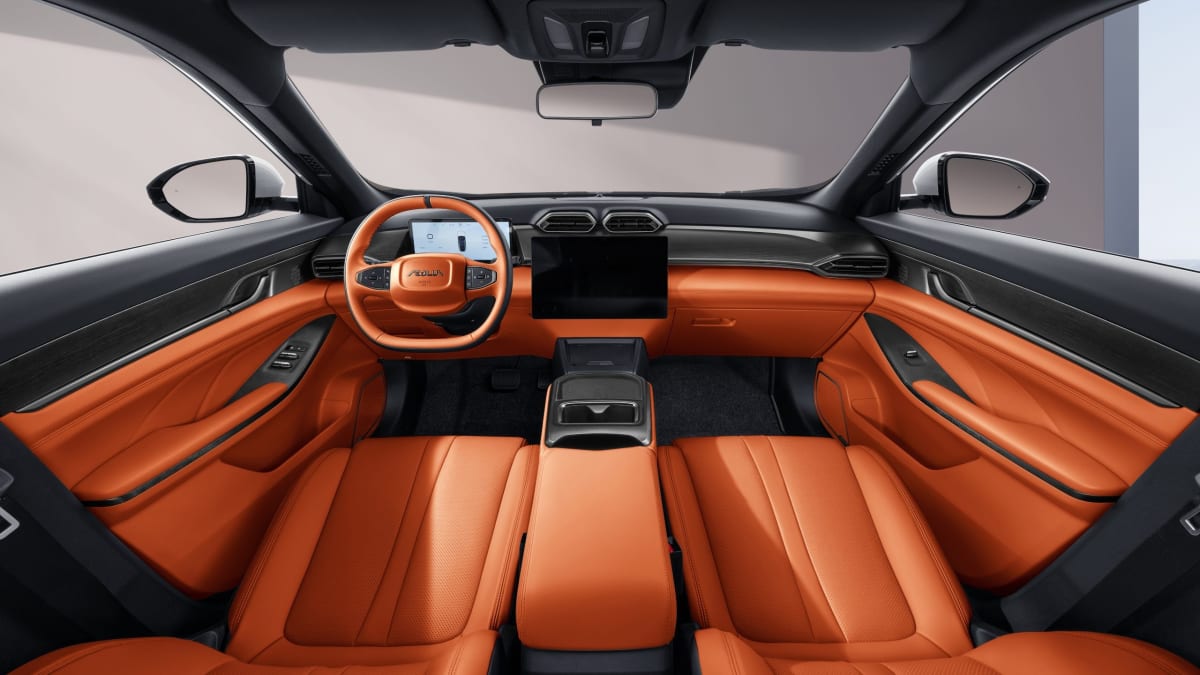
Inside, the cabin is built around a 14.6-inch central touchscreen and a 10.25-inch digital instrument cluster, with a flat-bottom steering wheel and a wood-effect trim strip across the dashboard. The press images show orange Eco-Leather sport seats, and the Israeli importer lists sport seats with Eco-Leather upholstery, a driver's seat with electric adjustment and memory, heated front seats, a panoramic opening roof with an electric blind, rear air vents and cabin air filtration. The steering-wheel hub in the press photos carries the Aeolus badge, the Chinese-market Fengshen brand name, which is a small reminder that the Mage is a rebadged export version.
Technology & Features
Wireless Apple CarPlay and Android Auto are standard, which matters because the Chinese-market infotainment will not be the main interface for European and Israeli drivers. The Israeli importer lists the 14.6-inch screen, the digital instrument cluster, wireless smartphone mirroring, a 540-degree camera view and a power tailgate on the standard specification, and a single equipment level means there are no option packs to decide on. In Spain the outlets we checked list LED intelligent headlights, adaptive cruise control, a blind-spot detector and a 540-degree camera as standard, and Autonocion adds the 14.6-inch screen, synthetic leather and panoramic roof; diariomotor appears to list some comfort items as options, so confirm the exact equipment with a dealer. A 7-year or 300,000 km vehicle warranty is mentioned for the Spanish launch by Autonocion and by the Portuguese outlet 4gnews, and the Spanish DGT classifies the Mage PHEV with the CERO environmental label, which gives access to low-emission zones.
Safety & ADAS
The Israeli importer's site lists autonomous emergency braking, lane departure warning and correction, adaptive cruise control with lane centring, traffic sign recognition, a driver fatigue warning, front and rear parking sensors, tyre pressure monitoring and six airbags as standard. The 540-degree camera system covers the blind spots around the car at low speed. A caveat applies to crash safety: Israeli outlets auto.co.il and iCar note that the Mage was not subjected to European crash testing at launch in July 2026, and we did not find a Euro NCAP result for the Mage PHEV in Spanish or Czech sources. Buyers who rank crash-test stars highly should check for a result before ordering.
| ADAS LEVEL | L2-type driver assistance (adaptive cruise with lane centring; level not stated by the importer) |
|---|---|
| ADAS FEATURES | AEB, ACC with lane centring, lane departure correction, traffic sign recognition, driver fatigue warning, 540° camera, front and rear parking sensors, tyre pressure monitoring, 6 airbags (Israeli specification) |
Available Versions
| VERSION | POWER | TORQUE | 0-100 | TOP SPEED | DRIVETRAIN | BATTERY | EV RANGE | COMBINED RANGE | PRICE | KEY DIFFERENCES |
|---|---|---|---|---|---|---|---|---|---|---|
| Mage PHEV 1.5 | 295 hp | 620 Nm | 10.6s | — | FWD | 17 kWh | 81 km | 1,200 km | EUR 31,990 | Single trim in Israel at NIS 149,900; Spain list price EUR 31,990, promotional from EUR 28,530 with financing |
Pricing & Availability
In Spain, Dongfeng lists the Mage PHEV at EUR 31,990 before incentives. Spanish outlets motor.es, diariomotor and motor16 report that with financing through the brand and the Plan Auto+ subsidy applied the price falls to EUR 28,530, while esdiario and carwow quote a launch cash price of EUR 28,740 (financing from EUR 195 a month). The carwow Spain specification page and the motor.es catalogue entry show a recommended price of EUR 34,990 for the single E1+ version, which does not match the launch coverage; we could not confirm which is current, so we use the EUR 31,990 list price that the launch coverage repeats. Carwow's launch story said the EUR 28,530 offer ran until 31 August 2026, and the September launch coverage quotes EUR 28,740. Reservations opened in July 2026 and carwow reports the official presentation at Dongfeng's Madrid event on 16 September 2026.
In Israel the importer is Delek Motors, which lists the Mage PHEV on its dedicated Dongfeng website at NIS 149,900 for a single, fully equipped version, with some colours costing NIS 4,000 more, plus a registration fee of about NIS 2,070 (auto.co.il lists NIS 2,076); the launch coverage from auto.co.il and Queen of the Road is dated 20 July 2026. In the Czech Republic the importer Plastonic announced in August 2026 that the plug-in hybrid will join the existing petrol Mage, which is sold from CZK 599,900 in a limited launch offer, but no price for the PHEV had been published as of October 2026. A Portuguese outlet, 4gnews, reported a pre-sale in Portugal in August 2026 at EUR 28,490 plus VAT under a launch campaign, which we could not confirm elsewhere. In China the car is the Dongfeng Fengshen L7 PHEV; Chinese outlets describe the Mage as its overseas version.
How It Compares
Two other Chinese plug-in hybrid SUVs from the Chery group make the closest in-house comparison, though neither is priced in euros, so the prices are from different markets and are shown as the local figures. The Chery Tiggo 7 Super Hybrid (2026 model year) and the Jaecoo J7 PHEV in its 2027 model-year, front-wheel-drive Track grade use an 18.3 to 18.4 kWh LFP battery, and both quote up to 1,200 km of total range. Chery publishes the Tiggo's parts (105 kW engine, 150 kW motor) rather than a system figure, while Australian outlets quote 205 kW (275 hp) for the Jaecoo, whose price was AU$43,990 drive-away before the MY27 update. On paper the Mage's 295 hp is 20 hp above that Jaecoo figure and its battery is slightly smaller at 17 kWh; its 81 km WLTP electric range is below the 90 km WLTP quoted for the Jaecoo, and the Tiggo 7's 93 km is an NEDC figure, which flatters it and cannot be compared directly with a WLTP value. All three make a similar total-range claim, so the deciding factors are price, local dealer support and warranty rather than the spec sheet; the Mage is a EUR 31,990 car in Spain and a NIS 149,900 car in Israel.
- Strong output for the price: 220 kW (295 hp) system power, from EUR 31,990 in Spain and NIS 149,900 in Israel
- Useful electric range for commuting: 81 km WLTP, with up to 1,200 km total range and a 525 L boot
- Rich standard equipment in Israel: 14.6-inch screen, panoramic roof, 540-degree camera, adaptive cruise control and 6 airbags on a single trim
- Slow charging: 30-80% on DC takes about 31 minutes, and AC is 3.3 kW with about 4.5 hours for a full charge
- No European crash-test result found at launch, and the 10.6 s 0-100 km/h time is unhurried for 295 hp
The Mage PHEV is a sensible, good-value family plug-in hybrid: 220 kW (295 hp), 81 km of WLTP electric range, a 525-litre boot and a long equipment list from EUR 31,990 in Spain or NIS 149,900 in Israel. Its weak points are the slow charging, the unhurried acceleration and the missing crash-test result, and the spec sheets differ between markets enough that buyers should check the exact figures with their local dealer. For commuters who can charge at home and want one car for long trips as well, it is a competitively priced option; buyers who care about brand strength and resale value will want to wait and see how Dongfeng's European dealer network develops.