
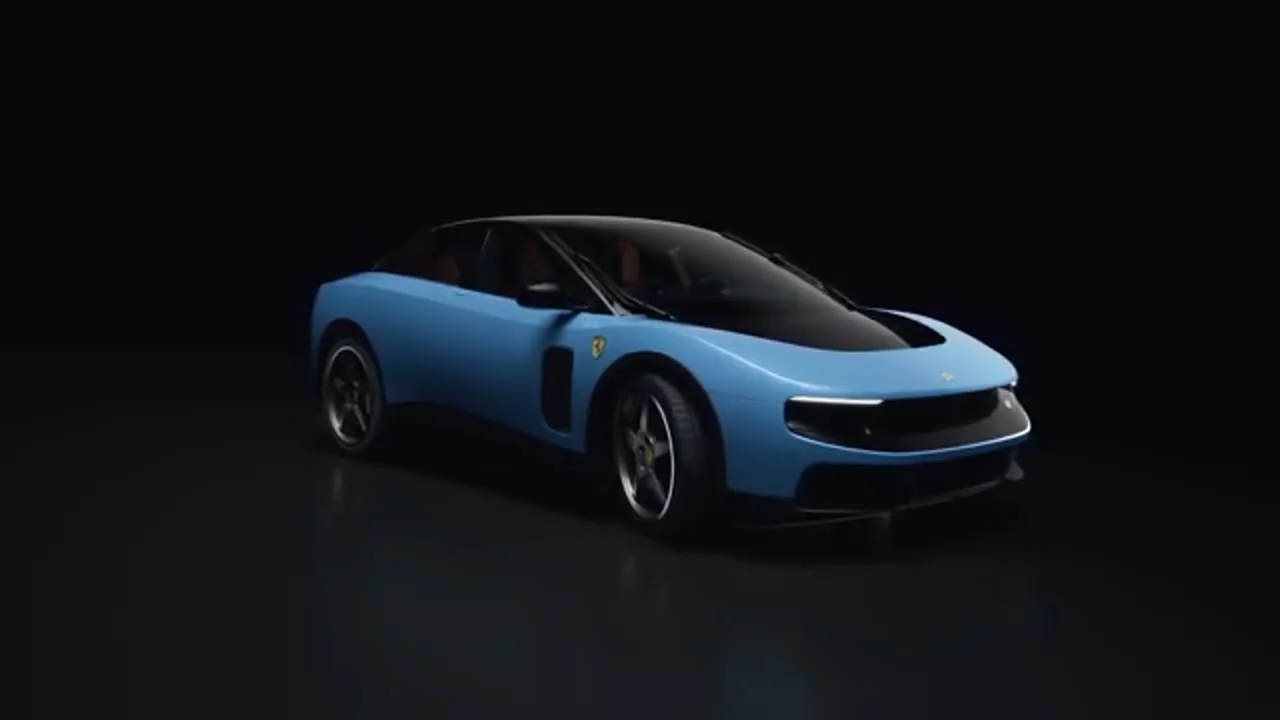
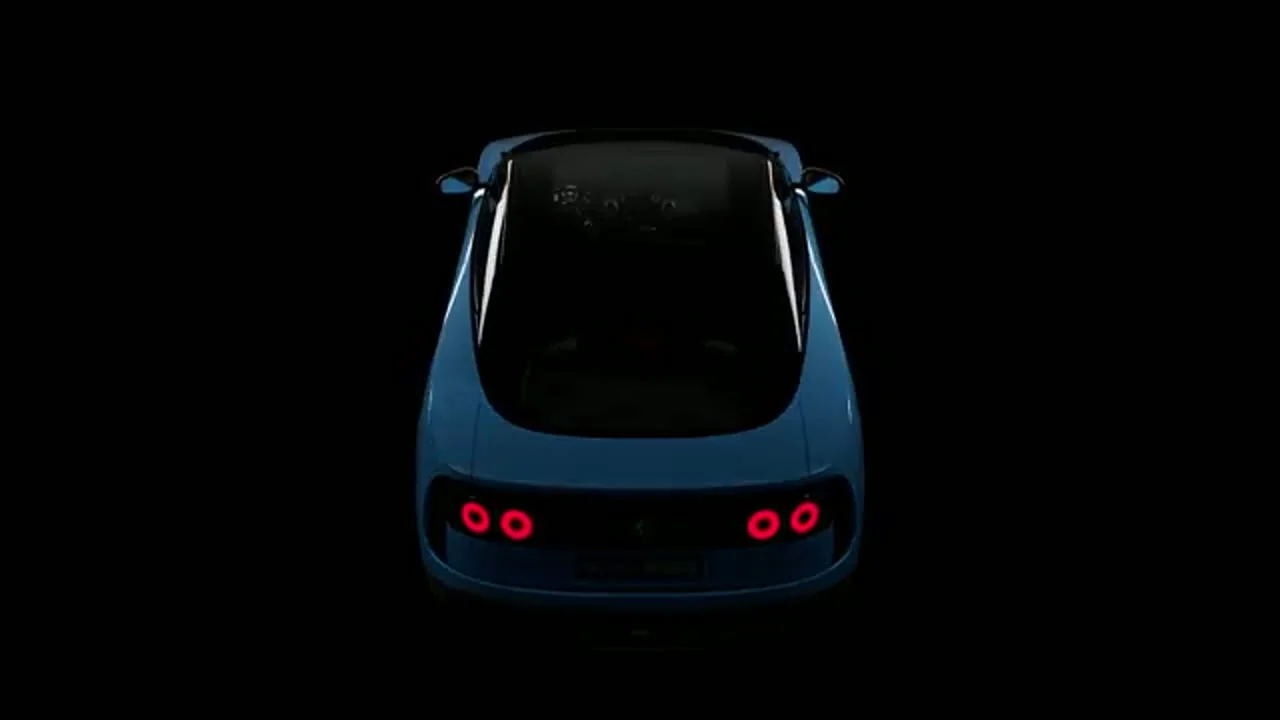
Ferrari unveiled the Luce on May 25, 2026 in Rome — the marque’s first fully electric production car and the most controversial product Maranello has ever launched. Five Luce prototypes were illuminated in a coordinated light show in front of 200+ journalists from around the world, marking the boldest brand pivot in Ferrari’s 79-year history. The Luce is a four-door, five-seat liftback (the first five-seat Ferrari ever) developed jointly with Jony Ive’s LoveFrom studio and Marc Newson, in a five-year collaboration that began before Ive’s formal exit from Apple. It packs four in-wheel electric motors producing a combined 1,050 PS (1,036 hp), a 122 kWh battery on an 800V architecture, and a 0.254 drag coefficient — one of the lowest of any production vehicle. The price: €550,000 ($640,000 / £440,000) — placing it directly between the Rolls-Royce Spectre and the established Chinese mega-power EV sedans. Ferrari stock fell after the reveal as fans split on the design and the brand strategy.
Powertrain & Performance
The Luce uses a quad-motor architecture with one electric motor at each wheel: two front motors at 105 kW each and two rear motors at 310 kW each, for a combined peak of 1,050 PS / 1,036 hp / 772 kW and 990 Nm (730 lb-ft) of torque. Drive splits between rear-wheel drive (Range mode) and full quad-motor torque-vectored AWD (everything above Range). 0-100 km/h is rated at 2.5 seconds with launch control engaged, and top speed is 310 km/h (193 mph). Despite the in-wheel motor layout (which trades some unsprung-mass refinement for packaging and torque-vector precision), Ferrari engineers say the Luce is balanced 48/52 front/rear with active anti-roll on all four corners. Curb weight is 2,260 kg (4,982 lb) — heavy by sports car standards but light for a five-seat 122 kWh BEV.

| Motor layout | 4× in-wheel (2F + 2R) |
|---|---|
| Front motors | 2 × 10⁵ kW |
| Rear motors | 2 × 310 kW |
| Peak power | 1,050 PS (772 kW) |
| Torque | 990 Nm |
| Architecture | 800V |
| Drive | Torque-vectored AWD |
| POWERTRAIN | Quad-motor BEV AWD (4 in-wheel motors) |
|---|---|
| PEAK POWER | 1,050 PS (1,036 hp / 772 kW) |
| TORQUE | 990 Nm (730 lb-ft) |
| 0-100 KM/H | 2.5 s (with launch control) |
| TOP SPEED | 310 km/h (193 mph) |
| WLTP RANGE | ~530 km (329 mi EPA-est) |
| BATTERY | 122 kWh / 800V architecture |
| DC FAST CHARGING | 350 kW peak / 10-80% in ~18 min |
| DRAG COEFFICIENT | 0.254 Cd |
Drive Modes & Torque Shift Engagement
Ferrari has built the Luce around four core driving modes that progressively unlock the powertrain. Range mode drops the Luce into pure rear-wheel drive, caps output at 425 PS, and limits top speed to 260 km/h — targeting maximum WLTP efficiency. Tour mode engages permanent AWD with 625 PS and standard road-going calibration. Performance mode ratchets output to 986 PS with full torque vectoring and aggressive throttle mapping. Only with launch control engaged does the Luce unlock its full 1,050 PS — a safeguard inherited from the SF90 Stradale playbook.
The most interesting driver-engagement technology is Torque Shift Engagement (TSE): a simulated gear-shift system operated through steering-wheel paddles. TSE gives drivers five discrete levels of acceleration and deceleration “steps” that can be triggered mid-corner to shift the car’s yaw attitude, replacing the visceral feedback of an ICE downshift in a way that’s purposely physical rather than touchscreen-mediated. Combined with two manettinos (one for vehicle dynamics, one for powertrain) and regenerative-braking paddles, the Luce keeps the driver’s hands on physical controls at all times.
The Jony Ive & Marc Newson Interior
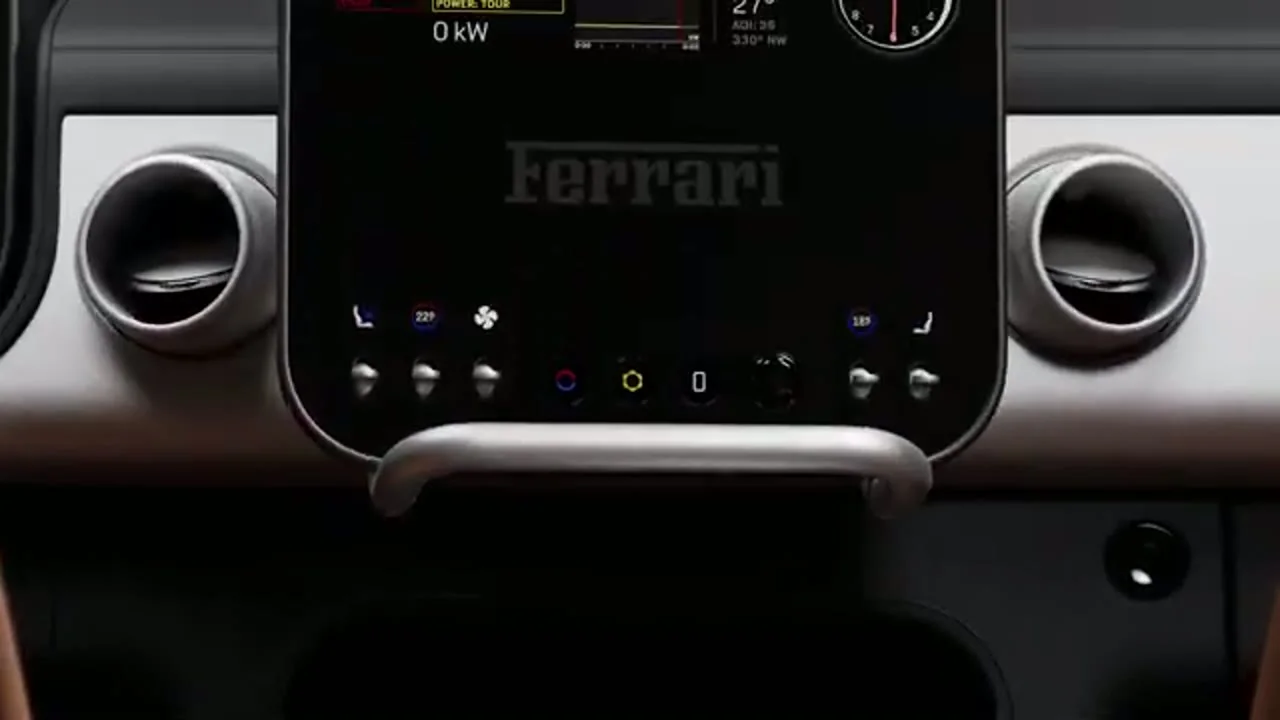
This is where the Luce divides opinion the most. Ferrari and LoveFrom spent five years resolving what an EV cabin could be if the designers refused the dominant industry convention that “EVs must have giant touchscreens.” The result: no central touchscreen at all. Climate, audio, drive-mode, lighting, and seat controls are routed through mechanical buttons, anodised aluminum dials, and glass-faced switches — tactile interfaces that, in Ive’s words, “viscerally and physically connect” the driver to the car.
The headline interior technology is the dual-layer OLED instrument cluster — two Samsung OLED panels stacked one above the other with real, physical needles sandwiched between them. The display thus combines digital flexibility (programmable graphics, configurable gauges) with the analog depth of a real mechanical pointer moving in three-dimensional space. Ferrari claims this is a world-first in production automotive. The steering wheel is 100% recycled aluminum with a thin rim and real, physical buttons throughout — not the touch-sensitive pads found on most modern Ferraris. The shifter, vents, and paddles all snap with deliberate mechanical detents.

| Length | 5,026 mm |
|---|---|
| Width | 1,999 mm |
| Height | 1,544 mm |
| Wheelbase | 2,961 mm |
| Curb weight | 2,260 kg |
Sound: Real Motor Amplification, Not Fake V12
Ferrari has explicitly rejected the route taken by Porsche, Hyundai, and other EV makers who synthesise fake combustion-engine sounds. Instead, the Luce uses rear-axle sensors that capture actual mechanical vibrations from the drivetrain — motors, gears, rotating components — and processes those raw signals through what Ferrari compares to a guitar amplifier. The amplified signal is then played through a 21-speaker, 3,000W in-cabin system and external speakers tuned for each drive mode. The result: a genuine acoustic signature derived from the powertrain itself, not a generated waveform. The pedestrian-warning external speakers and the cabin system run from the same audio processor, so what you hear inside is harmonically related to what you broadcast outside.
Charging, Battery & Range
The 122 kWh battery is one of the largest in any current production EV (only the YangWang U7’s 150 kWh Blade 2.0 and Lucid Gravity’s 123 kWh are bigger). Ferrari has not officially disclosed cell chemistry beyond that it’s a high-energy NMC chemistry with proprietary cooling. The 800V architecture supports 350 kW DC fast charging, with 10-80% in approximately 18 minutes at a CCS2-spec station — competitive but well behind the 600 kW Mercedes-AMG GT 4-Door achieves and the Xiaomi SU7 Ultra’s 5.2C / 11-minute time. AC charging tops out at 22 kW. WLTP range is around 530 km (Ferrari’s own claim is “more than 530 km”), which translates to roughly 329 miles on EPA cycles — impressive for the weight and quad-motor draw but at the lower end of the segment.
| LENGTH | 5,026 mm (197.9 in) |
|---|---|
| WIDTH | 1,999 mm (78.7 in) |
| HEIGHT | 1,544 mm (60.8 in) |
| WHEELBASE | 2,961 mm (116.6 in) |
| CURB WEIGHT | 2,260 kg (4,982 lb) |
| SEATING | 5 (first 5-seat Ferrari) |
| BODY STYLE | 4-door liftback |
| PRODUCTION | Maranello, Italy |
Pricing & Deliveries
The Luce starts at €550,000 in Europe / £440,000 in the UK / approximately $640,000 in the US. Orders are open now, with first deliveries scheduled for late 2026 in Italy and early 2027 elsewhere. Ferrari has not announced a production volume cap, but historical context suggests the Luce will not be production-restricted in the traditional Ferrari sense — the company expects to ship in mid-four-digit annual volumes to grow EV revenue, a departure from limited-run pricing pressure on cars like the Daytona SP3 or LaFerrari.
How It Compares
Verdict
- Genuinely historic — first Ferrari EV, first 5-seat Ferrari, first Jony Ive auto cabin
- Dual-layer Samsung OLED + mechanical needles is a world-first display tech
- Mechanical-button cabin philosophy is refreshingly contrarian in 2026
- 0.254 Cd drag coefficient is class-leading
- Real-motor sound amplification beats fake V12 simulation
- Quad in-wheel motor torque-vector precision
- $640,000 price — 2.7× Mercedes GT 63, 8.5× Xiaomi SU7 Ultra
- 1,050 PS is the lowest peak power in this segment (Chinese rivals start at 1,265 hp)
- 350 kW DC charging trails 500-600 kW peers
- ~530 km WLTP range is at segment floor — YangWang U7 nearly doubles it
- 0-100 in 2.5s is slower than every Chinese rival here
- Stock dropped after reveal; press & fan reception mixed-to-negative
The Ferrari Luce is the single most important Ferrari launch in two decades — not because of what it is technically (it isn’t segment-leading in any single spec), but because of what it represents: Maranello finally crossing the EV Rubicon, with a co-design partnership that no other automaker has been able to broker with Jony Ive. The dual-layer OLED, real-motor amplification, and physical-button cabin are genuinely brave engineering decisions. But they sit on top of a powertrain and battery package that the Chinese market would consider unremarkable at 1/8 the price. Buyers are paying for the Cavallino, the Ive design, and the historical moment — not for raw performance per dollar. If Ferrari can ship the Luce at the volumes it’s implying without diluting the brand, this becomes a foundational EV that defines the next 20 years of the marque. If it falls flat, it joins the FF and GTC4 Lusso in the “noble experiment” column. Either way, fascinating — and impossible to ignore.