

The GAC Aion UT is one of China's best-value small electric cars — a five-door supermini hatchback that undercuts almost everything while offering surprisingly big-car packaging. Priced from about ¥69,800 (~$9,600), it pairs up to 420 km of CLTC range with a roomy 2,750 mm wheelbase, a 440-litre boot and flat-folding "bed mode" seats. There's even a battery-swap version — the Aion UT Super — that refills in 99 seconds. With a 100 kW (134 hp) front motor, an English interface and right-hand-drive availability, it's already being exported across Asia. It's aimed squarely at the BYD Seagull and Geely Xingyuan, and on space-for-money it makes a strong case.
Performance & Specs
The Aion UT keeps things simple: a single 100 kW (134 hp) front-mounted motor drives the front wheels, good for a 150 km/h top speed. It's tuned for efficient, easy city driving rather than performance, with light, easy steering and instant low-speed response that suit its urban brief. Two battery sizes are offered on GAC's LFP "Magazine Battery 2.0": a 34.9 kWh pack for 330 km and a 44 kWh pack for the headline 420 km (CLTC). Separately, the battery-swap Aion UT Super uses a 54 kWh CATL Choco-SEB pack for around 500 km and a 99-second swap. Efficiency is strong at roughly 11.4 kWh/100 km, which is how such a small battery stretches to 420 km. For most buyers the 420 km version will be the sweet spot: enough range for a week of city commuting between charges, without paying for battery capacity a small car rarely needs.

| Powertrain | Single-motor, front-wheel drive (BEV) |
|---|---|
| Motor | 100 kW (134 hp) |
| Battery | 34.9 / 44 kWh Magazine LFP |
| EV range | 330 / 420 km (CLTC) |
| Top speed | 150 km/h |
| DC charging | 30–80% in ~24 min |
| POWERTRAIN | Single-motor, front-wheel drive (BEV) |
|---|---|
| MOTOR | 100 kW (134 hp) |
| BATTERY | 34.9 / 44 kWh Magazine LFP (54 kWh swap on UT Super) |
| EV RANGE | 330 / 420 km (CLTC) |
| TOP SPEED | 150 km/h |
| DC CHARGING | 30–80% in ~24 min |
Dimensions & Practicality

| Length | 4,270 mm |
|---|---|
| Width | 1,850 mm |
| Height | 1,575 mm |
| Wheelbase | 2,750 mm |
| Boot | 440 L |
| Kerb weight | 1,510–1,540 kg |
Packaging is the Aion UT's party trick. It's only 4,270 mm long, but a generous 2,750 mm wheelbase frees up genuinely roomy rear legroom and headroom for a car this cheap, plus a useful 440-litre boot. The flat-folding front seats create a "bed mode" for napping or loading long items, and a large panoramic sunroof brightens the cabin. It's a tall, boxy supermini that uses its footprint cleverly — closer to a small SUV inside than its price suggests. Kerb weight is a light 1,510–1,540 kg.
| LENGTH | 4,270 mm |
|---|---|
| WIDTH | 1,850 mm |
| HEIGHT | 1,575 mm |
| WHEELBASE | 2,750 mm |
| BOOT VOLUME | 440 L |
| SEATING | 5 seats |
Charging & Battery
The Aion UT uses GAC's own LFP Magazine Battery 2.0, offered in 34.9 kWh (330 km) and 44 kWh (420 km) sizes. DC fast charging runs the pack from 30–80% in about 24 minutes, with home AC charging overnight. The clever alternative is the Aion UT Super, which swaps its 54 kWh CATL Choco-SEB pack in around 99 seconds at a swap station — and can be bought with battery rental (from ~¥49,900) to slash the up-front price. For a car this affordable, having both fast-charge and battery-swap options is genuinely unusual. The swap route is particularly clever for buyers without home charging: you drive in, the pack is exchanged in under two minutes, and you drive out with a full battery — no waiting at a charger at all. Combined with the low running costs of an EV, it makes the Aion UT one of the cheapest cars to own and run in its class, whether you charge at home overnight or rely on public infrastructure.
| BATTERY | 34.9 / 44 kWh Magazine LFP |
|---|---|
| EV RANGE | 330 / 420 km (CLTC) |
| DC CHARGING | 30–80% in ~24 min |
| SWAP (UT SUPER) | 54 kWh pack, ~99-second swap |
Design & Interior
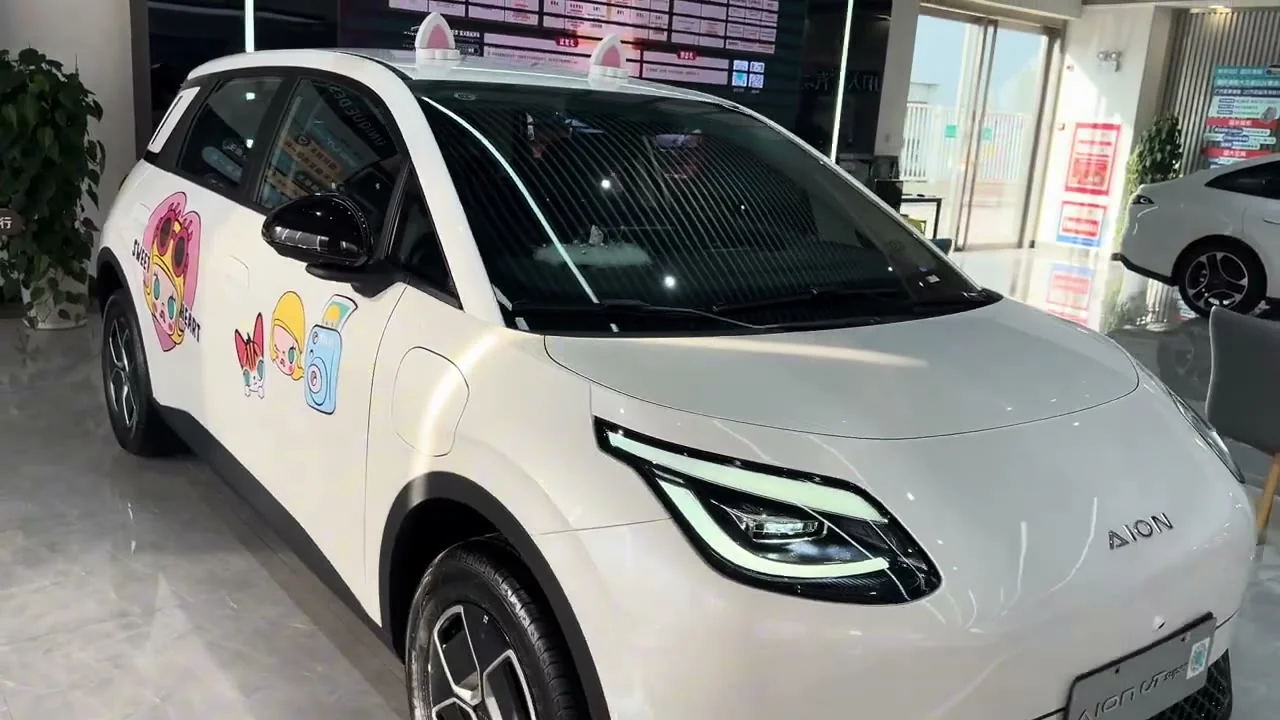
The Aion UT has a friendly, rounded supermini look with slim LED headlights, a clean nose and neat wraparound tail lights (the show car wore playful cartoon decals). Inside, it's simple but modern, built around a 14.6-inch central touchscreen and an 8.8-inch digital cluster, with a leather-wrapped wheel, physical climate switches and plenty of storage. Higher trims add a panoramic sunroof and heated seats. Materials are basic, as you'd expect at this price, but the layout is airy and practical, and crucially the system can be switched to English for export markets. The tall roofline and big glass area make it feel more spacious than its footprint suggests, and thoughtful touches — deep door bins, a flat floor and the fold-flat front seats — give it real everyday usability. It's the kind of honest, no-nonsense cabin that prioritises function over flash, which is exactly right for a car pitched at first-time EV buyers and busy city families.
Safety & ADAS
The top trim adds an L2 driver-assistance suite — adaptive cruise and lane keeping — which is rare in the sub-$12,000 class, along with a reversing camera and parking sensors. Lower trims keep the basics. The LFP Magazine battery brings the inherent thermal stability of that chemistry, and GAC quotes a solid passive-safety structure for the segment.
| ADAS LEVEL | L2 (top trim) |
|---|---|
| ADAS FEATURES | Adaptive cruise, lane keeping, reversing camera, parking sensors |

Available Versions
| VERSION | BATTERY | EV RANGE | POWER | PRICE |
|---|---|---|---|---|
| 320 Starlight | 34.9 kWh | 330 km | 100 kW (134 hp) | ~$9,600 (¥69,800) |
| 420 (mid) | 44 kWh | 420 km | 100 kW (134 hp) | ~$12,200 (¥82,800) |
| 420 (top, L2 ADAS) | 44 kWh | 420 km | 100 kW (134 hp) | ~$14,000 (¥101,800) |
| UT Super (swap) | 54 kWh swap | ~500 km | 100 kW (134 hp) | ~$12,630 (¥89,900) |
Pricing & Availability
The Aion UT lineup spans ¥69,800 to ¥101,800 (about $9,600 to $14,000) across five trims, launched in China in early 2025. The 330 km base starts at ~$9,600, the 420 km trims run from around ¥82,800 (~$12,200), and the battery-swap UT Super is ¥89,900 (~$12,630) with its pack (less with battery rental). GAC has already rolled the UT out across Asia — Thailand, Indonesia, Singapore, Australia and the Philippines — with right-hand-drive and English-language versions, making it one of the more export-focused budget EVs from China.
How It Compares
The Aion UT lands in the fiercely competitive Chinese budget-EV class. The BYD Seagull is cheaper and the benchmark, but smaller inside; the Geely Xingyuan (China's best-selling EV of 2025) matches it closely on range and price; and the Wuling Binguo S is another value pick. The Aion UT's edge is interior space and practicality for the money — that 2,750 mm wheelbase and 440 L boot — plus the rare battery-swap option on the UT Super. If you want the roomiest small EV around $10,000, it's a standout.
- Excellent space for the class — 2,750 mm wheelbase, 440 L boot, bed mode
- Up to 420 km CLTC range from a small, efficient LFP battery
- Battery-swap UT Super option (99-second swaps)
- Superb value from ~$9,600; export-ready with English UI and RHD
- Modest 100 kW power and 150 km/h top speed
- Basic cabin materials; L2 ADAS only on the top trim
- No AWD or performance option
- Fast-charging is decent, not rapid (24 min 30–80%)
The GAC Aion UT is one of the smartest small EVs money can buy. It won't win any drag races — 100 kW and 150 km/h are strictly city-and-suburb numbers — but that misses the point. For around $9,600 it delivers up to 420 km of range, small-SUV interior space thanks to its 2,750 mm wheelbase, a 440-litre boot, clever bed-mode seats and even an optional 99-second battery swap on the UT Super. Add an English interface and right-hand-drive availability, and it's a properly usable, export-ready budget EV. Against the BYD Seagull and Geely Xingyuan it's the practicality champion — if you want maximum space and range per dollar, the Aion UT is hard to beat.