
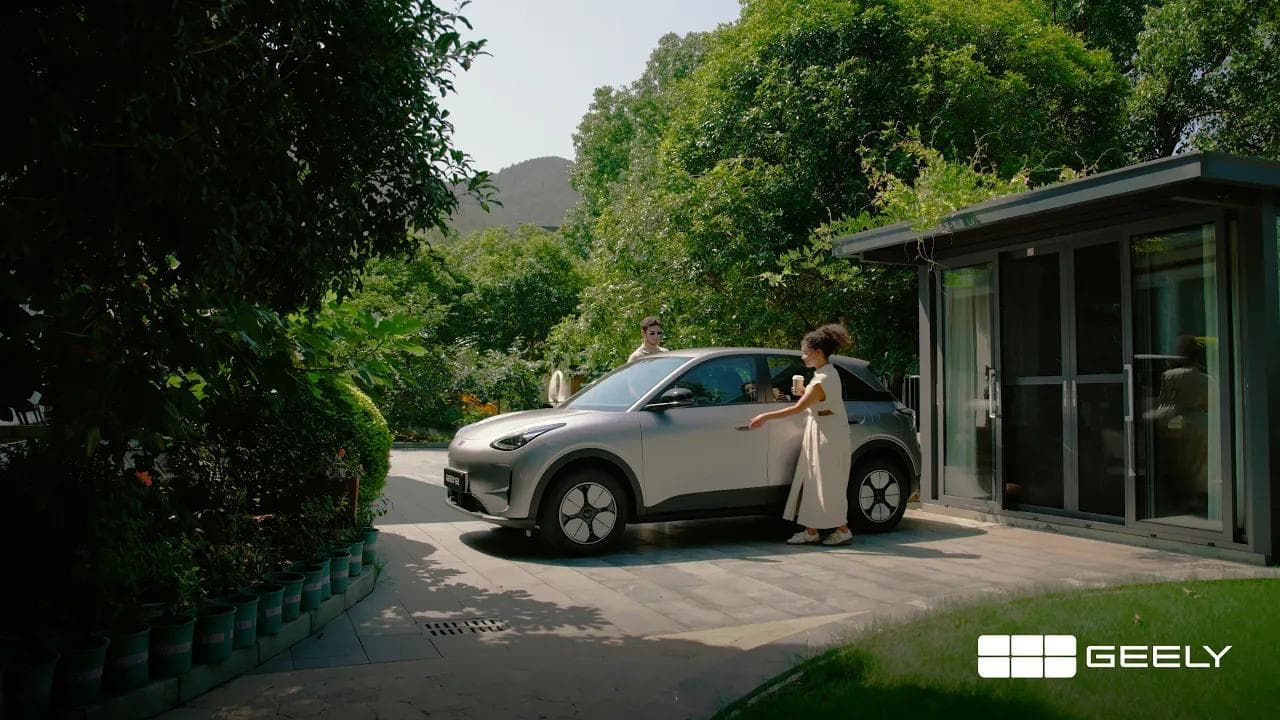
China's best-selling car of 2025 has started deliveries in Europe. Geely's compact hatchback -- known domestically as the Xingyuan and in several export markets as the EX2 -- launches across the continent under a third name, the E2, with Belgium the first market to open orders and first deliveries scheduled for September 2026. Two official teasers accompanied the rollout on September 9-10, 2026, and the pitch is simple: the same formula that sold over 465,000 units in China in 2025 alone, now with a European-spec battery lineup and WLTP-certified range figures.
One Car, Three Names
The badge-juggling is confusing but the car underneath is identical: Geely's small electric hatchback has sold as the Xingyuan in its home Chinese market, where it became the country's single best-selling car of any kind in 2025 with 465,775 units delivered, and as the EX2 in earlier export markets including Australia, Brazil, Belarus, Kazakhstan, and Thailand. For its European launch, Geely has settled on "E2" as the market name, with Belgium as the first country to take orders and a September 2026 delivery start. It's a compact five-door hatchback -- not the crossover-styled body some of the marketing imagery might suggest -- built specifically to compete on price against both combustion superminis and the wave of small Chinese EVs now reaching Europe.
Tech Highlights
- Two European battery options: a 35 kWh Pro entry pack rated at 252 km WLTP, and a 47 kWh pack on Max and Ultra trims rated at 345 km WLTP.
- 85 kW (114 hp) single rear motor across the European lineup, with a WLTP-tested 0-100 km/h of roughly 10.2 seconds.
- 70-liter front trunk in addition to a 375-liter rear cargo area (1,320 L with seats folded) -- unusually generous frunk space for a car this size.
- 14.6-inch center touchscreen with heated front seats standard even on the entry Pro trim, per Geely's published European feature list.
Design and Dimensions
At 4,135 mm long, 1,805 mm wide, and 1,580 mm tall on a 2,650 mm wheelbase, the E2 sits squarely in the supermini/small-hatchback class -- shorter than a Volkswagen ID.3 and closer in footprint to a Renault Zoe or a Peugeot e-208. Curb weight ranges from 1,295 kg on the entry Pro to 1,420 kg on the larger-battery Max and Ultra trims. The rounded, friendly front-end styling and chunky wheel arches seen in Geely's own teaser footage are a deliberate design signature the car carries across every market it's sold in, badge notwithstanding.

| Layout | Single motor, rear axle |
| Drive | Rear-wheel drive |
| Power | 85 kW (114 hp) |
| Torque | 150 Nm |

| Length | 4,135 mm (162.8 in) |
| Width | 1,805 mm (71.1 in) |
| Height | 1,580 mm (62.2 in) |
| Wheelbase | 2,650 mm (104.3 in) |
Performance and Specs
Every European-spec E2 uses the same 85 kW (114 hp), 150 Nm rear-mounted motor regardless of trim -- the difference between Pro and the Max/Ultra pair is purely battery size. The entry Pro's 35 kWh pack is WLTP-rated at 252 km, while stepping up to the 47 kWh pack on Max and Ultra lifts that to 345 km WLTP. That's noticeably more conservative than the CLTC-rated 310/410/460 km figures Geely quotes for the equivalent Chinese-market trims -- a reminder that WLTP and CLTC are different test cycles, not a sign of a lesser car. Charging is DC-capable at a claimed 1.66C rate, translating to roughly a 21-25 minute 30-80% top-up on the larger battery, plus 6.6 kW AC home charging.
| Spec | Pro | Max / Ultra |
|---|---|---|
| Battery | 35 kWh | 47 kWh |
| WLTP Range | 252 km | 345 km |
| Power | 85 kW (114 hp) | 85 kW (114 hp) |
| Torque | 150 Nm | 150 Nm |
| 0-100 km/h | ~10.2 sec | ~10.2 sec |
| Frunk | 70 L | 70 L |
| Cargo (seats up) | 375 L | 375 L |
Pricing and Availability
Belgium is the first European market live, with an introductory price of €19,490 (about $22,490) and a standard price of €21,490 (about $24,800) once the launch offer ends. Deliveries are scheduled to begin in September 2026. Geely hasn't yet detailed a full country-by-country European rollout schedule beyond Belgium, though the company's pattern in other regions -- entering one market first, then following with neighboring countries within months -- suggests wider European availability is likely to follow through late 2026 and into 2027. In China, where the car remains available as the Xingyuan, pricing spans 64,800 to 94,800 yuan (roughly $9,545-$13,960), underscoring just how much of the European price is import duties, homologation costs, and market positioning rather than production cost.
| Market | Name | Trim | Range | Price |
|---|---|---|---|---|
| China | Xingyuan | Entry | 310 km CLTC | ¥64,800 (~$9,545) |
| China | Xingyuan | Top | 460 km CLTC | ¥94,800 (~$13,960) |
| Europe (Belgium) | E2 | Pro | 252 km WLTP | €19,490 intro / €21,490 std |
| Europe (Belgium) | E2 | Max / Ultra | 345 km WLTP | from ~€21,490+ |
Why It Sold 465,000 Units
The Xingyuan's runaway success in China wasn't an accident of timing -- it hit a specific gap in the market that most manufacturers, Chinese or otherwise, had left open: a genuinely small, genuinely cheap EV that doesn't feel like a compliance-special afterthought. At under 65,000 yuan for the entry trim in China, it undercut most combustion-engine city cars on price while offering an EV's low running costs, a 14.6-inch touchscreen, heated seats, and a frunk larger than many cars two segments up. Geely also leaned hard on durability marketing domestically, publicizing what it called an "84,000 km, Six Extreme Tests" battery validation program that included saltwater immersion and arctic cold-testing -- a direct answer to the range-anxiety and battery-degradation concerns that still hold back EV adoption among budget-conscious buyers. Whether that same combination of price, features, and reassurance translates to European buyers used to a different competitive set (Dacia, Renault, and increasingly other Chinese brands like BYD's Dolphin Surf) is the real question the Belgium launch will start to answer.
What This Means for European Buyers
The E2's arrival adds to a growing list of budget Chinese EVs testing the European market at price points domestic manufacturers have largely abandoned in the EV space, where even the cheapest European-brand electric cars routinely start above €25,000. If Geely can hold close to its Belgium introductory pricing once the car reaches more countries, the E2 would undercut nearly everything in its class from an established manufacturer -- though buyers should weigh that against a thinner European service and charging-partner network than legacy brands offer, at least in these early markets. The safety and driver-assistance package for European-spec cars hasn't been fully detailed yet in English-language coverage, and Euro NCAP has not yet published a crash-test rating for the E2/EX2 as of this writing -- worth checking before ordering once that data becomes available.
How It Compares
BYD FCB Titanium 3
$41,318 | 320 hp | 550 km range
A much bigger, far more powerful SUV for roughly double the E2's European price -- illustrates just how far a budget stretches once you move up a size class within Chinese EV brands' own lineups.
Volkswagen ID.ERA 9X
$41,318 | 201 hp | 550 km range
A completely different scale of vehicle at a completely different price -- the honest comparison for the E2 is other budget European superminis like the Renault Zoe or Dacia Spring rather than anything in our own database at this size.
Pros and Cons
Pros
- Proven at massive scale -- over 465,000 sold in China in 2025 alone, not an unproven newcomer
- 70-liter frunk is unusually generous for a car this small and this cheap
- Heated front seats and a 14.6-inch touchscreen standard even on the entry Pro trim
- Undercuts most European-brand EVs by a wide margin even at the "standard" post-launch price
Cons
- Only Belgium has confirmed availability so far -- most of Europe has no confirmed launch date yet
- WLTP range (252-345 km) trails the CLTC-rated Chinese figures by a meaningful margin
- 114 hp and a ~10.2-second 0-100 km/h are adequate, not quick, for a car marketed partly on lifestyle appeal
- European price is more than double the equivalent Chinese sticker price once import costs are factored in
FAQs
Verdict
The Geely E2 isn't a new car -- it's China's best-selling model of 2025 finally reaching European driveways under yet another badge, with a WLTP-certified battery lineup and a genuinely competitive entry price for the segment. Belgium's September 2026 delivery start is the real news here, and if Geely follows its usual playbook, more European markets should follow within the next year. For budget-focused EV shoppers willing to buy a Chinese brand with limited local service history so far, it undercuts most alternatives by a wide margin.