
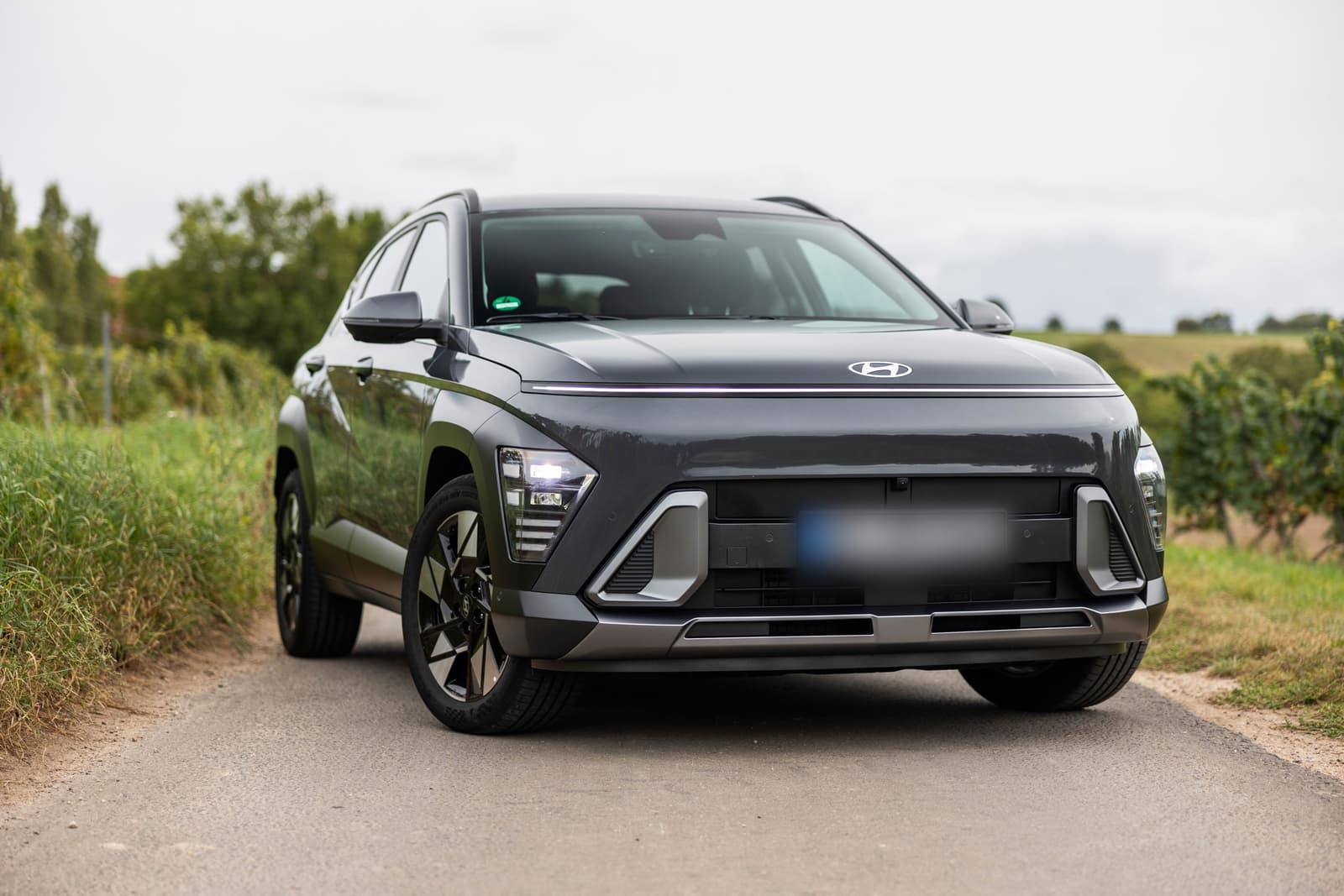
The Hyundai Kona Hybrid is the self-charging version of the second-generation Kona: a 1.6-litre petrol engine and a 32 kW electric motor with a tiny 1.32 kWh battery, driving the front wheels through a six-speed dual-clutch gearbox. It is a full hybrid (HEV), not a plug-in, so it never needs a charger, and Hyundai quotes a system output of 102 kW (138 PS, about 136 hp) and 265 Nm. Hyundai Germany lists it from EUR 33,450 in the Select trim, rising to EUR 40,450 for the N Line X, with official WLTP consumption of 4.6 to 4.8 L/100 km. In Israel the importer Kalmobil sells it from NIS 179,990 in the Pure trim, and Israeli coverage calls the output "138 hp", which is really the metric PS figure. We found no Kona Hybrid in the United States, where the 2026 Kona is sold with petrol engines. This article states which market each price and figure belongs to.
Performance & Specs
The Kona Hybrid uses Hyundai's 1.6 GDI petrol engine (1,580 cc, four cylinders), which makes 75 kW (102 PS, about 101 hp) and 141 Nm on its own. A 32 kW (44 PS) electric motor adds up to 170 Nm, and together they give a system output of 102 kW (138 PS / 136 hp) and 265 Nm, according to the Hyundai Germany technical data. Acceleration from 0 to 100 km/h takes 11.0 seconds and the top speed is 165 km/h, which makes it slower than every Kona in the German range except the 115 PS 1.0 T-GDI (11.9 seconds): the 1.6 T-GDI petrol with 132 kW (180 PS) needs 8.1 seconds. PS is the metric horsepower and is about 1.4 percent smaller than the imperial hp, so 138 PS converts to 136 hp rather than 138.
Israeli coverage (Queen of the Road, 28 May 2026) shows the same drivetrain, a 1.6-litre petrol engine plus a 32 kW motor, "138 horsepower" and the same six-speed dual-clutch gearbox, and the Israeli listings on auto.co.il and CarTube give 27 kgm (about 265 Nm), so the Israeli numbers match Germany. The "138 hp" label in Israeli listings is a PS figure. An Australian review dated 30 June 2026 quotes 104 kW and 265 Nm for the hybrid there; we use the German 102 kW figure, and show Australian figures separately where they differ.

| Powertrain | Full hybrid (HEV), not plug-in |
|---|---|
| Power | 102 kW (138 PS / 136 hp) system |
| Torque | 265 Nm system |
| 0–100 km/h | 11.0 s |
| Battery | 1.32 kWh lithium-ion (not rechargeable from a socket) |
| Fuel use | 4.6–4.8 L/100 km WLTP (Germany) |
| POWERTRAIN TYPE | Full hybrid (HEV), 1.6 GDI petrol plus electric motor, not plug-in |
|---|---|
| HORSEPOWER | 102 kW (138 PS / 136 hp) system; petrol engine 75 kW (102 PS), motor 32 kW (44 PS) |
| TORQUE | 265 Nm system (engine 141 Nm, motor 170 Nm) |
| ACCELERATION | 0-100 km/h in 11.0 s |
| TOP SPEED | 165 km/h |
| DRIVETRAIN | Front-wheel drive, six-speed dual-clutch |
| BATTERY | 1.32 kWh lithium-ion, charged by the engine and braking |
| FUEL USE | 4.6-4.8 L/100 km WLTP combined, 104-109 g/km CO2 (Germany) |
Dimensions & Practicality

| Length | 4,350 mm (N Line: 4,385 mm) |
|---|---|
| Width | 1,825 mm |
| Height | 1,570–1,585 mm |
| Wheelbase | 2,660 mm |
| Ground clearance | 160–170 mm |
The Kona is a small crossover. Hyundai Germany gives a length of 4,350 mm (4,385 mm for the N Line and N Line X), a width of 1,825 mm, a height of 1,570 to 1,585 mm depending on the wheels and a wheelbase of 2,660 mm. Ground clearance is 160 mm on the 16-inch wheels of the Select and 170 mm on 17- and 18-inch wheels. Israeli launch coverage gives the same length and wheelbase and a height of 1,570 mm (1,580 mm for the N Line), and says the boot holds up to 1,300 litres with the rear seats folded.
The German technical data list a boot of 466 litres with the seats up and 1,300 litres with them folded, and the ADAC catalogue gives the same 466 and 1,300 litres for the hybrid Trend. The Australian hybrid is quoted at 407 and 1,241 litres in a review that notes a space-saver spare wheel, and an Israeli listing (auto.co.il) gives 407 litres while CarTube lists 466 litres, so check the boot figure for the market and the spare-wheel option you are buying. The rear seat folds in a split, there is a roof load limit of 100 kg, and the Trend and N Line can add an electric tailgate for EUR 550, while the Prime and N Line X have it as standard.
| LENGTH | 4,350 mm (N Line / N Line X 4,385 mm) |
|---|---|
| WIDTH | 1,825 mm |
| HEIGHT | 1,570-1,585 mm (Israel 1,570 mm, N Line 1,580 mm) |
| WHEELBASE | 2,660 mm |
| CARGO VOLUME | 466 L (1,300 L seats folded), German list; Australia 407 L (1,241 L), Israel 407 L (auto.co.il; CarTube lists 466 L) |
| FUEL TANK | 38 L |
| ROOF LOAD | 100 kg |
Charging & Battery
There is nothing to plug in. The 1.32 kWh lithium-ion battery is far smaller than the packs in the plug-in hybrids and the electric Kona, and it is charged by the petrol engine and by regenerative braking. Hyundai says the system automatically chooses between engine and electric motor, and the instrument cluster shows an "EV READY" message when the system is ready, but Hyundai does not publish an electric-only range for it. Hyundai Germany gives an eight-year or 160,000 km warranty on the high-voltage battery for every hybrid and electric model, whichever comes first. Israeli cover is shorter on mileage: five years or 100,000 km for the vehicle and seven years or 150,000 km for the hybrid system, according to Israeli launch coverage.
Consumption is the point of the system. Hyundai Germany lists 4.8 to 4.6 L/100 km on the WLTP cycle (the exact value depends on the wheels and equipment) and 109 to 104 g/km of CO2, CO2 class C. The 21.3 km per litre quoted in Israel for the Pure equals 4.7 L/100 km, inside the German range, and Israeli test drives reported 17.7 to 18.1 km per litre in real driving, or roughly 5.5 to 5.7 L/100 km. On the 38-litre German tank that works out at roughly 670 to 690 km in real driving. The Australian review quotes a lower official 3.9 L/100 km, which comes from a different test procedure and should not be compared with the German WLTP figure.
| BATTERY | 1.32 kWh lithium-ion (not plug-in) |
|---|---|
| CHARGING | None; charged by engine and regenerative braking |
| FUEL TANK | 38 L |
| WLTP FUEL USE | 4.6-4.8 L/100 km (Germany); 21.3 km/L, equal to 4.7 L/100 km (Israel, Pure) |
| CO2 | 104-109 g/km WLTP, class C (Germany) |
| BATTERY WARRANTY | 8 years or 160,000 km (Germany) |
Design & Interior
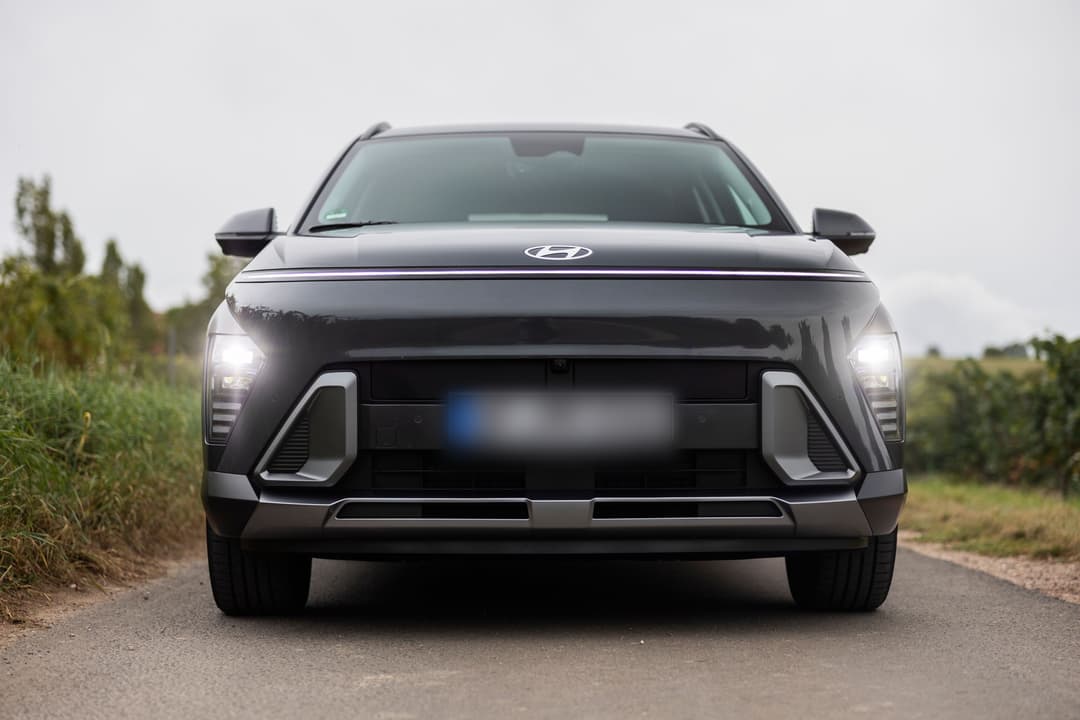
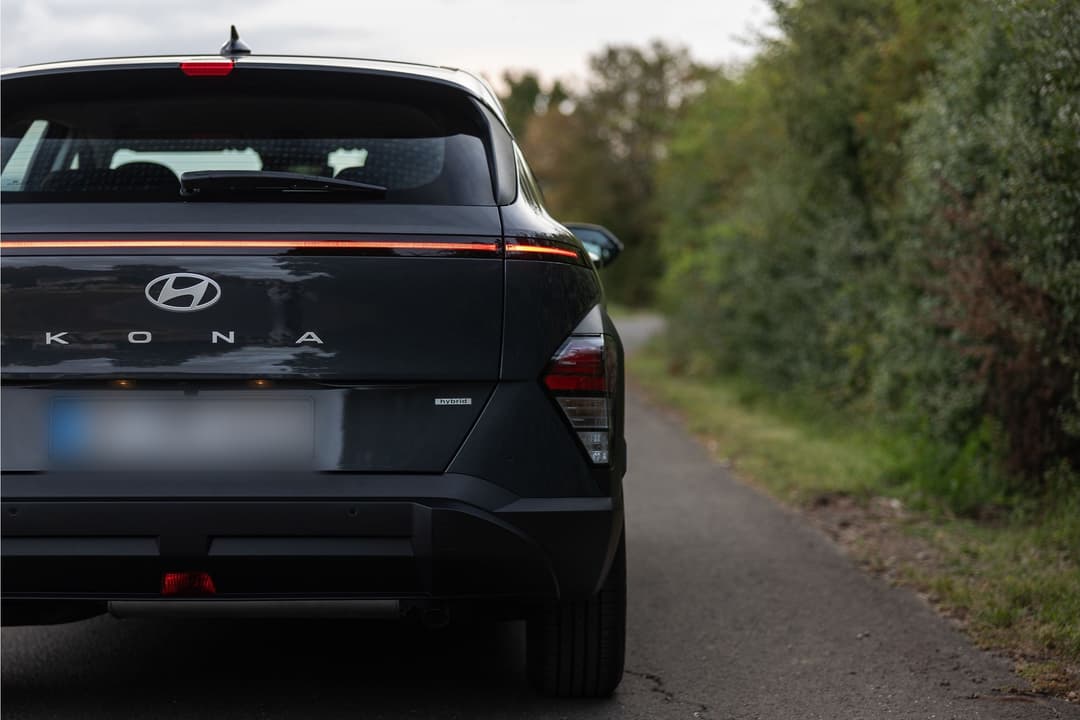
The second-generation Kona has a full-width LED light bar on the nose above vertical headlight clusters, and a matching strip across the tailgate above the Kona lettering. On the hybrid a small "hybrid" badge sits on the tailgate, beside the number plate, and the nose has air intakes below the light bar, not the closed face of the electric Kona. The Select rides on 16-inch alloy wheels, the Trend and Prime on 18-inch wheels and the N Line and N Line X on 18-inch wheels with the sportier N Line bumpers. Ultimate Red is offered only on the N Line and N Line X, and only for the hybrid, in Hyundai Germany's price list.
Inside there is a 12.3-inch touchscreen for navigation on every trim, physical climate buttons below it, and a lower console with a wireless phone charger from the Trend, USB-C sockets and a 12 V outlet. The Select has a rear camera and parking sensors but not the 12.3-inch digital cockpit, which arrives with the Trend together with multicolour ambient lighting, privacy glass, roof rails and a height-adjustable passenger seat; the hybrid Select already has two-zone climate control as standard. The Prime adds power seats, velour and leather upholstery, a 360-degree camera and the digital key, and the N Line X adds a BOSE sound system and Alcantara and leather seats with red accents.
Technology & Features
All Kona hybrids with the dual-clutch gearbox get navigation-based smart cruise control and Highway Driving Assist 1.5 in Germany. Hyundai's Bluelink connected services and over-the-air updates are standard, although both may carry a paid subscription, and the digital key needs a compatible phone, the myHyundai app and an active Bluelink subscription. The Israeli Pure adds a 360-degree camera and parking sensors in the 2026 equipment reshuffle, with the Ultimate adding a panoramic roof and power seats and the N-Line adding BOSE audio, a memory seat with relaxation function and heated front seats. The Select does not have the digital cockpit, so buyers who want it need the Trend or above.
Safety & ADAS
Israeli launch coverage lists seven airbags and a driver-assistance suite with lane-keeping assist, autonomous emergency braking, driver monitoring and adaptive cruise control. Hyundai Germany's list shows front, side, curtain and centre airbags on every trim, plus an electronic parking brake, multi-collision brake, hill-start assist and an eCall system as standard. Blind-spot assist with a monitor display, rear cross-traffic collision-avoidance assist, exit warning and rear parking assist with emergency braking arrive with the Prime and N Line X, or in a EUR 1,150 assistance package on the Trend and N Line, which also adds the 360-degree camera and side parking sensors.
| ADAS LEVEL | Driver-supervised assistance (no SAE level stated by Hyundai) |
|---|---|
| ADAS FEATURES | Navigation-based smart cruise control, Highway Driving Assist 1.5, multi-collision brake, hill-start assist, eCall; blind-spot, cross-traffic, exit warning and 360-degree camera standard from Prime (Germany), optional on Trend and N Line |
Available Versions
| VERSION | POWER | TORQUE | 0-100 | TOP SPEED | DRIVETRAIN | BATTERY | EV RANGE | COMBINED RANGE | PRICE | KEY DIFFERENCES |
|---|---|---|---|---|---|---|---|---|---|---|
| Select | 136 hp | 265 Nm | 11.0s | 165 km/h | FWD | 1.32 kWh | — | — | EUR 33,450 | 16-inch wheels, 12.3-inch navigation screen, parking sensors; Germany |
| Trend | 136 hp | 265 Nm | 11.0s | 165 km/h | FWD | 1.32 kWh | — | — | EUR 35,750 | 18-inch wheels, digital cockpit, heated seats and steering wheel, wireless charging |
| N Line | 136 hp | 265 Nm | 11.0s | 165 km/h | FWD | 1.32 kWh | — | — | EUR 37,250 | N Line bodywork and interior, 18-inch wheels, longer by 35 mm |
| Prime | 136 hp | 265 Nm | 11.0s | 165 km/h | FWD | 1.32 kWh | — | — | EUR 38,950 | Electric tailgate, 360-degree camera, power seats, velour and leather, digital key |
| N Line X | 136 hp | 265 Nm | 11.0s | 165 km/h | FWD | 1.32 kWh | — | — | EUR 40,450 | BOSE audio, Alcantara and leather seats, full assistance equipment |
Pricing & Availability
These are the recommended retail prices from Hyundai Germany's Kona price list, dated July 2026, which exclude delivery charges. The Kona Hybrid costs EUR 33,450 in Select, EUR 35,750 in Trend, EUR 37,250 in N Line, EUR 38,950 in Prime and EUR 40,450 in N Line X. At the ECB reference rate of 6 October 2026 (EUR 1 = USD 1.1269), that is roughly USD 37,700 for the Select and USD 45,600 for the N Line X. Hyundai Germany prices the hybrid EUR 2,100 above the 1.6 T-GDI petrol (110 kW / 150 PS) with the same dual-clutch gearbox in the Select (EUR 31,350) and EUR 2,200 above it in the Trend, N Line, Prime and N Line X. A heated-seat and heated-wheel function package costs EUR 500 on the hybrid Select, the assistance package is EUR 1,150 on the Trend and N Line, and a glass roof costs EUR 700 on Prime and N Line X. Hyundai gives a five-year vehicle warranty with no mileage limit.
In Israel the importer Kalmobil sells the Kona Hybrid in three retail trims, according to Queen of the Road and CarTube on 28 May 2026: Pure at NIS 179,990, Ultimate at NIS 186,990 and N-Line at NIS 207,990; auto.co.il also lists a fleet-oriented Premium at NIS 176,990. At the ECB rate of 6 October 2026 (NIS 1 = USD 0.32808) that is about USD 59,100, USD 61,300 and USD 68,200. Israeli prices carry local taxes and are not comparable with the German list prices. In Australia, a review dated 30 June 2026 quotes the hybrid from A$39,990 drive-away for the Base until the end of 2026, with list prices before on-road costs of A$36,950 for the Base, A$39,950 for the Elite and A$45,950 for the Premium. In the United Kingdom, Hyundai's price sheet effective 1 October 2026 lists the 1.6 Hybrid 138 PS (101 kW) from GBP 31,455 on the road for the Advance, rising to GBP 36,015 for the Ultimate. In the United States we found no Kona Hybrid: the 2026 Kona there is sold with petrol engines, and the Kona Electric is a separate model. Hyundai also sells the Kona Electric in the same showrooms, covered separately on this site.
How It Compares
The cards use the Israeli market because that is where all four cars have a list price in the same currency; the Honda card uses the Israeli model-year 2026 listing (Honda UK sells the car as 2027). The Nissan Qashqai e-POWER is a larger crossover that costs NIS 15,000 more than the Kona Pure and has about 66 hp more, with a similar 4.5 L/100 km WLTP figure, because its petrol engine only feeds the electric motor that drives the wheels. The Honda ZR-V e:HEV is about NIS 30,000 more than the Pure, with 181 hp against 136 hp and higher fuel use of 5.7 to 5.8 L/100 km WLTP. The Jaecoo 5 Hybrid undercuts the Kona by NIS 25,090 on its Premium trim and has far more power, with a system output of 210 hp in Israeli launch coverage, but it uses more fuel: its importer quotes 5.3 L/100 km against the Kona's 4.7 (Israeli Pure figure). The Kona is the least powerful of the four and the slowest at 11.0 seconds to 100 km/h, so its case rests on fuel use, equipment and the warranty and not on performance.
- Official WLTP consumption of 4.6 to 4.8 L/100 km and 104 to 109 g/km CO2 in Germany, with no charging needed
- Five trims from EUR 33,450 in Germany, with a 12.3-inch navigation screen and a parking camera on every trim
- Five-year vehicle warranty with no mileage limit and an eight-year, 160,000 km battery warranty in Germany
- Only 136 hp (138 PS) and 11.0 seconds to 100 km/h, noticeably slower than the 180 PS petrol Kona at 8.1 seconds
- Costs about EUR 2,100 to 2,200 more than the equivalent 150 PS dual-clutch petrol Kona in Germany, with no plug-in or all-wheel-drive option
The Kona Hybrid is a calm, efficient small crossover for buyers who want low fuel bills without a charger. Its 4.6 L/100 km WLTP figure is competitive and the Select at EUR 33,450 already has a 12.3-inch screen, a rear camera and parking sensors. The price is the trade-off: it asks about EUR 2,200 more than the 150 PS dual-clutch petrol Kona and offers 136 hp and an 11.0-second 0-100 km/h time. Choose it for commuting and city use, and pick the Trend if you want the digital cockpit and heated seats.