

The Leapmotor B10 is the compact C-segment SUV that Stellantis-backed Leapmotor sells in Europe and Israel, and since spring 2026 it comes in two flavours: a battery-electric version that arrived at the end of 2025 and a range-extender version that Leapmotor calls the B10 Hybrid EV. In the range-extender, the rear electric motor of 160 kW (218 PS, about 215 hp) is the only thing that drives the wheels. A 1.5-litre petrol engine is never connected to them and only spins a 50 kW generator to feed an 18.8 kWh battery. Leapmotor quotes up to 86 km of WLTP electric range and up to 900 km in total with the 50-litre tank. German orders opened on 28 April 2026 at EUR 32,400 including VAT for the Life trim and EUR 33,900 for Design. In the UK Leapmotor announced GBP 31,495 on the road for a single trim in March 2026, and in Israel the importer Samelet lists it from NIS 154,900.
Performance & Specs
The B10 Hybrid EV has one electric motor on the rear axle, rated at 160 kW (218 PS, about 215 hp) with 240 Nm of torque. A note on units: Stellantis and the Israeli importer print the figure as "218 hp", but it is the metric 218 PS; kW x 1.341 gives about 215 hp. Leapmotor says the motor weighs about 60 kg and is 94 percent efficient, and that it is built into an integrated rear multi-link suspension which saves 19 percent of the weight of a conventional independent layout. The UK press release gives 0-62 mph in 7.5 seconds and a top speed of 106 mph (170 km/h), and the ADAC database lists the same 7.5 seconds and 170 km/h. The electric B10 is a little slower at 8.0 seconds to 100 km/h with the same motor and the same top speed.
Leapmotor's pitch is that the car drives like an EV whatever the state of charge. Four energy modes decide how the engine is used. EV+ and EV keep the engine off for as long as possible, with EV+ giving the battery priority and EV letting the engine step in only when needed to support the charge. Fuel mode shifts priority to the generator so battery energy can be saved, for example for a low-emission zone in a city centre. Power+ combines full motor output with the generator for overtaking and steep roads. A later over-the-air update added one-pedal driving, according to the Stellantis release on the Rome media drive.
Official German figures give a weighted consumption of 12.0 kWh/100 km plus 2.4 l/100 km and CO2 of 54 g/km, which is for a typical user who charges daily, and 6.1 l/100 km with a depleted battery. The 6.1 l/100 km figure matches the range claim: 50 litres lasts about 820 km on petrol alone, and adding the 86 km of electric range lands at the 900 km Leapmotor quotes. The UK press release lists provisional WLTP CO2 of 21 g/km instead, a figure Stellantis says is based on provisional Euro 6e-bis data awaiting final UK homologation, so the German numbers are the better guide for now.

| Powertrain | Range-extender EREV: rear motor drives the wheels, 1.5 L petrol engine drives a 50 kW generator |
|---|---|
| Power | 160 kW (218 PS / 215 hp) |
| Torque | 240 Nm |
| 0–100 km/h | 7.5 s |
| Battery | 18.8 kWh LFP |
| Range | 86 km WLTP EV / up to 900 km total |
| POWERTRAIN TYPE | Range-extender EREV (Leapmotor "Hybrid EV"), plug-in |
|---|---|
| HORSEPOWER | 160 kW (218 PS / 215 hp) |
| TORQUE | 240 Nm |
| ACCELERATION | 0-100 km/h in 7.5 s |
| TOP SPEED | 170 km/h |
| DRIVETRAIN | RWD, single rear motor |
| BATTERY | 18.8 kWh LFP (ADAC lists it as gross; usable capacity not published by Stellantis) |
| ELECTRIC RANGE | Up to 86 km WLTP |
| COMBINED RANGE | Up to 900 km WLTP |
Dimensions & Practicality

| Length | 4,530 mm (UK sources: 4,515 mm) |
|---|---|
| Width | 1,885 mm |
| Height | 1,655 mm |
| Wheelbase | 2,735 mm |
| Luggage | 330 L seats up (ADAC: 334 L; 1,005 L seats folded) |
The B10 is 4,530 mm long, 1,885 mm wide and 1,655 mm tall on a 2,735 mm wheelbase, according to Stellantis's media-drive release, the ADAC database and Israeli coverage; the UK press release and Fleet World's first drive list 4,515 mm, which is also the length published for the electric B10, so treat the length as roughly 4.5 metres either way. For luggage space ADAC lists 334 litres with the seats up and 1,005 litres with the rear bench folded, with a kerb weight of 1,835 kg (the EU figure, which includes a 75 kg driver) and a braked and unbraked towing limit of 750 kg. The UK press release's equipment list still prints 430 litres, which is the electric model's figure, while Fleet World's first drive ("disappointingly small for a family car") and the Israeli launch coverage give 330 litres for the Hybrid EV.
Leapmotor says the B10 offers the largest rear passenger space in its segment, with 2,390 mm measured from the rear seats to the front footwells, plus class-leading headroom and 22 storage spaces. Those are the brand's own claims. The single UK specification includes a 60:40 split-folding rear bench, two ISOFIX points, an electric tailgate, a heat pump and a 1.8 square metre panoramic roof with an electric sunshade.
| LENGTH | 4,530 mm (UK sources: 4,515 mm) |
|---|---|
| WIDTH | 1,885 mm |
| HEIGHT | 1,655 mm |
| WHEELBASE | 2,735 mm |
| CARGO VOLUME | 330 L seats up (Fleet World, Israeli coverage); ADAC: 334 L / 1,005 L seats folded |
| KERB WEIGHT | 1,835 kg EU kerb weight incl. driver (ADAC) |
| TOWING | 750 kg braked and unbraked |
Charging & Battery
The B10 Hybrid EV has an 18.8 kWh lithium-iron-phosphate battery. The ADAC database labels the 18.8 kWh as gross capacity, and Stellantis does not publish a usable figure. AC charging is single-phase at up to 6.6 kW (ADAC lists 360 minutes for a full charge) and DC charging peaks at 46 kW, a figure that ADAC and the Israeli launch coverage both give. That makes it a car that can be plugged in at home and at a public fast charger, though the DC speed is far below the electric B10's 168 kW, because the battery is much smaller. For 30-80% on a DC charger the UK press release says 20 minutes and flags its data as provisional, while the ADAC database lists about 30 minutes, so treat the time as roughly 20 to 30 minutes.
The electric B10 is a different proposition. It comes with a 56.2 kWh or a 67.1 kWh LFP battery, rated at 361 km and 434 km WLTP respectively, and charges at up to 168 kW DC with a quoted 30-80% in 20 minutes and 11 kW AC. The range figures were published as provisional at launch and sit well below the Chinese CLTC numbers of 510 and 600 km at the 2025 launch. The Chinese B10 itself was refreshed in July 2026 with 60.8 and 69.7 kWh batteries (540 and 610 km CLTC) and an 800-volt silicon-carbide fast-charging platform on the long-range version, so the European cars do not share those specifications. An independent January 2026 test by electrive saw 330 km in real driving against the 434 km WLTP claim, and Israel's Jerusalem Post reviewer got about 350 km in mostly urban driving, which is a reminder that WLTP is a best case for the electric version.
| BATTERY | 18.8 kWh LFP (B10 EV: 56.2 or 67.1 kWh LFP) |
|---|---|
| AC CHARGING | 6.6 kW single-phase (B10 EV: 11 kW) |
| DC FAST CHARGING | 46 kW (B10 EV: up to 168 kW) |
| DC 30-80% TIME | About 30 min (ADAC); 20 min in the UK press release (provisional) |
| WLTP CONSUMPTION | 12.0 kWh/100 km + 2.4 l/100 km weighted; 6.1 l/100 km depleted |
| CO2 (WLTP, GERMANY) | 54 g/km weighted |
Design & Interior
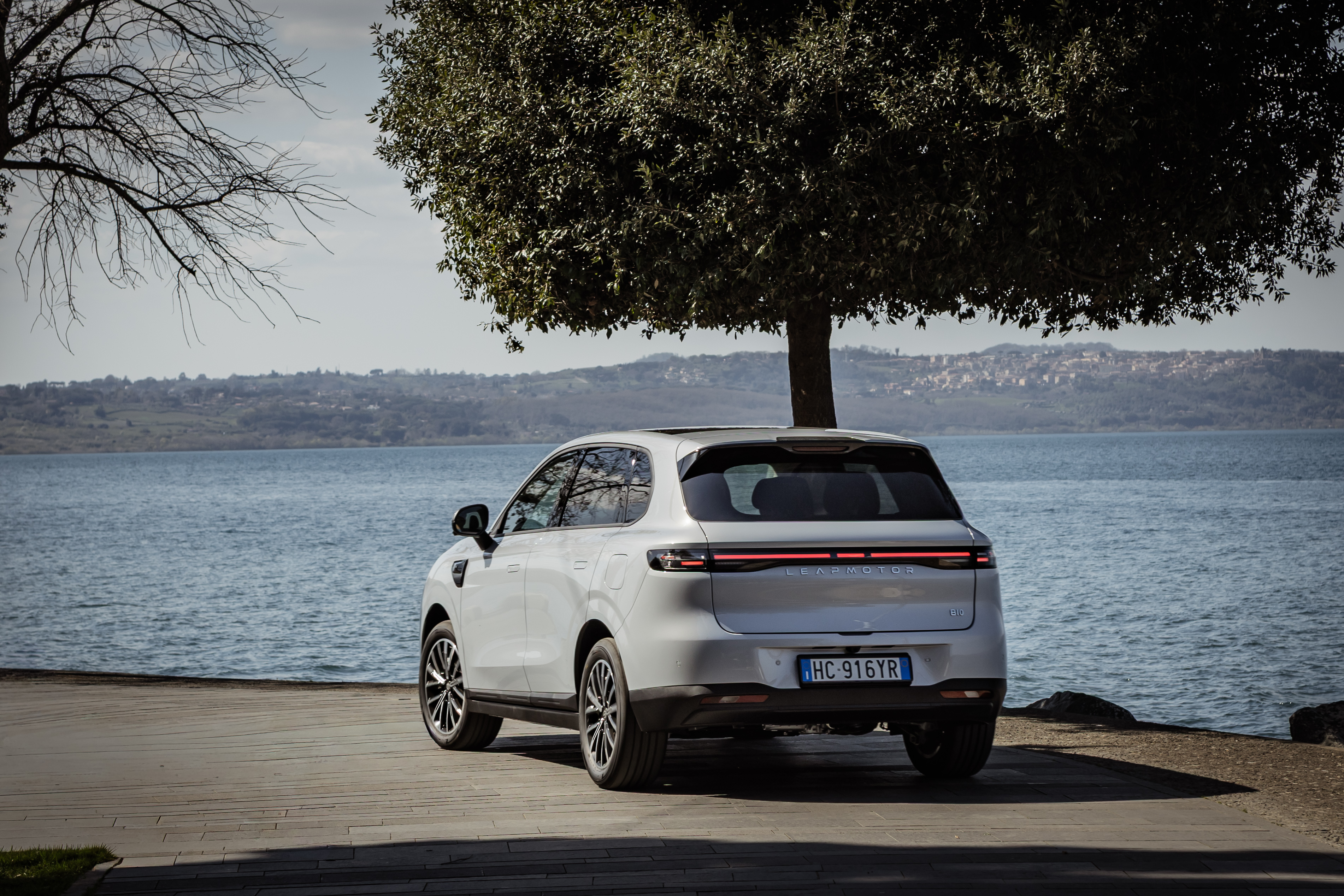
The B10 is a compact crossover with a smooth, rounded body and a light bar across the nose that Leapmotor calls the Wing Star design, with matching taillights and flush-fitting door handles. Six paint finishes are offered, including the metallic Starry Night Blue that Leapmotor says is inspired by Van Gogh's Starry Night Over the Rhone, plus Light White, Tundra Grey, Dawn Purple, Metallic Black and Galaxy Silver. In the UK Starry Night Blue, Light White and Tundra Grey are standard and the other three cost GBP 575. Inside there are three colour themes in Germany and two in the UK, built around a floating 14.6-inch screen and an 8.8-inch instrument cluster.
The single UK specification includes heated and ventilated front seats with ECO leather in a seven-layer construction, a heated steering wheel, a wireless phone-charging pad between the front seats, 64-colour ambient lighting that can sync with music, a 12-speaker hi-fi, a 360-degree surround camera and rear air vents. The front seats recline flat for a rest, and the car has Pet, Camping and Cleaning modes. In Germany the range is split into Life and Design lines. In Israel, Carzone's and auto.co.il's trim listings say the Life has a 6-speaker audio system, while the Design adds a 12-speaker system, synthetic leather, electrically adjustable heated and ventilated front seats with driver memory, an electric tailgate, a heated steering wheel and ambient lighting, so the UK's single trim is better equipped than the Israeli Life.
Technology & Features
The infotainment runs LEAP OS 4.0 Plus on a Qualcomm 8155 chipset, according to Stellantis. The most recent over-the-air update added native Apple CarPlay and Android Auto support, wired and wireless, one-pedal driving, a refined child-presence reminder, and smoother adaptive cruise and lane centring when approaching curves. The Leapmotor app handles remote air conditioning, central locking, steering-wheel heating and seat heating or ventilation, and doubles as the key. Navigation is real-time, the car has a 4G Wi-Fi hotspot, and voice commands cover two zones of the cabin. Reviewers have been less kind about some of the execution: Fleet World's first drive described the over-reliance on the screen for basic tasks as a frustration and the generator as surprisingly intrusive when it starts, adding a drone to an otherwise quiet cabin.
Safety & ADAS
The B10 has a high-strength body structure, seven airbags and 17 driver-assistance functions that Leapmotor says allow Level 2 semi-autonomous driving. The electric B10 earned five stars from Euro NCAP, announced by Stellantis on 20 November 2025, with 93% for adult occupants (37.3 of 40 points), 93% for children (46.0 of 49), 84% for vulnerable road users and 85% for safety assist. The range-extender has not been tested separately, so the rating applies to the electric car. Standard systems include autonomous emergency braking, lane keeping assist, blind-spot detection, cyclist door-opening warning, adaptive cruise control, traffic jam assist, driver drowsiness warning, rear cross-traffic braking and intelligent speed assist.
| ADAS LEVEL | Level 2 (17 driver-assistance functions) |
|---|---|
| ADAS FEATURES | AEB, ACC, traffic jam assist, lane keeping, blind-spot detection, door-open warning, rear cross-traffic braking, driver monitoring, intelligent speed assist, 360° camera, 7 airbags |
| EURO NCAP | 5 stars (electric B10, Nov 2025): 93% adult, 93% child, 84% VRU, 85% safety assist |

Available Versions
| VERSION | POWER | TORQUE | 0-100 | TOP SPEED | DRIVETRAIN | BATTERY | EV RANGE | COMBINED RANGE | PRICE | KEY DIFFERENCES |
|---|---|---|---|---|---|---|---|---|---|---|
| B10 Hybrid EV Life | 215 hp | 240 Nm | 7.5s | 170 km/h | RWD | 18.8 kWh | 86 km | 900 km | €32,400 | German list price incl. VAT; 160 kW (218 PS), 1.5 L generator engine; UK GBP 31,495, Israel NIS 154,900 |
| B10 Hybrid EV Design | 215 hp | 240 Nm | 7.5s | 170 km/h | RWD | 18.8 kWh | 86 km | 900 km | €33,900 | Higher equipment line; Israel NIS 164,900 |
| B10 EV 56.2 kWh (Life Pro) | 215 hp | 240 Nm | 8.0s | 170 km/h | RWD | 56.2 kWh | 361 km | — | €29,900 | Battery-electric, 168 kW DC, launch price in Germany |
| B10 EV 67.1 kWh | 215 hp | 240 Nm | 8.0s | 170 km/h | RWD | 67.1 kWh | 434 km | — | €32,400 | Battery-electric, 168 kW DC; German list price (Life Pro Max); UK GBP 30,495 with grant, Israel NIS 139,900 |
Pricing & Availability
In Germany, Leapmotor's press release of 28 April 2026 opened orders for the Hybrid EV at EUR 32,400 for the Life line and EUR 33,900 for Design, including VAT, with a leasing offer from EUR 199 a month including the state EV subsidy (36 months, 10,000 km a year, EUR 3,280 down payment, valid until 30 June 2026). Eligibility for that subsidy rests on the 86 km electric range. The UK price announced on 26 March 2026 is GBP 31,495 on the road for a single trim, with orders and first deliveries planned for summer 2026; Leapmotor UK's July update still said the Hybrid EV would be available to order later in the summer. The electric B10 costs GBP 31,995 on the road in the UK, or GBP 30,495 for retail buyers after the GBP 1,500 Leap Grant, so the Hybrid EV figure above is the March announcement and may have moved since. Italy opened orders in late January 2026 at EUR 29,900 for the Life and EUR 31,400 for Design, with lower promotional prices of EUR 25,900 and EUR 27,400 for buyers who trade in or scrap an old car. The Italian launch quoted a preliminary 80 km of electric range, while the German and UK figures are 86 km and 50 miles (80 km).
In Israel the importer Samelet Motors launched the plug-in version in mid-July 2026 at NIS 154,900 for the Life and NIS 164,900 for the Design, according to the outlets Queen of the Road, Carzone and Cartube. The importer's own website currently advertises the B10 from NIS 169,900, so check the current price with the importer. The electric B10 has been on sale there since December 2025 at NIS 139,900 and NIS 149,900. The importer's Israeli figures list 86 km of electric range and 7.5 seconds to 100 km/h. In China, the B10 is sold only as a battery-electric car, from CNY 99,800 to CNY 125,800 after the July 2026 refresh, and it has not been offered there with a range extender.
How It Compares
All three cards use UK pricing so the cycles and taxes line up. The B10 Hybrid EV's announced GBP 31,495 on the road is close to the electric version's GBP 31,995, and for a UK retail buyer the electric B10 at GBP 30,495 after the grant is GBP 1,000 cheaper and has the longer electric range, 434 km against 80 km. The range-extender's selling point is the 900 km total, which removes range anxiety for buyers who cannot charge at home. The Jaecoo 7 SHS-P, which we cover as the J7 PHEV, is the closest plug-in rival in size and powertrain concept: Jaecoo lists 204 PS (about 201 hp) from a combined petrol-electric system, 56 miles (90 km) of electric range and a UK price of GBP 35,170 for the Luxury trim, which is GBP 3,675 more than the Leapmotor. The Jaecoo's extra money buys a longer electric range and a bigger boot with the seats up, 500 litres against the Leapmotor's 330 litres, while the Leapmotor offers more power, a quicker 0-62 mph time (7.5 seconds against Jaecoo's 8.5) and a lower price, so the Jaecoo is the roomier choice and the Leapmotor the cheaper one.
- True electric drive in every mode: a 160 kW (215 hp) rear motor with 240 Nm and 7.5 seconds to 100 km/h, with the petrol engine only a generator
- 86 km WLTP electric range and 900 km total, which is enough to qualify for German hybrid subsidies and removes charging stops on long trips
- Highly equipped in the UK: the single GBP 31,495 trim includes a panoramic roof, 360-degree camera, 12-speaker audio and a 14.6-inch screen as standard, and the Israeli Life trim also has the panoramic roof and 14.6-inch screen
- DC charging peaks at only 46 kW and AC at 6.6 kW single-phase, and the 330-litre boot is about 100 litres smaller than the 430 litres Leapmotor lists for the electric B10
- Reviewers report that the generator is noticeable when it starts and that the touchscreen carries too many basic controls
The B10 Hybrid EV is a sensible way into electric driving for buyers who still want a petrol backup: it drives with the quiet, even torque of an EV, covers about 86 km on a charge and 900 km in total, and costs about the same as the electric B10. The electric version remains the better value for anyone who can charge at home, with 434 km WLTP and fast 168 kW charging from GBP 30,495 for UK retail buyers, or from EUR 29,900 in Germany with the smaller 361 km battery. The range-extender's compromises are a smaller boot, a slow 46 kW DC charge and an audible generator, so it makes most sense for long-distance drivers without a reliable charging routine.