
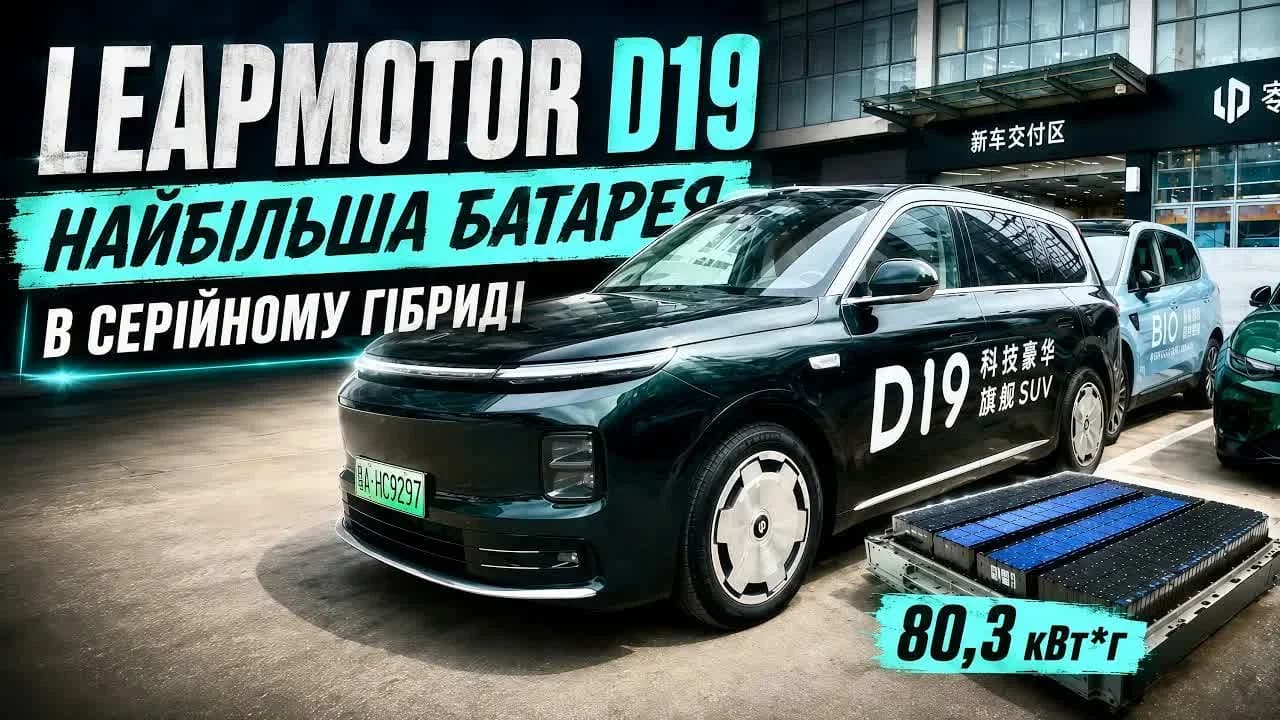
The 2026 Leapmotor D19 has been flying off Chinese showroom floors since its mid-April debut, and now the first wave of full real-world test drives is hitting reviewer channels. What stands out from this latest 5,252-mm-long flagship walkaround is not just the world’s-largest 80.3 kWh EREV battery or the 1,000V BEV architecture — both already well-documented — but a set of value-engineering and feature decisions that explain why a vehicle priced below ¥270,000 ($37,500) for its top trim still gets “180-day waiting list” status in China. Headlining the surprises: the D19 is the first production car ever offered with a factory oxygen generator — a ¥10,000 ($1,400) option that adds two emergency O2 masks under the front torpedo for high-altitude Tibetan-plateau driving. Combined with a 23-speaker in-house audio system, 800V hybrid / 1,000V EV dual architectures, and a reviewer-confirmed 16.7 kWh/100 km real-world consumption over 4,500 km, the D19 is shaping up to be the most aggressively-specced SUV of 2026 at this price point.
Powertrain Architecture: EREV 800V + BEV 1,000V

| EREV generator | 1.5L Turbo (ZF-developed) — series only |
|---|---|
| EREV battery (base) | 63.7 kWh LFP |
| EREV battery (top) | 80.3 kWh LFP — world’s largest in a production hybrid |
| BEV battery (base) | 99.6 kWh |
| BEV battery (mid) | 115 kWh |
| BEV architecture | 1,000 V high-voltage system |
| EREV architecture | 800 V high-voltage system |
The D19 ships in two distinct platforms under one body. The EREV (Range-Extender Electric Vehicle) variant runs an 800V high-voltage architecture — uncommon at this price point — using a ZF-developed 1.5L turbo as a generator only. The hybrid pairs that engine with either a 63.7 kWh (400 km EV / approx. 1,150 km combined) or an 80.3 kWh LFP pack (500 km EV / approx. 1,300 km combined), the latter being the largest battery ever fitted to a production hybrid. The BEV variant jumps to a 1,000V system with a 99.6 kWh entry pack good for 620 km CLTC, a 115 kWh mid-trim pack for 720 km, and a top tri-motor configuration adding a rear-steering electric axle (540 kW combined / 745 Nm / 0-100 in 3.9 s / 680 km). Reviewer-measured real-world consumption on the BEV mid-trim sat at 16.7 kWh/100 km across 4,500 km, well under the 21-23 kWh/100 km the same reviewer recorded on a competing Denza model.
| POWERTRAIN OPTIONS | EREV AWD or BEV AWD (twin or tri-motor) |
|---|---|
| SYSTEM POWER (EREV) | 300 kW (~402 hp) |
| SYSTEM TORQUE (EREV) | 525 Nm |
| SYSTEM POWER (BEV mid) | 410 kW (~550 hp) |
| SYSTEM POWER (BEV top tri-motor) | 540 kW (~724 hp) |
| 0-100 KM/H (EREV top) | 6.0 s |
| 0-100 KM/H (BEV mid) | 4.9 s |
| 0-100 KM/H (BEV tri-motor) | 3.9 s |
| EV-ONLY RANGE (EREV top) | 500 km (CLTC) |
| BEV RANGE (max) | 720 km (CLTC) |
| FUEL CONSUMPTION (EREV) | 6.5 L/100 km (claimed) |
| REAL-WORLD EV CONSUMPTION | 16.7 kWh/100 km (4,500 km logged) |
| TOP SPEED | 180 km/h |
| BATTERY | 63.7 / 80.3 (EREV), 99.6 / 115 (BEV) kWh |
| COMBINED RANGE | 1180-1300 (EREV) km |
| FUEL TANK | 40 (80.3 kWh EREV) / 52 (63.7 kWh EREV) L |
| DRIVETRAIN | AWD |
| SEATS | 6/7 |
Body, Dimensions & Air Suspension

| Length | 5,252 mm |
|---|---|
| Width | 1,995 mm |
| Height | 1,780 mm |
| Wheelbase | 3,110 mm |
| Ground clearance (neutral) | 184 mm |
| Ground clearance (range) | 150–210 mm (air suspension) |
| Frunk volume (BEV only) | 176 L |
| Trunk volume | 337 L |
| Wheels / tires | 21-inch / 265/45 R21 |
At 5,252 mm long on a 3,110 mm wheelbase, the D19 is now the largest non-luxury Chinese SUV under $40,000. Standard air suspension on all trims except the base EREV gives a 60-mm height adjustment range — 150 to 210 mm of ground clearance — with 184 mm in the neutral setting. The BEV variant gets a 176-liter frunk (the hybrid uses that space for the 1.5L generator), and the rear cargo area measures 337 liters with all rows up — modest for the footprint, but expanding considerably with the third row folded. Pop-up flush door handles remain standard despite incoming Chinese regulation that will ban them from 2027 onward. 21-inch wheels are standard across the lineup, with the rim design varying by trim. The body is the first Leapmotor with the brand’s “technology luxury flagship” design language — a connected light bar across the front, vertical LED headlight clusters, and a continuous rear bar with programmable LED pictogram graphics.
Interior: 23 Speakers, 21.3" Rear Screen & the Oxygen Generator
| SEATING CONFIG | 6-seat (2+2+2 captains) or 7-seat (2+3+2) |
|---|---|
| UPHOLSTERY | Nappa leather (entry hybrid) / softer in-house developed leather (top trims) |
| FRONT SEATS | Heated / ventilated / massage / power |
| SECOND ROW | Heated / ventilated / massage / power recline to zero-gravity / ottoman |
| THIRD ROW | Heated / power recline / dedicated sunshade |
| CENTRAL TOUCHSCREEN | 17.3" with Snapdragon 8295 |
| REAR ENTERTAINMENT SCREEN | 21.3" |
| DRIVER HUD | Projection HUD with karaoke lyrics overlay |
| AUDIO | 23-speaker Leapmotor in-house system |
| REAR REFRIGERATOR | 8.2 L (heat + cool, auto-open/close) |
| WIRELESS CHARGER | 50W single + dual cup holders |
| FRAGRANCE DIFFUSER | Standard |
| OXYGEN GENERATOR (option) | ¥10,000 / $1,400 — 2 face masks under glovebox |
The cabin is where Leapmotor’s value-engineering becomes most visible. The 23-speaker audio system is in-house developed rather than licensed from Bose / Harman / B&W — reviewer commentary notes the sound quality is “genuinely excellent” despite the unbranded badge, a direct outcome of Leapmotor producing roughly 70% of its parts in-house at its own factory. The headline interior reveal is the oxygen generator option — a ¥10,000 add-on (about $1,400) that places two oxygen masks under the dashboard. Designed for drivers heading to the Tibetan plateau and other high-altitude regions, this is genuinely the first time a production passenger vehicle has shipped with this feature factory-fit. The 17.3-inch central touchscreen runs on a Qualcomm Snapdragon 8295 SoC — the same chip as the BMW Neue Klasse cockpit — though the on-launch software is currently Chinese-only (Leapmotor confirms English availability for vehicles destined for European markets, which Stellantis will distribute starting late 2026). The 21.3-inch ceiling-mounted rear-cabin screen reclines manually from the headliner and supports Dolby content. Behind the rear armrest, the auto-opening 8.2L refrigerator heats and cools beverages. Tray tables out of the second-row captain’s chairs are rated to hold 3 kg.
Real-World Test Drive Notes
The reviewer’s 4,500 km mixed-condition test loop in Guangdong province highlighted three notable behaviors: First, the double-glazed glass on all four doors delivers genuinely impressive cabin isolation, comparable to vehicles costing 30-50% more. Second, the EREV top trim’s claimed 6.0 s 0-100 felt “deliberately slow” on the test drive — consistent with the 2,800+ kg curb weight and the tuning bias toward comfort over outright acceleration. Third, the cabin material grading reveals the price compromise: while the seats, door cards, and steering wheel use high-grade leather and stitched alcantara, the upper dashboard and headliner microfiber finish look closer to mid-tier than premium — an acknowledged trade-off given the sub-$38,000 ceiling. The 360-degree camera resolution was described as “average,” though acceptable for the price band.
Available Versions
| VERSION | POWER | BATTERY | EV RANGE | KEY DIFFERENCES | PRICE |
|---|---|---|---|---|---|
| EREV 400 km | 402 hp (dual) | 63.7 kWh | 400 km / 1300 km combined | 1.5-liter turbocharged range extender, smaller battery, 52-liter fuel tank | 219,800 yuan (~$32,240) |
| EREV 500 km | 402 hp (dual) | 80.3 kWh | 500 km / 1180 km combined | 1.5-liter turbocharged range extender, larger 80.3 kWh battery, 40-liter fuel tank | 239,800 yuan (~$35,170) |
| BEV 620 km | 550 hp (dual) | 99.6 kWh | 620 km | All-electric, dual motor, longer range | 239,800 yuan (~$35,170) |
| BEV 720 km | 550 hp (dual) | 115 kWh | 720 km | All-electric, dual motor, largest battery, longest range | 249,800 yuan (~$36,640) |
| BEV 680 km Tri-Motor | 724 hp (triple) | 115 kWh | 680 km | All-electric, tri-motor, performance version, faster acceleration | 269,800 yuan (~$39,570) |
How It Compares
| Model | Powertrain Options | Top Power | Range (CLTC) | Starting Price |
|---|---|---|---|---|
| 2026 Leapmotor D19 (this car) | EREV or BEV (tri-motor) | 724 hp | up to 720 km BEV / 500 km EREV | $32,200 |
| 2025 BYD Datang EV | BEV AWD | 590 hp | 850 km | ~$36,200 |
| 2025 ONVO L90 | BEV AWD | 510 hp | 605 km | ~$36,660 |
| 2025 NIO ES8 | BEV AWD | 510 hp | 635 km | ~$43,000 |
| 2025 GWM Wey GaoShan PHEV | PHEV AWD | 510 hp | 200 km EV / 1,050 km combined | ~$43,500 |
The D19’s pricing position is unusual: at $32,200 entry, it’s priced like a mid-size SUV but ships at full-size dimensions and full-size luxury feature content. Its closest range competitor in BEV form — the BYD Datang — uses an old-school BYD platform without the 1,000V architecture or the 723 hp tri-motor option. NIO’s ES8 has comparable build quality but costs roughly $10,000 more for less range. The only direct family-SUV rival at this dimension and ambition is the Wey GaoShan PHEV, which is $11,000 more expensive and lacks the BEV-only option. The Stellantis 51% ownership stake means D19 export sales are likely from 2027 onward through Fiat / Citroen / Peugeot networks; European pricing has not yet been confirmed, but is expected to land in the €40,000-50,000 range to align with Leapmotor C10 / B10 positioning.
Verdict
The 2026 Leapmotor D19 is the most aggressive value play in the Chinese full-size SUV segment of 2026. Its oxygen generator option is genuinely a world-first feature. Its 800V hybrid + 1,000V BEV dual architecture is technical content typically reserved for $80,000+ vehicles. The 23-speaker in-house audio and 4-zone heated/ventilated/massaged seating deliver luxury content that costs 30-50% more elsewhere. The compromises — upper-dash microfiber that feels less than premium, Chinese-only OS on launch, modest 337 L base trunk, and the ZF-supplied 1.5L generator that still requires 10,000 km oil-change intervals — are exactly the kinds of trade-offs that allow $32,200 to be possible. For the Chinese domestic market, the 180-day waitlist tells the rest of the story; for European buyers, the Stellantis distribution play makes the D19 the most likely “Chinese flagship that actually arrives at your local dealer” story of 2027.