
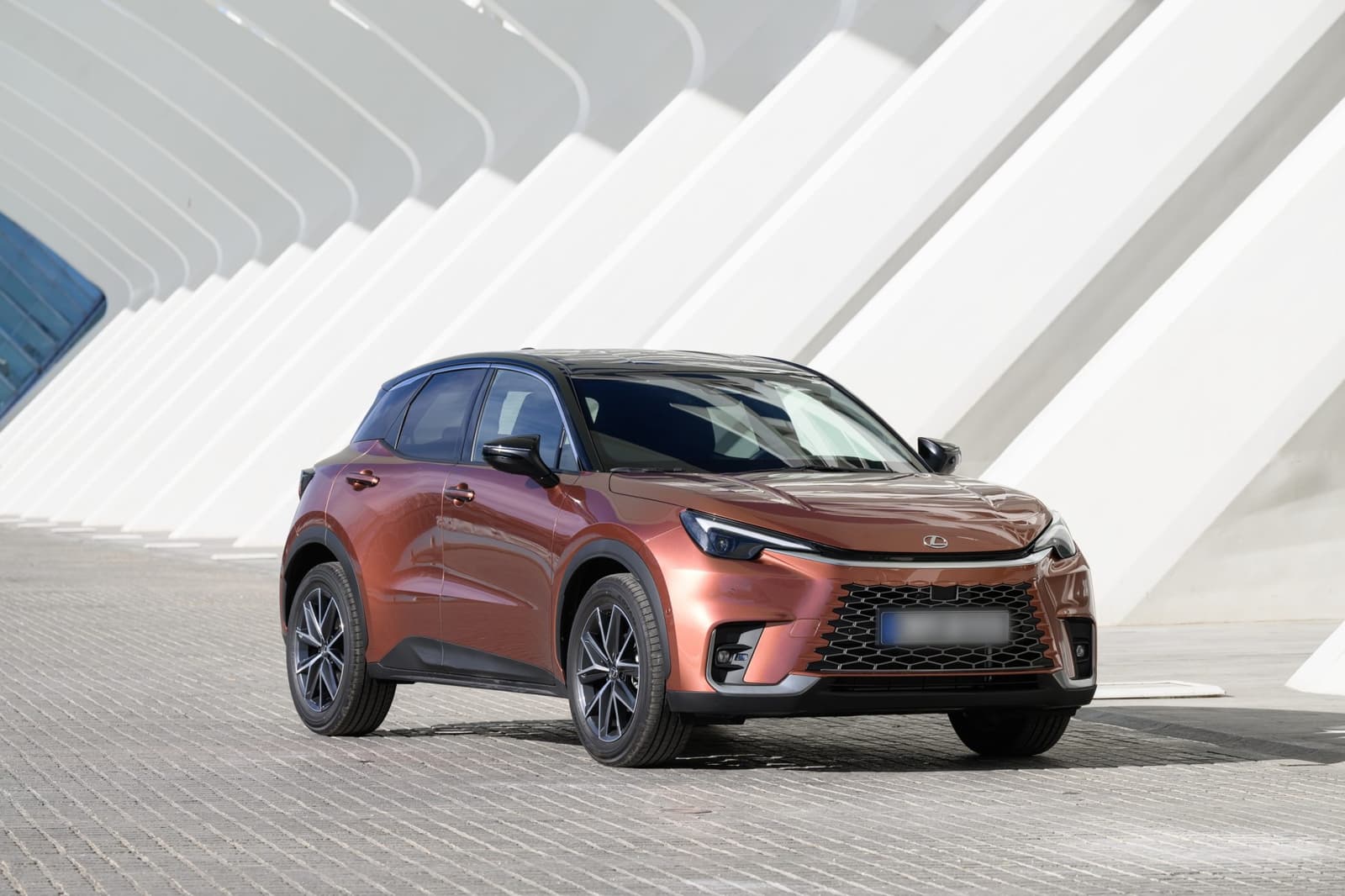
The Lexus LBX is the smallest car the brand has ever built: a 4,190 mm compact crossover with a full-hybrid powertrain that Lexus markets as a Self-Charging Hybrid. It is a conventional hybrid (HEV), not a plug-in, so it cannot be charged from a socket and its small battery is topped up by the petrol engine and by braking. For the 2026 model year the 1.5-litre three-cylinder system is unchanged at 100 kW (136 PS / 134 hp), and the range is organised around four equipment themes that Lexus calls atmospheres: Elegant, Emotion, Relax and Cool. A limited Vibrant Edition with black styling and red accents was added in autumn 2025. In Israel the importer Lexus Israel lists the LBX from NIS 205,990 for the Elegant (about $67,600), with the Vibrant Edition at NIS 241,990. In the UK Lexus lists the car from £29,995 on the road (LBX Urban, about $39,800), and Spanish coverage in November 2025 gave a range starting at €33,900.
Performance & Specs
The LBX uses a 1,490 cc three-cylinder petrol engine that makes 67 kW (91 PS / about 90 hp) at 5,500 rpm and 120 Nm of torque between 3,600 and 4,800 rpm. A permanent-magnet electric motor on the front axle adds 69 kW (94 PS / about 93 hp) and 185 Nm. Lexus quotes the combined system output as 100 kW, which is 136 PS (DIN hp) or 134 bhp; Israeli sites print the 136 figure as "hp", but it is the metric figure, so the imperial equivalent is 134 hp. Power goes through an e-CVT. Front-wheel drive is the standard layout, and in Europe an E-Four version adds a small 4.7 kW, 52 Nm induction motor on the rear axle. We found no Israeli source that lists the E-Four version, and Lexus UK's model page lists none either.
Lexus gives a 0-100 km/h time of 9.2 seconds for front-wheel drive and 9.6 seconds for E-Four, with a top speed of 170 km/h (106 mph in the UK specification). The engine is the weak point on paper, but the electric motor supplies the torque from standstill, and Lexus says the system was redesigned to raise both power and economy. The 36-litre fuel tank, the efficient hybrid system and a kerb weight of 1,280-1,350 kg for the front-wheel-drive car (1,365-1,415 kg for E-Four) keep consumption low: the European brochure for the 2026 model year lists 4.7-4.4 l/100 km WLTP and 107-100 g/km of CO2 for front-wheel drive, and 5.0-4.6 l/100 km and 113-105 g/km for the European E-Four car, depending on wheel size and equipment. Lexus UK's model page gives 60.1-62.7 mpg (4.5-4.7 l/100 km) and 102-104 g/km for front-wheel drive and lists no E-Four car. The Lexus Israel importer site gives 4.5-4.6 l/100 km WLTP and 103 g/km.

| Powertrain | Full hybrid (HEV, not plug-in), 1.5-litre 3-cylinder + electric motor, e-CVT |
|---|---|
| Power | 100 kW (136 PS / 134 hp) system output |
| Torque | 185 Nm electric motor; 120 Nm engine |
| 0–100 km/h | 9.2 s (FWD); 9.6 s (E-Four) |
| Battery | 1.0 kWh nickel-metal hydride, 201.6 V |
| Fuel use | 4.4-4.7 l/100 km WLTP (Europe, FWD) |
| POWERTRAIN TYPE | Full hybrid (HEV), not plug-in; 1.5-litre 3-cylinder petrol + electric motor, e-CVT |
|---|---|
| HORSEPOWER | 100 kW (136 PS / 134 hp) system; engine 67 kW (91 PS); front motor 69 kW (94 PS) |
| TORQUE | 185 Nm peak system torque per the Lexus European brochure (front electric motor 185 Nm; engine 120 Nm) |
| ACCELERATION | 0-100 km/h in 9.2 s (FWD), 9.6 s (E-Four) |
| TOP SPEED | 170 km/h |
| DRIVETRAIN | Front-wheel drive; E-Four all-wheel drive available in Europe |
| BATTERY | Nickel-metal hydride, 1.0 kWh, 5.0 Ah, 201.6 V |
| FUEL USE (WLTP) | 4.4-4.7 l/100 km FWD, 4.6-5.0 l/100 km E-Four (Europe, 2026 brochure) |
Dimensions & Practicality

| Length | 4,190 mm |
|---|---|
| Width | 1,825 mm |
| Height | 1,560 mm (1,550 mm on 17-inch wheels) |
| Wheelbase | 2,580 mm |
| Ground clearance | 170 mm |
The LBX is 4,190 mm long, 1,825 mm wide and 1,560 mm tall on a 2,580 mm wheelbase, with 170 mm of ground clearance, a drag coefficient of 0.34 and a tyre turning radius of 5.2 metres. That makes it a little longer than a typical supermini crossover and close to the size of Toyota's Yaris Cross, and Lexus says the extended wheelbase and low centre of gravity give a ride quality normally associated with larger luxury cars. Luggage space depends on the document: the European brochure gives 332 litres with the rear seats up (330 litres with the Mark Levinson audio system) and 994 litres with them folded, the UK technical sheet (September 2025) lists 402 litres for the front-wheel-drive car and 317 litres for E-Four, and the UK model page quotes 322 litres. The 994-litre folded figure is the same in the European and UK documents, and the E-Four versions list less luggage space. Braked towing is rated at 750 kg.
| LENGTH | 4,190 mm |
|---|---|
| WIDTH | 1,825 mm |
| HEIGHT | 1,560 mm; 1,550 mm with 17-inch wheels |
| WHEELBASE | 2,580 mm |
| CARGO VOLUME | 332 L seats up (EU brochure, VDA), 994 L seats folded; UK sheet (Sep 2025) 402 L FWD / 317 L E-Four |
| KERB WEIGHT | 1,280-1,350 kg FWD; 1,365-1,415 kg E-Four |
| TOWING | 750 kg braked |
Charging & Battery
The LBX has nothing to plug in. Its high-voltage battery is a new, lighter and more compact nickel-metal hydride design with 168 cells, a nominal 201.6 V, 5.0 Ah of capacity and a total energy of 1.0 kWh, according to Lexus UK's technical sheet. It sits under the rear seats and is charged by the engine and by regenerative braking. Lexus says the hybrid system allows electric-only driving for short distances in town, but it publishes no electric range figure, and the battery is far too small to compare with a plug-in hybrid. The only fuelling is petrol, with a 36-litre tank, and the WLTP consumption figures quoted here are the car's only efficiency numbers: there is no AC or DC charging rating, and no 10-80% time.
| BATTERY | Nickel-metal hydride, 1.0 kWh, 201.6 V (HEV, self-charging) |
|---|---|
| AC CHARGING | None (not a plug-in) |
| DC FAST CHARGING | None (not a plug-in) |
| FUEL TANK | 36 L petrol |
| WLTP FUEL USE | 4.4-4.7 l/100 km FWD (EU); 4.5-4.7 l/100 km (UK, 60.1-62.7 mpg); 4.5-4.6 l/100 km (Israel) |
Design & Interior
Lexus describes the LBX as a car that overturns the idea that small means inferior, in the words of its chief engineer Kunihiko Endo. The nose carries the unified spindle grille, a low bonnet and sharp headlights, and the underbody panels have a dimpled surface, like a golf ball, which Lexus says improves stability. The door handles use an e-Latch system that opens the door with one smooth movement. Inside, the Tazuna cockpit keeps the controls within reach of the driver, and the grades differ mainly in colours, materials and finishes rather than in mechanical content. Elegant has synthetic Tahara seats, Emotion is the more vivid choice, Relax uses semi-aniline leather with Tatami stitching and a 13-speaker Mark Levinson sound system, and Cool adds 18-inch machined alloy wheels, black leather and suede upholstery with embroidery and a head-up display. Emotion and Cool both have bi-tone paint.
The Vibrant Edition is the sporty variant. It adds matt black 18-inch wheels, black spoiler and window trim, a jet-black grille finish inspired by the LBX RR Morizo concept, and bi-tone or all-black paint. The cabin has black semi-aniline leather with Dark Rose accents on the bolsters and seat belts (the Israeli importer describes ruby-red accents and red Tatami stitching), an eight-way power driver's seat, 64-colour ambient lighting, a wireless charging pad, paddle shifters and nanoe-X air purification. In Israel Lexus offers it in red with a black roof, white with a black roof, or all black.
Technology & Features
Higher grades have a 12.3-inch digital instrument display and a 9.8-inch multimedia screen with wireless Apple CarPlay and Android Auto. A digital key lets owners lock, unlock and start the car from a smartphone, share access with others, and the app can set the temperature or defrost the windscreen remotely. The "wet arm" wipers stay hidden when not in use and stop when a front door opens to avoid spraying passers-by, and the clearance lights stay on for 15 seconds after the doors are locked or unlocked. The sound system choices are a 6-speaker system and a 13-speaker Mark Levinson Premium Surround system. Lexus describes the approach as omotenashi, a Japanese idea of hospitality that means anticipating the needs of the occupants before they ask.
Safety & ADAS
The LBX comes with the latest generation of Lexus Safety System +, which monitors the road ahead and can warn the driver and brake if needed. Safe Exit Assist prevents a door from opening when a cyclist is approaching from behind, the Panoramic View Monitor helps with tight manoeuvres, and Remote Parking is on the equipment list of the higher grades. Lexus states that the system does not replace the driver's own attention. Euro NCAP rated the LBX at five stars in 2024 (tested December 2024; adult occupant 82%, child occupant 83%, vulnerable road users 79%, safety assist 76%), according to Lexus UK and Lexus Europe.
| ADAS LEVEL | Driver-supervised assistance (no SAE level stated by Lexus) |
|---|---|
| ADAS FEATURES | Lexus Safety System +; individual features vary by grade and market |
Available Versions
| VERSION | POWER | TORQUE | 0-100 | TOP SPEED | DRIVETRAIN | BATTERY | EV RANGE | COMBINED RANGE | PRICE | KEY DIFFERENCES |
|---|---|---|---|---|---|---|---|---|---|---|
| Elegant | 134 hp | 185 Nm | 9.2s | 170 km/h | FWD | 1.0 kWh | — | — | NIS 205,990 (~$67,600) | Entry grade in Israel; 136 PS system; synthetic Tahara seats |
| Cool | 134 hp | 185 Nm | 9.2s | 170 km/h | FWD | 1.0 kWh | — | — | NIS 237,990 (~$78,100) | 18-inch machined wheels, head-up display, leather and suede; bi-tone paint (Emotion and Cool) |
| Vibrant Edition | 134 hp | 185 Nm | 9.2s | 170 km/h | FWD | 1.0 kWh | — | — | NIS 241,990 (~$79,400) | Black styling, matt black 18-inch wheels, Mark Levinson audio |
| E-Four (Europe) | 134 hp | 185 Nm | 9.6s | 170 km/h | AWD | 1.0 kWh | — | — | — | Adds a 4.7 kW rear motor; 4.6-5.0 l/100 km WLTP (EU brochure); not listed in Israel or on the Lexus UK model page |
Pricing & Availability
In Israel the importer Lexus Israel lists the LBX from NIS 205,990 on its own website. Israeli outlet auto.co.il lists the 2026 range in January 2026 as Elegant NIS 205,990, +Elegant NIS 220,990, Emotion NIS 226,990, Relax NIS 231,990, Cool NIS 237,990 and Vibrant Edition NIS 241,990, and Queen of the Road, which covered the Vibrant Edition launch on 22 January 2026, gives NIS 241,990 for the Vibrant Edition. The NIS 205,990 figure is the list price of the Elegant grade, not a discounted price. At 3.0482 NIS per US dollar (6 October 2026) the Elegant is about $67,600, which is far above European prices, partly because Israeli list prices include VAT and purchase tax. The importer said in January 2026 that more than 1,100 LBX had been delivered in Israel since the launch.
Spanish outlets published the 2026 range in November 2025 (November 2025 coverage, not re-confirmed on Lexus Spain): from €33,900 (about $38,200) for the base LBX to €47,000 (about $53,000) for the top grade, with the Vibrant Edition at €43,200. In the UK, Lexus's model page (read 26 October 2026) lists the LBX Urban from £29,995 on the road (about $39,800) and the Premium at £34,695 (about $46,100), including VAT, first-year vehicle tax and delivery. The Vibrant Edition is £36,695 (about $48,700) and the Vibrant Bi-Tone £37,695 (about $50,000), both still listed by Lexus UK on 26 October 2026, and all four UK cars are front-wheel drive with no E-Four car listed. Lexus UK planned to build the Vibrant Edition from September 2025 to May 2026 and Spanish coverage gives the same end date; the Israeli importer showed it in its showrooms in January 2026. Israeli pre-sales opened on 18 December 2023, with the first cars expected in the first quarter of 2024. Prices and availability in other markets, including the US, are not confirmed here as of October 2026.
How It Compares
The closest cross-shop inside the Toyota family is the Yaris Cross Hybrid 130, which is 18 mm shorter than the LBX, makes 130 PS (129 hp) against the LBX's 136 PS (134 hp) and has similar official fuel use of 4.4-5.1 l/100 km WLTP. In the UK the Yaris Cross starts at £27,445 on the road, against £29,995 for the LBX Urban (£34,695 for the Premium), so the Lexus costs about £2,550 more at entry level for the same hybrid layout, a more upmarket cabin and the Lexus dealer network. The Aygo X Hybrid is the budget end of the same hybrid philosophy: at 3,776 mm it is 414 mm shorter, has 116 PS (114 hp) and uses 3.8-3.9 l/100 km, which makes it cheaper to run but also a much smaller car. The LBX sits between them in the way a small premium crossover should.
- Full hybrid with no charging required: 100 kW (136 PS / 134 hp), 4.4-4.7 l/100 km WLTP in Europe and 100-107 g/km CO2
- Compact 4,190 mm body with 170 mm of ground clearance, a 5.2 m turning radius and a premium cabin with a 13-speaker Mark Levinson option
- Four equipment themes plus the Vibrant Edition, with the same powertrain on every grade, so choosing is about style rather than mechanics
- Modest performance: 9.2 s from 0-100 km/h and 170 km/h, and the boot is only 332 L by the European measurement (the UK sheet lists 402 L)
- Expensive for its size in Israel: NIS 205,990 to NIS 241,990 at list, against NIS 158,990-159,990 for the Toyota Yaris Cross, and the Vibrant Edition was planned as a limited run in Europe
The Lexus LBX is a small, well-equipped full hybrid for buyers who want a premium badge and low fuel use without a plug. The 136 PS system is not fast, but 4.4-4.7 l/100 km WLTP, a compact body and a well-equipped cabin suit city driving. In Israel the NIS 205,990 entry price is a clear step up from mainstream hybrid crossovers, and the Vibrant Edition at NIS 241,990 costs about NIS 36,000 more than the Elegant for styling and equipment rather than any extra performance. It is a good fit for urban buyers who value the badge and the cabin more than speed or boot space.