
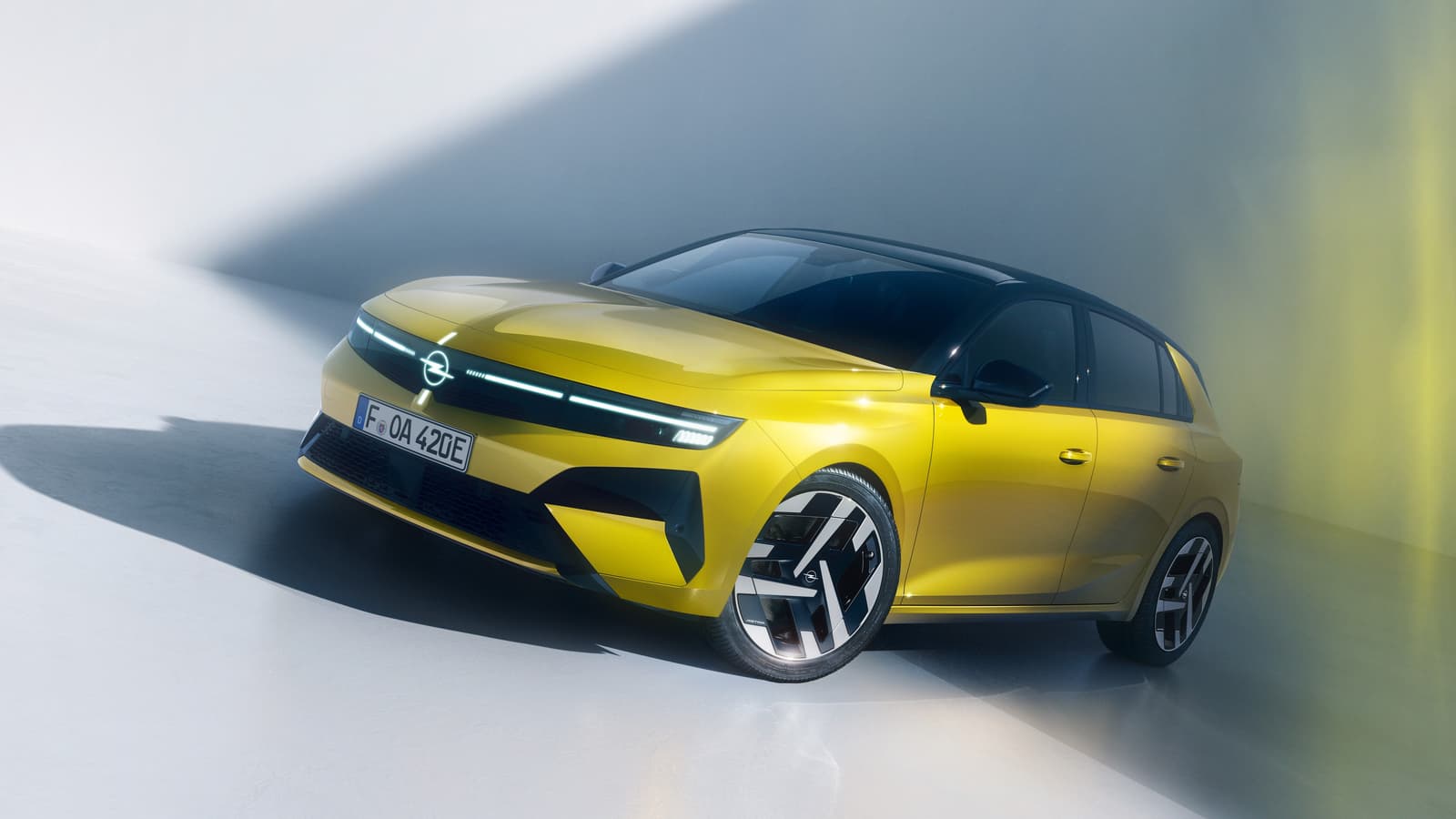
The Opel Astra is the compact hatchback and Sports Tourer wagon that Opel designs and builds in Rüsselsheim, and in mid-October 2026 Opel Germany added a new entry trim called Start to the updated range. On the battery-electric Astra Electric (BEV) it lowers the German list price by €1,900 to €36,490, including 19 percent VAT and before delivery costs. The Astra Hybrid (48V mild hybrid, MHEV, 145 PS) falls by €1,500 to €31,890, and the Sports Tourer Hybrid to €33,390. According to Opel Germany's price list of 1 October 2026, the Electric carries a 58 kWh gross (55 kWh net) battery that is good for 432 to 454 km WLTP in the hatchback and 422 to 445 km in the Sports Tourer.
The 156 PS (154 hp) front motor and the 100 kW DC charging peak are the same on every Electric trim, so Start saves money mainly by dropping equipment. The heat pump is not available on Start at all, and the 180-degree reversing camera and the Keyless Open & Start entry system also move up to Edition. The plug-in hybrid (PHEV, 196 PS system output, 82 to 84 km electric range) is not offered in Start and begins at €38,990 in Edition trim. Opel says the Start badge will spread gradually to its other models after the Frontera and Combo.
Performance & Specs
The Astra Electric (BEV) uses a single front-mounted motor rated at 115 kW (156 PS, about 154 hp) with 270 Nm of torque and front-wheel drive. Opel's price list quotes 0–100 km/h in 9.3 seconds for the hatchback and 9.5 seconds for the Sports Tourer, with a top speed of 170 km/h. The 30-minute continuous output is 62 kW (84 PS). (PS is the metric horsepower, about 1.4 percent smaller than the imperial hp used here.) Opel's WLTP consumption is 14.7 to 15.5 kWh/100 km for the hatchback and 15.0 to 15.8 kWh/100 km for the Sports Tourer, which gives a city-cycle range of 544 to 580 km for the hatchback.
The Astra Plug-in Hybrid (PHEV) pairs a 1.6-litre turbo petrol engine of 110 kW (150 PS) with a 92 kW (125 PS) electric motor for a system output of 144 kW (196 PS, about 193 hp) and 360 Nm, through a seven-speed electrified dual-clutch gearbox. Opel quotes 0–100 km/h in 7.6 seconds (hatchback) or 7.7 seconds (Sports Tourer) and a top speed of 225 km/h. Its 14 kWh net (17 kWh gross) battery gives an electric range of 82 to 84 km WLTP in the hatchback and 81 to 83 km in the Sports Tourer, and the weighted WLTP consumption is 12.1 to 12.6 kWh/100 km plus 2.1 to 2.3 l/100 km across both body styles.
The Astra Hybrid (MHEV) is a 48V mild hybrid and cannot be plugged in. A 1.2-litre three-cylinder turbo of 100 kW (136 PS) works with a 15.6 kW (21 PS) electric motor in the electrified six-speed dual-clutch gearbox, for a system output of 107 kW (145 PS, about 143 hp) and 230 Nm. It reaches 100 km/h in 9.0 seconds and 210 km/h, and Opel's WLTP fuel consumption is 4.7 to 5.1 l/100 km depending on body style. Opel also lists a 1.5-litre diesel in the range, which is outside this site's scope.

| Powertrain | Single-motor FWD BEV |
|---|---|
| Power | 115 kW (156 PS / 154 hp) |
| Torque | 270 Nm |
| 0–100 km/h | 9.3 s (hatchback) |
| Battery | 58 kWh gross / 55 kWh net |
| Range | 432–454 km WLTP (hatchback) |
| POWERTRAIN TYPE | BEV (Electric), PHEV (Plug-in Hybrid) and MHEV (Hybrid, 48V mild hybrid, not plug-in) |
|---|---|
| HORSEPOWER | BEV 115 kW (156 PS / 154 hp); PHEV 144 kW (196 PS / 193 hp) system; MHEV 107 kW (145 PS / 143 hp) system |
| ACCELERATION | 0-100 km/h: BEV 9.3 s (hatchback) / 9.5 s (Sports Tourer); PHEV 7.6 / 7.7 s; MHEV 9.0 s |
| TOP SPEED | BEV 170 km/h; PHEV 225 km/h; MHEV 210 km/h |
| DRIVETRAIN | FWD (all) |
| BATTERY | BEV 58 kWh gross / 55 kWh net; PHEV 17 kWh gross / 14 kWh net; MHEV 48V system |
| WLTP RANGE | BEV 432-454 km (hatchback), 422-445 km (Sports Tourer); PHEV 82-84 km electric (hatchback), 81-83 km (Sports Tourer) |
| WLTP CONSUMPTION | BEV 14.7-15.5 kWh/100 km (hatchback), 15.0-15.8 (Sports Tourer); PHEV 12.1-12.6 kWh/100 km plus 2.1-2.3 l/100 km weighted; MHEV 4.7-5.1 l/100 km |
Dimensions & Practicality

| Length | 4,374 mm (Sports Tourer 4,642 mm) |
|---|---|
| Width | 1,859 mm (2,062 mm with mirrors) |
| Height | 1,482–1,488 mm (Electric hatchback) |
| Wheelbase | 2,675 mm (Sports Tourer 2,732 mm) |
| Boot (Electric) | 352 L / 1,268 L seats folded (hatchback) |
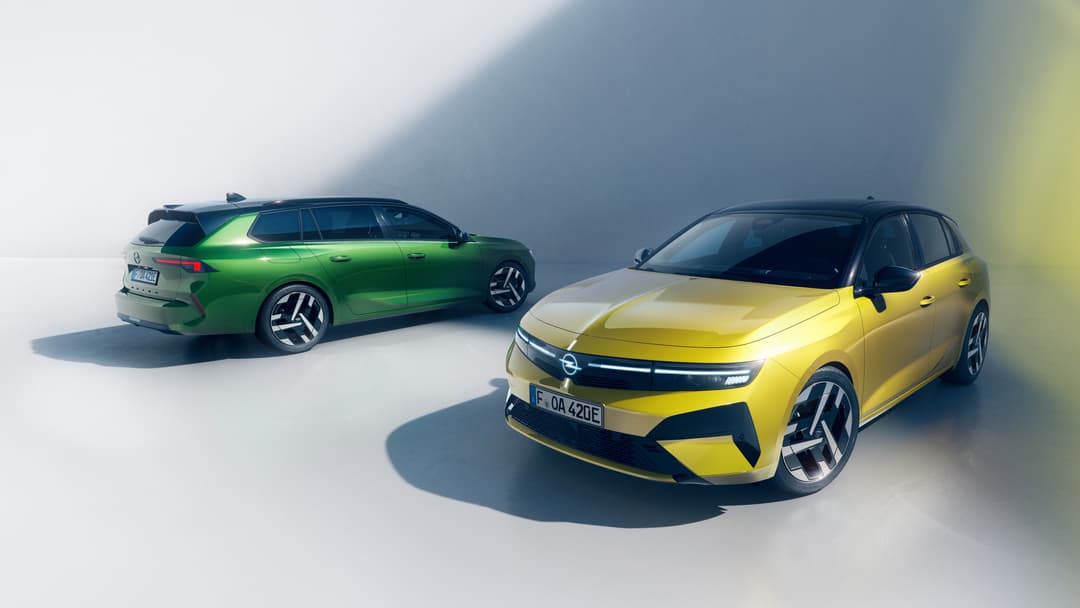
The hatchback is 4,374 mm long on a 2,675 mm wheelbase, and the Sports Tourer stretches to 4,642 mm and 2,732 mm. Both are 1,859 mm wide, or 2,062 mm with the mirrors unfolded. Boot space depends on the powertrain: Opel lists 422 to 1,339 L for the Hybrid hatchback, 352 to 1,268 L for the Electric and 310 to 1,236 L for the PHEV, against 597 to 1,634 L, 516 to 1,553 L and 466 to 1,483 L in the Sports Tourer. The flat Flex Floor with the Easy Fold rear seat is not fitted to the Electric or the PHEV.
Weight and towing also differ. The EU kerb weights, which include a 75 kg driver, are 1,733 kg for the Electric hatchback (1,765 kg Sports Tourer), 1,682 kg for the PHEV hatchback (1,736 kg) and 1,454 kg for the Hybrid hatchback (1,502 kg). The PHEV tows up to 1,380 kg braked in the hatchback and the Hybrid 1,150 kg, but the Electric has no towing rating at all: its optional detachable tow bar is approved only for a bicycle carrier with a 60 kg nose weight.
| LENGTH | 4,374 mm hatchback / 4,642 mm Sports Tourer |
|---|---|
| WIDTH | 1,859 mm (2,062 mm with mirrors) |
| HEIGHT | 1,482-1,488 mm Electric hatchback (1,463-1,498 mm Sports Tourer) |
| WHEELBASE | 2,675 mm hatchback / 2,732 mm Sports Tourer |
| CARGO VOLUME | Electric 352-1,268 L (hatchback), 516-1,553 L (Sports Tourer); PHEV 310-1,236 L / 466-1,483 L; Hybrid 422-1,339 L / 597-1,634 L |
| KERB WEIGHT (EU, incl. 75 kg driver) | Electric 1,733 / 1,765 kg; PHEV 1,682 / 1,736 kg; Hybrid 1,454 / 1,502 kg (hatchback / Sports Tourer) |
| TOWING (braked) | Electric none (bike carrier only, 60 kg nose weight); PHEV 1,380 / 1,330 kg; Hybrid 1,150 kg |
Charging & Battery
The Astra Electric (BEV) stores 55 kWh net (58 kWh gross) and charges on DC at up to 100 kW, which Opel puts at about 32 minutes from 20 to 80 percent. The on-board charger is a bidirectional three-phase 11 kW unit, so an 11 kW wallbox takes about 3 hours 20 minutes for 20 to 80 percent and a household socket at about 3.2 kW needs about 11 hours 55 minutes for the same window. A 22 kW Mode 3 cable is included, and the same hardware is what makes Vehicle-to-Load possible once the accessory adapter is added; Opel states an output of up to 3.6 kW for it. Opel's Electric All In package adds an 8-year or 160,000 km battery warranty that guarantees at least 70 percent of the original capacity.
As a sanity check, 55 kWh net and 454 km imply about 12.2 kWh/100 km at the battery, while Opel's official WLTP consumption of 14.7 kWh/100 km is measured at the plug and so includes charging losses. The PHEV charges only on AC, at up to 7.4 kW single-phase: about 2 hours 5 minutes from empty to full on a 7.4 kW wallbox and about 7 hours 25 minutes on a 2.3 kW household socket. The Hybrid has no plug.
| BATTERY | BEV 58 kWh gross / 55 kWh net; PHEV 17 kWh gross / 14 kWh net |
|---|---|
| AC CHARGING | BEV 11 kW three-phase (20-80% in about 3 h 20 min); PHEV 7.4 kW single-phase (0-100% in about 2 h 5 min) |
| DC FAST CHARGING | BEV 100 kW; PHEV and MHEV none |
| DC 20-80% TIME | BEV about 32 min (Opel price list, public charger of about 100 kW) |
Design & Interior
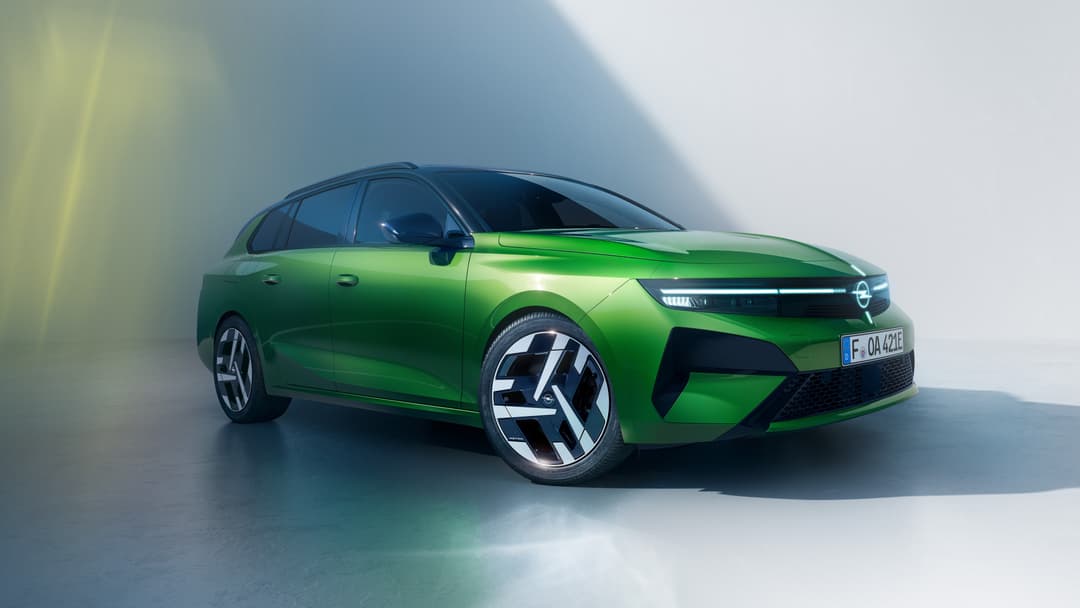
The updated Astra keeps the compact shape of the earlier car and sharpens the front with a narrower Opel Vizor in which the Blitz emblem is permanently lit, and with slimmer air-intake blades; the lit Vizor is standard on every trim, Start included. The Electric rides on 18-inch alloy wheels on every trim, while the Hybrid and Diesel Start use 16-inch steel wheels with plastic covers, as the Start press images show. A new metallic Denim Blue is standard on Start, and the roof matches the body colour on Start and Edition, with a black roof offered from GS. The Astra is built in Rüsselsheim, which Opel stresses in its current "Feel the Made in Germany" campaign.
Inside, Start gets the same Pure Panel dashboard as the other trims, with a 10-inch driver display and a 10-inch touchscreen, and six-way adjustable Intelli-Seats with the ergonomic recess at the front. Start also has single-zone automatic climate control, a leatherette steering wheel with paddles, front and rear parking sensors and the Keyless Start button. The optional Start Comfort Pack (€500 on the hatchback) adds heat-shielding Solar Protect glazing, an auto-dimming mirror and a centre armrest, plus roof rails on the Sports Tourer. Edition adds the 180-degree reversing camera, Keyless Open & Start entry, six speakers and, on the Electric, the heat pump and a front armrest.
Technology & Features
All trims share the Pure Panel infotainment with wireless Apple CarPlay and Android Auto, Bluetooth, DAB+ radio and an emergency call function. Start has four speakers; Edition and GS have six, and GS upgrades to the full-glass Pure Panel Pro display. Ultimate adds navigation, the Intelli-HUD head-up display, wireless phone charging and the Connect Plus services, which are free for the first six months after the warranty starts and are then paid. Over-the-air software updates are listed as standard on Edition, GS and Ultimate for the electrified versions, and the Electric includes a six-month Connect Plus trial with remote charge monitoring and cabin preconditioning.
Safety & ADAS
Every Astra has front collision warning with automatic emergency braking and pedestrian and cyclist detection, lane keeping assist, a traffic sign assistant, drowsiness detection, a driver attention camera, hill-start assist and an automatic speed assistant with stop function, plus front and side airbags, curtain airbags and tyre pressure monitoring. Start adds front and rear parking sensors but not the rear camera. The Intelli-Drive 1.0 package with blind-spot warning, cross-traffic warning and active lane keeping is standard only on Ultimate, and Opel's Electric price list offers it for €1,500 together with the IntelliLux HD matrix headlights as an option. Opel does not state an automation level for the Astra.
| ADAS LEVEL | Not stated by Opel; Intelli-Drive 1.0 (active lane keeping) on Ultimate only |
|---|---|
| ADAS FEATURES | Front collision warning with automatic braking, pedestrian and cyclist detection, lane keeping assist, traffic sign assistant, drowsiness detection, hill-start assist, automatic speed assistant with stop function, front and rear parking sensors |
Available Versions
| VERSION | POWER | TORQUE | 0-100 | TOP SPEED | DRIVETRAIN | BATTERY | EV RANGE | COMBINED RANGE | PRICE | KEY DIFFERENCES |
|---|---|---|---|---|---|---|---|---|---|---|
| Astra Electric Start (BEV) | 154 hp | 270 Nm | 9.3s | 170 km/h | FWD | 55 kWh net | 432 km | — | €36,490 | Hatchback; band 432-454 km WLTP; no heat pump, no rear camera |
| Astra Sports Tourer Electric Start (BEV) | 154 hp | 270 Nm | 9.5s | 170 km/h | FWD | 55 kWh net | 422 km | — | €37,990 | Wagon; band 422-445 km WLTP; 516-1,553 L boot |
| Astra Plug-in Hybrid Edition (PHEV) | 193 hp | 360 Nm | 7.6s | 225 km/h | FWD | 14 kWh net | 82 km | — | €38,990 | 196 PS system output; no Start version; Sports Tourer €40,490 |
| Astra Hybrid Start (MHEV) | 143 hp | 230 Nm | 9.0s | 210 km/h | FWD | — | — | — | €31,890 | 145 PS, 48V mild hybrid, 4.7-5.0 l/100 km WLTP, not plug-in |
| Astra Sports Tourer Hybrid Start (MHEV) | 143 hp | 230 Nm | 9.0s | 210 km/h | FWD | — | — | — | €33,390 | Wagon; 4.8-5.1 l/100 km WLTP; 597-1,634 L boot |
Pricing & Availability
Opel announced the Start trim on 13 October 2026, and Opel Germany's price list of 1 October 2026 shows the full ladder, including 19 percent VAT and before delivery costs. The Astra Electric hatchback costs €36,490 in Start, €38,490 in Edition, €40,990 in GS and €44,390 in Ultimate, and the Sports Tourer Electric €37,990, €39,990, €42,490 and €46,390. The Astra Plug-in Hybrid starts at €38,990 in Edition (€41,990 GS, €45,790 Ultimate), with the Sports Tourer at €40,490, €43,490 and €47,790. The Astra Hybrid costs €31,890 in Start, €33,490 in Edition, €36,490 in GS and €40,290 in Ultimate, and the Sports Tourer Hybrid €33,390, €34,990, €37,990 and €42,290.
The €36,490 entry price is €1,900 below the previous Electric entry price of €38,390, and the Edition trim, which adds the heat pump and rear camera, costs €2,000 more than Start. The updated Astra has been orderable since February 2026. In the UK the car is sold as the Vauxhall Astra, which Vauxhall's official release of 28 May 2026 lists from GBP 28,495 (about $37,800) on the road after the GBP 1,500 plug-in grant, in Griffin, GS and Ultimate trims, with a preliminary range of 281 miles (about 452 km) WLTP from a 58.3 kWh gross battery; in Israel Opel is imported by David Lubinski Ltd, whose Opel Israel Astra page shows no price (marked coming soon) as of October 2026.
How It Compares
The Astra Electric now sits right in the middle of the German entry-level electric compacts. The Skoda Elroq 60 asks €37,890, which is €1,400 more, for 188 hp and up to 453 km WLTP, essentially the same range as the Astra's best case, and it peaks at 105 kW of DC charging against the Astra's 100 kW. The Kia EV3 Air Standard Range costs €36,190, €300 less than the Astra Electric Start, with 201 hp from a 58.3 kWh battery and 438 km WLTP, and Kia quotes about 29 minutes for 10 to 80 percent, a wider window than the Opel's 20 to 80 percent in about 32 minutes. The Astra wins on boot choice, because only it offers a wagon, and on price against the Elroq, but it gives up power and, on Start, the heat pump, and it charges a little slower than the Kia EV3.
For the plug-in version, the BYD Dolphin G DM-i Boost (PHEV) lists at €31,990 in Germany, €7,000 less than the Astra Plug-in Hybrid Edition at €38,990, with 209 hp against 193 hp and up to 105 km of electric range against 82 to 84 km. The Astra's case there is a German-built car with a dual-clutch gearbox, a 225 km/h top speed and 1,380 kg of braked towing. The comparison cars carry the model-year labels used in our own articles on them (Elroq and EV3 as 2027, Dolphin G as 2026); all prices are German list prices including VAT and all ranges are WLTP.
- The Astra Electric (BEV) starts at €36,490 and still delivers 432 to 454 km WLTP from a 55 kWh net battery, the same range class as the Skoda Elroq 60 at €37,890
- Three electrified powertrains in two body styles: BEV, PHEV with 82 to 84 km electric range and 193 hp, and an MHEV Hybrid from €31,890
- Vehicle-to-Load preparation and an 11 kW three-phase on-board charger are standard on every Electric, Start included
- The Start trim has no heat pump, which Opel sells only from Edition (€2,000 more), and no rear camera, so winter range may suffer
- The 100 kW DC peak (about 32 minutes for 20-80%) and 9.3 s 0-100 km/h are modest next to the Kia EV3 and the Elroq, and the Electric cannot tow a trailer
The Start trim makes the Astra Electric a genuinely affordable entry to the compact class: €36,490 for a 154 hp BEV with up to 454 km WLTP, a lit Vizor, 18-inch wheels and Intelli-Seats is competitive with the Kia EV3 and undercuts the Skoda Elroq 60. Buyers who live in cold climates should still look at the €38,490 Edition, because it adds the heat pump and rear camera for €2,000, while those who want a plug-in or the cheapest Astra ticket will find the PHEV at €38,990 and the MHEV Hybrid at €31,890. It is a sensible, unflashy compact rather than a class leader on charging speed or performance.