
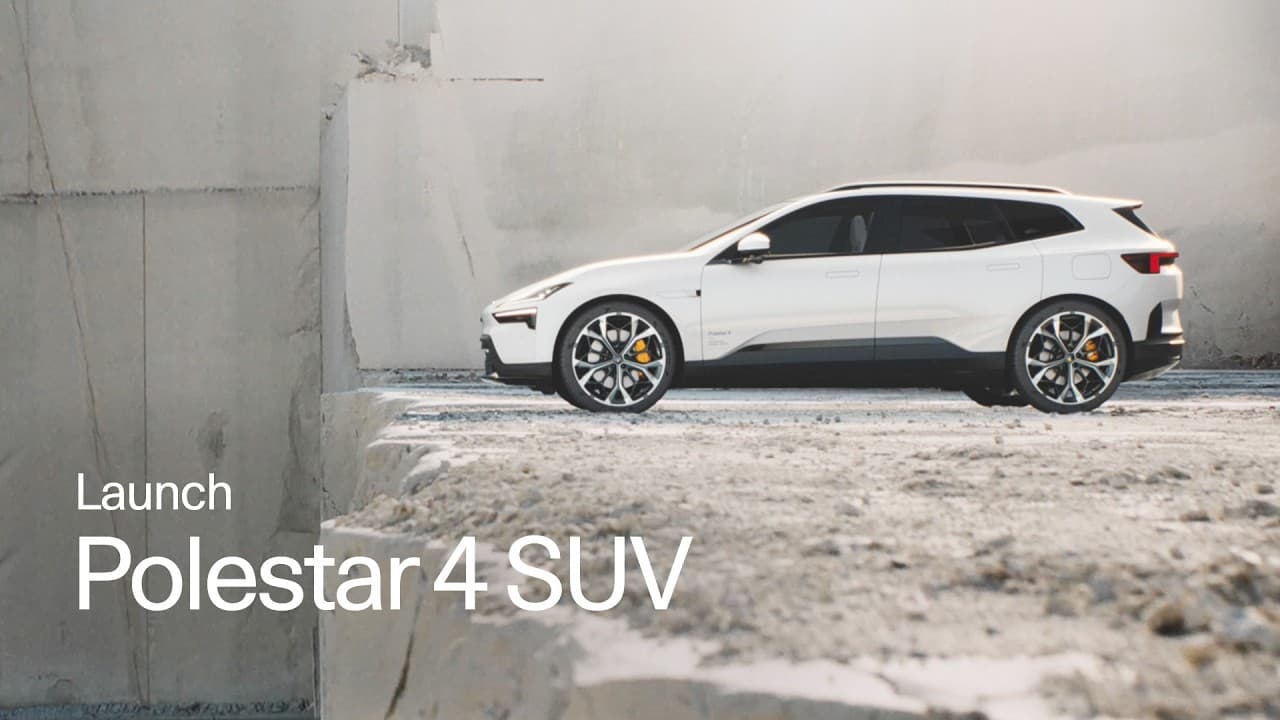
The Polestar 4 SUV is a new body variant of the three-year-old Polestar 4 coupe, going on sale September 2, 2026 with a more conventional SUV silhouette — and, notably, an actual rear window, something the original coupe famously did without in favor of a camera-only rear-view system. Built on the same 100 kWh battery platform as the coupe and produced at Polestar's Busan, South Korea plant, the SUV keeps the same rear-motor and dual-motor AWD powertrain choices while adding a straighter roofline, a more upright tailgate, and full-length roof rails for genuinely useful cargo capacity. German pricing opens at €57,900 (about $67,200) for the single-motor Rear Motor trim and tops out at €76,300 (about $88,500) for the Performance-pack Dual Motor. First customer deliveries are due in Q4 2026 across most of Polestar's global markets — notably excluding the United States, where Polestar has no plans to sell the SUV following an import ban on the brand.
Performance & Specs
Every Polestar 4 SUV shares the same 100 kWh battery, with power and range varying by motor configuration. The entry Rear Motor trim uses a single 200 kW (272 hp) motor for a 7.3-second 0-100 km/h time, prioritizing range over performance. Step up to the Dual Motor AWD and total output jumps to 400 kW (544 hp) with 686 Nm of torque, cutting 0-100 km/h to 3.9 seconds — genuinely quick for a mid-size electric SUV. WLTP range actually runs slightly higher on the slower Rear Motor version (up to 630 km) than the more powerful Dual Motor (up to 600 km), the usual single-motor efficiency advantage playing out here as it does on most EVs offered in both configurations.

| Powertrain | Dual-motor AWD BEV |
|---|---|
| Power | 400 kW (544 hp) |
| Torque | 686 Nm |
| 0–100 km/h | 3.9 s |
| Battery | 100 kWh |
| Range | Up to 600 km (WLTP) |
| POWERTRAIN TYPE | BEV, single or dual motor |
|---|---|
| HORSEPOWER | 272 hp (Rear Motor) / 544 hp (Dual Motor) |
| ACCELERATION | 7.3 s (Rear Motor) / 3.9 s (Dual Motor), 0-100 km/h |
| DRIVETRAIN | RWD (Rear Motor) / AWD (Dual Motor) |
| BATTERY | 100 kWh |
| WLTP RANGE | Up to 630 km (Rear Motor) / Up to 600 km (Dual Motor) |
Dimensions & Practicality
Polestar hasn't published a full set of exterior dimensions specific to the SUV body style separate from the coupe, but the practical differences are clear from the spec sheet: second-row headroom improves by 2.5 cm over the coupe thanks to the straighter roofline, and total storage capacity reaches 1,680 liters, with 1,665 liters of luggage space once the rear seats are folded. Full-length roof rails, standard on the SUV, add a 100 kg roof-load rating for roof-box or bike-rack use that the coupe's smoother roofline wasn't designed around.

| Cargo (total) | 1,680 L |
|---|---|
| Cargo (seats folded) | 1,665 L |
| Roof load | 100 kg |
| 2nd row headroom | +2.5 cm vs. coupe |
| CARGO VOLUME (TOTAL) | 1,680 L |
|---|---|
| CARGO VOLUME (SEATS FOLDED) | 1,665 L |
| ROOF LOAD CAPACITY | 100 kg |
Charging & Battery
The Polestar 4 SUV's 100 kWh battery supports up to 200 kW DC fast charging regardless of motor configuration, and 22 kW AC charging is available in selected markets for faster home or destination charging than the standard onboard charger allows. Polestar has not published a specific 10-80% DC charge time for the SUV body style separately from the coupe.
| BATTERY | 100 kWh |
|---|---|
| AC CHARGING | Up to 22 kW (selected markets) |
| DC FAST CHARGING | Up to 200 kW |
Design & Interior
The Polestar 4 SUV keeps the coupe's minimalist Scandinavian design language up front — the same slim LED headlight signature and clean, largely unadorned fascia — but diverges meaningfully from the roofline back. Where the coupe's fastback shape and lack of a rear window became its signature (and most polarizing) styling decision, the SUV adopts a straighter roofline and a more conventional, upright tailgate, restoring both a real rear window and a standard interior rear-view mirror. It's a deliberate practicality-over-drama trade, aimed at buyers who liked the Polestar 4's technology and performance but found the coupe's cargo access and rear visibility genuinely limiting day to day.
Technology & Features
Polestar carries over the Polestar 4 coupe's core technology suite to the SUV, unchanged aside from the rear-visibility hardware itself: the coupe's camera-based digital rear-view mirror is replaced here with a real glass rear window and a conventional mirror, reversing one of the coupe's most talked-about (and most debated) design decisions. The rest of the cabin tech, infotainment platform, and driver-assistance suite carry over from the existing Polestar 4 lineup, including the Android Automotive-based operating system, Google services baked directly into the car rather than mirrored from a phone, and the brand's usual over-the-air update cadence for both infotainment and drivetrain software. Polestar has also continued its practice of prioritizing sustainable materials in the cabin across the lineup, an area the brand has leaned on as a differentiator against both German luxury rivals and other Chinese-backed premium EV brands.
Safety & ADAS
Polestar has not published SUV-specific ADAS documentation separate from the existing Polestar 4 coupe's safety suite as of this writing; expect the same driver-assistance hardware and software to carry over given the shared platform and battery. The restored rear window is arguably a safety-relevant change in its own right, not just a styling one: a real glass rear window paired with a conventional mirror gives the driver a direct, unprocessed view rearward that a camera-and-screen setup, however well implemented, can't fully replicate in every lighting and weather condition.
| ADAS LEVEL | Not officially disclosed (SUV-specific) |
|---|---|
| ADAS FEATURES | Carried over from the Polestar 4 coupe platform |
Available Versions
| VERSION | POWER | TORQUE | 0-100 | DRIVETRAIN | BATTERY | WLTP RANGE | PRICE | KEY DIFFERENCES |
|---|---|---|---|---|---|---|---|---|
| Rear Motor | 272 hp | — | 7.3s | RWD | 100 kWh | 630 km | $67,200 | Entry trim, longest range |
| Dual Motor | 544 hp | 686 Nm | 3.9s | AWD | 100 kWh | 600 km | $76,400 | Dual-motor AWD, mid trim |
| Dual Motor Performance Pack | 544 hp | 686 Nm | 3.9s | AWD | 100 kWh | 600 km | $88,500 | Range-topping trim with Performance Pack |
Pricing & Availability
The Polestar 4 SUV went on sale September 2, 2026, with German pricing running from €57,900 (about $67,200) for the Rear Motor to €76,300 (about $88,500) for the Dual Motor with Performance Pack; the standard Dual Motor sits between the two at €65,900 (about $76,400). Production takes place at Polestar's Busan, South Korea plant, and the SUV rolls out across most of Polestar's global markets with first customer deliveries planned for Q4 2026. Polestar has confirmed the SUV will not be sold in the United States, following the brand's recently announced US import ban.
How It Compares
The Polestar 4 SUV genuinely undercuts every one of these premium electric SUV rivals on price while matching or beating their range figures on the entry Rear Motor trim — only the NIO ES9's 697 hp output clearly outguns the Polestar's 544 hp flagship. Against the Audi Q4 e-tron specifically, the Polestar offers a meaningful power and range advantage for roughly the same money, while the AITO M9 and NIO ES9 both come from brands with a more limited service and charging footprint outside China than Polestar's more globally established network. For buyers who wanted the Polestar 4 coupe's tech and performance but needed a proper rear window and more usable cargo space, this SUV variant closes that gap without asking a price premium over the coupe.
- Undercuts the Audi Q4 e-tron and AITO M9 on price while matching or beating their range and power
- Restores a genuine rear window and conventional mirror that many coupe buyers specifically asked for
- 1,680 liters of total cargo capacity plus a 100 kg roof-rail rating make it meaningfully more practical than the coupe
- Not available in the United States following Polestar's import ban there
- Dual Motor's extra power comes with a real-world range penalty (600 km vs. 630 km on the Rear Motor)
The Polestar 4 SUV is the practical answer to the coupe's biggest real-world complaint, and it arrives with genuinely competitive pricing against premium EV SUV rivals rather than a premium-for-practicality markup. The Rear Motor trim is the value pick for buyers prioritizing range, while the Dual Motor delivers genuinely quick performance without sacrificing much everyday usability. The only real asterisk is market availability — this is not a car for US buyers, at least for now — but everywhere else it's a strong, well-priced entry in a crowded segment.