
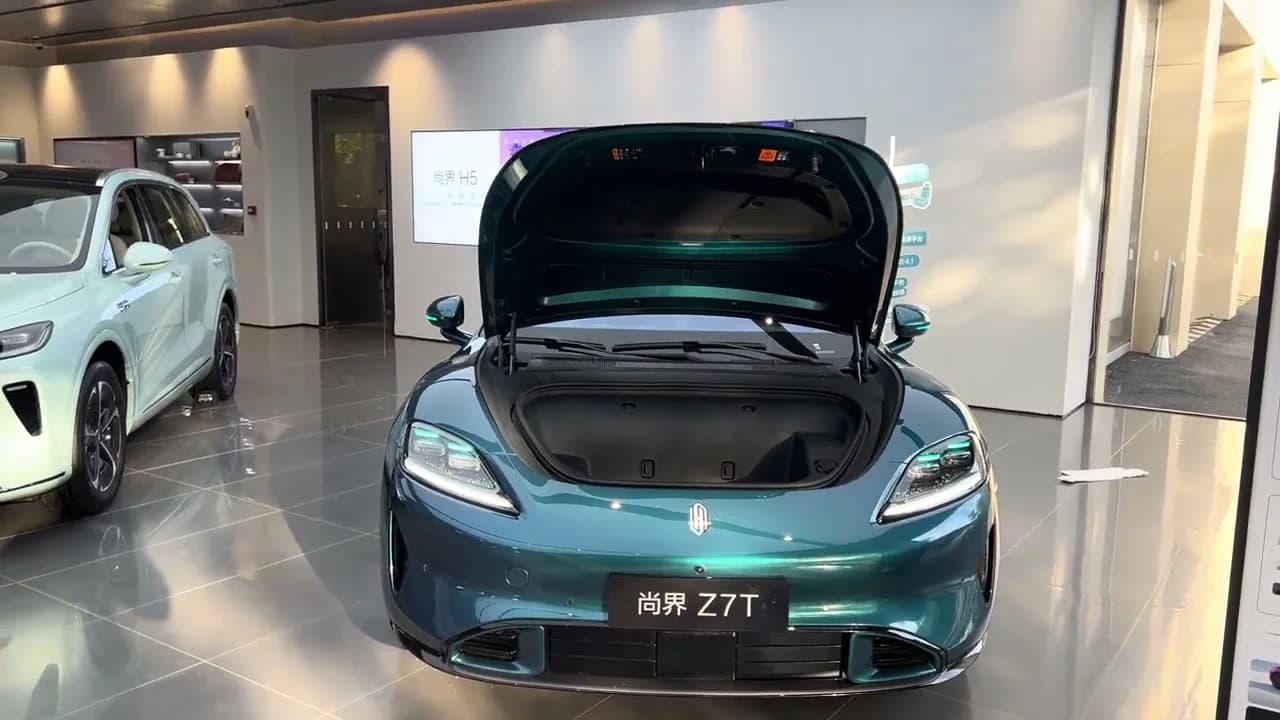
The 2026 SAIC Z7T (sold under the new Shangjie brand — Huawei's joint venture with SAIC Motor) is the shooting-brake variant of the Z7 sedan, jointly developed under Huawei's HIMA (Harmony Intelligent Mobility Alliance) framework and unmistakably positioned as the Chinese answer to a Porsche Taycan Sport Turismo at roughly a third of the price. Pre-orders opened on March 23, 2026, and within weeks the Shangjie Z7 / Z7T line had logged over 80,000 confirmed reservations across both body styles. The Z7T shooting brake carries a RMB 10,000 premium over the Z7 sedan, putting its price band at RMB 229,800 to RMB 309,800 (about $33,500 to $45,150). At the top, the Z7T Ultra delivers 434 kW (582 hp) from a dual-motor AWD setup paired with a 100 kWh CATL ternary lithium battery, hitting 100 km/h in 3.44 seconds and covering 905 km on the CLTC cycle — segment-leading numbers for a body shape that historically sells more on style than on raw spec. Huawei's Qiankun ADS provides the brains, complete with a roof-mounted 896-line LiDAR.
Performance & Specs
The Z7T comes in two distinct powertrain configurations. The base RWD version uses a single rear motor producing 264 kW (354 hp) and 416 Nm of torque — already enough for sub-six-second 0-100 sprints. The Ultra AWD adds a front motor for a combined 434 kW (582 hp) and 760 Nm, dropping the 0-100 figure to a remarkable 3.44 seconds and pushing top speed to a governed 240 km/h. All trims share the same 800V high-voltage architecture and CATL ternary lithium battery, with two pack sizes available — 81 kWh on the entry trims and 100 kWh on the long-range and Ultra variants. Real-world acceleration on the Ultra is helped by genuine sports-car-class tyre fitment: 275/40 R20 Pirelli rubber as standard.

| POWERTRAIN TYPE | BEV (RWD single-motor or AWD dual-motor) |
|---|---|
| HORSEPOWER | 354 hp (264 kW) RWD / 582 hp (434 kW) AWD Ultra |
| TORQUE | 416 Nm (RWD) / 760 Nm (AWD) |
| ACCELERATION 0-100 | 3.44 s (Ultra AWD) / ~5.8 s (RWD) |
| TOP SPEED | 240 km/h |
| DRIVETRAIN | RWD (entry) / AWD (Ultra) |
| BATTERY | 81 kWh or 100 kWh CATL ternary lithium |
| RANGE (CLTC) | up to 905 km |
Dimensions & Practicality

| Length | 5,030 mm |
|---|---|
| Width | 1,970 mm |
| Height | 1,460 mm |
| Wheelbase | 3,000 mm |
| Ground clearance | ~100 mm |
At 5.03 metres long with a 3-metre wheelbase and just 1.46 metres tall, the Z7T sits firmly in shooting-brake territory — same family DNA as a Porsche Panamera Sport Turismo or BMW i5 Touring, but with a sleeker rear glass house. The five-seat cabin uses individual sports-style front seats and a bench-style rear that takes three adults comfortably given the wheelbase. Cargo behind the rear seats is 475 litres, expanding to 1,600 litres with the rear seats folded — practical for a body shape often criticised for prioritising style over storage. A separate 90-litre frunk handles charging cables or carry-on bags. The 100 mm ground clearance gives the Z7T its sporting stance but limits it on rough surfaces — this is intentionally a road car.
| LENGTH | 5,030 mm |
|---|---|
| WIDTH | 1,970 mm |
| HEIGHT | 1,460 mm |
| WHEELBASE | 3,000 mm |
| GROUND CLEARANCE | ~100 mm |
| CARGO VOLUME | 475 L (1,600 L seats folded) |
| FRUNK | 90 L |
| SEATING | 5 |
| WHEELS / TYRES | 20-inch alloys / 275/40 R20 Pirelli |
Charging & Battery
The Z7T runs on an 800V high-voltage architecture — the now-standard for premium Chinese EVs in 2026, supporting fast DC charging up to about 250 kW peak. Real-world charging from 10 to 80 percent takes around 15 minutes on a compatible charger. AC charging tops out at 11 kW. The 100 kWh CATL ternary lithium battery on the Ultra trim delivers up to 905 km of CLTC range — currently the longest-range figure of any production wagon-bodied EV. The 81 kWh entry battery on the Z7T base covers approximately 712 km CLTC. Real-world highway range will track typical CATL NMC efficiency at roughly 75-85% of CLTC depending on temperature and speed.
| BATTERY | 81 kWh (entry) / 100 kWh (Ultra) CATL NMC |
|---|---|
| ARCHITECTURE | 800V |
| AC CHARGING | 11 kW |
| DC FAST CHARGING | 10-80% in ~15 minutes (compatible charger) |
| RANGE (CLTC) | 712 km (81 kWh) / up to 905 km (100 kWh Ultra) |
Design & Interior
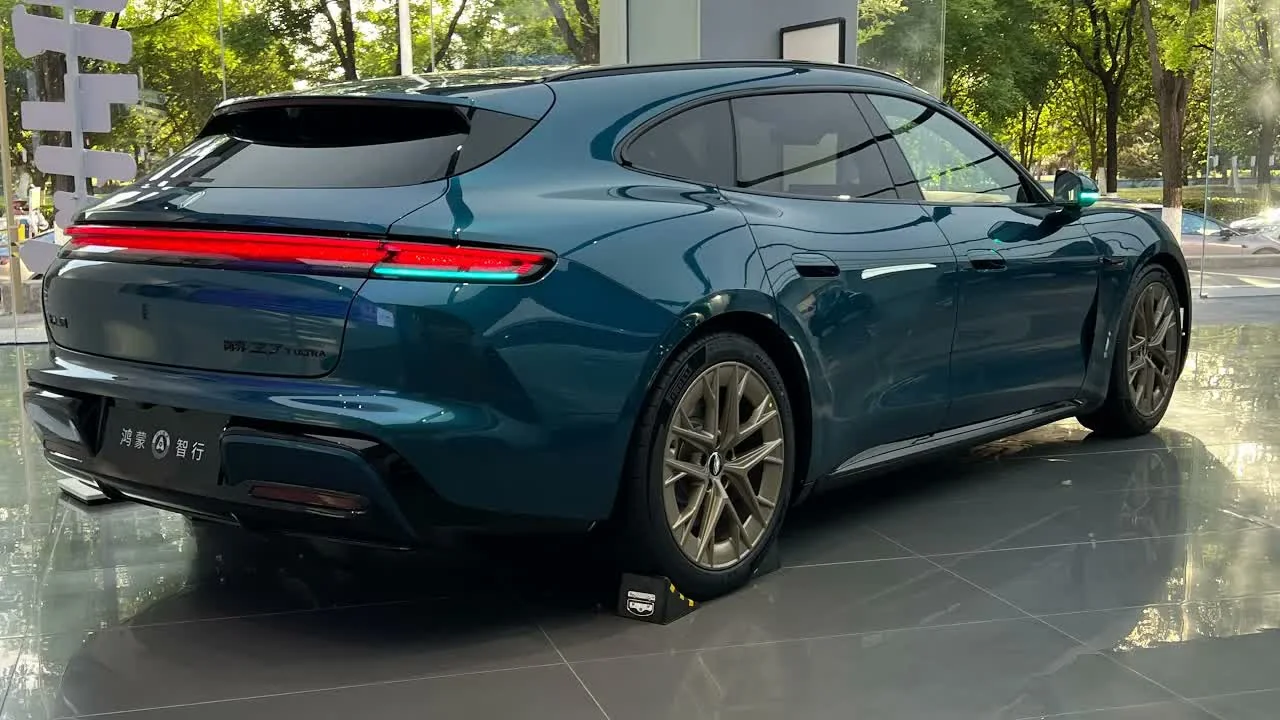
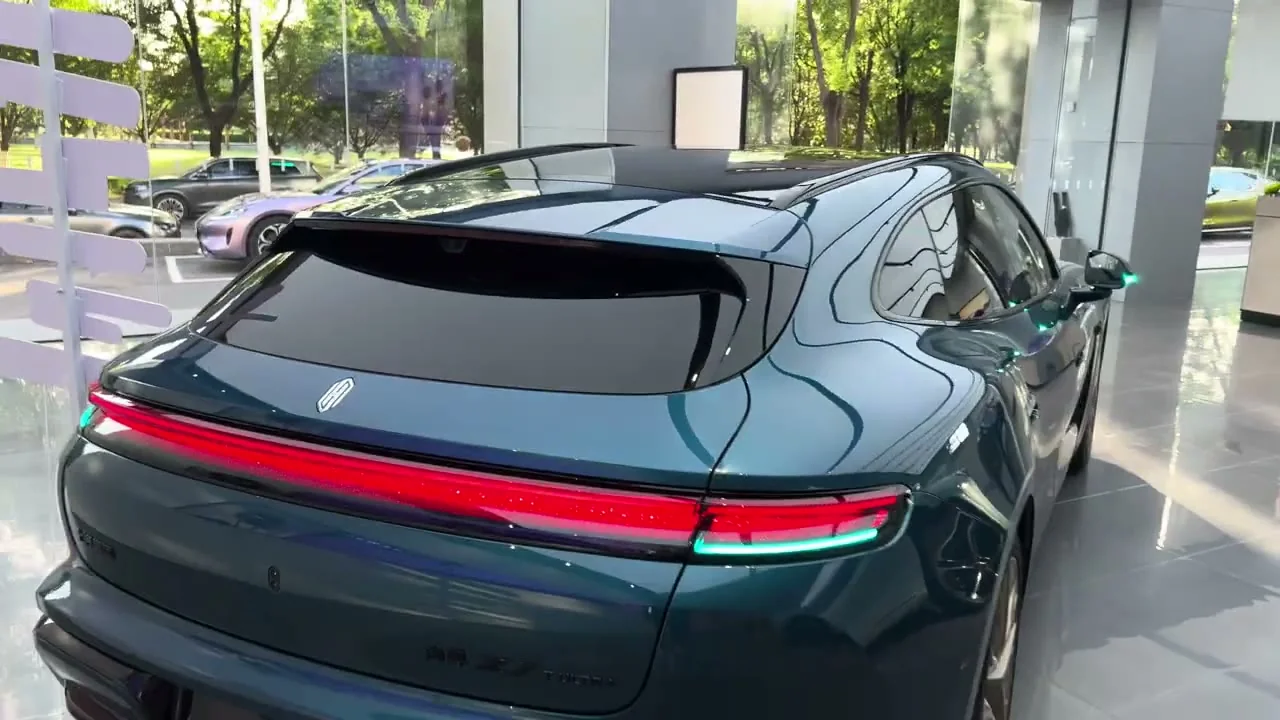
Even casual observers will notice the Porsche-Taycan-by-way-of-Polestar styling cues: the Z7T's roofline drops dramatically toward the rear, the side-glass tapers in a single elegant curve, and the rear wraps a full-width LED light bar with red brake lighting and turquoise running-light accents. The "Shangjie Z7T Ultra" badge sits at the centre of the rear lid, with HIMA branding on the lower decklid signalling Huawei's involvement. Inside, the cabin uses Italian Nappa leather across the seats, Alcantara on the dashboard top and headliner, and high-gloss carbon fibre or open-pore wood inserts depending on trim. The dashboard is dominated by a wide horizontal display strip plus a separate central touchscreen running HarmonyOS, with a head-up display projecting onto the windscreen. A 23-speaker premium audio system is standard from the Pro trim up. Frameless doors are standard.
Technology & Features
HarmonyOS infotainment runs the same software family deployed across AITO, Luxeed and Stelato — meaning seamless connection with Huawei phones and tablets, voice control across the cabin, and OTA updates to both cockpit and ADAS firmware. English-language support is built in from launch, easing future export adaptation. Standard equipment includes dual wireless phone chargers, in-armrest refrigerator, electric soft-close doors, ambient lighting, and an electric tailgate. The Ultra trim adds a panoramic glass roof with electrochromic dimming, massage and ventilation across all five seats, and an extended-colour ambient lighting package.
Safety & ADAS
Huawei's Qiankun ADS suite is the headline safety technology — the same software stack that's now standard on every AITO and Luxeed model. The hardware suite on the Z7T Ultra includes a roof-mounted 896-line LiDAR (a finer-resolution sensor than the more common 192-line variants), 4D millimeter-wave radars, 11 cameras and 12 ultrasonic sensors. This supports point-to-point Navigate-on-Autopilot in both highway and urban environments, automated parking, and Automatic Emergency Steering at speeds up to 130 km/h. Passive safety covers the full airbag set including curtain bags for both rows, plus a structural target of five-star C-NCAP.
| ADAS LEVEL | L2++ (Huawei Qiankun ADS — point-to-point NOA highway + urban) |
|---|---|
| ADAS HARDWARE | 896-line roof LiDAR, 4D mmWave radars, 11 cameras, 12 ultrasonic sensors |
| FEATURES | Highway NOA, urban NOA, AEB, ACC, LKA, BSM, 360° transparent chassis, AES at 130 km/h, valet park |
Available Versions
| VERSION | POWER | BATTERY | RANGE | PRICE | KEY DIFFERENCES |
|---|---|---|---|---|---|
| Z7T (base RWD) | 354 hp (264 kW) | 81 kWh CATL | ~712 km CLTC | ~$33,500 | Single rear motor, base ADAS hardware, 20-inch alloys |
| Z7T Pro RWD | 354 hp (264 kW) | 100 kWh CATL | ~873 km CLTC | ~$38,200 | Long-range battery, full Qiankun ADS |
| Z7T Ultra AWD | 582 hp (434 kW) | 100 kWh CATL | ~905 km CLTC | ~$45,150 | Dual-motor AWD, 0-100 in 3.44 s, 896-line LiDAR, premium audio, panoramic glass roof |
Pricing & Availability
Pre-orders for the SAIC Z7T opened on March 23, 2026 in mainland China, with deliveries scheduled to begin in May 2026. Pricing spans RMB 229,800 to RMB 309,800 ($33,500 to $45,150) — a RMB 10,000 premium over the matching Z7 sedan trim. The combined Z7 / Z7T programme has logged over 80,000 confirmed pre-orders within the first four weeks, putting it on track to be one of the most successful HIMA launches yet. International expansion through Huawei's growing partnership network has been hinted at but not formally announced.
How It Compares
This is one of the most crowded segments of the 2026 China EV market — three direct rivals all offering similar shooting-brake silhouettes at similar prices. The Xiaomi SU7 (technically a sedan, not a wagon, but the closest comparator on chassis size and price) is the obvious comparison, matching the 905 km range claim and pulling the same crowd. Versus the SU7, the Z7T trades absolute peak power for a more practical body and Huawei's industry-leading Qiankun ADS suite. The ZEEKR 007 GT is the Z7T's most direct shooting-brake rival, undercutting on price and matching closely on power, but lagging on range and ADAS. The BYD Denza Z9 GT goes further on power and offers a PHEV alternative, but at significantly higher pricing. For buyers who specifically want the wagon body plus Huawei's tech stack, the Z7T is the only game in town at this price.
- Up to 905 km CLTC range — segment-leading for a wagon-bodied EV
- Huawei Qiankun ADS with 896-line LiDAR — among the most advanced ADAS hardware shipping in 2026
- 3.44 s 0-100 on the Ultra AWD trim is sports-car-class for the price
- 80,000+ pre-orders proves market validation; HIMA service network already in place
- 100 mm ground clearance — strictly a road car, no off-road or even rough-road capability
- 5-seat-only — the wagon body offers no third-row option for buyers who need it
- Brand recognition outside China still limited; "Shangjie" is a new HIMA name many buyers will need to learn
The SAIC Z7T is the clearest sign yet that Huawei's HIMA programme is operating at full power. The combination of segment-leading 905 km CLTC range, Qiankun ADS, sub-3.5-second 0-100, and the increasingly rare shooting-brake silhouette — all at $33,500 to $45,150 — makes it the value play of the entire premium-wagon-EV segment. The Z7T Pro at $38,200 is the value sweet spot for buyers who want the long-range battery without the dual-motor premium; the Ultra is for those who want segment performance leadership. Either way, the 80,000+ pre-orders signal that this is a launch that's working — and that the next several years of premium-wagon competition in China just got a lot more interesting.