

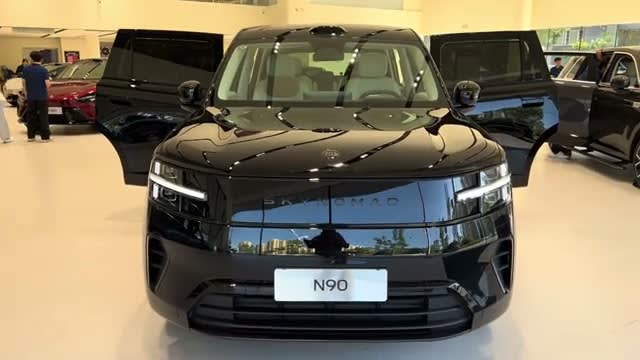
The Xiaomi SkyNomad N90 went on sale in China on September 7, 2026, and a dealer walkaround gives one of the clearest hands-on looks yet at Xiaomi's first range-extended EV. The N90 is the flagship of SkyNomad, Xiaomi's second vehicle line after the SU7 and YU7 electric cars, and it is built to compete directly with Li Auto's family SUVs. The N90 Max seen in the video is a 5.28-meter, seven-seat EREV SUV with a 76 kWh battery and a 1.5-liter range-extender engine that never touches the wheels. It launched at 269,900 yuan (about $40,300 at 6.70 yuan per dollar), 30,000 yuan below its pre-sale price. The car in the video is finished in gloss black with the cream-beige leather interior, sitting on the showroom floor next to a Zeekr 9X — the car the reviewer, and much of the Chinese market, treats as the N90's closest rival. Xiaomi also launched a five-seat N90 Max Explorer Edition with a factory electric pop-up roof at 299,900 yuan (about $44,800), and the SkyNomad range collected more than 10,000 locked-in orders within four minutes of the launch. Xiaomi is betting that its ecosystem integration and aggressive pricing can repeat the SU7 playbook in the premium family-SUV segment.
Performance & Specs
The N90 Max pairs a 1.5-liter turbocharged range-extender engine (112 kW / 150 hp, sourced from Changan subsidiary Harbin Dongan) with a dual-motor all-wheel-drive setup rated at 310 kW (416 hp) combined — a 210 kW (282 hp) front motor and a 100 kW (134 hp) rear motor. The gasoline engine only ever spins a generator to top up the 76 kWh CALB ternary-lithium battery; it never drives the wheels directly. Xiaomi quotes 5.9 seconds for 0-100 km/h and a 190 km/h top speed, and the reviewer reads the same figures off the car's own window sticker on camera. Peak torque has not been officially disclosed as of this writing — treat any specific torque number circulating online as unconfirmed, since two secondary aggregator sites quote two different figures (540 Nm and 690 Nm). Curb weight is about 2,800 kg in Xiaomi's regulatory filing. DC fast charging takes the pack from 20-80% in about 18 minutes, and Xiaomi claims a 15-minute charge adds about 285 km of CLTC range; peak DC charging power in kW has not been published.

| Powertrain | Dual-motor AWD EREV |
|---|---|
| Power | 310 kW (416 hp) |
| Torque | TBA (not officially disclosed) |
| 0–100 km/h | 5.9 s |
| Battery | 76 kWh (CALB ternary lithium) |
| Range | 464 km EV / 1,705 km combined (CLTC) |
| POWERTRAIN TYPE | EREV (range-extended EV) |
|---|---|
| HORSEPOWER | 310 kW (416 hp) |
| ACCELERATION | 5.9 s (0–100 km/h) |
| TOP SPEED | 190 km/h |
| DRIVETRAIN | Dual-motor AWD |
| BATTERY | 76 kWh (CALB ternary lithium) |
| ELECTRIC RANGE | 464 km (CLTC) |
| COMBINED RANGE | 1,705 km (CLTC) |
Dimensions & Practicality

| Length | 5,285 mm |
|---|---|
| Width | 1,998 mm |
| Height | 1,825 mm |
| Wheelbase | 3,080 mm |
| Curb weight | ∼2,800 kg |
| Seats | 7 (2+2+3 layout); 5 on the Explorer Edition |
At 5,285 mm long on a 3,080 mm wheelbase, the N90 is a genuinely large three-row SUV that the reviewer repeatedly measures on camera at "5.28 meters," confirming Xiaomi's own published figure. Front and rear track width both come in around 1,990 mm, and the showroom car rides on 21-inch wheels with staggered 255/45 (front) and 265/45 (rear) tires, with a ground clearance the reviewer pegs at roughly 200 mm. The N90 Max is a seven-seater in a 2+2+3 layout, and the captain's chairs visible in the second row on camera are part of that layout; the five-seat cabin belongs to the separate Explorer Edition described below. Boot space is rated at 577 litres with all rows in place, expanding to 1,831 litres (the reviewer rounds this to "1,800 liters" on camera) with the second and third rows folded flat. The front seats can rotate up to 180 degrees when parked — front-seat rotation is part of Xiaomi's launch-window benefit package — and the second row gets a fold-out table for use in that configuration. Air suspension is fitted, which the reviewer specifically calls out as sharing "the same concept" as the pricier Zeekr 9X.
| LENGTH | 5,285 mm |
|---|---|
| WIDTH | 1,998 mm |
| HEIGHT | 1,825 mm |
| WHEELBASE | 3,080 mm |
| CARGO VOLUME | 577 L (1,831 L seats folded) |
| CURB WEIGHT | 2,800 kg |
Charging & Battery
The N90 Max's 76 kWh ternary-lithium battery pack is supplied by CALB, and the 1.5-liter range-extender engine's only job is to spin a generator that tops the pack up on longer trips — it never drives the wheels directly. Xiaomi has not published the peak DC charging rate, but it quotes a 20-80% DC fast-charge time of about 18 minutes, and a 15-minute charge is claimed to add roughly 285 km of range. Xiaomi's official figures also list a 60-litre fuel tank and a WLTC fuel consumption of 6.26 L/100 km once the battery is depleted, which lines up with what the reviewer reads out on camera. AC charging specifications have not yet been disclosed.
| BATTERY | 76 kWh (CALB ternary lithium) |
|---|---|
| AC CHARGING | TBA (not disclosed) |
| DC FAST CHARGING | TBA (peak rate not disclosed) |
| DC 20-80% TIME | ∼18 min |
| FUEL TANK | 60 L (range-extender) |
| FUEL CONSUMPTION | 6.26 L/100 km (WLTC, battery depleted) |
Design & Interior
The showroom car's black paint shows off a slab-sided greenhouse, a full-width LED taillight bar with a red accent strip running through the "SKYNOMAD" script, and a front fascia with LED daytime running lights, LED headlights and LED high beams — there's no combustion engine to feed, so the front end mostly houses sensor and cooling ducting. Xiaomi's own aerodynamic work brought the drag coefficient down to 0.255 Cd, an unusually low figure the reviewer independently reads off the car's spec sheet as "0.25." Inside, the cream-beige leather cabin the video walks through pairs Alcantara dash trim with a diamond-quilted seat pattern, a glass roof, and a power-adjustable head-up display. The center console carries a glovebox, a ticket/document holder, a wireless charging pad, and a storage box built into the armrest. Second-row captain's chairs get their own rear entertainment screen and a central console with two cupholders and a dedicated control panel, and both front seats can rotate up to 180 degrees to face the second row when the car is parked — a five-second delay before the rotation engages is a deliberate safety pause built into the mechanism. One notable rough edge the reviewer flags directly: the infotainment software on this showroom unit is entirely in Chinese, with no English-language option available.
The N90 Max also gets 16-point zero-gravity massage seats and a 25-speaker, roughly 4,890 W audio system with 7.1.4 surround processing — a genuinely premium setup for the price bracket. Rear doors open to close to a 90-degree angle to ease child-seat access and third-row entry, and Xiaomi's "living room on wheels" pitch extends to a fold-out middle table and, on the separate Explorer Edition, a factory-integrated electric pop-up roof for camping use.
Technology & Features
The N90's driver-assistance hardware is built around the 4nm Nvidia Thor chip (roughly 700 TOPS) paired with two standard LiDAR units, one roof-mounted and one rear solid-state, running Xiaomi's in-house HAD assisted-driving software for highway and urban assistance. The 16.1-inch center touchscreen is driven by a Snapdragon 8 Gen 3 chip, and both it and the digital gauge cluster run Xiaomi's existing HyperOS car interface rather than an all-new system, which should make the transition familiar to existing SU7 and YU7 owners; the steering wheel hub carries the "SKYNOMAD" wordmark. Dual 5G and Wi-Fi connectivity keeps the car online for over-the-air updates and in-car streaming on long family road trips.
Safety & ADAS
Safety hardware includes 12 airbags backed by nine collision sensors, and Xiaomi says roughly 91% of the body structure uses high-strength steel and aluminum. Wading depth is rated at 750 mm, a figure more commonly quoted for off-roaders than family SUVs, and the published braking figure of 38.57 metres from 100 km/h to a stop is competitive for the class.
| ADAS LEVEL | Xiaomi HAD (LiDAR + Nvidia Thor compute; exact SAE level not specified by Xiaomi) |
|---|---|
| ADAS FEATURES | Two LiDAR units (roof and rear solid-state), 4D millimeter-wave radar, 11 cameras, 12 ultrasonic sensors, 700-TOPS Thor compute platform, highway/urban assist via Xiaomi HAD, 12 airbags, 9 collision sensors |

Available Versions
| VERSION | POWER | TORQUE | 0-100 | TOP SPEED | DRIVETRAIN | BATTERY | EV RANGE | COMBINED RANGE | PRICE | KEY DIFFERENCES |
|---|---|---|---|---|---|---|---|---|---|---|
| N90 Max | 416 hp | TBA | 5.9 s | 190 km/h | AWD | 76 kWh | 464 km | 1,705 km | $40,300 (¥269,900) | Seven-seat 2+2+3 flagship; 30,000 yuan below its pre-sale price |
| N90 Max Explorer | 416 hp | TBA | 5.9 s | TBA | AWD | 76 kWh | 462 km | 1,688 km | $44,800 (¥299,900) | Five-seat camper with a factory electric pop-up roof, heated floor and fold-flat bed |
The N90 Max Explorer Edition swaps the seven-seat layout for a five-seat cabin and adds a factory-integrated electric pop-up roof. With the roof raised, standing height inside reaches 2,294 mm and an upper loft of about 2,110 x 985 mm opens up, rated for 200 kg; the second row folds into a flat 1.87 x 1.24 m bed in about 30 seconds, and the floor is a wood-grain aluminium surface with three-level heating up to 38°C. Xiaomi also fits a 20-litre built-in wardrobe and lists a 30-inch projector. With the roof closed the body stands 1,925 mm tall, 100 mm taller than the standard N90, and Xiaomi allows the roof to be used only while parked on non-public roads. The Explorer is rated at 462 km of electric range and 1,688 km combined (CLTC), slightly below the standard car's 464 km and 1,705 km.
Xiaomi's smaller five-seat sibling, the SkyNomad N70, is a separate model rather than an N90 trim: the N70 Pro starts at 209,900 yuan (about $31,300) and the N70 Max at 239,900 yuan (about $35,800).
Pricing & Availability
Xiaomi launched the SkyNomad range in China on September 7, 2026 with four models: the N70 Pro at 209,900 yuan, the N70 Max at 239,900 yuan, the N90 Max at 269,900 yuan (about $40,300 at 6.70 yuan per dollar) and the N90 Max Explorer Edition at 299,900 yuan (about $44,800). The N90 Max is 30,000 yuan (10%) cheaper than the 299,900 yuan pre-sale price Xiaomi announced on July 30, which works out to about $44,800 at the same rate. Buyers who order before October 7 can claim launch-window benefits that Xiaomi values at up to 81,000 yuan on the N90 Max, plus a limited-time financing offer at 1.99% a year over five years with a down payment from 49,900 yuan. Cars from an initial batch can be locked with a 20,000 yuan deposit and are promised within one to five weeks, and deliveries began on September 12 in 75 Chinese cities — the black N90 Max in this video was seen on an active dealer floor next to a Zeekr 9X. The SkyNomad is sold only in China for now: as of September 2026 Xiaomi has not confirmed the model for Europe or any other market.
How It Compares
The reviewer spends much of the video comparing the N90 directly to the Zeekr 9X sitting next to it on the showroom floor — and the numbers show why. The 9X Max lists at 465,900 yuan, roughly $29,300 more than the N90 Max, and its 660 kW (885 hp) hybrid system is far more powerful, but it is rated at 300 km of electric range and 1,200 km combined against the N90's 464 km and 1,705 km (all CLTC). The Li Auto L9 Ultra starts at 459,800 yuan, about $28,300 above the N90 Max, with 420 kW (563 hp), 420 km of electric range and 1,650 km combined. The AITO M9 Max+ EREV starts at 479,800 yuan, about $31,300 more than the N90 Max, with 497 kW (667 hp), 340 km of electric range and 1,345 km combined, though AITO's Huawei-backed software has a longer market track record than Xiaomi's brand-new SkyNomad line. Against all three, the N90 Max's pitch is the same one Xiaomi used with the SU7: come in far below the segment's usual price and still beat or match it on the range figure that matters for road-trip buyers, while giving up power.
- Undercuts the large three-row EREVs from Li Auto, Zeekr and AITO by roughly $28,000-$31,000 at list price while matching or beating their combined range
- Two standard LiDAR units (roof and rear) and a 700-TOPS Nvidia Thor chip fitted as standard rather than sold as options
- Genuinely large 2+2+3 cabin with rotating front seats, air suspension, a 1,831 L max cargo hold and premium touches like 16-point massage seats and a 25-speaker sound system, plus an Explorer Edition with a factory pop-up roof
- The showroom car's infotainment software is Chinese-only with no English interface, and its 416 hp trails the 563-885 hp of the rivals above
- Brand-new line with no ownership or reliability track record, and sold only in China as of September 2026
Seeing the SkyNomad N90 Max in the metal rather than in press renders only reinforces the first impression: this is a genuinely aggressive opening shot at Li Auto and Zeekr's home turf, and the launch cut its price to 269,900 yuan, about $40,300, while the hardware — two standard LiDAR units, a 700-TOPS compute platform, air suspension, a 25-speaker audio system — still undercuts segment leaders on both spec sheet and price. The catches are real, though: this is a brand nobody has owned a car from yet, the cabin software on the showroom car isn't localized past Chinese, and it can only be bought in China for now. For buyers who trust Xiaomi's execution after the SU7 and YU7, and who can wait for deliveries, the N90 Max looks like one of the sharper value plays in China's family-SUV segment this year.