
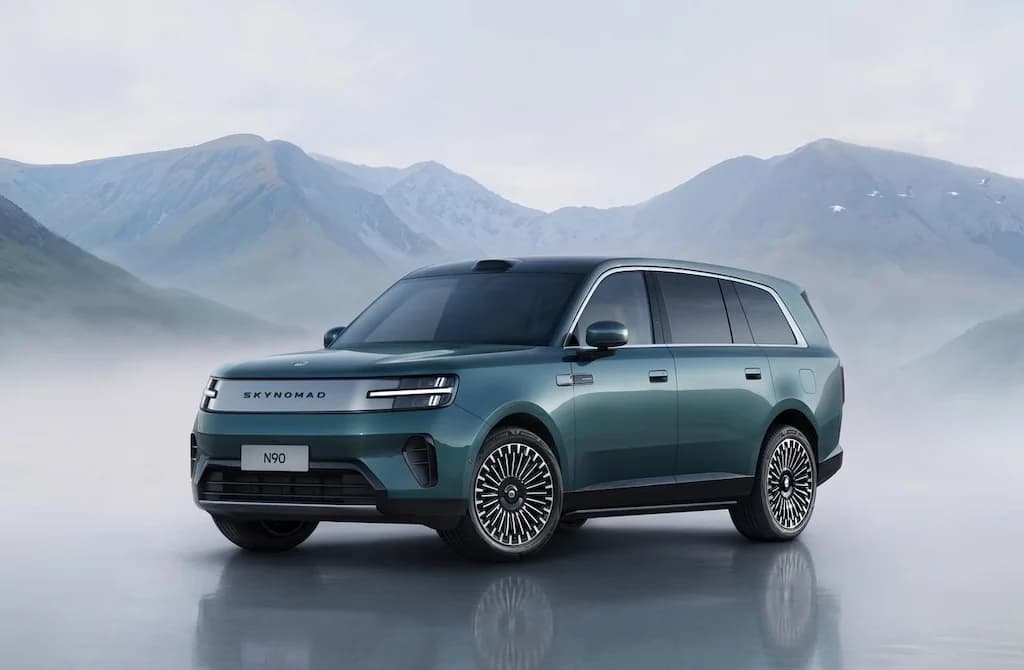
Xiaomi's first range-extended EV is not another SU7 or YU7 variant. SkyNomad is the company's second vehicle line and its first dedicated EREV lineup, built to go straight after Li Auto's family-hauler SUVs. Xiaomi published the first N90 images on July 10, 2026, opened pre-sales on July 30, showed the car at the Chengdu Auto Show on August 21 and launched it on September 7. The N90 is the larger of the two launch models: a full-size, three-row EREV SUV with a 76 kWh battery and a 1.5-liter range-extender engine that only ever spins a generator. The N90 Max is priced at 269,900 yuan (about $40,300 at 6.70 yuan per dollar), roughly $28,000 below the Li Auto L9 and about $29,000 below the Zeekr 9X, while topping their combined-range figures. Xiaomi is betting that its phone-and-appliance ecosystem, HyperOS integration, and aggressive pricing can do to the premium family-SUV segment what the SU7 did to sport sedans.
Performance & Specs
The N90 Max pairs a 1.5-liter turbocharged four-cylinder range-extender engine (sourced from Changan subsidiary Dongan, 112 kW / 150 hp) with a dual-motor all-wheel-drive setup rated at 310 kW (416 hp) combined — a 210 kW (282 hp) front motor plus a 100 kW (134 hp) rear motor. The gasoline engine never drives the wheels directly; it exists purely to spin a generator and top up the 76 kWh ternary-lithium battery pack (supplied by CALB) on longer trips. Xiaomi quotes a 0-100 km/h time of 5.9 seconds and a top speed of 190 km/h, brisk for a nearly 5.3-metre, seven-seat family SUV. Peak torque has not been officially disclosed by Xiaomi as of this writing, so treat any specific torque figure circulating online as unconfirmed. DC fast charging takes the battery from 20-80% in about 18 minutes, and a 15-minute top-up is claimed to add roughly 285 km of range. The 505 km EV-range figure that is sometimes quoted for SkyNomad belongs to the smaller N70 Max sibling; the bigger, heavier N90 Max is rated at 464 km CLTC on electric power alone.

| Powertrain | Dual-motor AWD EREV |
|---|---|
| Power | 310 kW (416 hp) |
| Torque | TBA (not officially disclosed) |
| 0–100 km/h | 5.9 s |
| Battery | 76 kWh (CALB ternary lithium) |
| Range | 464 km EV / 1,705 km combined (CLTC) |
| POWERTRAIN TYPE | EREV (range-extended EV) |
|---|---|
| HORSEPOWER | 310 kW (416 hp) |
| ACCELERATION | 5.9 s (0–100 km/h) |
| TOP SPEED | 190 km/h |
| DRIVETRAIN | Dual-motor AWD |
| BATTERY | 76 kWh (CALB ternary lithium) |
| ELECTRIC RANGE | 464 km (CLTC) |
| COMBINED RANGE | 1,705 km (CLTC) |
Dimensions & Practicality

| Length | 5,285 mm |
|---|---|
| Width | 1,998 mm |
| Height | 1,825 mm |
| Wheelbase | 3,080 mm |
| Curb weight | ∼2,800 kg |
| Seats | 7 (2+2+3 layout); 5 on the Explorer Edition |
At 5,285 mm long on a 3,080 mm wheelbase, the N90 is a genuinely large three-row SUV, and its 2,760 mm cabin length gives genuinely usable third-row legroom rather than token jump seats. The N90 Max is a seven-seater in a 2+2+3 layout with second-row captain's chairs, and the front seats can rotate up to 180 degrees to face the second row when the car is parked. Boot space is rated at 577 litres with all three rows in place, expanding to 1,831 litres with the second and third rows folded flat. Xiaomi's separate N90 Max Explorer Edition has a five-seat cabin and a factory electric pop-up roof aimed at China's camping and road-trip market, and its body stands 1,925 mm tall with the roof closed, 100 mm above the standard 1,825 mm.
| LENGTH | 5,285 mm |
|---|---|
| WIDTH | 1,998 mm |
| HEIGHT | 1,825 mm |
| WHEELBASE | 3,080 mm |
| CARGO VOLUME | 577 L (1,831 L seats folded) |
Charging & Battery
The N90 Max's 76 kWh ternary-lithium battery pack is supplied by CALB, and the range-extender engine's only job is to spin a generator that tops the pack up on longer trips rather than ever driving the wheels directly. Xiaomi has not published the peak DC charging rate, but the automaker quotes a 20-80% DC fast-charge time of about 18 minutes, and a 15-minute splash charge is claimed to add roughly 285 km of range. Official figures also list a 60-litre fuel tank and a WLTC fuel consumption of 6.26 L/100 km with the battery depleted. AC charging specifications have not yet been disclosed.
| BATTERY | 76 kWh (CALB ternary lithium) |
|---|---|
| AC CHARGING | TBA (not disclosed) |
| DC FAST CHARGING | TBA (peak rate not disclosed) |
| DC 20-80% TIME | ∼18 min |
| FUEL TANK | 60 L (range-extender) |
| FUEL CONSUMPTION | 6.26 L/100 km (WLTC, battery depleted) |
Design & Interior
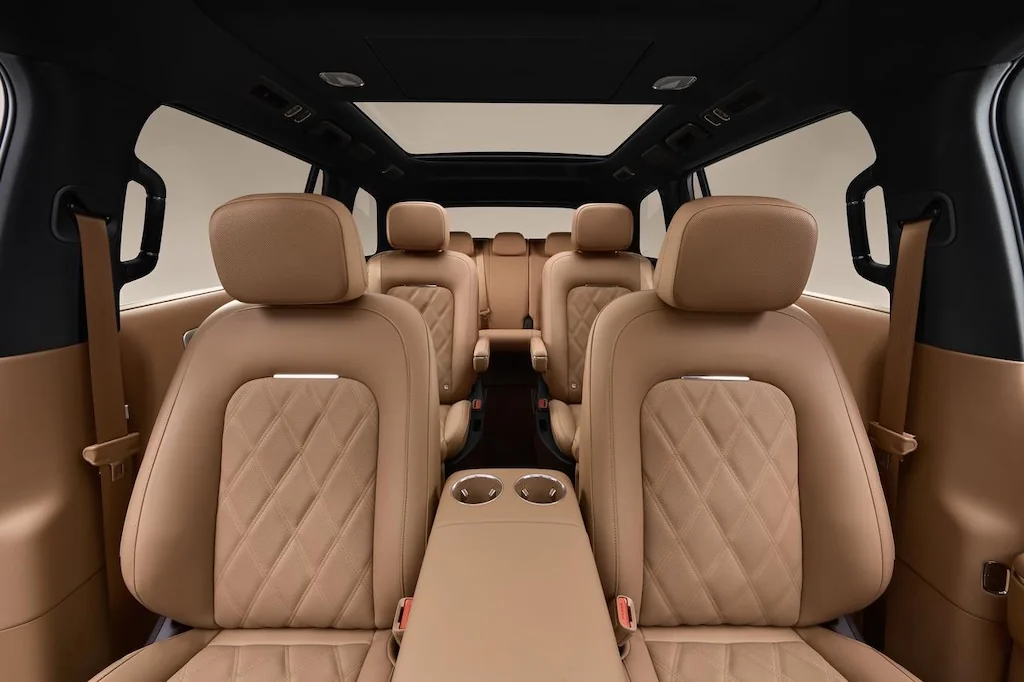
Several outlets covering the reveal noted a visual family resemblance to boxy British luxury SUVs, with a tall, slab-sided greenhouse, a wide vertical grille-like front fascia (there is no combustion engine to feed, so it largely houses sensors and cooling ducts), and flush door handles. Xiaomi leaned into a "living room on wheels" pitch for the interior rather than a sporty one: both front seats can rotate up to 180 degrees so occupants can face each other or the middle row when the car is parked, and Xiaomi offers an optional fold-out table between the seats for that use case. The N90 Max's cabin gets 16-point zero-gravity massage seats, and Xiaomi is pushing a genuinely premium audio setup for the segment — a 25-speaker system with roughly 4,890 W of amplification and 7.1.4 surround processing, well beyond what most EREV family SUVs in this price bracket offer.
Materials and trim finishes have not been fully itemized in English-language coverage yet, but Xiaomi's own product photography shows a mix of soft-touch upper dash surfaces, a large centre console bridge, and a minimalist digital cockpit that leans on Xiaomi's existing HyperOS car interface rather than introducing an entirely new system. The rear doors open to close to a 90-degree angle to ease child-seat access and third-row entry, a detail Xiaomi specifically called out during the reveal.
Technology & Features
The N90's driver-assistance hardware is built around a 4nm Nvidia Thor chip with roughly 700 TOPS of compute, paired with two standard LiDAR units, one roof-mounted and one rear solid-state. That hardware runs Xiaomi HAD, the company's in-house assisted-driving software stack, for highway and urban driving assistance. The car also gets dual 5G and Wi-Fi connectivity for a more stable always-on link than single-modem systems, useful for over-the-air updates and in-car streaming on long family road trips.
Safety & ADAS
Safety hardware includes 12 airbags backed by nine collision sensors, and Xiaomi says roughly 91% of the body structure uses high-strength steel and aluminum. Wading depth is rated at 750 mm, a figure more commonly quoted for off-roaders than family SUVs, and the published braking figure of 38.57 metres from 100 km/h to a stop is competitive for the class.
| ADAS LEVEL | Xiaomi HAD (LiDAR + Nvidia Thor compute; exact SAE level not specified by Xiaomi) |
|---|---|
| ADAS FEATURES | Two LiDAR units (roof and rear solid-state), 4D millimeter-wave radar, 11 cameras, 12 ultrasonic sensors, 700-TOPS Thor compute platform, highway/urban assist via Xiaomi HAD, 12 airbags, 9 collision sensors |
Available Versions
| VERSION | POWER | TORQUE | 0-100 | TOP SPEED | DRIVETRAIN | BATTERY | EV RANGE | COMBINED RANGE | PRICE | KEY DIFFERENCES |
|---|---|---|---|---|---|---|---|---|---|---|
| N90 Max | 416 hp | TBA | 5.9 s | 190 km/h | AWD | 76 kWh | 464 km | 1,705 km | $40,300 (¥269,900) | Seven-seat 2+2+3 flagship; 30,000 yuan below its pre-sale price |
| N90 Max Explorer | 416 hp | TBA | 5.9 s | TBA | AWD | 76 kWh | 462 km | 1,688 km | $44,800 (¥299,900) | Five-seat camper with a factory electric pop-up roof, heated floor and fold-flat bed |
The N90 Max Explorer Edition swaps the seven-seat layout for a five-seat cabin and adds a factory-integrated electric pop-up roof. With the roof raised, standing height inside reaches 2,294 mm and an upper loft of about 2,110 x 985 mm opens up, rated for 200 kg; the second row folds into a flat 1.87 x 1.24 m bed in about 30 seconds, and the floor is a wood-grain aluminium surface with three-level heating up to 38°C. Xiaomi allows the roof to be used only while parked on non-public roads. The Explorer is rated at 462 km of electric range and 1,688 km combined (CLTC). The smaller five-seat SkyNomad N70 is a separate model: the N70 Pro starts at 209,900 yuan (about $31,300) and the N70 Max at 239,900 yuan (about $35,800).
Pricing & Availability
Xiaomi opened pre-sales for the SkyNomad N90 Max at 299,900 yuan (about $44,800 at 6.70 yuan per dollar) on July 30, 2026, alongside the smaller N70 Max at 259,900 yuan (about $38,800). At the official launch on September 7 the N90 Max was cut to 269,900 yuan (about $40,300), a 10% reduction; the N70 Max fell to 239,900 yuan (about $35,800), and Xiaomi added an entry-level N70 Pro at 209,900 yuan (about $31,300) and the N90 Max Explorer Edition at 299,900 yuan. Orders placed before October 7 carry launch-window benefits that Xiaomi values at up to 81,000 yuan on the N90 Max, plus a 1.99% five-year financing offer. Deliveries began on September 12 in 75 Chinese cities, and the SkyNomad lineup logged more than 10,000 locked-in orders within four minutes of the launch. The SkyNomad is China-only for now: Xiaomi has said it plans to begin selling cars in Europe in 2027, but as of September 2026 it has not confirmed the SkyNomad for Europe or any other export market.
How It Compares
Xiaomi wants buyers to line the N90 up against Li Auto's flagship, and the numbers explain why. The Li Auto L9 Ultra starts at 459,800 yuan, about $28,300 more than the N90 Max, and offers more power (563 hp against 416 hp) but a lower rated range — 420 km electric and 1,650 km combined, against the N90's 464 km and 1,705 km (all CLTC). The Zeekr 9X Max lists at 465,900 yuan, roughly $29,300 above the N90 Max, with a far more powerful 660 kW (885 hp) hybrid system but 300 km of electric range and 1,200 km combined. The AITO M9 Max+ EREV is the priciest of the group at 479,800 yuan, about $31,300 more than the N90 Max, with 497 kW (667 hp), 340 km of electric range and 1,345 km combined, though AITO's Huawei-backed software ecosystem has a longer market track record than Xiaomi's brand-new SkyNomad line.
- Undercuts the large three-row EREVs from Li Auto, Zeekr and AITO by roughly $28,000-$31,000 at list price while matching or beating their combined range
- Two standard LiDAR units and a 700-TOPS Nvidia Thor chip fitted as standard rather than sold as options
- Genuinely large 2+2+3 cabin with rotating front seats and a 1,831 L max cargo hold, plus an Explorer Edition with a factory electric pop-up roof for camping
- At 416 hp it is well short of the 563-885 hp offered by the rivals it undercuts
- Brand-new line with no ownership or reliability track record, and sold only in China as of September 2026
The SkyNomad N90 Max is a genuinely aggressive opening shot at Li Auto's home turf: a bigger and far cheaper three-row EREV SUV than the segment's flagships, with hardware — two standard LiDAR units, a 700-TOPS compute platform — that undercuts segment leaders on both spec sheet and price. The catches are that nobody has owned one yet, it gives up a lot of power to the rivals it undercuts, and it can only be bought in China for now. For buyers who trust Xiaomi's execution after the SU7 and YU7, the N90 Max looks like one of the sharper value plays in China's family-SUV segment this year.