
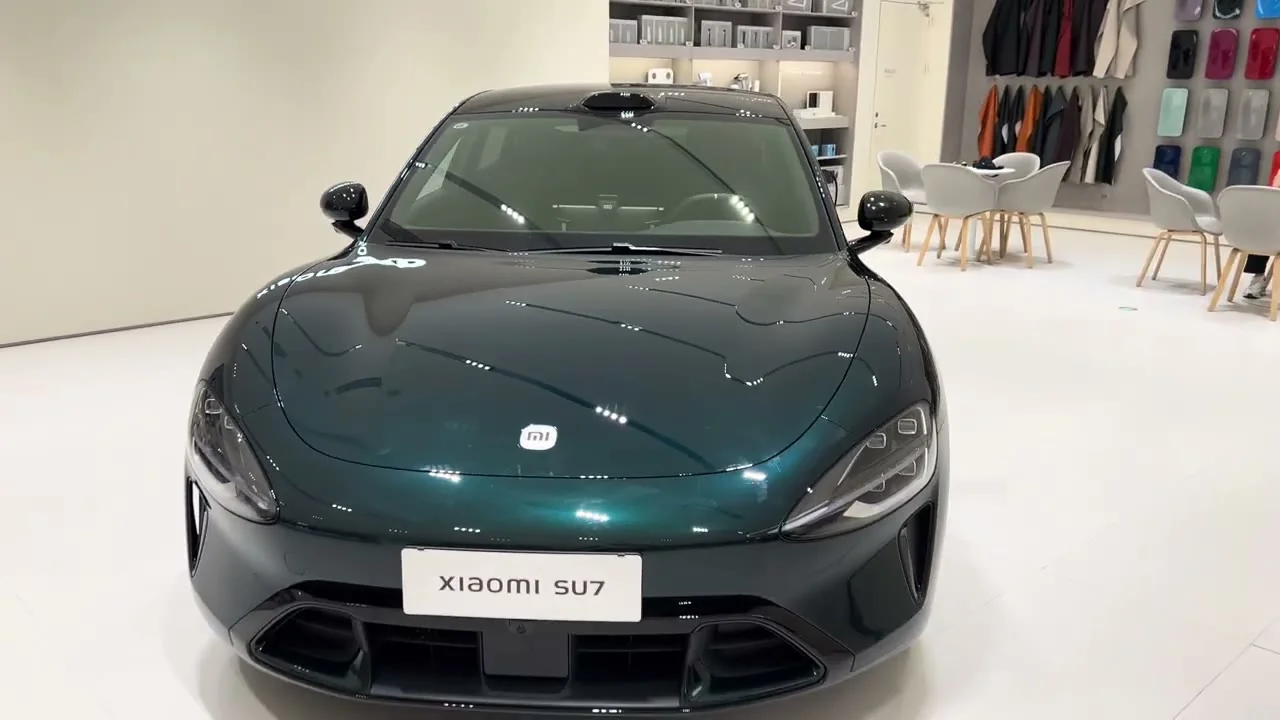
The 2026 Xiaomi SU7 is the second-generation refresh of the sedan that put Xiaomi on the auto-industry map — and the new model raises the bar in every direction. Launched in China on March 19, 2026 with three trims spanning RMB 219,900 to RMB 303,900 (about $31,870 to $44,040), the new SU7 logged 15,000 confirmed orders within 34 minutes of order books opening. The headline upgrade is the new Dragon Chassis, paired with two voltage architectures — a 752-volt silicon-carbide platform on the Standard and Pro, and an 897-volt SiC platform on the Max — supporting fast charging that adds 670 km of range in 15 minutes on the top trim. CLTC range tops out at 902 km on the Pro trim's 96.3 kWh LFP battery, while the Max delivers 690 hp from a dual-motor AWD setup with 0-100 km/h in roughly 3 seconds. Crucially, every 2026 SU7 trim ships with a roof-mounted LiDAR and an Nvidia Thor-U processor delivering 700 TOPS of compute — moving Xiaomi from "value tech-brand sedan" into the same ADAS hardware tier as the Shangjie Z7 and ZEEKR 007.
Performance & Specs
The new-gen SU7 splits sharply across its three trims. The Standard and Pro share a single rear-mounted electric motor producing 235 kW (320 hp) and 500 Nm of torque — enough for a 5.7-second 0-100 km/h sprint. The Max trim adds a front motor for a combined 508 kW (690 hp) AWD, dropping the same benchmark to roughly 3 seconds and pushing top speed close to 265 km/h. Where the Max really differentiates is the upgraded 897V silicon-carbide architecture (versus 752V on the lower trims) and the larger 101.7 kWh ternary lithium battery — the only chemistry change in the lineup, with Standard and Pro both using LFP for their 73 and 96.3 kWh packs respectively. All three trims ride on Xiaomi's new Dragon Chassis with adaptive damping; the Max adds dual-chamber air suspension as standard.

| POWERTRAIN TYPE | BEV (RWD single-motor or AWD dual-motor) |
|---|---|
| HORSEPOWER | 320 hp (235 kW) RWD / 690 hp (508 kW) AWD Max |
| TORQUE | 500 Nm (RWD) / ~838 Nm (AWD Max) |
| ACCELERATION 0-100 | ~3.0 s (Max) / 5.7 s (Standard/Pro RWD) |
| TOP SPEED | ~265 km/h (Max) |
| DRIVETRAIN | RWD (Standard / Pro) / AWD (Max) |
| BATTERY | 73 kWh LFP / 96.3 kWh LFP / 101.7 kWh ternary lithium |
| RANGE (CLTC) | 720 / 902 / 835 km — by trim |
Dimensions & Practicality

| Length | 4,997 mm |
|---|---|
| Width | 1,963 mm |
| Height | 1,455 mm |
| Wheelbase | 3,000 mm |
| Ground clearance | ~120 mm |
At just under 5 metres long with a 3-metre wheelbase, the SU7 sits between a Tesla Model 3 (4.7 m) and a Tesla Model S (5.0 m) in physical footprint — but with a noticeably more aggressive low-and-wide stance thanks to the 1,455 mm height. The five-seat cabin is well-laid-out for a performance sedan: comfortable rear legroom thanks to the wheelbase, but headroom is tight for taller passengers in the rear due to the sloping coupe-style roofline. Cargo capacity is a useful 493 litres in the boot, with a separate 105-litre frunk under the front clamshell hood for charging cables. Standard wheels are 19-inch on the Standard trim, 20-inch on Pro, and 21-inch forged alloys on the Max. The SU7 doesn't offer an air-suspension option below the Max trim, so the Standard and Pro rely on conventional dampers — capable but not as compliant as the Max.
| LENGTH | 4,997 mm |
|---|---|
| WIDTH | 1,963 mm |
| HEIGHT | 1,455 mm |
| WHEELBASE | 3,000 mm |
| GROUND CLEARANCE | ~120 mm |
| CARGO VOLUME | 493 L |
| FRUNK | 105 L |
| SEATING | 5 |
| WHEELS / TYRES | 19" (Standard) / 20" (Pro) / 21" forged (Max) — 245/45 R19 to 265/40 R21 |
Charging & Battery
The 2026 SU7 introduces two distinct charging architectures across the lineup. The Standard and Pro trims use a 752V silicon-carbide high-voltage platform — already faster than most current 800V cars in real-world testing. The Max steps up to a 897V SiC architecture that supports peak DC charging rates among the highest in the segment, adding 670 kilometres of range in just 15 minutes of charging on a compatible high-power station. AC charging tops out at 11 kW. The dual-chemistry battery strategy is unusual: LFP (lithium iron phosphate) for the Standard and Pro because of cost and longevity advantages, ternary lithium (NMC) for the Max because of higher energy density and better cold-weather performance. The Pro trim's 96.3 kWh LFP delivering 902 km CLTC range is the standout — the highest CLTC figure currently available on any production sedan EV at this price.
| BATTERY | 73 kWh LFP / 96.3 kWh LFP / 101.7 kWh ternary |
|---|---|
| ARCHITECTURE | 752V SiC (Standard / Pro) / 897V SiC (Max) |
| AC CHARGING | 11 kW |
| DC FAST CHARGING | 15 min adds ~670 km on Max; ~10-80% in 15-20 min on Standard / Pro |
| CHEMISTRY | LFP for Standard / Pro (longevity), Ternary for Max (energy density) |
Design & Interior
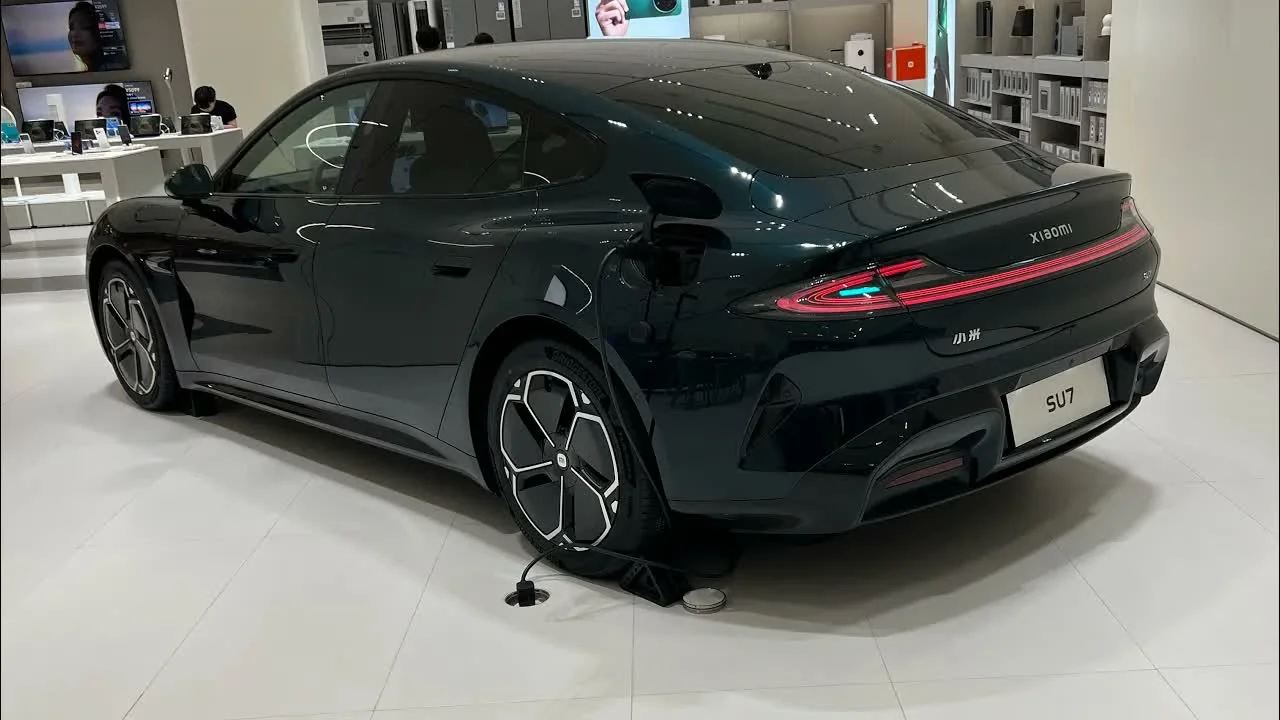
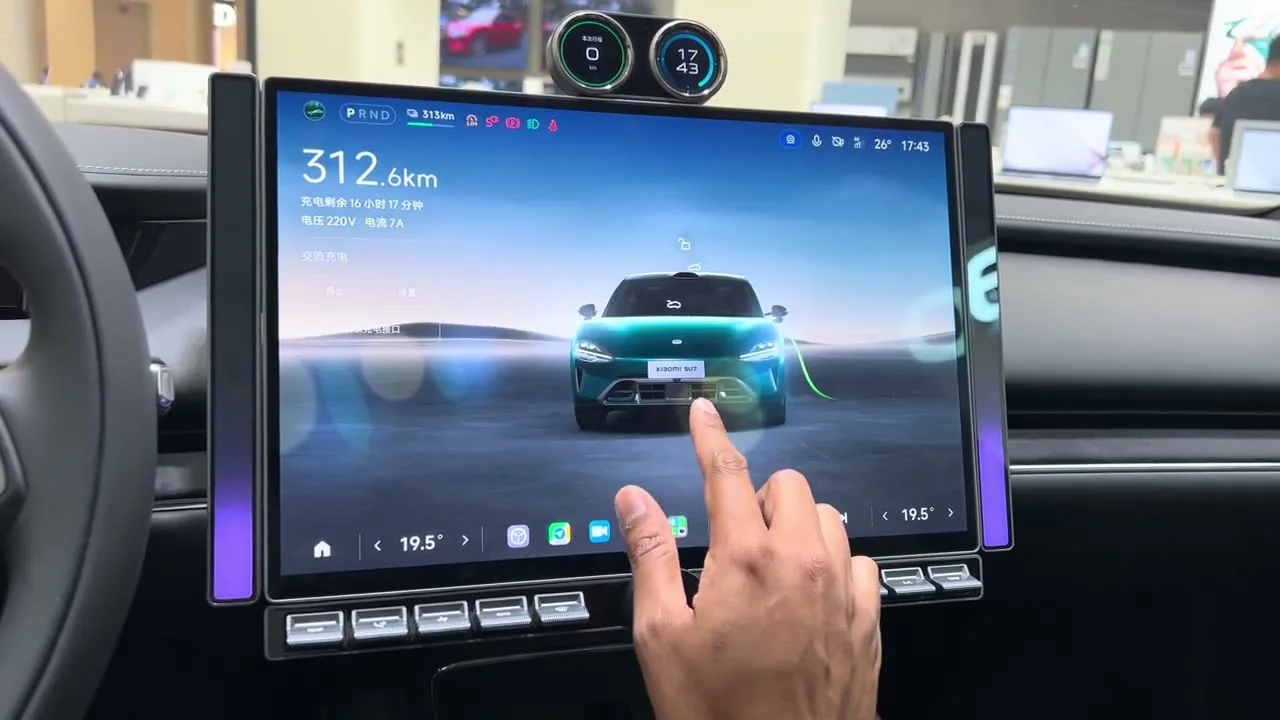
The 2026 SU7 keeps the strikingly Porsche-influenced silhouette of the original — long bonnet, fastback rear, frameless doors — but sharpens the front fascia with new-design daytime running lights and a more aggressive lower air intake. The rear features a continuous full-width LED light bar with red brake bars and turquoise running-light accents, plus the now-distinctive "Xiaomi" wordmark above the SU7 model badge. Available paint colours include Aqua Blue, Olive Green (the demo car shown), and Mineral Grey. Inside, the cabin is dressed in Xiaomi's signature minimalist style: a wide central touchscreen, a small driver instrument cluster, and ambient lighting threaded through the door panels. Materials use synthetic leather across the seats with optional Nappa upgrade on the Max trim, plus Alcantara on the dashboard top. The HyperOS infotainment is the deepest tie-in to Xiaomi's smart-home and phone ecosystem available in any Chinese EV — letting buyers control all their existing Xiaomi devices through the car's HMI.
Technology & Features
HyperOS infotainment runs on Qualcomm Snapdragon silicon with seamless connection between the SU7 and the user's existing Xiaomi phone, tablet, smart-watch, and home appliances. Voice control is multi-zone with natural-language commands. Standard equipment includes wireless phone chargers, an in-armrest refrigerator (Pro and Max), a head-up display projecting onto the windscreen (Pro and Max — Standard skips it), ambient lighting and an electric tailgate. The Max adds an upgraded Bowers & Wilkins-class audio system, electric soft-close doors, and the panoramic glass roof.
Safety & ADAS
Every 2026 SU7 trim ships with the same comprehensive ADAS hardware suite — a roof-mounted LiDAR, multiple millimeter-wave radars, surround camera array and an Nvidia Thor-U processor delivering 700 TOPS of compute. That makes the SU7 one of the few sub-$32k sedans on the market to offer flagship-tier ADAS hardware as standard, supporting point-to-point Navigate-on-Pilot for both highway and urban driving, automated parking, and Automatic Emergency Steering at speeds up to 130 km/h. Passive safety covers a comprehensive airbag set with full curtain coverage and a structural target of five-star C-NCAP.
| ADAS LEVEL | L2++ (highway and urban NOP, AES at 130 km/h) |
|---|---|
| ADAS HARDWARE | Roof LiDAR + multiple mmWave radars + surround cameras (every trim) |
| COMPUTE | NVIDIA Thor-U @ 700 TOPS (every trim) |
| FEATURES | Highway NOP, urban NOP, AEB, ACC, LKA, BSM, AES at 130 km/h, valet park |
Available Versions
| VERSION | POWER | BATTERY | RANGE | PRICE | KEY DIFFERENCES |
|---|---|---|---|---|---|
| SU7 Standard | 320 hp (235 kW) | 73 kWh LFP | 720 km CLTC | ~$31,870 | Single rear motor, 752V SiC, 19-inch alloys, full ADAS hardware |
| SU7 Pro | 320 hp (235 kW) | 96.3 kWh LFP | 902 km CLTC | ~$36,215 | Long-range LFP pack, head-up display, refrigerator, 20-inch alloys |
| SU7 Max | 690 hp (508 kW) | 101.7 kWh ternary | 835 km CLTC | ~$44,040 | Dual-motor AWD, 897V SiC, 0-100 in ~3 s, air suspension, 21-inch forged wheels |
Pricing & Availability
The new-gen SU7 went on sale in mainland China on March 19, 2026 with pricing from RMB 219,900 to RMB 303,900 ($31,870 to $44,040). Within 34 minutes of order books opening, Xiaomi confirmed 15,000 reservations — a launch pace that signals the original SU7's market reception is comfortably reproducing for the second-gen model. Deliveries began rolling out to early-reservation customers in late April, with broader fulfilment ramping through May and June. International expansion is being explored through Xiaomi's growing global presence in mobile devices, but no firm timeline for the SU7 outside China has been announced as of this article's writing.
How It Compares
Among the premium electric sedan crowd in this exact price bracket, the SU7 sets itself apart on three things: ADAS hardware as standard (LiDAR + Nvidia Thor on every trim — most rivals reserve flagship ADAS for their top trims), the deep Xiaomi ecosystem tie-in for buyers already invested in the brand's phones and smart-home gear, and the Pro trim's 902 km CLTC range — segment-leading at this price for a true single-motor LFP pack. Versus the new Shangjie Z7, the SU7 trades Huawei's Qiankun ADS reputation for the Xiaomi ecosystem advantage and slightly higher absolute power (690 hp vs 582 hp on the Max). The ZEEKR 007 is the closest rival on raw spec-for-money, and undercuts on entry price by a small margin, but its lower-tier ADAS hardware can't match the SU7's standard LiDAR + Thor-U combination. The BYD Han L EV offers similar range and power at similar prices, but lacks both the ecosystem story and the LiDAR-as-standard promise.
- LiDAR + Nvidia Thor-U (700 TOPS) standard on every trim — flagship ADAS at $31,870
- 902 km CLTC range on the Pro trim is segment-leading at this price
- Max trim's 897V architecture adds 670 km in 15 min charging — one of the fastest in 2026
- Deepest Xiaomi ecosystem integration of any Chinese EV — phone, tablet, smart-home all unified
- 120 mm ground clearance — a road car only, no rough-surface capability
- Standard trim skips HUD and air suspension; many "premium" features only unlock at Pro+
- Brand recognition outside China is still strongest in mobile devices, not cars — reseller network is thinner than NIO or AITO in some regions
The 2026 SU7 is Xiaomi proving the original wasn't a fluke — a tighter, faster, smarter sedan that meaningfully closes the gap on the segment leaders while keeping the same disruptive pricing strategy. Standard LiDAR plus Nvidia Thor-U on every trim is the headline win, dragging the entire premium-sedan segment toward the same table-stakes ADAS hardware. The Pro trim is the value sweet spot at $36,215 — the long-range LFP pack and head-up display make it the smart purchase. The Max is for buyers who want the 897V fast charging and the 0-100-in-3-second statement. Either way, this is one of the most consequential sedan launches of 2026, and Xiaomi's competitors are now playing catch-up on ADAS hardware standardisation.