

The 2026 Xiaomi YU7 GT just rewrote the production-SUV rulebook on the most demanding race track in the world. Driven by Xiaomi’s chief test driver Ren Zhoucan (the first Chinese driver to earn official Nürburgring lap certification), the YU7 GT lapped the Nordschleife in 7:22.755 on April 2, 2026 with the optional 24K Carbon / Track Package fitted — beating the previous production-SUV record holder, the Audi RS Q8 Performance (7:36.698), by nearly 14 seconds. The earlier announcement of a 7:34.931 lap (already a record at the time) was Xiaomi’s first marketing waypoint; the 7:22.755 figure is the official sales-launch number. Then on May 21, 2026, Xiaomi officially launched the production YU7 GT at ¥389,900 ($57,300) entry / ¥429,900 ($63,100) top trim — making this the cheapest production SUV ever to hold a verified Nordschleife class record. The powertrain is a dual-motor 800V layout producing 738 kW (990 hp / 1,003 PS), accelerating from 0-100 km/h in 2.92 seconds with a 300 km/h electronically governed top speed.
Performance & Specs
The YU7 GT uses Xiaomi’s newest HyperEngine V8s EVO motor pair: a 288 kW (386 hp) front motor + a 450 kW (604 hp) rear motor, for a combined system output of 738 kW (990 hp / 1,003 PS) with approximately 866 Nm of system torque. The dual-motor AWD layout sits on Xiaomi’s 800V high-voltage architecture (nominal 871V at the cell level), pulling power from a 101.7 kWh CATL ternary lithium NMC battery pack. The result: 0-100 km/h in 2.92 seconds, 0-200 km/h in 6.5 seconds, and a 300 km/h (186 mph) electronically governed top speed. CLTC EV range is rated at 705 km — substantial for a 2,460 kg performance SUV. The GT trim is meaningfully more powerful than the YU7 Max sibling (681 hp), gaining roughly 309 horsepower and 0.6 seconds of acceleration over the Max’s 3.5-second 0-100.

| POWERTRAIN TYPE | BEV dual-motor AWD (HyperEngine V8s EVO) |
|---|---|
| FRONT MOTOR | 288 kW (386 hp) |
| REAR MOTOR | 450 kW (604 hp) |
| SYSTEM POWER | 738 kW (990 hp / 1,003 PS) |
| SYSTEM TORQUE | ~866 Nm (estimated, not officially split) |
| 0-100 KM/H | 2.92 s |
| 0-200 KM/H | ~6.5 s |
| TOP SPEED | 300 km/h (186 mph) |
| BATTERY | 101.7 kWh CATL ternary lithium NMC |
| EV RANGE | 705 km (CLTC) |
| HV ARCHITECTURE | 800 V (nominal 871 V) |
Nürburgring Record — The Story In Detail
Xiaomi’s Nürburgring Nordschleife campaign was a two-phase strategy. First, in late April 2026, Xiaomi announced an initial 7:34.931 lap with a near-production YU7 GT — already faster than the Audi RS Q8 Performance’s 7:36.698. That figure made the YU7 GT the fastest production SUV around the Nordschleife full stop, regardless of powertrain. Then Xiaomi went back for a faster lap, this time with the optional 24K Carbon / Track Package fitted (carbon-ceramic brakes + 22-inch wheels + Michelin track-oriented rubber). On April 2, 2026, driver Ren Zhoucan delivered 7:22.755 — 13.9 seconds faster than the Audi RS Q8 Performance, and effectively redefining the production-SUV benchmark. Caveats worth noting: Xiaomi did not publish full test-spec disclosure (tire compound, ballast, safety cage, software calibration), and the record car wore the optional Track Package rather than the base GT — so this is a "fastest production SUV with optional track equipment" claim rather than a standard production-spec lap. Industry observers including Motor1, Electrek, and Carscoops have confirmed the lap time via Xiaomi’s official video evidence, but it has not yet been independently re-validated by a third-party publication.
Dimensions & Practicality

| Length | 5,015 mm |
|---|---|
| Width | 2,007 mm |
| Height | 1,597 mm |
| Wheelbase | 3,000 mm |
| Ground clearance | ~140 mm |
At 5,015 mm long on a 3,000 mm wheelbase with a low 1,597 mm roofline, the YU7 GT sits firmly in the coupe-SUV class — same dimensional tier as the Porsche Macan Turbo Electric and Lotus Eletre, but with the more dramatic fastback silhouette favored by Chinese-market buyers. Cargo measures approximately 678 liters with rear seats up, expanding to 1,758 liters with the rear bench folded (carry-over from the standard YU7 platform). The GT also adds a substantial 141-liter front frunk — the carbon-fiber aerodynamic package adds wider arches and a more aggressive front splitter visible in the reviewer’s walkaround. Ground clearance is approximately 140 mm in standard configuration. Standard wheels are 21-inch alloys wrapped in Michelin Pilot Sport S 5 (295/35 R21) per reviewer observation; the 24K Carbon Pack upgrades to 22-inch alloys with track-oriented Michelin tires.
| LENGTH | 5,015 mm |
|---|---|
| WIDTH | 2,007 mm |
| HEIGHT | 1,597 mm |
| WHEELBASE | 3,000 mm |
| CARGO VOLUME | 678 L (1,758 L seats folded) |
| FRUNK | 141 L |
| SEATING | 5 (no rear-bench delete option) |
| WHEELS / TIRES (STD) | 21″ / 295/35 R21 Michelin Pilot Sport S 5 |
| WHEELS / TIRES (24K CARBON) | 22″ / Michelin track-spec |
| CURB WEIGHT | 2,460 kg |
Charging & Battery
The YU7 GT’s 101.7 kWh CATL ternary lithium NMC pack uses Xiaomi’s 800V SiC architecture with a nominal cell-level voltage of 871V. Peak DC charging speed has not been officially disclosed but is consistent with the Xiaomi platform’s typical 490-500 kW class — completing a 10-80% top-up in approximately 12 minutes. AC charging on the 11 kW onboard charger replenishes the full pack overnight in approximately 11 hours. The CLTC EV range of 705 km translates to approximately 560-580 km WLTP estimated equivalent (Xiaomi has not officially published the WLTP figure). The Xiaomi closed-loop fast-charging network rollout is in progress across major Chinese cities, with compatible 800V stations targeting 1,500+ locations by end of 2026.
| BATTERY | 101.7 kWh CATL ternary lithium NMC |
|---|---|
| HV ARCHITECTURE | 800 V SiC (nominal 871 V cell level) |
| AC CHARGING | 11 kW |
| DC FAST CHARGING | ~490-500 kW peak (estimated) |
| DC 10-80% TIME | ~12 min |
| EV RANGE (CLTC) | 705 km |
| EV RANGE (WLTP est.) | ~560-580 km |
Design & Interior
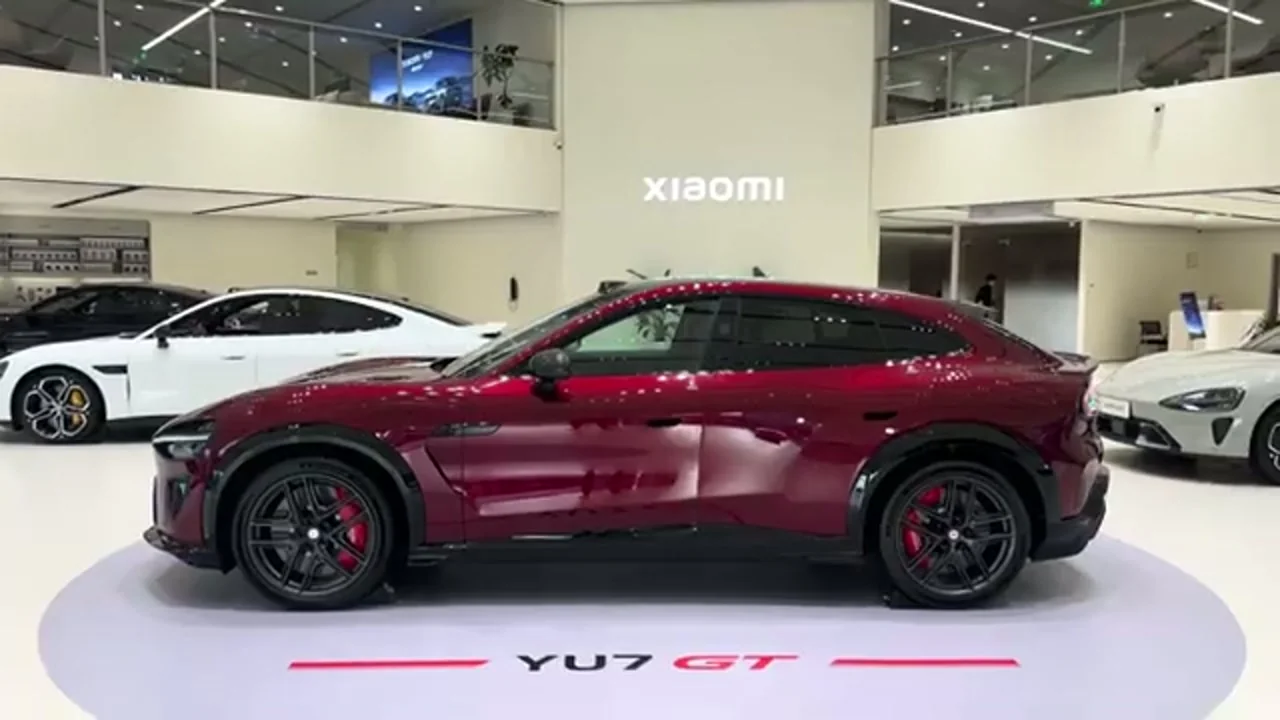
The YU7 GT exterior is the most aggressive Xiaomi production vehicle to date. The reviewer’s walkaround unit is finished in burgundy/wine-red metallic with a black contrast roof, with the carbon-fiber aerodynamic package adding wider front and rear arches, a front splitter, a sculpted rear diffuser, and the signature carbon-fiber rear wing visible above the tailgate. Frameless side mirrors are the cleanest visual departure from the standard YU7 Max. The reviewer specifically calls out the extensive carbon-fiber detail (“they have used a lot of carbon fibers all over in the vehicle”) on the front splitter, rear wing, side skirts, and rear diffuser. Inside, the cabin features a striking red-and-black Nappa leather + Alcantara two-tone treatment with diamond-stitched perforated seats, contrasting Alcantara on the headliner and pillars, and a dash-wide HyperVision panoramic display that wraps from the driver’s instrument cluster across the dashboard. The center console is dominated by exposed carbon-fiber, with a vertical AMG-style red performance-mode toggle on the leather-wrapped sport steering wheel. The reviewer notes the cabin material grade is meaningfully above the standard YU7 Max, with more premium textile and stitching across all touchpoints.
Technology & Features
The YU7 GT runs Xiaomi’s HyperOS cockpit on a Qualcomm Snapdragon 8295 SoC, with the dash-wide HyperVision panoramic display as the primary visual element — complemented by an AR head-up display (AR-HUD) and the dual-axis touchscreen running media, climate, and navigation. Storage is 16 GB RAM / 256 GB internal. The cockpit integrates tightly with Xiaomi’s broader smartphone + smartwatch + IoT ecosystem, supporting cross-device handoff for Xiaomi phone owners. The reviewer specifically notes English-language UI is NOT available out-of-the-box — Chinese-only at launch, with export-channel dealers required to perform a firmware flash on request. This is more restrictive than recent BYD and Denza products which ship with English-UI capability standard. The 22-speaker premium audio system uses Xiaomi-developed software tuning rather than a licensed brand (Bose / Harman). The reviewer also notes the standard 360-degree surround camera, automatic parking with route memory, and dual 50W wireless charging pads up front.
Safety & ADAS
| ADAS LEVEL | L2+ (Xiaomi HAD — HyperOS Autonomous Driving) |
|---|---|
| LiDAR | 1 × Hesai 128-line, ~200 m range |
| COMPUTE | NVIDIA DRIVE AGX Thor-U, 700 TOPS |
| CAMERAS | Multiple HD + 360-degree surround |
| ULTRASONIC | 12 |
| ADAS FEATURES | Highway NOA, Urban NOA, Auto Park, AEB, ACC, LKA, BSM, 360° camera, valet park with route memory |
The YU7 GT ships with Xiaomi’s newest Xiaomi HAD (HyperOS Autonomous Driving) stack, built around a roof-mounted Hesai 128-line LiDAR (~200 m range) and an NVIDIA DRIVE AGX Thor-U compute platform delivering 700 TOPS — meaningfully more compute headroom than the 254 TOPS Orin X used by most rival Chinese performance EVs. The system supports Highway + Urban NOA (Navigate-on-Autopilot), full automated parking with route memory, AEB up to 130 km/h, and a 360-degree surround camera. One controversial note: while the driving compute is on Thor-U (automotive-grade), the cockpit SoC is the Snapdragon 8295 — a consumer-grade chip, which has drawn some Chinese-market criticism but is consistent with industry practice for cockpit/infotainment workloads.
Available Versions
| VERSION | POWER | 0-100 | TOP SPEED | PRICE | KEY DIFFERENCES |
|---|---|---|---|---|---|
| YU7 GT | 990 hp (738 kW) | 2.92 s | 300 km/h | $57,300 | Standard trim: 21″ Michelin, steel discs, Nappa interior |
| YU7 GT + 24K Carbon Pack | 990 hp (738 kW) | 2.92 s | 300 km/h | $63,100 | Brembo carbon-ceramic + 22″ Michelin track tires + carbon-fiber package — the Nürburgring record configuration |
Pricing & Availability
The 2026 Xiaomi YU7 GT officially launched on May 21, 2026 at Xiaomi’s Beijing flagship event, with deliveries beginning late May 2026. Pricing is ¥389,900 ($57,300) for the standard GT trim and ¥429,900 ($63,100) for the top trim with the 24K Carbon Pack — the configuration used for the Nürburgring record. The reviewer’s YouTube walkaround references “$57,500” entry which aligns with the official launch pricing within rounding. Initial demand has been substantial: Xiaomi reported delivery wait times of 8-12 months for the YU7 family at the May 21 launch, with the GT-specific allocation prioritized for the first 3,000 reservation holders. China-domestic market only at launch; export markets have not been officially confirmed for 2026. The Russian / CIS market is reportedly receiving grey-import allocations via broker networks in Q3 2026 onward.
How It Compares
The YU7 GT’s pricing position is the headline disruption. At $57,300 standard / $63,100 with the Nürburgring-record-setting Track Pack, the YU7 GT undercuts the Porsche Macan Turbo Electric by $47,000+ while offering 360 more horsepower and 0.4 seconds faster 0-100 acceleration. The Lotus Eletre R has slightly more peak power (905 hp continuous vs Xiaomi’s 990 hp peak) but costs nearly $90,000 more. The Audi RS Q8 Performance is the prior production-SUV record holder — the YU7 GT has comprehensively replaced it as the segment benchmark with the record-breaking lap. The closest spiritual rival is actually the Mercedes-AMG GT 4-Door (also recently freshmotors-covered) but in a different body type. For Chinese first-tier-city buyers wanting Nürburgring-validated performance + 990 hp + 800V charging at sub-$65k, the YU7 GT has zero credible competitors in 2026.
- 7:22.755 Nürburgring lap — fastest production SUV ever, beats Audi RS Q8 Performance by 13.9 s
- 990 hp / 866 Nm dual-motor AWD with 2.92 s 0-100 km/h, 300 km/h top speed
- 705 km CLTC range from 101.7 kWh CATL NMC pack
- 800V SiC architecture with 10-80% in 12 minutes
- Hesai 128-line LiDAR + NVIDIA Thor-U (700 TOPS) — segment-best compute headroom
- Jiaolong Smart Chassis 2.0 + eLSD + rear torque vectoring + Brembo carbon-ceramic option
- $57,300 entry — undercuts Porsche Macan Turbo Electric by ~$47,000
- Carbon-fiber aero package (rear wing, splitter, diffuser, wider arches, frameless mirrors)
- Nürburgring record set with optional 24K Carbon Pack ($63,100 trim), not standard GT
- Chinese-only UI at launch — English requires dealer-side firmware flash
- Cockpit SoC is consumer-grade Qualcomm Snapdragon 8295 (driving compute is automotive-grade Thor-U)
- 2,460 kg curb weight — expect real-world highway range below 580 km
- 5-seat strict layout — no rear-bench delete or +2 family seating option
- Initial delivery wait times 8-12 months — no immediate availability outside reservation queue
- No export markets confirmed for 2026 — grey-import via broker networks only
The 2026 Xiaomi YU7 GT is the most consequential Chinese performance-EV launch since the Xiaomi SU7 Ultra. By taking the standard YU7 platform and adding 309 hp + Brembo carbon-ceramic brakes + Jiaolong Smart Chassis 2.0 + a carbon-fiber aero package, Xiaomi has built the cheapest production SUV ever to hold a verified Nürburgring class record — 7:22.755 with the 24K Carbon Pack, beating the Audi RS Q8 Performance by nearly 14 seconds. At $57,300 standard and $63,100 with the record-setting Track Pack, the YU7 GT is priced like a Tesla Model Y Performance and performs like a Porsche Macan Turbo Electric with 360 more horsepower — the value equation simply doesn’t have a Western parallel in 2026. The compromises are real: Chinese-only UI at launch, consumer-grade cockpit SoC, 2,460 kg curb weight, 8-12 month delivery wait. But for Chinese first-tier-city buyers shopping the Porsche / Lotus / Mercedes-AMG performance-EV segment with a quarter of the budget, the YU7 GT now defines what “performance EV value” means in 2026.