

The XPeng G9L is the brand's new flagship family SUV, and on 12 October 2026 it made its European debut at the Paris Motor Show as a battery-electric (BEV) model with six or seven seats. It is a 5,120 mm long three-row car on a 3,100 mm wheelbase, and unlike the five-seat G9L sold in China it comes to Europe with a 110 kWh gross NCM battery, an 800 V architecture and a claimed peak DC charging power of 540 kW. XPeng's German price list starts at EUR 74,600 for the 7-seat rear-drive Long Range Ultra, with the all-wheel-drive Performance Ultra from EUR 79,600 (seven seats) and EUR 85,600 (six seats). The car is assembled by Magna Steyr in Graz, Austria, as the fourth XPeng model built there, and the first European deliveries are planned for December 2026. Order books opened in eight European markets at the Paris launch.
Performance & Specs
The European G9L comes in two powertrains, both BEV. The 7-seat RWD Long Range Ultra has a single permanent-magnet motor on the rear axle rated at 270 kW (367 PS, about 362 hp) and 465 Nm, which XPeng's configurator pairs with a 0-100 km/h time of 7.0 seconds. The two AWD Performance Ultra versions add an induction motor on the front axle, and the combined output is 430 kW (585 PS, about 577 hp) with 695 Nm and a 4.9 second sprint. Top speed is 200 km/h on every version. (PS is the metric horsepower, about 1.4 percent smaller than the imperial hp used here.)
The G9L is a heavy car, which is normal for a 5.1 metre three-row SUV: the kerb weight is 2,700 kg for the RWD, 2,760 kg for the six-seat AWD and 2,800 kg for the seven-seat AWD, each figure about 25 kg higher with the towing hitch. XPeng fits every version with dual-chamber air suspension, adaptive DCC damping and active rear-axle steering of up to 5 degrees, and the drag coefficient is quoted at 0.246. The 21-inch wheels carry ventilated discs front and rear, and XPeng claims a 100-0 km/h braking distance of 35.1 metres. The turning circle of 11 metres is small for a car of this length because of the rear steering.
The official WLTP figures are preliminary and still subject to final homologation, according to XPeng's German configurator. The RWD version is rated at up to 591 km with a combined consumption of 21.1 kWh/100 km, and both AWD versions at up to 553 km with 22.5 kWh/100 km. The range spread between the two drivetrains is therefore 38 km, which is small for the 160 kW of extra power and 100 kg of extra weight.

| Powertrain | Single-motor RWD BEV |
|---|---|
| Power | 270 kW (367 PS / 362 hp) |
| Torque | 465 Nm |
| 0–100 km/h | 7.0 s |
| Battery | 110 kWh gross (NCM) |
| Range | Up to 591 km WLTP |
| POWERTRAIN TYPE | Battery electric (BEV), 3 versions |
|---|---|
| HORSEPOWER | 270 kW (367 PS / 362 hp) RWD; 430 kW (585 PS / 577 hp) AWD |
| TORQUE | 465 Nm (RWD); 695 Nm (AWD) |
| ACCELERATION | 0-100 km/h in 7.0 s (RWD) or 4.9 s (AWD) |
| TOP SPEED | 200 km/h |
| DRIVETRAIN | RWD (rear PMSM) or AWD (front induction + rear PMSM) |
| BATTERY | 110 kWh gross, NCM |
| WLTP RANGE | Up to 591 km (RWD); up to 553 km (AWD), preliminary |
| WLTP CONSUMPTION | 21.1 kWh/100 km (RWD); 22.5 kWh/100 km (AWD) |
Dimensions & Practicality

| Length | 5,120 mm |
|---|---|
| Width | 1,999 mm |
| Height | 1,788 mm |
| Wheelbase | 3,100 mm |
| Ground clearance | 176 mm (laden) |
The G9L measures 5,120 mm long, 1,999 mm wide and 1,788 mm high on a 3,100 mm wheelbase, with a track of 1,725 mm at the front and 1,749 mm at the rear. The seven-seat versions have a 2+3+2 layout with a three-seat second row, while the six-seat version has two individual captain's chairs in the second row, a layout XPeng developed specifically for Europe. With all three rows in use the boot holds 259 litres by the VDA standard, or 367 litres using the underfloor compartment. Folding the third row gives 935 litres in the seven-seat cars and 1,330 litres in the six-seater, and the front trunk adds 65 litres.
The G9L can tow 2,000 kg braked with a 75 kg nose weight, and the roof rails take 75 kg. Payload is 600 kg without the towing hitch and 575 kg with it, and the gross vehicle weight is 3,300 kg for the RWD, 3,360 kg for the six-seat AWD and 3,400 kg for the seven-seat AWD. XPeng also lists a wading depth of 700 mm, and the car offers a 6 kW vehicle-to-load socket for camping or tools. The tailgate is electric with a memory function, and the third-row seats fold electrically.
| LENGTH | 5,120 mm |
|---|---|
| WIDTH | 1,999 mm |
| HEIGHT | 1,788 mm |
| WHEELBASE | 3,100 mm |
| SEATS | 7 (2+3+2) or 6 (2+2+2) |
| CARGO VOLUME | 259 L (367 L with underfloor compartment); 935 L (7 seats) or 1,330 L (6 seats) with third row folded |
| FRUNK | 65 L |
| KERB WEIGHT | 2,700 kg (RWD); 2,760 kg (AWD, 6 seats); 2,800 kg (AWD, 7 seats) |
| TOWING (braked) | 2,000 kg |
Charging & Battery
All three versions use the same 110 kWh gross NCM battery on an 800 V architecture, and XPeng quotes a peak DC charging power of 540 kW, which it markets as 5C charging. The 10-80 percent charge takes 11.7 minutes on XPeng's Belgian, Dutch and Norwegian pages and 12 minutes on the German and French ones, and 20-80 percent takes 10 minutes. These are figures under ideal conditions at a charger that can deliver the full power, and German outlet electrive notes that the common 400 kW Alpitronic chargers cannot, so the headline number will be reached rarely in the near term. AC charging is 22 kW on the three-phase version, which takes about 6 hours for 5-100 percent, or about 11.5 hours at 11 kW.
As a sanity check, the RWD's 110 kWh gross and 591 km imply about 18.6 kWh/100 km at the battery, and the official 21.1 kWh/100 km is about 13 percent higher, which is the normal size of charging losses. The AWD works out at about 19.9 kWh/100 km against 22.5 kWh/100 km, a similar gap. XPeng has not published a usable-capacity figure in the material read for this article, and CarNewsChina quotes 106.7 kWh for the pack, which may be the usable figure but is not confirmed by XPeng.
| BATTERY | 110 kWh gross, NCM |
|---|---|
| AC CHARGING | 22 kW, CCS2; 6 h for 5-100% at 22 kW (11.5 h at 11 kW) |
| DC FAST CHARGING | Up to 540 kW peak |
| DC 10-80% TIME | 11.7-12 min (20-80%: 10 min) |
Design & Interior
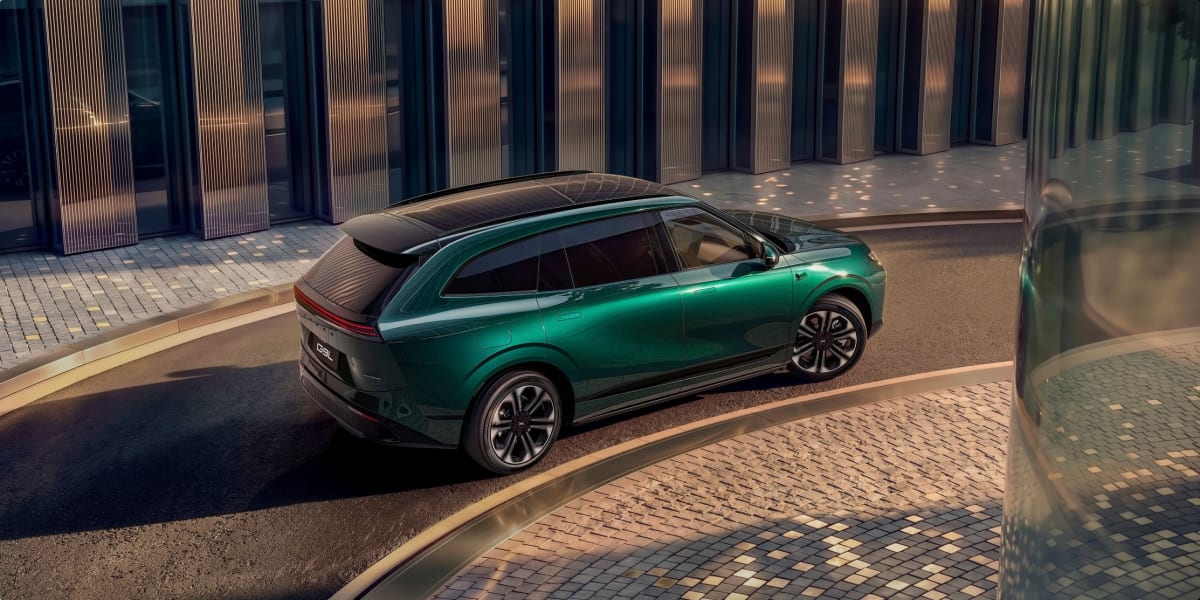
The G9L's design is built around a slim light blade across the nose and a matching one at the tail, which XPeng calls the Dual-Through Light Blade. The door handles are flush and extend when the car is unlocked, the doors are electric soft-close units on all four sides, and the roof is a panoramic glass panel with electric blinds. The 21-inch wheels fill the arches of a body that is nearly 5.1 metres long. XPeng offers four colours in Europe, with Arctic White at no extra charge and Diamond Black, Mirror Grey and Waving Green for EUR 1,200 each in Germany, and two Nappa leather interiors, Meteorite Black and Tangerine.
Inside, the front and second-row seats are heated, ventilated and have ten-point massage as standard, while the third row has seat heating. The Premium Package, which costs EUR 4,990 on the seven-seat cars and is included in the six-seater, upgrades the front seats with a Zero Gravity passenger seat, 16-point massage, adjustable cushion firmness and bolsters, AI seat adjustment, illuminated retractable running boards, electric doors and DLP pixel headlights. A 12.5-litre fridge between the second-row seats, a 21.4-inch ceiling screen and a 23-speaker sound system complete the lounge-style cabin that XPeng is selling against larger premium SUVs.
Technology & Features
The driver faces an 8.8-inch instrument cluster and an 88-inch augmented-reality head-up display, with a 17.3-inch central touchscreen that includes integrated Google Maps and route-based charging planning. Apple CarPlay and Android Auto are supported, and the voice assistant, called by saying Hey XPENG, understands German. The car has a UWB digital key, a smartphone and smartwatch key, over-the-air updates and a Sentry mode. XPeng also fits a rear display for second-row passengers, and electrive adds a children's area with specially chosen materials.
The headline assisted-driving feature, XPeng's Next Generation Pilot (NGP) powered by the VLA 2.0 model, is not part of the car at delivery. XPeng and electrive say it is planned to arrive in Europe from 2027 by over-the-air update, subject to local regulation and approval, and XPeng wants to be the first automaker certified under UN Regulation No. 171, Series 02. Until then the car offers XPILOT Assist, with adaptive cruise control, lane centring, automatic lane change, parking assistance and a transparent-chassis camera view.
Safety & ADAS
XPeng says the G9L went through three years of testing in 26 countries and regions, covering more than 6.74 million kilometres, and describes the body as designed to the standards of a five-star Euro NCAP rating; no rating had been published at the time of writing. The car has nine airbags as standard, rising to ten in the six-seat layout, with a centre airbag between the front seats, side airbags in the first two rows and curtain airbags across all three. Automatic emergency braking works at speeds up to 150 km/h, and the stability system can keep the car controlled after a tyre blowout. Driver monitoring, an occupant detection system, child presence detection and tyre pressure monitoring are included.
| ADAS LEVEL | L2 (XPILOT Assist at delivery); NGP with VLA 2.0 planned from 2027, subject to approval |
|---|---|
| ADAS FEATURES | AEB (up to 150 km/h), ACC, lane centring, blind-spot detection, door-opening warning, lane-departure prevention, emergency lane keeping, 360° camera, automatic and remote parking, driver monitoring, eCall |

Available Versions
| VERSION | POWER | TORQUE | 0-100 | TOP SPEED | DRIVETRAIN | BATTERY | EV RANGE | COMBINED RANGE | PRICE | KEY DIFFERENCES |
|---|---|---|---|---|---|---|---|---|---|---|
| G9L RWD Long Range Ultra (7 seats) | 362 hp | 465 Nm | 7.0s | 200 km/h | RWD | 110 kWh | 591 km | — | €74,600 | 270 kW (367 PS), 21.1 kWh/100 km, lightest at 2,700 kg |
| G9L AWD Performance Ultra (7 seats) | 577 hp | 695 Nm | 4.9s | 200 km/h | AWD | 110 kWh | 553 km | — | €79,600 | 430 kW (585 PS), dual motor, 22.5 kWh/100 km |
| G9L AWD Performance Ultra (6 seats) | 577 hp | 695 Nm | 4.9s | 200 km/h | AWD | 110 kWh | 553 km | — | €85,600 | Captain's chairs in row two, Premium Package included, 1,330 L boot with row three folded |
Pricing & Availability
XPeng's own German page and configurator list the G9L at EUR 74,600 for the 7-seat RWD, EUR 79,600 for the 7-seat AWD and EUR 85,600 for the 6-seat AWD, recommended retail prices including 19 percent VAT and before options, as of 14 October 2026. The French, Belgian and Dutch configurators show EUR 74,990, EUR 79,990 and EUR 85,990 for the same three versions, and the Austrian page EUR 75,600, EUR 80,600 and EUR 86,600. In Sweden the prices are SEK 849,900, SEK 899,900 and SEK 979,900, in Denmark DKK 639,995, DKK 699,995 and DKK 769,995, and in Norway, where only the AWD versions are listed, the configurator shows an estimated price of NOK 749,900. Options in Germany include the Premium Package at EUR 4,990 for the seven-seaters, a towing hitch at EUR 1,290 and paint (three colours) at EUR 1,200.
The launch markets are France, Germany, the Netherlands, Belgium, Norway, Denmark, Sweden and Austria, and XPeng says it plans to bring the G9L to 64 countries and regions. Europe-bound cars are assembled by Magna Steyr in Graz, which avoids the additional EU duty on EVs imported from China, according to German outlet chinaelektro, and the first car completed trial production there on 7 October 2026. A range-extender version is also being engineered for Europe, but XPeng has not given a date or a price for it. In Israel, XPeng is sold by the importer Freesbe, which had not announced the G9L as of October 2026.
How It Compares
The closest rival on the European stand is the BYD Atto 8, another seven-seat BEV SUV shown in Paris, which is rated at 456 hp and 652 km WLTP in the RWD Design and up to 764 hp in the AWD; BYD has not named a European price, so the G9L's EUR 74,600 start is the only firm number in this pair. The Tesla Model X sets a price marker in the US at $99,990 with 670 hp and 566 km on the more generous EPA cycle, but Tesla has ended its production, so it is mainly a benchmark. The NIO ES9 is a six-seat flagship that is sold in China only, so the comparison with its 697 hp and 620 km CLTC range is a market contrast rather than a cross-shop. The cycles and markets differ across these cards, and CLTC and EPA figures are generally more generous than WLTP, so the range lines should not be compared one to one. German outlet chinaelektro positions the G9L against the BMW iX, Kia EV9 and Volvo EX90 and argues that the XPeng undercuts German makers at this size.
- From EUR 74,600 in Germany for a 5.12 m, seven-seat BEV with air suspension, rear steering and a 110 kWh battery
- 540 kW peak DC charging and 10-80% in 11.7 to 12 minutes, backed by 800 V architecture and 22 kW AC charging
- 430 kW (577 hp) AWD with a 4.9 second sprint, 2,000 kg towing and a choice of seven seats or six captain's chairs
- Weighs 2,700 to 2,800 kg, and the AWD versions are rated at up to 553 km WLTP and 22.5 kWh/100 km
- The Next Generation Pilot driver-assistance system arrives only from 2027, subject to approval, and deliveries start in December 2026
The G9L is XPeng's most serious attempt to take on the large premium electric SUVs in Europe, with a spec sheet of air suspension, 800 V charging, a lounge-style interior and six or seven seats at EUR 74,600 to EUR 85,600. The rear-drive Long Range Ultra at 591 km WLTP is the sensible pick, while the AWD cars add 577 hp but give up some range. Its weak points are the weight, the preliminary WLTP figures and the delayed driver-assistance features, so buyers should wait for homologated numbers, a crash rating and the first real-world charging results. For families who need three rows and a big tow rating, it is a strong newcomer.