
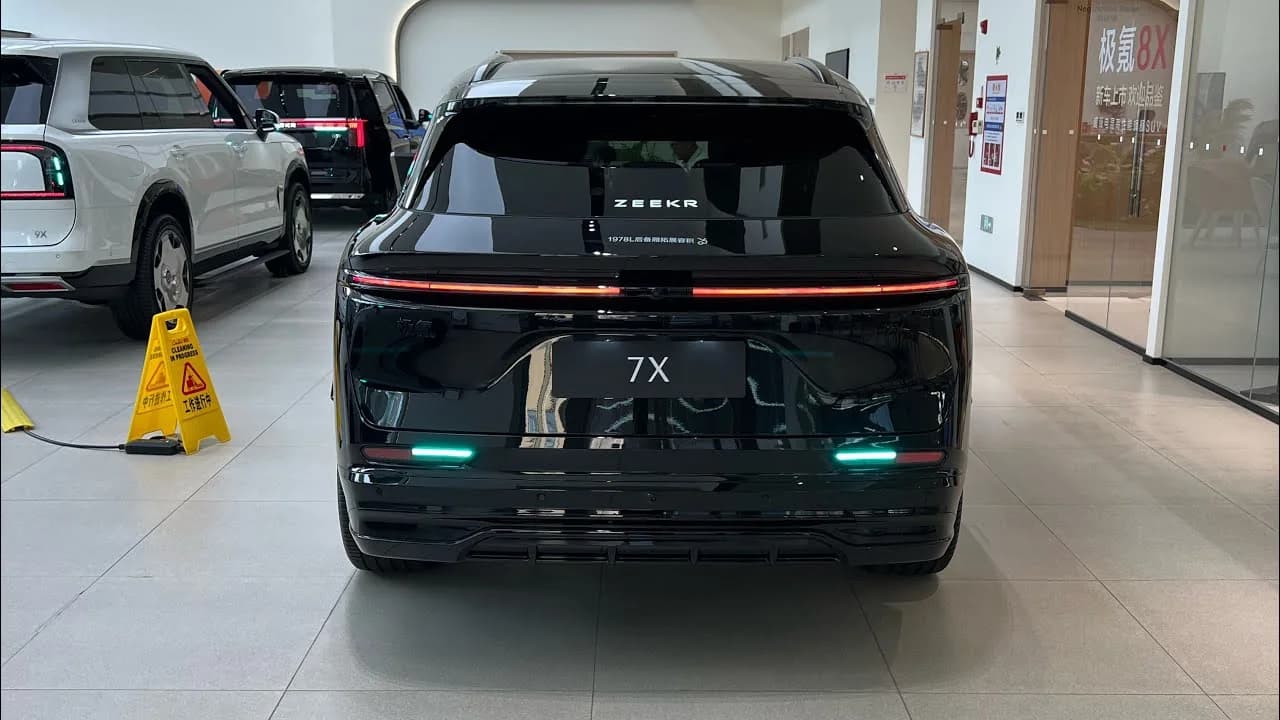
The 2026 Zeekr 7X is a tech-loaded mid-size electric SUV that packs flagship hardware at a mainstream price. The 2026 model-year update went on sale in China on 28 October 2025 (the original 7X launched in September 2024) and brings a 900V architecture on the 103 kWh cars, up to 6C ultra-fast charging (10–80% in about 10 minutes), up to 802 km of CLTC range and, remarkably, a roof LiDAR with Nvidia Drive Thor-U (700 TOPS) standard on every trim. The range spans a 496 hp rear-drive Max to a 784 hp dual-motor Ultra that hits 100 km/h in 2.98 seconds. Official China list prices run from RMB 229,800 (about $34,300) to RMB 269,800 (about $40,300), and Zeekr says the 7X is already sold in more than 50 countries, including the Netherlands, Sweden, Norway and Australia.
Performance & Specs
The 7X comes in three variants. The rear-drive Max models use a single 370 kW (496 hp) motor with 535 Nm and a 240 km/h top speed, good for 0–100 km/h in 5.4 seconds (75 kWh) or 5.1 seconds (103 kWh). The flagship Ultra adds a front motor for 585 kW (784 hp) and 812 Nm of dual-motor all-wheel drive, a 255 km/h top speed and a supercar-humbling 2.98-second 0–100 km/h. All ride on Zeekr's SEA platform, and the 103 kWh cars run the new 900V electrical system while the 75 kWh entry car stays on 800V. It's a genuinely fast, refined SUV whichever version you pick, with the base rear-driver already quicker than most rivals. Power is delivered smoothly and with real muscle in the mid-range, and even the entry Max never feels underdone — 496 hp in a family SUV is plenty, while the Ultra's 2.98-second sprint puts it in genuine performance-car territory. Whichever you choose, the electric motors are backed by well-tuned regenerative braking and a stable, planted feel at speed.

| RWD (Max) | 370 kW (496 hp), 535 Nm |
|---|---|
| AWD (Ultra) | 585 kW (784 hp), 812 Nm, dual-motor |
| Battery | 75 kWh LFP / 103 kWh NMC |
| EV range | 620–802 km (CLTC) |
| 0–100 km/h | 5.4 s RWD / 2.98 s AWD |
| Architecture | 900V, 6C (103 kWh); 800V, 5.5C (75 kWh) |
| POWERTRAIN | Single-motor RWD or dual-motor AWD (BEV) |
|---|---|
| RWD POWER | 370 kW (496 hp), 535 Nm |
| AWD POWER | 585 kW (784 hp), 812 Nm |
| ACCELERATION | 0–100 km/h 5.4 s (75 kWh RWD) / 5.1 s (103 kWh RWD) / 2.98 s (AWD) |
| TOP SPEED | 240 km/h (Max) / 255 km/h (Ultra) |
| BATTERY | 75 kWh LFP / 103 kWh CATL Qilin NMC |
| EV RANGE | 620 / 802 / 715 km (CLTC) |
| CHARGING | 103 kWh: 900V, 6C, 10–80% ~10 min; 75 kWh: 800V, 5.5C, ~10.5 min |
Dimensions & Practicality

| Length | 4,825 mm |
|---|---|
| Width | 1,930 mm |
| Height | 1,656–1,666 mm |
| Wheelbase | 2,925 mm |
| Boot | 905 L (1,978 L folded) |
| Tyres | 255/50 R19 (up to 21") |
At 4,825 mm long on a 2,925 mm wheelbase, the 7X is a spacious five-seat family SUV. The 905-litre boot (the China-market figure) expands to 1,978 litres with the rear seats folded, and there's a front trunk under the bonnet for charging cables. It rides on 19- to 21-inch wheels, and the air suspension that comes standard on the Ultra (and as an option on the Max) can lift ground clearance to 230 mm. Kerb weight runs from 2,280 kg (RWD) to 2,460 kg (AWD). Inside, it's a genuinely upmarket cabin with Alcantara and Nappa leather, a panoramic glass roof, an optional rear entertainment screen and an optional fridge.
| LENGTH | 4,825 mm |
|---|---|
| WIDTH | 1,930 mm |
| HEIGHT | 1,656–1,666 mm |
| WHEELBASE | 2,925 mm |
| BOOT VOLUME | 905 L (1,978 L folded) |
| SEATING | 5 seats |
Charging & Battery
The headline upgrade is charging. The long-range models use a 103 kWh CATL Qilin (NMC) battery on a 900V architecture with 6C charging — a 10–80% top-up in around 10 minutes, adding over 400 km. The 75 kWh base uses an LFP "Golden Battery" on an 800V system with 5.5C charging (about 10.5 minutes for 10–80%). CLTC ranges are 620 km (75 kWh RWD), 802 km (103 kWh RWD) and 715 km (103 kWh AWD). With that much range and charging that quick, the 7X essentially removes range anxiety from the equation — a 10-minute stop is barely longer than a coffee break, and on a long trip you can add hundreds of kilometres in the time it takes to use the restroom. It's worth noting the 802 km figure is on China's optimistic CLTC cycle, so real-world range will be lower, but even a conservative estimate leaves a comfortable buffer for long trips. The LFP base battery also brings the durability and thermal stability that chemistry is known for.
| BATTERY | 75 kWh LFP / 103 kWh NMC (Qilin) |
|---|---|
| EV RANGE | 620 / 802 / 715 km (CLTC) |
| ARCHITECTURE | 900V (103 kWh), 6C; 800V (75 kWh), 5.5C |
| 10–80% CHARGE | ~10 minutes (103 kWh) / ~10.5 minutes (75 kWh) |
Design & Interior
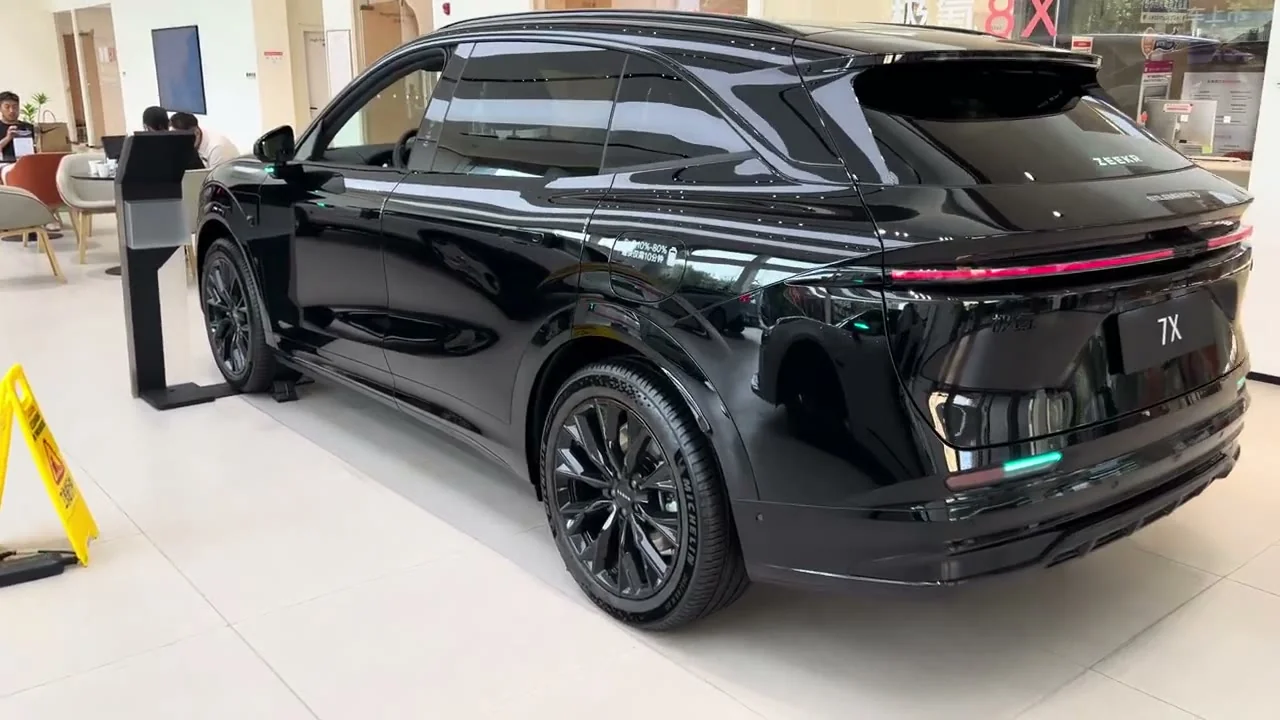
The 2026 facelift keeps the 7X's clean, confident SUV shape — this is a tech-led update rather than a styling overhaul — with full-width connected LED lighting front and rear, flush details and a choice of colours (black shown). Inside is where it feels special for the money: a minimalist, horizontally-themed dashboard wrapped in Alcantara and Nappa leather, a floating central screen, ambient lighting and a panoramic glass roof. The seats are broad and supportive, the second row is spacious thanks to the long wheelbase, and higher trims add ventilation and that rear entertainment screen, with a temperature-controlled fridge on the options list. It's an interior that could pass for something considerably more expensive, and a big part of why the 7X feels like such strong value.
Technology & ADAS
The 7X's other standout is driver assistance. Every trim comes with a roof-mounted LiDAR, 31 sensors and Nvidia Drive Thor-U (700 TOPS) running Zeekr's G-Pilot H7 assisted-driving system — hardware usually reserved for far pricier cars. Inside, a 16-inch 3.5K central touchscreen, a 13-inch driver cluster and a giant 36-inch AR head-up display run on a Qualcomm Snapdragon 8295 chip, with an optional 13-inch rear OLED screen. It's a comprehensive tech package that makes the price look even sharper.
| ADAS | Standard LiDAR + Nvidia Thor-U (700 TOPS), G-Pilot H7 |
|---|---|
| SCREENS | 16" central, 13" cluster, 36" AR-HUD (+ optional rear) |
Available Versions
| VERSION | POWER | TORQUE | 0-100 | TOP SPEED | DRIVETRAIN | BATTERY | EV RANGE | COMBINED RANGE | PRICE | KEY DIFFERENCES |
|---|---|---|---|---|---|---|---|---|---|---|
| Max | 496 hp | 535 Nm | 5.4 s | 240 km/h | RWD | 75 kWh LFP | 620 km | — | ~$34,300 (RMB 229,800) | 800V, 5.5C charging (~10.5 min 10–80%) |
| Max Long Range | 496 hp | 535 Nm | 5.1 s | 240 km/h | RWD | 103 kWh NMC | 802 km | — | ~$37,300 (RMB 249,800) | 900V, 6C charging (~10 min 10–80%) |
| Ultra | 784 hp | 812 Nm | 2.98 s | 255 km/h | AWD | 103 kWh NMC | 715 km | — | ~$40,300 (RMB 269,800) | Dual motor, 900V, 6C, standard air suspension |
Pricing & Availability
The 2026 Zeekr 7X went on sale in China on 28 October 2025. Official China list prices are RMB 229,800 (about $34,300) for the 75 kWh Max, RMB 249,800 (about $37,300) for the 103 kWh Max Long Range and RMB 269,800 (about $40,300) for the dual-motor Ultra, converted at about 6.70 RMB per US dollar. As of September 2026 Zeekr is also including RMB 18,999 of options (a power rear seat, a smart fridge and 20-inch wheels) with the current car. A 2027 model-year update is due in China in the fourth quarter of 2026 with a new 85 kWh Aegis Golden Brick LFP battery; media estimates put its range above 700 km on the CLTC cycle, but its price and official range have not been announced.
Unlike most Chinese launches, the 7X is genuinely global — Zeekr says it is sold in more than 50 countries, including the Netherlands, Sweden, Norway, Australia, New Zealand, Thailand and Mexico. Export specifications and prices differ from the China-market figures above: Australia, for example, lists a 310 kW (416 hp) rear-drive 75 kWh base car from A$57,900 before on-road costs, with the Long Range at A$63,900 and the Performance AWD at A$72,900. It's one of the few Chinese EVs here you can actually buy in Europe today.
How It Compares
The 7X sits right in the thick of China's mid-size EV SUV fight, and every price here is China-market, at about 6.70 RMB per US dollar. The entry Tesla Model Y costs roughly $5,000 more (RMB 263,500) for 593 km of CLTC range, less power and no LiDAR, although the Model Y Long Range RWD stretches to 821 km at RMB 288,500 (about $43,100). The Xiaomi YU7 starts at almost the same money (RMB 233,500, 643 km), and its 96.3 kWh Long Range at RMB 253,500 (about $37,800) edges the 7X on headline range at 835 km. The cheaper Xpeng G6 undercuts the 7X by roughly $7,900 with 625 km of CLTC range, but its single 218 kW (292 hp) motor is well short of the 7X's 370 kW (496 hp). With up to 802 km, 10-minute charging and Thor-U ADAS from about $34,300, the Zeekr makes a powerful all-round case.
- Up to 802 km range and 6C charging (10–80% in about 10 min) on the 103 kWh cars
- Standard roof LiDAR + Nvidia Thor-U (700 TOPS) on every trim
- 496–784 hp; the Ultra does 0–100 in 2.98 s
- Upmarket cabin, big AR-HUD, and it's actually sold in Europe
- Heavy (2,280–2,460 kg)
- Air suspension is standard only on the top Ultra
- Export pricing is higher than in China, and export specifications differ
- Five seats only — no third-row option
The 2026 Zeekr 7X is one of the most complete electric SUVs on sale. The 900V architecture and 6C charging on the 103 kWh cars turn a 10-minute stop into 400-plus kilometres, the long-range Max manages up to 802 km on the CLTC cycle, and every single trim gets roof LiDAR and Nvidia's 700-TOPS Thor-U chip — genuinely flagship hardware at a starting price of about $34,300 (RMB 229,800). Add 496–784 hp, a plush Alcantara-and-Nappa cabin and a giant AR head-up display, and it comfortably out-specs the entry Tesla Model Y for less money. It's heavy, and you'll pay more outside China, but as a do-everything family EV, the 7X is hard to beat — and it's one of the few here you can already buy in Europe.