

Audi's electric Gran Turismo is now a four-model family. The facelift unveiled on 18 June 2024 split the range into the S e-tron GT, the RS e-tron GT and the new RS e-tron GT performance, and in May 2025 Audi added an entry-level e-tron GT quattro below them. All four share a 105 kWh gross (97 kWh net) battery, an 800-volt system and up to 320 kW of DC charging, and they are built by Audi Sport GmbH at the Böllinger Höfe plant in Neckarsulm. Power runs from 370 kW (503 PS, about 496 hp) in the quattro to 680 kW (925 PS, about 912 hp) with Launch Control in the RS e-tron GT performance, which Audi calls the most powerful production car it has ever built and its first fully electric RS performance model. Official WLTP range reaches 622 km. In Germany prices run from €108,900 to €160,500 including VAT, while US buyers can currently order only the RS e-tron GT performance, at $170,500.
Performance & Specs
Every version is all-wheel drive with one permanent-magnet synchronous motor on each axle and a two-speed gearbox on the rear axle. The rear motor is a newly developed unit rated at 415 kW (564 PS) that Audi says is about ten kilograms lighter than before. The front motor makes 176 kW (239 PS) in the S and the RS and 252 kW (342 PS) in the RS e-tron GT performance, which also gets a revised front pulse inverter that allows currents of up to 600 amps. Audi quotes three kinds of output, and they must not be mixed up: the normal maximum, a boost function (Push-to-Pass) and the short Launch Control peak. In normal driving the e-tron GT quattro delivers 370 kW (503 PS, about 496 hp), the S e-tron GT 435 kW (591 PS, about 583 hp), the RS e-tron GT 500 kW (680 PS, about 671 hp) and the RS e-tron GT performance 550 kW (748 PS, about 738 hp).
With Launch Control the numbers become 430 kW (585 PS, about 577 hp), 500 kW (679 PS, about 670 hp), 630 kW (856 PS, about 845 hp) and 680 kW (925 PS, about 912 hp). A note on units: Audi's German figures are in PS, the metric horsepower, which is about 1.4 percent smaller than the imperial hp, so 925 PS works out at about 912 hp, the number Audi USA prints for the same 680 kW. The two RS models also have a Push-to-Pass boost on the left steering-wheel satellite that adds 70 kW for up to ten seconds, while Audi's data sheets also list a "system output" of 570 kW (about 764 hp) for the RS and 620 kW (about 831 hp) for the RS performance, each exactly 70 kW above the normal maximum. Audi's quoted 0-100 km/h times are 4.2 seconds for the quattro, 3.6 for the S, 3.1 for the RS and 2.9 for the RS performance, or 4.0, 3.4, 2.8 and 2.5 seconds with Launch Control. Top speed is 245 km/h for the quattro and the S and 250 km/h for the RS models, and Audi's maximum torque figures are 625, 740, 865 and 1,027 Nm. In the US, Audi quotes 0-60 mph in 2.4 seconds for the RS e-tron GT performance and 3.3 seconds for the 2026 S e-tron GT.
The chassis changed as much as the drivetrain. A newly developed air suspension with two-chamber, two-valve technology is standard, and a wheel-selective active suspension is optional for the first time; Audi says it keeps the body almost level under braking, steering and acceleration. All-wheel steering that turns the rear wheels by up to 2.8 degrees is available on request. The RS models add two configurable RS modes on the steering wheel, and the RS e-tron GT performance has an exclusive RS performance mode for circuits. Both RS versions use tungsten-carbide-coated brake discs, and carbon-ceramic discs are offered across the range. Recuperation power rose from 290 kW to 400 kW, and the car can brake with the motors alone up to a deceleration of 4.5 m/s2 according to Audi.

| Powertrain | Dual-motor AWD BEV (one motor per axle) |
|---|---|
| Power | 550 kW (748 PS / 738 hp); 680 kW (925 PS / 912 hp) with Launch Control |
| Torque | 1,027 Nm maximum |
| 0–100 km/h | 2.9 s (2.5 s with Launch Control) |
| Battery | 105 kWh gross / 97 kWh net |
| Range | 533–592 km WLTP |
| POWERTRAIN TYPE | Dual-motor BEV, permanent-magnet synchronous motors on both axles, two-speed rear gearbox |
|---|---|
| HORSEPOWER | quattro 370 kW (503 PS / 496 hp); S 435 kW (591 PS / 583 hp); RS 500 kW (680 PS / 671 hp); RS performance 550 kW (748 PS / 738 hp) |
| LAUNCH CONTROL POWER | 430 kW (585 PS / 577 hp); 500 kW (679 PS / 670 hp); 630 kW (856 PS / 845 hp); 680 kW (925 PS / 912 hp) |
| ACCELERATION | 0-100 km/h in 4.2 s; 3.6 s; 3.1 s; 2.9 s (4.0 s; 3.4 s; 2.8 s; 2.5 s with Launch Control) |
| TOP SPEED | 245 km/h; 245 km/h; 250 km/h; 250 km/h |
| DRIVETRAIN | AWD (quattro) |
| BATTERY | 105 kWh gross / 97 kWh net, 800 V |
| ELECTRIC RANGE | 574-622 km; 563-609 km; 528-598 km; 533-592 km WLTP |
Dimensions & Practicality

| Length | 4,997–5,004 mm |
|---|---|
| Width | 1,964 mm (2,158 mm with mirrors) |
| Height | 1,369–1,402 mm |
| Wheelbase | 2,900 mm |
| Luggage | 350–405 L plus 77 L front |
The e-tron GT is a long, low four-door coupe: just under five metres from nose to tail, 1,964 mm wide without mirrors and between 1,369 and 1,402 mm tall depending on version, on a 2,900 mm wheelbase. Audi cut recesses into the underbody battery to act as footwells, which it says gives rear passengers more comfort, and the rear backrest folds partly or fully for long items. Boot space behind the rear seats is 405 litres in the e-tron GT quattro and the S e-tron GT and 350 litres in the RS versions, with a further 77 litres under the front lid in all four, according to Audi's German technical data. The RS e-tron GT performance lists 2,320 kg unladen without driver, the RS 2,320 kg, the S 2,310 kg and the quattro 2,280 kg, so the entry model is about 30 kg lighter than the S, as Audi states.
Aerodynamics differ by version. Audi's press release for the e-tron GT quattro quotes a drag coefficient of 0.24 with controllable air intakes, while the German technical data sheet lists 0.25 for the quattro, 0.26 for the S and the RS performance and 0.27 for the RS. All use a frontal area of 2.35 square metres. The loading edge sits 666 to 684 mm above the ground, and the turning circle is 11.6 metres according to Audi's data sheet. Standard wheels are 19-inch on the quattro, 20-inch on the S, RS and RS performance, with 21-inch forged wheels optional on the RS models.
| LENGTH | 4,997-5,004 mm |
|---|---|
| WIDTH | 1,964 mm (2,158 mm including mirrors) |
| HEIGHT | 1,369-1,402 mm |
| WHEELBASE | 2,900 mm |
| CARGO VOLUME | 405 L (quattro, S); 350 L (RS, RS performance) |
| FRUNK | 77 L |
| UNLADEN WEIGHT (no driver) | 2,280 kg; 2,310 kg; 2,320 kg; 2,320 kg |
| DRAG COEFFICIENT | 0.25 (press release: 0.24); 0.26; 0.27; 0.26 |
Charging & Battery
The facelift's biggest engineering change is the battery. Audi raised gross capacity to 105 kWh (97 kWh net) while cutting the pack's weight by nine kilograms to 625 kg, using a new cell chemistry with adjusted nickel, cobalt and manganese content, a two-layer cooling plate and 33 modules of twelve pouch cells each. Maximum charge and discharge current is 400 amps, and up to 1,100 amps can flow in Launch Control and Push-to-Pass in the RS e-tron GT performance. Peak DC charging power rose by 50 kW to 320 kW, and Audi says the car can go from 10 to 80 percent in 18 minutes at a high-power charger under ideal conditions, which is the same figure in all four versions. In ten minutes the S, RS and RS performance can take on energy for up to 280 km of range, and the quattro up to 285 km.
WLTP range is 574 to 622 km for the e-tron GT quattro, 563 to 609 km for the S, 528 to 598 km for the RS and 533 to 592 km for the RS performance, with combined consumption of 17.8 to 21.1 kWh/100 km depending on version and equipment. Those consumption numbers are measured at the socket, which is why they sit above what 97 kWh divided by the range would suggest. In the US the EPA rated the 2026 RS e-tron GT performance at 278 miles (about 447 km) and the 2026 S e-tron GT at 300 miles (about 483 km) with 20-inch wheels; no EPA figure was published on Audi USA's 2027 page. At home the car charges on AC at up to 11 kW, which takes about 11 hours for a full charge according to Audi's data, and there is a second charging port as standard. Audi's 2024 press release mentioned an optional 22 kW AC charger, but the German technical data from June 2026 lists 11 kW only, so check the local specification.
| BATTERY | 105 kWh gross / 97 kWh net, 396 cells, 800 V |
|---|---|
| AC CHARGING | 11 kW (about 11 h, 0-100%) |
| DC FAST CHARGING | Up to 320 kW |
| DC 10-80% TIME | 18 min under ideal conditions (HPC charger) |
| 10-MINUTE CHARGE | Up to 280 km (S, RS, RS performance); up to 285 km (quattro) |
| WLTP CONSUMPTION | 19.3-17.8; 19.7-18.0; 21.1-18.4; 20.8-18.7 kWh/100 km |
Design & Interior
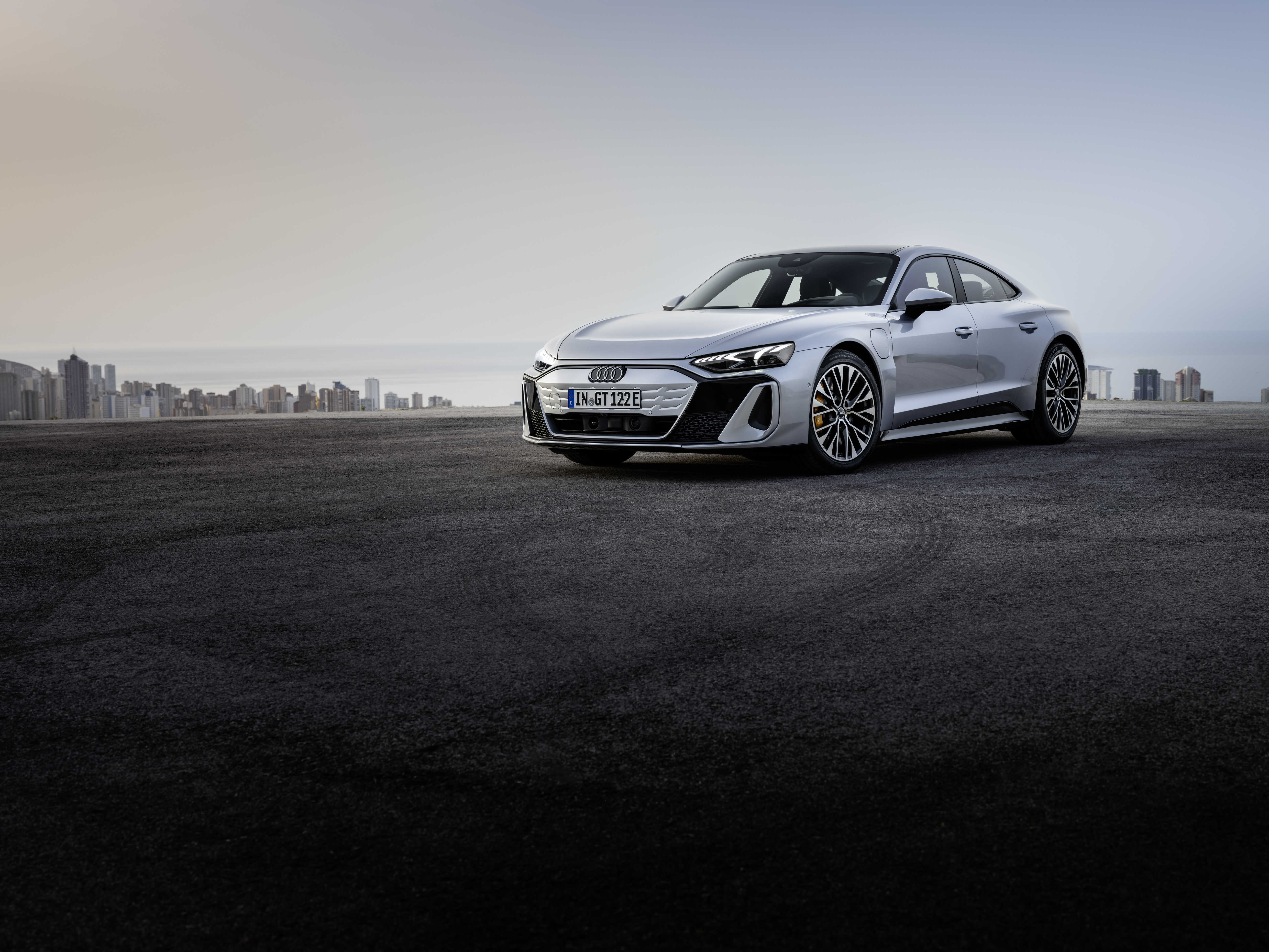
Audi described the facelift as a sharper look for each version. The S e-tron GT has a fully closed, inverted Singleframe in a black mask, a body-colour strip above it and a rear diffuser with vertical fins. The RS e-tron GT gets the RS 3D honeycomb grille, L-shaped blades in the front bumper and a motorsport-style red reflector between the diffuser's aero channels. The RS e-tron GT performance adds an optional matte, darkened carbon roof and, for the first time at Audi, optional carbon camouflage trim on the bumpers, door trim, diffuser and mirrors, plus the exclusive Bedford Green paint. The four rings are now a flat two-dimensional emblem, there are nine exterior colours, and new 20-inch and forged 21-inch wheels were added, the latter inspired by the 1991 Avus quattro study.
Inside, the steering wheel is flattened at top and bottom, with two red control satellites in the RS models, and the seats have a new funnel-shaped design with an illuminated logo. The S comes with 14-way sports seats, the RS models can be ordered with massage, and the RS performance has an optional 18-way seat and a Serpentine Green design package. Audi uses Dinamica microfibre with 37 to 45 percent recycled polyester, the Cascade fabric and floor mats made of Econyl, which is recycled nylon. An optional panoramic roof uses polymer-dispersed liquid crystal technology to switch from clear to opaque at the touch of the screen, working like a digital curtain with four presets. The RS e-tron GT performance can show a white power meter and speedometer, a reference to the 1994 Audi RS 2 Avant.
Technology & Features
The 12.3-inch virtual cockpit plus now shows battery temperature, a quick-charging forecast, the preconditioning status and the maximum charging power available in real time. The MMI touch system uses a 10.1-inch screen, and Audi Connect services, on-demand functions and an app store are included. The UK specification lists a Bang & Olufsen sound system with 16 speakers and 3D sound on the RS e-tron GT performance, and a head-up display is also listed as standard there. A standard heat pump and four optimised cooling circuits keep the battery and drive components at working temperature, and the navigation system preconditions the pack when a fast charger is set as the destination.
Safety & ADAS
Audi UK lists adaptive cruise assist with emergency assist, active lane assist, turn assist, swerve assist, efficiency assist and camera-based traffic sign recognition in the Tour Pack, which comes as standard on the RS e-tron GT performance, along with a 360-degree camera and park assist. Equipment varies by market and by version, so buyers should check the local list. Audi does not state an automation level, and the systems are driver-supervised. We found no Euro NCAP crash-test rating for the e-tron GT, so it should be treated as unrated.
| ADAS LEVEL | Driver-supervised assistance (no automation level stated by Audi) |
|---|---|
| ADAS FEATURES | Adaptive cruise assist, active lane assist, turn assist, swerve assist, traffic sign recognition, 360° camera, park assist (UK Tour Pack specification) |
Available Versions
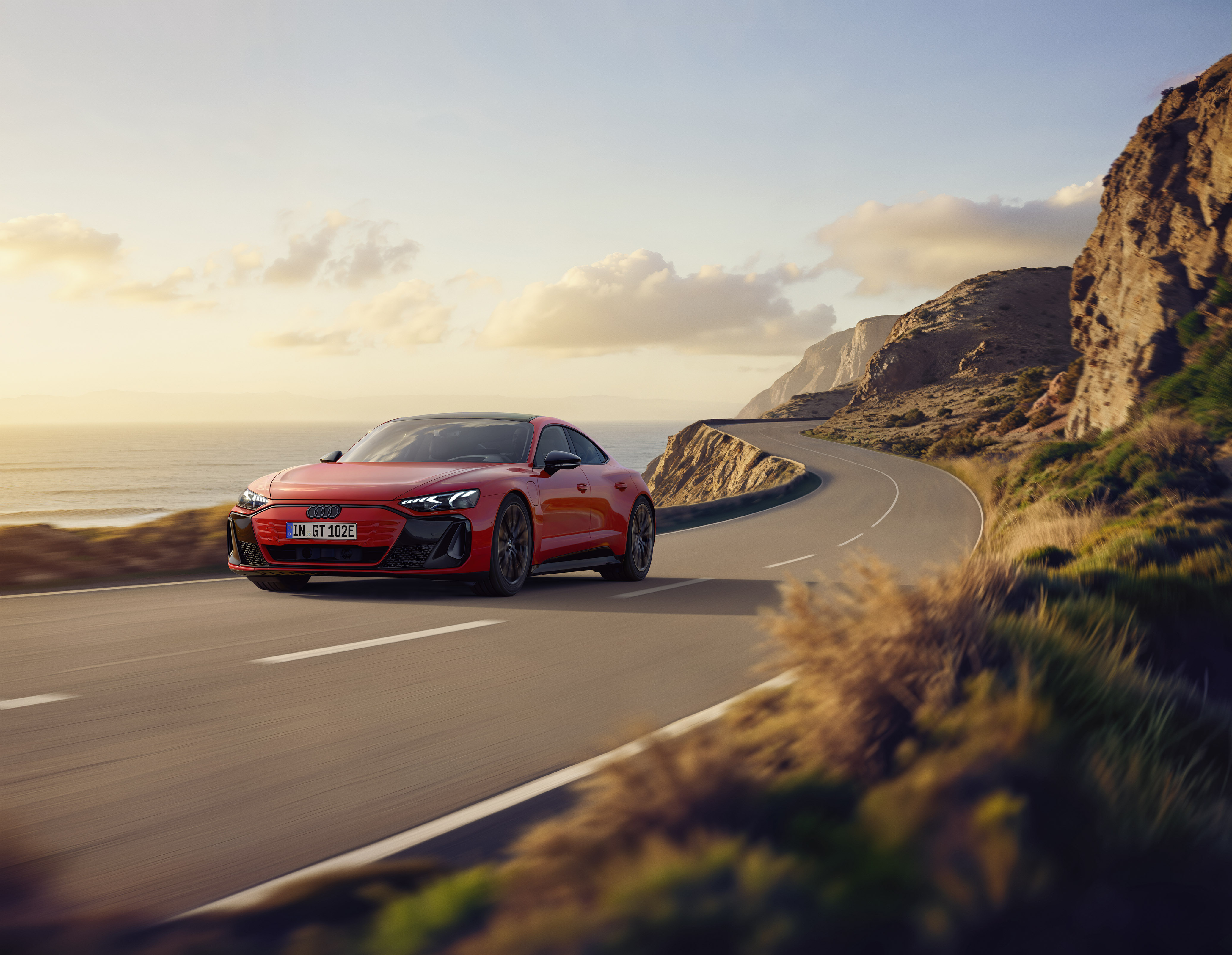
| VERSION | POWER | TORQUE | 0-100 | TOP SPEED | DRIVETRAIN | BATTERY | EV RANGE | COMBINED RANGE | PRICE | KEY DIFFERENCES |
|---|---|---|---|---|---|---|---|---|---|---|
| e-tron GT quattro | 496 hp | 625 Nm | 4.2s | 245 km/h | AWD | 105 kWh | 622 km | — | EUR 108,900 | 370 kW (503 PS); 430 kW (585 PS / 577 hp) with Launch Control, 4.0 s; longest range and lightest version; not listed by Audi USA or Audi Israel |
| S e-tron GT | 583 hp | 740 Nm | 3.6s | 245 km/h | AWD | 105 kWh | 609 km | — | EUR 126,000 | 435 kW (591 PS); 500 kW (679 PS / 670 hp) with Launch Control, 3.4 s; US price $127,700 for 2026 |
| RS e-tron GT | 671 hp | 865 Nm | 3.1s | 250 km/h | AWD | 105 kWh | 598 km | — | EUR 147,500 | 500 kW (680 PS); Push-to-Pass adds 70 kW; 630 kW (856 PS / 845 hp) with Launch Control, 2.8 s |
| RS e-tron GT performance | 738 hp | 1,027 Nm | 2.9s | 250 km/h | AWD | 105 kWh | 592 km | — | EUR 160,500 | 550 kW (748 PS); Push-to-Pass adds 70 kW; 680 kW (925 PS / 912 hp) with Launch Control, 2.5 s; US price $170,500 |
Pricing & Availability
All prices are manufacturer or importer list prices checked on 6 October 2026. Audi Germany lists the e-tron GT quattro at €108,900, the S e-tron GT at €126,000, the RS e-tron GT at €147,500 and the RS e-tron GT performance at €160,500, all including VAT. Audi UK shows on-the-road prices including VAT of £88,605, £107,875, £126,475 and £166,475 for the same four versions. In Switzerland, importer AMAG's list valid from 1 January 2026 gives CHF 112,900, CHF 130,000, CHF 153,000 and CHF 166,000 including 8.1 percent VAT. In the US, Audi sold the S e-tron GT at $127,700 and the RS e-tron GT performance at $170,500 for the 2026 model year; the 2027 US lineup, as reported by autoevolution from Audi of America's pricing, has a single e-tron GT, the RS e-tron GT performance at $170,500 with 912 hp, before the destination charge, and Audi USA's 2027 page lists it at the same price.
In Israel the importer Champion Motors launched the facelifted car in November 2024 in two versions only, the S e-tron GT at NIS 979,000 and the RS e-tron GT performance at NIS 1,390,000, according to Carzone. Carzone's current list price for the S is NIS 999,600, which matches iCar, while the RS performance is listed at NIS 1,350,000 by auto.co.il, NIS 1,401,900 by Cartube and NIS 1,453,000 by iCar, so the importer's current price list should be checked. Audi Israel's own site shows only these two versions, and the e-tron GT quattro and the plain RS e-tron GT are not offered there.
How It Compares
The obvious rival is the car the e-tron GT is closest to under the skin. The Porsche Taycan shares its platform with the e-tron GT and now uses the same 105 kWh (97 kWh net) battery and 320 kW peak charging, so the contest comes down to price, power and range. The RS e-tron GT performance lists $170,500 in the US and €160,500 in Germany, while the Taycan Turbo S lists $221,400 and €211,000, roughly 30 percent more for 939 hp with Launch Control against Audi's 912 hp, a gap of only 27 hp. The Porsche is also a little quicker on paper at 2.4 seconds to 100 km/h in Germany against Audi's 2.5, and its WLTP range of up to 634 km beats the Audi's 592 km.
The Taycan GTS is the closer match on price: $157,000 in the US and €148,800 in Germany, with 690 hp under Launch Control (515 kW) and up to 637 km of WLTP range. For $13,500 more the Audi RS e-tron GT performance adds 222 hp, but gives up about 45 km of rated range. The Taycan figures come from Porsche's own US and German model pages, and Audi's range is the official WLTP window rather than a single best case, so real differences will depend on wheels, options and driving. The cheaper Audi versions, including the €108,900 e-tron GT quattro with up to 622 km, are outside this comparison.
- One 105 kWh (97 kWh net), 800-volt battery in four versions, with 320 kW peak DC charging and 10-80% in 18 minutes under ideal conditions
- Power from 370 kW (496 hp) to 680 kW (912 hp) with Launch Control, and an RS performance that undercuts the Taycan Turbo S by about $50,900 in the US
- Up to 622 km WLTP in the e-tron GT quattro, at €108,900 in Germany
- Heavy: 2,280 to 2,320 kg unladen without driver, and the RS versions have only 350 litres of boot space
- The top two versions give up range, with 533-592 km WLTP for the RS performance against up to 634 km for the Taycan Turbo S, and the peak figures need Launch Control or Push-to-Pass
- Choice is narrow outside Europe: the US lineup is now the RS performance alone and Israel sells only two versions
After the facelift, the e-tron GT is a more complete car than the one it replaced: a bigger battery, 320 kW charging, up to 622 km WLTP and a range that now starts at €108,900 and tops out at a 912 hp RS performance. The quattro is the sensible pick for long-distance buyers, while the RS e-tron GT performance is the one that makes the case against the Taycan Turbo S on price. Buyers should remember that the headline power numbers apply only for short bursts, that range falls with the faster versions, and that the car is heavy. It is a convincing electric Gran Turismo, especially in Europe where all four versions are on sale.