
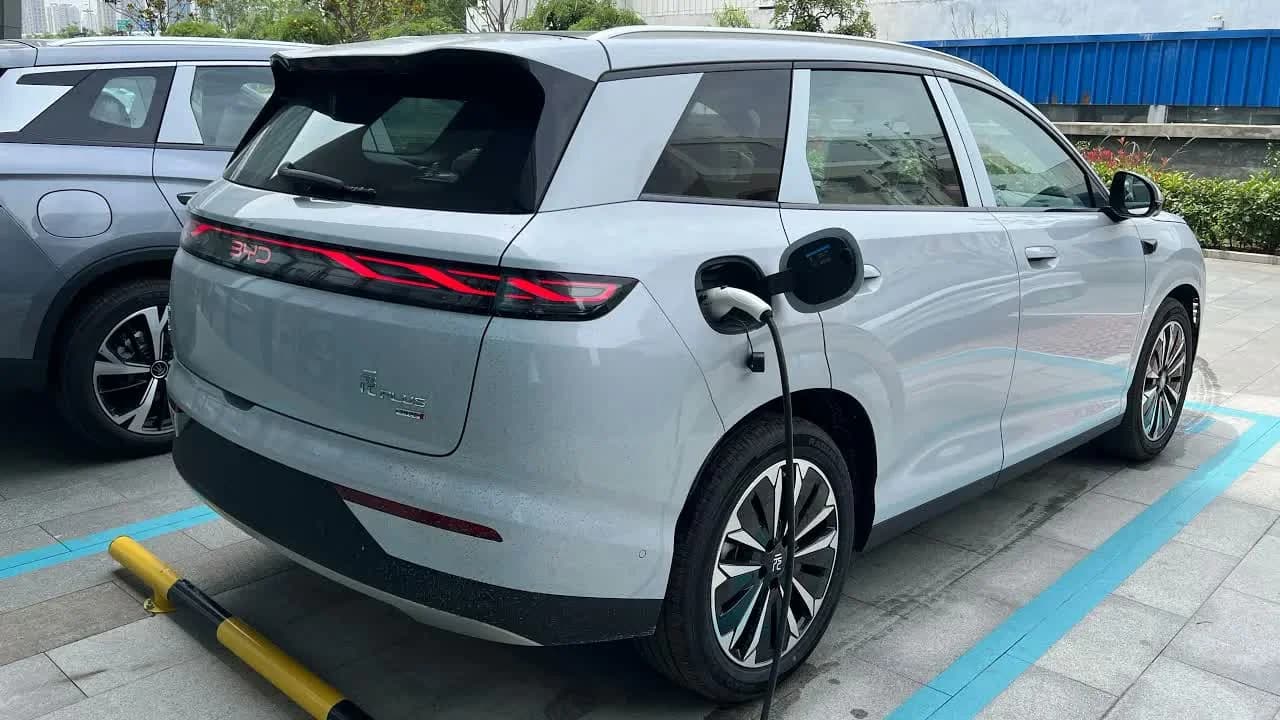
BYD launched the third-generation Yuan Plus in China on May 21, 2026, after unveiling it at the Beijing Auto Show in April. It is a full platform change rather than a facelift: the new car sits on BYD’s e-Platform 3.0 Evo, is rear-wheel drive, uses the second-generation Blade Battery and supports BYD’s Flash Charging, which takes the battery from 10% to 70% in about five minutes and to 97% in about nine. Range rises to 540 km or 630 km on the CLTC cycle, the body grows to 4,665 mm long with a 750 L boot and a new 180 L front trunk, and the LiDAR-equipped God’s Eye B driver-assist package is offered as a CNY 12,000 (about $1,800) option on the three upper trims. Four trims run from CNY 119,900 (about $17,900) for the 540 Leading to CNY 149,900 (about $22,400) for the 630 Excellence, converted throughout at 6.70 CNY per dollar. Every version is a single rear motor: 200 kW (272 PS / 268 hp) on the 540 km trims and 240 kW (326 PS / 322 hp) on the 630 km trims. There is no dual-motor all-wheel-drive version in this lineup, and BYD reported more than 30,000 orders in the first week on sale.
Performance & Specs
The third-generation Yuan Plus uses a single rear-mounted permanent-magnet motor in every trim, offered in two outputs. The 540 km trims get 200 kW (272 PS / 268 hp), good for 0-100 km/h in 6.6 seconds and a 190 km/h top speed, while the 630 km trims get 240 kW (326 PS / 322 hp), 5.9 seconds and 200 km/h. Curb weight is 1,690 kg for the 540 km version and 1,840 kg for the 630 km version. The two LFP second-generation Blade Battery packs hold 57.5 kWh and 68.5 kWh and are rated at 540 km and 630 km on the CLTC cycle. CLTC consumption is listed at 11.8 kWh/100 km for the 540 km car and 12.1 kWh/100 km for the 630 km car; these are grid-side figures, which is why they sit about 11% above the pack size divided by range. The chassis uses a MacPherson front and five-link rear suspension, with adaptive DiSus-C damping on the higher trims.

| Powertrain | Single-motor RWD BEV |
|---|---|
| Power | 240 kW (322 hp) |
| Drivetrain | Rear-wheel drive |
| 0–100 km/h | 5.9 s |
| Battery | 68.5 kWh LFP Blade 2.0 |
| Range | 630 km CLTC |
| POWERTRAIN TYPE | BEV single-motor RWD (e-Platform 3.0 Evo) |
|---|---|
| HORSEPOWER (540 trims) | 268 hp (200 kW / 272 PS) |
| HORSEPOWER (630 trims) | 322 hp (240 kW / 326 PS) |
| 0-100 KM/H | 6.6 s (540 trims) / 5.9 s (630 trims) |
| TOP SPEED | 190 km/h (540 trims) / 200 km/h (630 trims) |
| DRIVETRAIN | RWD |
| BATTERY (540) | 57.5 kWh Blade Battery 2.0 LFP |
| BATTERY (630) | 68.5 kWh Blade Battery 2.0 LFP |
| EV RANGE | 540 km / 630 km (CLTC) |
| ENERGY CONSUMPTION | 11.8 kWh/100 km (540) / 12.1 kWh/100 km (630), CLTC grid-side |
| CURB WEIGHT | 1,690 kg (540) / 1,840 kg (630) |
Dimensions & Practicality

| Length | 4,665 mm |
|---|---|
| Width | 1,895 mm |
| Height | 1,675 mm |
| Wheelbase | 2,770 mm |
| Ground clearance | ~170 mm |
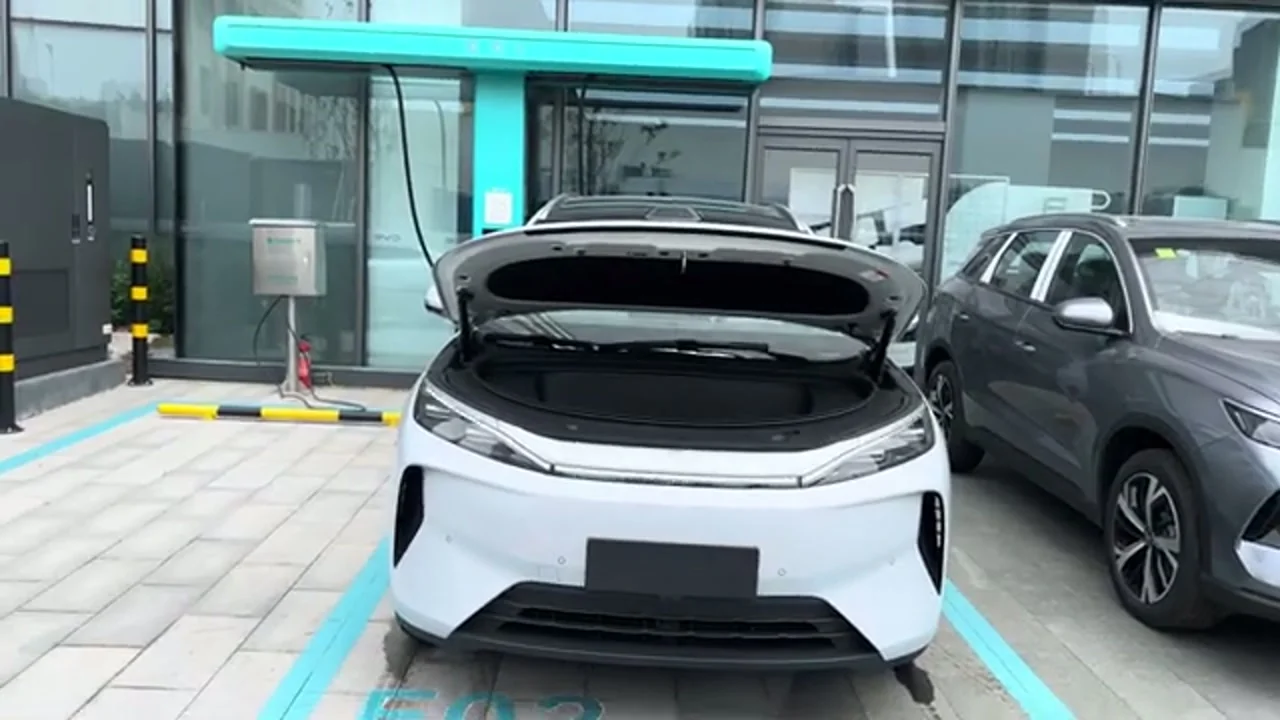
The third-generation Yuan Plus grows in every direction over the previous generation: 210 mm longer (4,665 mm against 4,455 mm), a 50 mm longer wheelbase (2,770 mm against 2,720 mm) and a taller 1,675 mm roof line. The extra length goes into cargo space: 750 liters with the rear seats up and about 1,750 liters with the rear bench folded, plus the new 180-liter front trunk, and BYD counts 39 storage spaces in the cabin. The reviewer demonstrates the “knock twice to open” gesture on the front trunk. The 630 km trims ride on 19-inch wheels with 235/50 R19 tires (Chaoyang tires on the reviewer’s car), and the reviewer puts ground clearance at about 170 mm. The reviewer notes that the body looks completely different from the previous Yuan Plus, with flush door handles, a two-spoke steering wheel and a full-width LED rear light bar carrying a central BYD wordmark.
| LENGTH | 4,665 mm |
|---|---|
| WIDTH | 1,895 mm |
| HEIGHT | 1,675 mm |
| WHEELBASE | 2,770 mm |
| CARGO VOLUME | 750 L (about 1,750 L seats folded) |
| FRUNK | 180 L |
| SEATING | 5 |
| WHEELS / TIRES | 19″ / 235/50 R19 (630 km trims) |
| GROUND CLEARANCE | ~170 mm |
Charging & Battery
Every version of the third-generation Yuan Plus ships with the second-generation Blade Battery and BYD’s Flash Charging. On a BYD flash-charging station the battery goes from 10% to 70% in about five minutes and from 10% to 97% in about nine minutes at normal temperatures, and BYD says a cold day at -30°C adds only about three minutes. BYD had built more than 6,000 flash-charging stations in China by launch, and the launch package includes a one-year free-charging offer. The quoted times apply to that station network, so charging elsewhere will be slower. The smaller 57.5 kWh pack is rated at 540 km CLTC and the larger 68.5 kWh pack at 630 km.
| BATTERY OPTIONS | 57.5 / 68.5 kWh Blade Battery 2.0 LFP |
|---|---|
| DC FLASH CHARGING | 10-70% in ~5 min (BYD stations) |
| DC 10-97% TIME | ~9 min |
| COLD WEATHER | About 3 min longer at -30°C |
Design & Interior
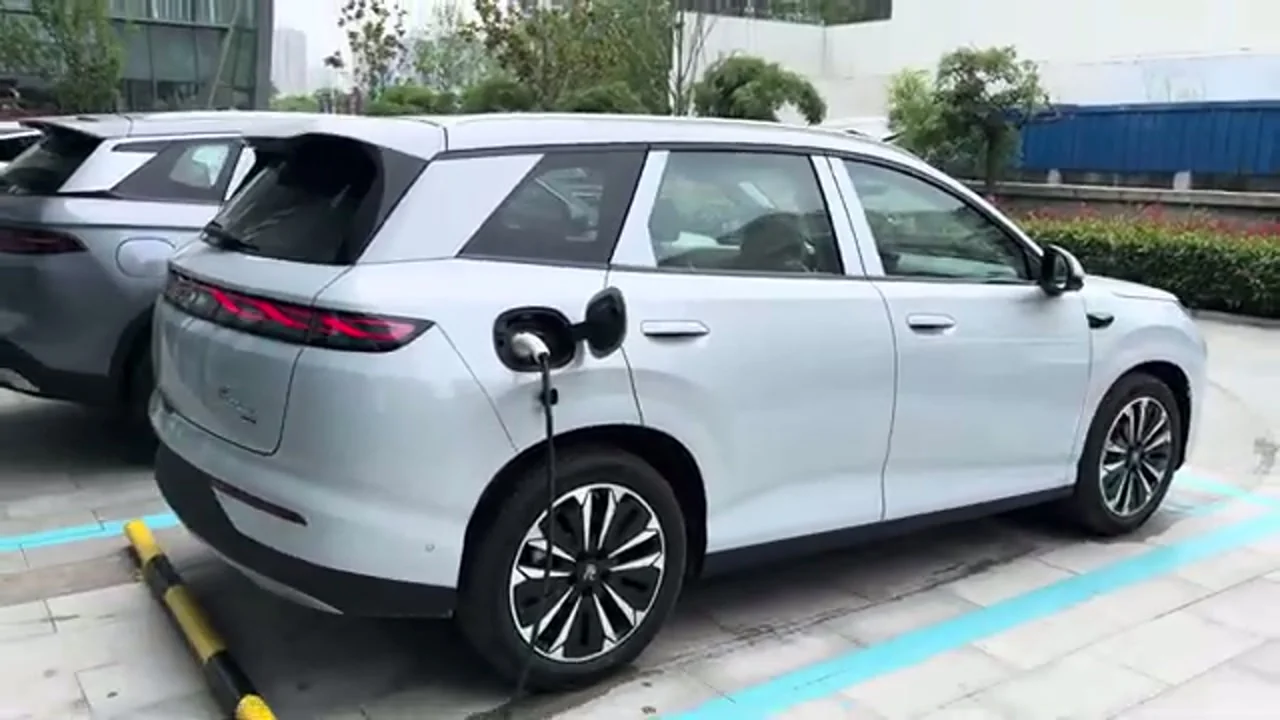
The Yuan Plus exterior is a clean-sheet redesign. The reviewer’s walkaround car is finished in arctic white pearl with body-color cladding along the lower side sills. The front fascia moves to a more horizontal LED daytime running light bar with the BYD wordmark, which the reviewer says looks similar to the Song Pro. New flush-fit door handles replace the exposed handles of the previous generation, and the rear gets a full-width connected LED tail-light bar with a central BYD wordmark. Inside, the cabin uses a more cohesive layout built around a floating central touchscreen (15.6 inches from the 540 Beyond trim up, 12.8 inches on the entry trim), a two-spoke leather-wrapped steering wheel and an 8.8-inch digital instrument cluster. The reviewer’s car shows electric front seats with leather upholstery, dual 50W wireless phone chargers ahead of the gear selector, a heating-and-cooling fridge in the center console and a panoramic glass roof with a sunshade. The panoramic roof starts at the 540 Beyond trim, and the Excellence trim adds a 12-inch head-up display, 256-color ambient lighting, a 16-speaker audio system, a heated steering wheel and a “Queen Seat” front passenger seat with a powered leg rest.
Technology & Features
The Yuan Plus runs BYD’s DiLink cockpit on the floating central touchscreen, with an AI voice assistant and a full English-language interface shown on the reviewer’s car. Behind the steering wheel sits an 8.8-inch digital instrument cluster, and the higher trims add a 12-inch head-up display. The 630 Excellence brings the 16-speaker sound system and the Queen Seat passenger configuration with a powered leg support, while the 630 Beyond and Excellence both carry the heating-and-cooling fridge and a power tailgate. All versions come with seven airbags, and BYD counts 39 storage spaces in the cabin, including dual rear storage modules.
Safety & ADAS
| ENTRY TRIM (540 LEADING) | No God’s Eye driver-assist package; 360° surround view with transparent-chassis display |
|---|---|
| STANDARD, BEYOND AND UP | God’s Eye C driver assistance |
| LIDAR OPTION | God’s Eye B / DiPilot 300 for CNY 12,000 (about $1,800), on the 540 Beyond, 630 Beyond and 630 Excellence only |
| SENSING (OPTION) | 30 sensing units including a roof-mounted LiDAR |
| FEATURES (OPTION) | Highway and urban navigation assist, all-scenario automated parking |
| AIRBAGS | 7 (all versions) |
The entry 540 Leading has no God’s Eye driver-assist package. From the 540 Beyond up, God’s Eye C is standard, and the LiDAR-based God’s Eye B can be added for CNY 12,000 (about $1,800), which brings urban and highway navigation assist and automated parking with 30 sensing units. Because the option is not offered on the entry trim, the cheapest LiDAR-equipped Yuan Plus is the 540 Beyond plus the option at CNY 141,900 (about $21,200). That compares with the GAC Aion N60, which fits LiDAR as standard on every trim from CNY 109,800 (about $16,400).
Available Versions
| VERSION | POWER | 0-100 | TOP SPEED | DRIVETRAIN | BATTERY | EV RANGE | PRICE | KEY DIFFERENCES |
|---|---|---|---|---|---|---|---|---|
| 540 Leading | 268 hp | 6.6s | 190 km/h | RWD | 57.5 kWh | 540 km | $17,900 | Entry trim, 12.8″ screen, no God’s Eye driver assist, no panoramic roof |
| 540 Beyond | 268 hp | 6.6s | 190 km/h | RWD | 57.5 kWh | 540 km | $19,400 | 15.6″ screen, God’s Eye C, panoramic roof, adaptive headlights, adaptive damping; LiDAR option |
| 630 Beyond | 322 hp | 5.9s | 200 km/h | RWD | 68.5 kWh | 630 km | $21,300 | 240 kW motor, larger battery, 19″ wheels, fridge, power tailgate; LiDAR option |
| 630 Excellence | 322 hp | 5.9s | 200 km/h | RWD | 68.5 kWh | 630 km | $22,400 | Adds 12″ head-up display, 16 speakers, Queen Seat, heated steering wheel; LiDAR option |
Pricing & Availability
The third-generation Yuan Plus was unveiled at the Beijing Auto Show in April 2026 and went on sale in China on May 21, 2026, in four trims from CNY 119,900 to CNY 149,900 (about $17,900 to $22,400). The entry price is CNY 4,100 (3.5%) above the CNY 115,800 starting price of the outgoing car, and the God’s Eye B LiDAR pack adds CNY 12,000 (about $1,800) on the three upper trims. BYD reported more than 30,000 orders in the first week. Outside China, BYD plans to sell this generation as the Atto 5. New Zealand is the only confirmed market so far, with a 2027 launch that replaces the current Atto 3 there. A European launch before 2027 appears unlikely, and Australia has not been confirmed. Buyers outside China today can still get the previous-generation Atto 3, including the Atto 3 Evo, which is a different car. Availability is as of September 2026.
How It Compares
The Yuan Plus enters the most crowded part of the Chinese EV market: compact electric crossovers priced around CNY 100,000 to 150,000. Its closest rival on features is the GAC Aion N60, which fits LiDAR and 4D radar to every trim starting at CNY 109,800 (about $16,400), while the cheapest LiDAR-equipped Yuan Plus costs about $21,200. In return the BYD offers more power (268 hp or 322 hp against up to 221 hp), a slightly longer top range (630 km against 610 km) and BYD’s five-minute Flash Charging. The Geely Galaxy E5 offers comparable range and a wider price spread, and the latest Leapmotor B10 undercuts everyone at CNY 99,800 (about $14,900) while offering 800-volt charging on its 610 km version and LiDAR on two of its five trims. For buyers who want the most power, five-minute Flash Charging and the option of LiDAR driver assist, the Yuan Plus is the more complete package, at a higher entry price.
- Up to 630 km CLTC range on the 68.5 kWh pack, against 510 km for the previous generation
- 750 L boot and a new 180 L front trunk in a 4,665 mm body
- Flash Charging: 10-70% in about 5 minutes on BYD stations, 10-97% in about 9
- Optional LiDAR God’s Eye B with urban and highway navigation assist for CNY 12,000 (about $1,800)
- 240 kW (322 hp) RWD top trim with 0-100 km/h in 5.9 seconds
- 15.6″ floating touchscreen, and a fridge, 16 speakers and a Queen Seat at the top of the range
- Entry price only about 3.5% above the outgoing car’s
- No dual-motor or all-wheel-drive version in the lineup
- The entry 540 Leading has no God’s Eye driver assist, no panoramic roof and only a 12.8″ screen
- LiDAR is not offered on the entry trim, so the cheapest LiDAR car is about $21,200
- Flash-charging times apply only at BYD stations, more than 6,000 of them in China
- Overseas availability is confirmed only for New Zealand (2027, as the Atto 5)
- Rivals such as the Leapmotor B10 and GAC Aion N60 start lower
The third-generation Yuan Plus is a large step up on paper: a longer body, rear-wheel drive, a second-generation Blade Battery and Flash Charging, all for an entry price only about 3.5% above the outgoing car. Range reaches 630 km CLTC, the boot grows to 750 L and LiDAR-based driver assist is available from the mid trims. The catch is that the headline extras sit higher up the trim ladder than the starting price suggests: the 240 kW motor and 630 km pack start at CNY 142,900 (about $21,300), the cheapest LiDAR car costs about $21,200, and there is no all-wheel-drive version. Against the GAC Aion N60, which fits LiDAR to every trim from CNY 109,800, the BYD offers more power and faster charging at a higher price. For buyers in China it is a very strong compact EV; for everyone else it is a 2027 story, starting with New Zealand.