
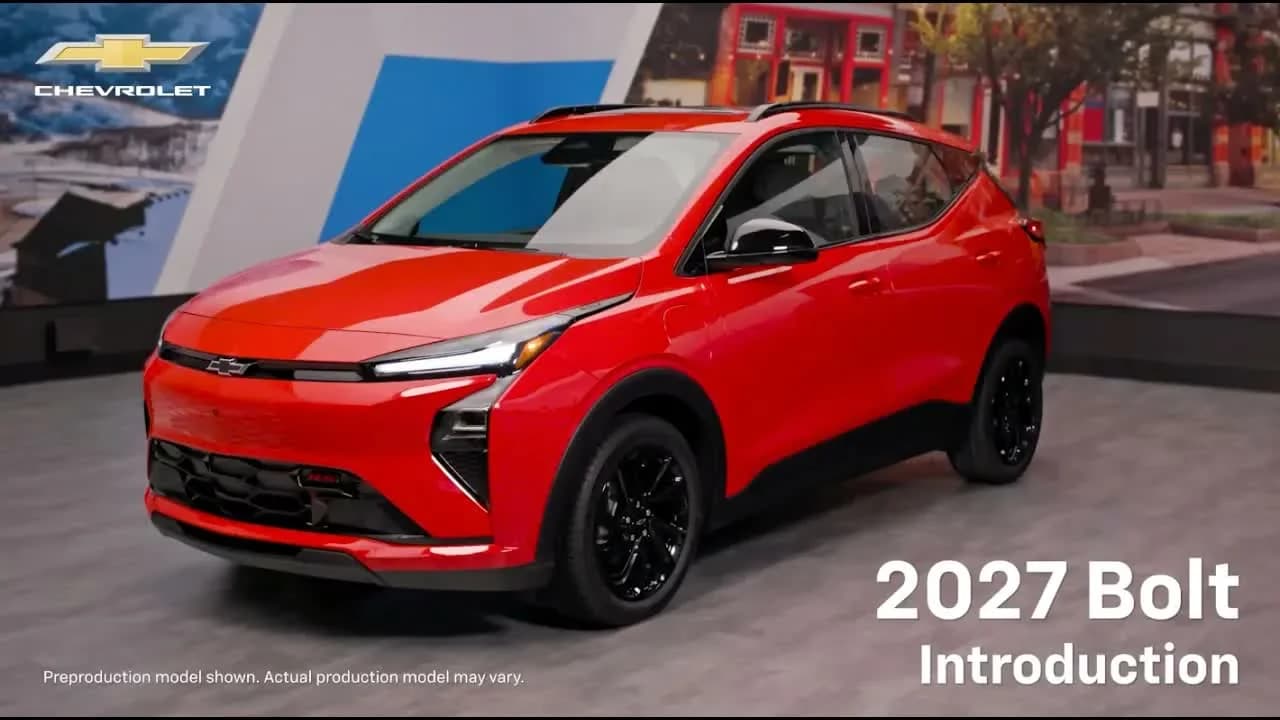
The Chevrolet Bolt EV is back — and the 2027 model fixes the two things that always held the old one back. The returning subcompact electric crossover keeps its famous low price, starting at just $27,600, but now adds an EPA-rated 262 miles (422 km) of range, 150 kW DC fast charging (nearly three times quicker than before) and Chevrolet's first factory native NACS port for built-in Tesla Supercharger access. It's also GM's first vehicle to use a cheaper, longer-lasting LFP battery, and it brings bidirectional vehicle-to-home power and Google Built-in software. For buyers who just want an affordable, practical EV that charges quickly, the new Bolt is one of the most sensible cars on sale.
Performance & Specs
The 2027 Bolt sticks to a simple, sensible formula. A single front-mounted motor drives the front wheels with 210 hp (about 156 kW) and 169 lb-ft (229 Nm) of torque, good for a 0–60 mph time of 6.8 seconds — not quick, but perfectly adequate for a city-focused EV. There's no all-wheel-drive option; like the original Bolt, this is a front-drive-only car aimed at efficiency and value rather than performance. The big change is underneath: the Bolt is GM's first EV to use a lithium-iron-phosphate (LFP) battery, a roughly 65 kWh pack that's cheaper to build, more durable, and happy being charged to 100% every day. That delivers an EPA-rated 262 miles (422 km) of range, slightly up on the old Bolt's 259 miles and far more usable thanks to faster charging.

| POWERTRAIN TYPE | Single-motor BEV |
|---|---|
| HORSEPOWER | 210 hp (~156 kW) |
| TORQUE | 169 lb-ft (229 Nm) |
| ACCELERATION | 0–60 mph 6.8 s |
| DRIVETRAIN | Front-wheel drive |
| BATTERY | ~65 kWh LFP |
| ELECTRIC RANGE | 422 km / 262 mi (EPA) |
| CHARGING PORT | Native NACS |
Dimensions & Practicality

| Length | 4,308 mm |
|---|---|
| Width | 1,770 mm |
| Height | 1,623 mm |
| Wheelbase | 2,675 mm |
| Cargo | 459 L (1,594 L folded) |
At 4,308 mm long on a 2,675 mm wheelbase, the Bolt is a compact, easy-to-park crossover-hatch that's tailor-made for city life. Despite the small footprint, it's a genuine five-seater with a useful 459 litres of cargo behind the rear seats, expanding to about 1,594 litres with them folded — plenty for a family's weekly errands or a weekend away. Curb weight is around 1,713 kg, very light for an EV, which helps both efficiency and agility. There's no front trunk, but the boot and flexible rear seats make the most of the space.
| LENGTH | 4,308 mm (169.6 in) |
|---|---|
| WIDTH | 1,770 mm (69.7 in) |
| HEIGHT | 1,623 mm (63.9 in) |
| WHEELBASE | 2,675 mm (105.3 in) |
| CARGO VOLUME | 459 L (1,594 L seats folded) |
| CURB WEIGHT | ~1,713 kg |
Charging & Battery
This is where the new Bolt truly leaps ahead of its predecessor. The old car's painfully slow 55 kW DC charging is replaced by 150 kW fast charging, allowing a 10–80% top-up in roughly 26 minutes — finally making the Bolt a viable road-trip car. The roughly 65 kWh LFP battery pairs with an 11.5 kW onboard AC charger for home charging, and the Bolt's native NACS port means it can plug straight into Tesla Superchargers without an adapter (a CCS adapter is offered for older stations). There's no vehicle-to-load (V2L) function, but the Bolt does offer up to 9.6 kW of vehicle-to-home (V2H) backup power with GM Energy hardware.
| BATTERY | ~65 kWh LFP |
|---|---|
| AC CHARGING | 11.5 kW |
| DC FAST CHARGING | 150 kW |
| DC 10-80% TIME | ~26 min |
Design & Interior
The new Bolt drops the old car's rounded look for Chevrolet's current EV design language, sharing its face with the larger Equinox and Blazer EVs: a slim split-headlight signature, a body-coloured closed nose with the Chevy bowtie, and a sportier, more crossover-like stance with black wheel-arch cladding and roof rails. The RS trim shown adds black alloy wheels and red accents. Inside, the cabin is modern and simple, built around the dual-screen layout, with practical materials suited to the price point. Higher RS trim brings heated and ventilated front seats and added comfort features. It's a clear generational leap over the outgoing Bolt's dated interior, with a more upright crossover seating position, improved outward visibility and a flat floor that opens up rear-seat space despite the compact footprint. The new design also sheds the old Bolt's slightly toy-like image for something that looks far more like a modern Chevrolet, which should widen its appeal well beyond die-hard EV bargain hunters.
Technology & Features
The Bolt runs GM's Google Built-in infotainment across an 11.3-inch central touchscreen and an 11-inch digital driver display, with Google Maps, Google Assistant and Play Store apps native to the car. Notably, there's no Apple CarPlay or Android Auto — GM is committing to its own connected platform. Standard driver aids include adaptive cruise control, lane-keep assist and a 360-degree camera, while hands-free Super Cruise is available as an option arriving in late 2026, complete with a three-year trial.
Safety & ADAS
Every Bolt comes with Chevy Safety Assist, bundling automatic emergency braking, lane-keep assist and lane-departure warning, plus a 360-degree camera system with video recording. Adaptive cruise control is standard, and buyers can add Super Cruise for genuine hands-free highway driving on compatible roads once it arrives later in 2026.
| ADAS LEVEL | L2 (Super Cruise hands-free optional) |
|---|---|
| ADAS FEATURES | AEB, adaptive cruise, lane-keep, 360° camera, Super Cruise (optional) |
Available Versions
| VERSION | POWER | BATTERY | EV RANGE | 0-60 MPH | PRICE | KEY DIFFERENCES |
|---|---|---|---|---|---|---|
| Bolt LT | 210 hp | ~65 kWh LFP | 422 km (262 mi) | 6.8 s | $27,600 | Base trim, full core tech |
| Bolt RS | 210 hp | ~65 kWh LFP | 422 km (262 mi) | 6.8 s | $31,600 | Heated/ventilated seats, roof rails, black wheels |
Pricing & Availability
The 2027 Chevrolet Bolt EV starts at $27,600 for the LT and $31,600 for the RS (plus a $1,395 destination charge), keeping it among the cheapest EVs in the US. Production began at GM's Fairfax Assembly plant in Kansas in November 2025, with cars reaching dealerships from January 2026. Reports suggest it's a relatively short-run model — roughly 16–18 months — so availability may be limited before the plant is retooled.
How It Compares
At $27,600, the Bolt undercuts almost everything. The all-new Nissan Leaf offers more range (up to 303 miles) but costs more to start, while the Kia EV3 is pricier still. Chevrolet's own Equinox EV goes further and is roomier, but it's a size up and several thousand dollars more. The Bolt's trump cards are its rock-bottom price, native NACS charging and a now-respectable 262-mile range — a combination that makes it the default pick for budget-minded EV buyers, provided you can get one before the limited production run ends.
- Among the cheapest EVs in the US at $27,600
- 150 kW charging — nearly 3x faster than the old Bolt
- Native NACS port for Tesla Supercharger access
- Durable LFP battery and 262-mile EPA range
- Front-wheel drive only and modest 6.8s 0-60
- No Apple CarPlay / Android Auto, no V2L
- Reportedly a short, limited production run
The 2027 Chevrolet Bolt EV takes a much-loved budget EV and finally gives it the charging speed and connector it always needed. With 150 kW DC charging, native NACS, a tough LFP battery and 262 miles of range — all from $27,600 — it removes the biggest compromises of the old car while keeping the price that made the Bolt a hit. It's still front-drive-only and drops some features like CarPlay, but as cheap, no-nonsense electric transport that can now actually road-trip, the new Bolt is outstanding value. The only catch is the reportedly limited production run, so interested buyers shouldn't wait too long.