
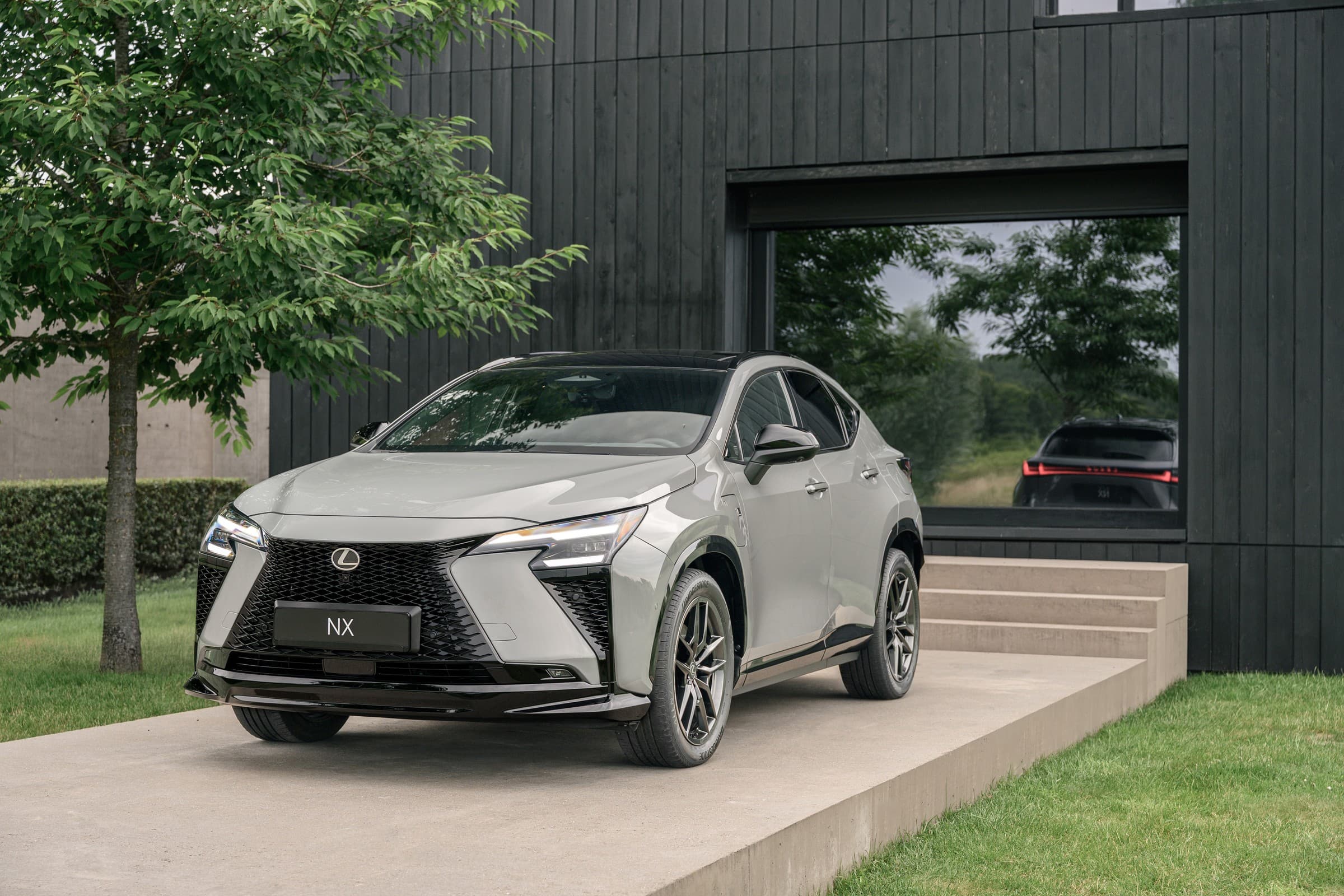
Lexus gave the NX its mid-cycle update on September 1, 2026, and the headline changes sit in the plug-in hybrid. The 2027 Lexus NX 450h+ moves to a new 23 kWh battery, up from 18 kWh, which Lexus says should deliver more than 100 km of electric range on the WLTP cycle, almost 40 percent more than the outgoing car. It is also the first Lexus plug-in hybrid that can use DC fast charging, with a 10–80% top-up quoted at about 30 minutes. System output in the European specification rises to 226 kW (307 PS, about 303 hp), and Lexus quotes 0–100 km/h in 6.1 seconds. This is an update of the second-generation NX that launched in 2021, not an all-new car: the platform and body are carried over, wrapped in a new face, a redesigned cabin and sixth-generation hybrid hardware. Official pricing has not been announced, so the price stays “TBA” here, and Lexus stresses that all figures are provisional until homologation.
Performance & Specs
The NX now uses Lexus’s sixth-generation hybrid technology, built around a new e-Axle that integrates the transaxle, electric motor and power control unit in one assembly. In the NX 450h+ it is paired with a 2.5-litre inline four-cylinder petrol engine and the E-Four electronic all-wheel-drive system, which Lexus has retuned so that the rear motor can support continuous all-wheel-drive operation in a wider range of conditions. The European figures are a system output of 226 kW (307 PS, roughly 303 hp) and a 0–100 km/h time of 6.1 seconds. Lexus’s global press material quotes a broader range of 215–240 kW, which works out to about 288–322 hp depending on the market, and a 0–100 km/h time of 6.0 seconds. Towing capacity rises to 1,500 kg. Lexus says the updated NX is also the first of its cars to be tuned at the Nürburgring for European roads, and Lexus Europe says both hybrid systems meet the coming Euro 7 standard.

| Powertrain | Plug-in hybrid (PHEV), 2.5L four + e-Axle |
|---|---|
| Power | 226 kW (307 PS / 303 hp), Europe |
| Drivetrain | E-Four electronic AWD |
| 0–100 km/h | 6.1 s (Europe) |
| Battery | 23 kWh lithium-ion |
| EV range | Over 100 km (WLTP, provisional) |
| POWERTRAIN TYPE | Plug-in hybrid (NX 450h+) and self-charging hybrid (NX 350h, NX 300h) |
|---|---|
| HORSEPOWER | NX 450h+: 226 kW (307 PS / 303 hp) in Europe; up to 240 kW (326 PS / 322 hp) globally |
| ACCELERATION | NX 450h+: 0–100 km/h in 6.0–6.1 s |
| TOP SPEED | Not yet disclosed |
| DRIVETRAIN | NX 450h+: AWD; NX 350h: FWD or AWD |
| BATTERY | NX 450h+: 23 kWh lithium-ion |
| ELECTRIC RANGE | NX 450h+: over 100 km WLTP (Europe), over 140 km WLTC (Japan), over 40 miles EPA (North America) |
| COMBINED RANGE | Not yet disclosed |
Dimensions & Practicality

| Length | 4,690 mm |
|---|---|
| Width | 1,865 mm |
| Height | 1,660 mm |
| Wheelbase | 2,690 mm |
| Kerb weight | 2,050–2,130 kg (NX 450h+) |
The facelift adds 30 mm of length, taking the NX to 4,690 mm, while width, height and wheelbase are unchanged at 1,865 mm, 1,660 mm and 2,690 mm. The NX 450h+ weighs 2,050–2,130 kg, against 1,790–1,870 kg for the NX 350h with all-wheel drive and 1,730–1,810 kg with front-wheel drive, according to Lexus Europe. Wheels are 18 or 20 inches, on 235/60R18 or 235/50R20 tyres depending on the grade. Lexus has not published a boot volume for the updated car, so we are not printing a figure until it does. The interior redesign gives the driver a lower seat and a steering wheel 10 mm smaller in diameter for a sportier driving position. The cabin architecture is inspired by the new ES sedan and the TZ three-row SUV, with a strongly horizontal instrument panel that gives the driver a better view forward.
| LENGTH | 4,690 mm (+30 mm) |
|---|---|
| WIDTH | 1,865 mm |
| HEIGHT | 1,660 mm |
| WHEELBASE | 2,690 mm |
| KERB WEIGHT | 2,050–2,130 kg (450h+); 1,730–1,870 kg (350h) |
| TOWING CAPACITY | 1,500 kg (450h+ and 350h) |
| CARGO VOLUME | Not yet disclosed |
Charging & Battery
Charging is where the NX 450h+ changes most. The battery grows from 18 kWh to 23 kWh, a rise Lexus rounds to 30 percent, and it now uses a transverse cell layout and sits lower under the floor, which adds side-impact rigidity and lowers the centre of gravity. The larger pack supports the more-than-100 km WLTP electric range, and the NX becomes the first Lexus plug-in hybrid compatible with DC fast charging, standard on every grade. Lexus quotes 10–80% in about 30 minutes, though it has not published the peak charging power in kW. The outgoing car had only a 6.6 kW AC on-board charger, and Lexus has not restated an AC figure for the new model. The charge port now has a power-operated lid, and Lexus Europe says the NX 450h+ also gains a 1,500 W AC outlet so it can act as a mobile power supply. The self-charging NX 350h gets a smaller upgrade: its hybrid battery drops from 32.7 kg to 23.5 kg, and Lexus keeps its output at a maximum of 199 PS.
| BATTERY | 23 kWh lithium-ion (NX 450h+), up from 18 kWh |
|---|---|
| AC CHARGING | Not restated for the new model (outgoing NX 450h+: 6.6 kW) |
| DC FAST CHARGING | Standard on NX 450h+; peak power not disclosed |
| DC 10-80% TIME | About 30 min |
Design & Interior
Outside, the NX keeps its solid silhouette but gains a frameless spindle grille that blends into the bodywork, new “all-weather” headlights with cleaners, cornering lights and an adaptive high beam, and rear lights redrawn as a repeated L-motif that bridges an illuminated Lexus logo. Bright chrome has been removed from every model, and the mirrors and body mouldings move to a dark finish. There are nine exterior colours, including Sonic Platinum, the khaki-green Sonic Tellus and a Titanium Carbide Grey that is exclusive to the F SPORT. The F SPORT adds piano-black roof rails, spoiler, lower bumper and sills, red brake calipers and 20-inch twin-spoke wheels. Inside, a new horizontal dashboard carries a 12.3-inch digital instrument cluster and the 14-inch multimedia screen on the same axis, and the climate and volume controls hide inside the dashboard trim until the driver approaches, then light up and answer with physical feedback. New interior colours include Clay Red, a vivid red for the F SPORT, Dark Brown Oak trim on Luxury models and a Forged Bamboo trim containing 55% bio-material. The Sensory Concierge, a first for Lexus, offers Inspire, Radiance and Revitalise modes with 50 cabin lighting tones and fragrances developed with Givaudan.
Technology & Features
The new LexusConnect software runs on the 14-inch display with, Lexus says, four times faster processing and eight times more storage than before. The home screen has a quick-settings menu, customisable widgets and a notification centre, and Lexus Link+ connected services, offered as trial bundles in Europe, add remote functions and over-the-air updates. A 360-degree drive recorder can save up to 90 one-minute clips, and Luxury and F SPORT grades can add a 17-speaker Mark Levinson audio system, a digital rear-view mirror and a panoramic roof. The Luxury grade also brings a head-up display and automatic remote parking. Equipment differs by market: European grades are Business, Executive, Luxury and F SPORT, while the US press release lists Premium, Premium+, F SPORT and Luxury, with the 14-inch screen standard on every grade in both.
Safety & ADAS
Every NX carries the latest generation of Lexus Safety System +, the suite already fitted to the new ES and TZ. Sensor upgrades widen the horizontal viewing angle by 115% and extend detection distance by 170%. The Pre-Collision System now covers intersection collisions and adds active Emergency Steering Assist, Dynamic Radar Cruise Control uses map data to anticipate junctions and bends, and Lane Departure Alert can spot roadside structures such as utility poles and barriers. An Emergency Driving Stop System, backed by a driver monitor camera, brings the car to a halt in its lane if the driver becomes unresponsive, and Lane Tracing Assist and emergency response now work while towing.
| ADAS LEVEL | L2 (Lexus Safety System +, latest generation) |
|---|---|
| ADAS FEATURES | Pre-Collision System with intersection support and Emergency Steering Assist, map-connected Dynamic Radar Cruise Control, Lane Tracing Assist, Lane Departure Alert, Emergency Driving Stop System, driver monitor camera, 360° camera (Executive and above in Europe) |
Available Versions
| VERSION | POWER | TORQUE | 0-100 | TOP SPEED | DRIVETRAIN | BATTERY | EV RANGE | COMBINED RANGE | PRICE | KEY DIFFERENCES |
|---|---|---|---|---|---|---|---|---|---|---|
| NX 450h+ (PHEV) | 303 hp | — | 6.1s | — | AWD | 23 kWh | 100+ km | — | TBA | European figures; up to 322 hp in other markets; DC fast charging standard; 1,500 kg towing |
| NX 350h AWD (HEV) | 196 hp | — | 7.3s | — | AWD | — | — | — | TBA | European figures; up to 241 hp in other markets; 23.5 kg hybrid battery; self-charging |
| NX 350h FWD (HEV) | 196 hp | — | 7.7s | — | FWD | — | — | — | TBA | European figures; lightest version at 1,730–1,810 kg |
| NX 300h (HEV) | 194 hp | — | 9.2s | — | FWD | — | — | — | TBA | 2.0L self-charging hybrid, select markets only; 145 kW system output |
Pricing & Availability
Lexus world-premiered the updated NX on September 1, 2026, and says it will be introduced across global markets from the end of 2026. In Europe, pre-sales open in autumn 2026 with deliveries from early spring 2027, and the launch figures are marked tentative until homologation. In North America the electric range is quoted at more than 40 miles on the EPA cycle, with official ratings and grade details to follow closer to the on-sale date, and in Japan Lexus quotes more than 140 km on the WLTC cycle. No market has an official price yet. For reference, Lexus says the NX has sold about 1.9 million units in more than 90 countries and regions since the first generation arrived in 2014, so this update matters to one of the brand’s core models. Lexus says the 2027 NX range moves to a fully electrified line-up of hybrid and plug-in hybrid grades.
How It Compares
The closest real cross-shop in our catalog is the Audi Q3 e-hybrid, a compact premium plug-in SUV with 268 hp and up to 119 km of WLTP electric range. On paper the NX 450h+ answers with more power at 303 hp in European trim, and a similar electric range of more than 100 km, but the Audi is priced at €49,300 in Germany while the Lexus has no price yet, so the value comparison has to wait. The two Chinese plug-in SUVs are a different kind of contrast rather than a cross-shop: the BYD Sealion 08 offers 268 hp and 1,650 km of combined range from $34,300, and the Haval H7 Hi4 offers 359 hp and 1,000 km from $21,050, both in China. They show how much plug-in hardware the market now delivers per dollar, which is the bar the NX has to clear with brand, cabin quality and refinement rather than raw numbers. Those Chinese cars are not sold alongside the NX in Europe, and their range figures use a different test cycle, so they are context, not head-to-head rivals.
- Over 100 km of WLTP electric range from a 23 kWh battery, almost 40% more than the outgoing NX 450h+
- First Lexus plug-in hybrid with DC fast charging, 10–80% in about 30 minutes
- More power (303 hp in Europe, up to 322 hp elsewhere), 0–100 km/h in 6.1 seconds and 1,500 kg towing
- No price, boot volume, top speed or DC peak charging power published yet, and all figures are provisional until homologation
- Deliveries in Europe only start in early spring 2027, and the NX 450h+ is only offered with all-wheel drive at 2,050–2,130 kg
The 2027 NX is a well-judged mid-cycle update for buyers who want a premium hybrid SUV without going fully electric. The NX 450h+ fixes the outgoing car’s biggest weakness by adding DC fast charging and a battery large enough for more than 100 km of everyday electric driving, and the redesigned cabin brings it in line with the new ES and TZ. The trade-offs are the missing price, boot volume and charging power, plus a wait until spring 2027 in Europe. It looks like a strong upgrade, but we would wait for official pricing and homologated figures before committing.