
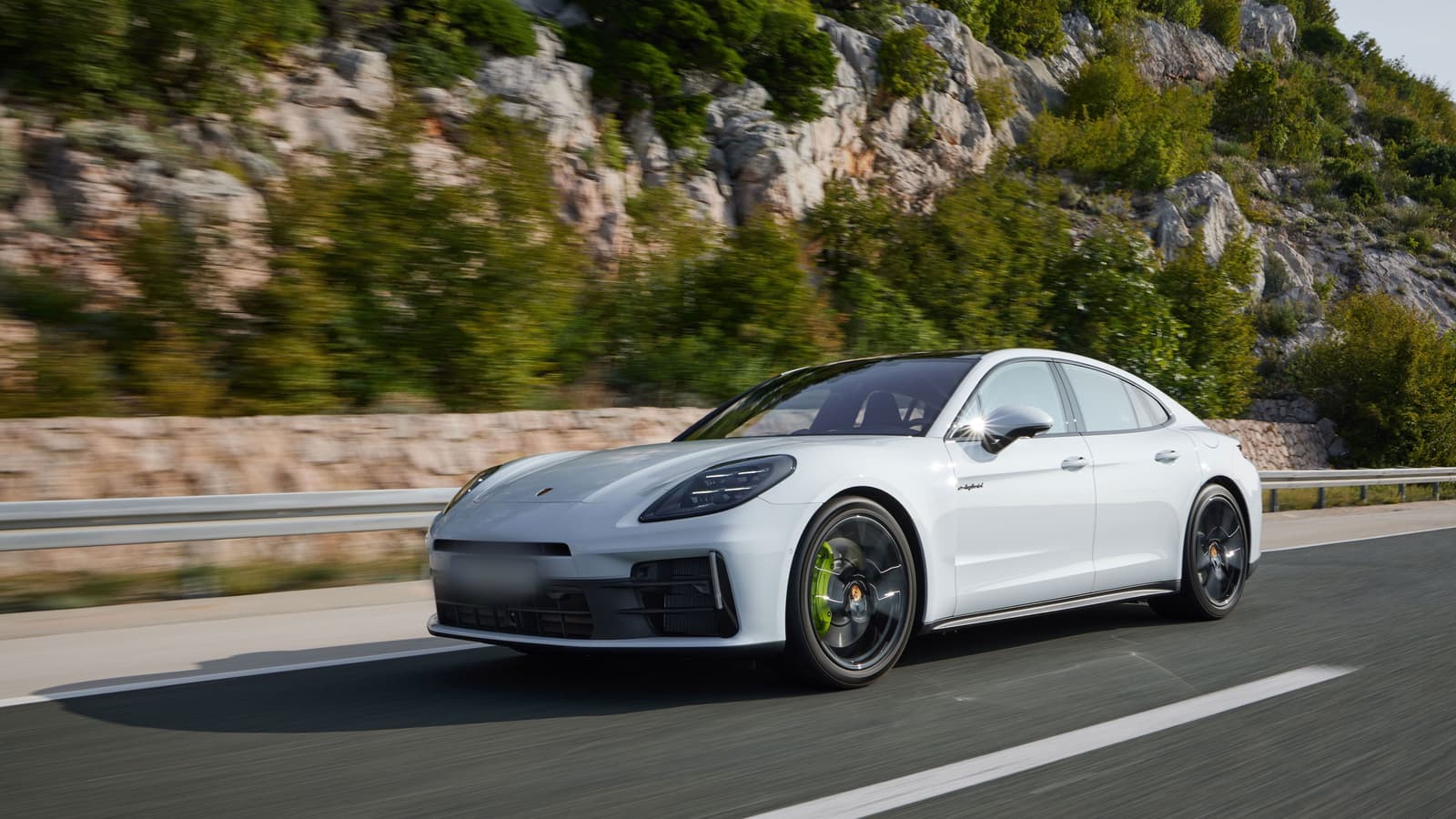
The Porsche Panamera plug-in hybrid (PHEV) family is the petrol-electric side of Porsche's four-door flagship, and for the 2027 model year it covers four trims: the Panamera 4 E-Hybrid, the 4S E-Hybrid, the Turbo E-Hybrid and the Turbo S E-Hybrid. All four share one 25.9 kWh gross battery and a 140 kW (190 PS) electric motor built into the eight-speed PDK gearbox, and they differ in the combustion engine: a 2.9-litre twin-turbo V6 in the 4 and 4S, a 4.0-litre twin-turbo V8 in the Turbo and Turbo S. System output runs from 346 kW (470 PS / 463 hp) to 575 kW (782 PS / 771 hp), and Porsche quotes a WLTP electric range of up to 96 km. In the US the line starts at $127,200 before a $2,350 delivery fee, and Porsche Germany lists the 4 E-Hybrid from €132,800 including VAT. A note on units: Porsche quotes PS, the metric horsepower, which is about 1.4 percent smaller than the imperial hp, so 544 PS is 536 hp, not 544 hp.
Performance & Specs
Porsche calls the layout a parallel full hybrid with plug-in technology: the combustion engine and the electric motor sit on the same axis, with an electromagnetic clutch between them, and everything feeds an eight-speed Porsche Doppelkupplung (PDK) and Porsche Traction Management all-wheel drive. The Panamera 4 E-Hybrid combines a 224 kW (304 PS) V6 with the 140 kW motor for 346 kW (470 PS / 463 hp) and 650 Nm, good for 0-100 km/h in 4.1 seconds and 280 km/h. The 4S E-Hybrid uses a stronger V6 with 260 kW (353 PS) and reaches 400 kW (544 PS / 536 hp) and 750 Nm, with 0-100 km/h in 3.7 seconds and a top speed of 290 km/h. All 0-100 times are Porsche's figures with the Sport Chrono package.
The two V8 cars are the performance end of the family. The Turbo E-Hybrid makes 500 kW (680 PS / 670 hp) and 930 Nm, with 3.2 seconds to 100 km/h and 315 km/h. The Turbo S E-Hybrid pairs a 441 kW (599 PS) 4.0-litre V8 with the same electric motor for 575 kW (782 PS / 771 hp) and 1,000 Nm, which Porsche rates at 2.9 seconds to 100 km/h (2.8 seconds to 60 mph in the US) and 325 km/h. The electric motor alone delivers 450 Nm and can push any of the four to 140 km/h without the engine, and recuperation reaches up to 88 kW. Porsche's US site quotes the same cars as 463, 536 and 771 hp; Israeli listings that print 544 hp for the 4S are showing the PS figure as if it were hp.
Suspension is adaptive two-chamber air suspension with Porsche Active Suspension Management as standard. Porsche Active Ride, an active suspension with active shock absorbers and an electro-hydraulic pump, is available as an option on the E-Hybrid models, as is rear-axle steering. The Turbo S comes with Porsche Ceramic Composite Brakes (440 mm front, 410 mm rear discs) as standard according to Porsche's technical data, while the 4S uses six-piston front calipers with 410 mm discs.

| Powertrain | Plug-in hybrid (PHEV), V6 + electric motor, AWD |
|---|---|
| Power | 400 kW (544 PS / 536 hp) |
| Torque | 750 Nm |
| 0–100 km/h | 3.7 s (Sport Chrono) |
| Battery | 25.9 kWh gross (21.8 kWh net) |
| Range | 81–91 km WLTP electric (Germany) |
| POWERTRAIN TYPE | PHEV (plug-in hybrid): twin-turbo V6 or V8 plus 140 kW electric motor in the PDK |
|---|---|
| HORSEPOWER | 4 E-Hybrid 346 kW (470 PS / 463 hp); 4S 400 kW (544 PS / 536 hp); Turbo 500 kW (680 PS / 670 hp); Turbo S 575 kW (782 PS / 771 hp) |
| TORQUE | 650 Nm; 750 Nm; 930 Nm; 1,000 Nm (system) |
| ACCELERATION | 0-100 km/h in 4.1 s; 3.7 s; 3.2 s; 2.9 s (Sport Chrono) |
| TOP SPEED | 280 km/h; 290 km/h; 315 km/h; 325 km/h |
| DRIVETRAIN | AWD (Porsche Traction Management), eight-speed PDK |
| BATTERY | 25.9 kWh gross, 370 V nominal (21.8 kWh net on the 4 and 4S) |
| ELECTRIC RANGE | 85–96 km; 81–91 km; 84–94 km; 81–85 km WLTP (Porsche Germany, 2027 model year) |
| COMBINED RANGE | Not published by Porsche in the data sheets checked; 80-litre fuel tank |
Dimensions & Practicality

| Length | 5,052 mm (Turbo S: 5,054 mm) |
|---|---|
| Width | 1,937 mm (2,165 mm with mirrors) |
| Height | 1,419–1,423 mm |
| Wheelbase | 2,950 mm |
| Luggage | 430–1,264 L (4, 4S) |
The Panamera is a long, low four-door hatchback with a 2,950 mm wheelbase. Porsche's technical data for the EU model lists 5,052 mm in length for the 4 and 4S (5,054 mm for the V8 cars), 1,937 mm in width without mirrors and 1,419 mm in height for the 4 or 1,423 mm for the 4S and Turbo S. Luggage space is 430 litres with the rear seats up and 1,264 litres folded in the 4 and 4S, and 421 to 1,255 litres in the two V8 cars.
The plug-in hardware shows up on the scales. Porsche's data sheets, issued in March and July 2024 for the EU model, list unladen weights (DIN) of 2,230 kg for the 4 E-Hybrid, 2,255 kg for the 4S, 2,360 kg for the Turbo and 2,365 kg for the Turbo S. The drag coefficient is 0.28 for the 4 and 4S and 0.29 for the Turbo S. A long-wheelbase Executive body style is offered on a market-specific basis; its length of 5,202 mm is 150 mm more than the standard car, and its standard equipment includes four-zone climate control and a large centre console. The dimensions, luggage figures and weights come from those 2024 data sheets, because the 2027 model pages do not repeat them.
| LENGTH | 5,052 mm (Turbo S 5,054 mm); Executive 5,202 mm |
|---|---|
| WIDTH | 1,937 mm (2,165 mm with mirrors) |
| HEIGHT | 1,419 mm (4); 1,423 mm (4S, Turbo S) |
| WHEELBASE | 2,950 mm |
| CARGO VOLUME | 430 L / 1,264 L seats up / folded (4, 4S); 421 L / 1,255 L (Turbo, Turbo S) |
| KERB WEIGHT (DIN) | 2,230 kg (4); 2,255 kg (4S); 2,360 kg (Turbo); 2,365 kg (Turbo S) |
Charging & Battery
All four trims use the same lithium-ion pack with a gross energy content of 25.9 kWh, a nominal voltage of 370 V and temperature control. Porsche's data sheets for the 4 and 4S list 21.8 kWh net; the Turbo S sheet gives only the 25.9 kWh gross figure. Porsche says the pack stores about 45 percent more energy than the previous-generation Panamera E-Hybrid in a comparable space. That matters when you read older figures: the previous-generation Panamera 4S E-Hybrid had a 17.9 kWh battery, so any listing that still shows 17.9 kWh or a range of 50 to 56 km belongs to the earlier car, not to the 2027 model.
Charging is AC only. The on-board charger is rated at 11 kW and Porsche quotes about 2 hours 39 minutes for a full charge at 11 kW and about 3 hours 15 minutes at 9.6 kW. The technical data lists no DC fast-charging capability for these models, which is the clearest difference from the Taycan. Official WLTP electric range depends on the trim and, according to Porsche Germany's 2027 model pages, is 85–96 km for the 4 E-Hybrid, 81–91 km for the 4S, 84–94 km for the Turbo and 81–85 km for the Turbo S. Porsche's 2024 launch data sheets (March and July 2024) listed slightly different windows (79–92 km for the 4, 78–89 km for the 4S, 78–84 km for the Turbo S), so the 2027 figures are the ones to use. Drivers can choose E-Power, Hybrid Auto, E-Hold and E-Charge modes, and in Sport and Sport Plus the target battery charge is raised to 20 and 30 percent.
| BATTERY | 25.9 kWh gross, 370 V (21.8 kWh net on the 4 and 4S) |
|---|---|
| AC CHARGING | 11 kW on-board charger |
| DC FAST CHARGING | Not listed by Porsche |
| AC FULL CHARGE TIME | About 2 h 39 min at 11 kW; about 3 h 15 min at 9.6 kW |
| ELECTRIC RANGE (WLTP) | 81–96 km depending on trim (Porsche Germany, 2027) |
Design & Interior
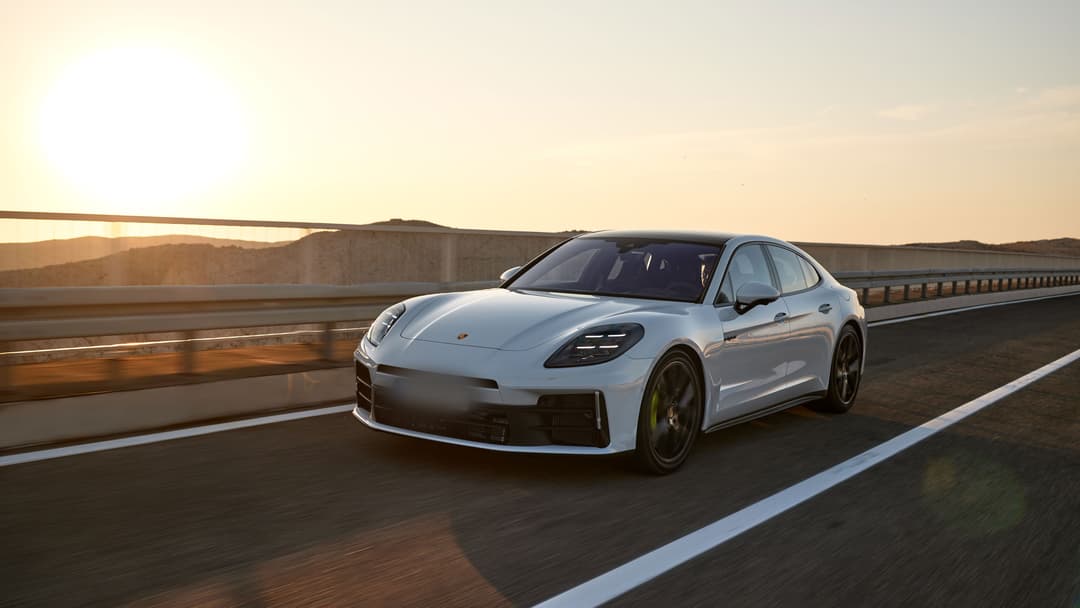
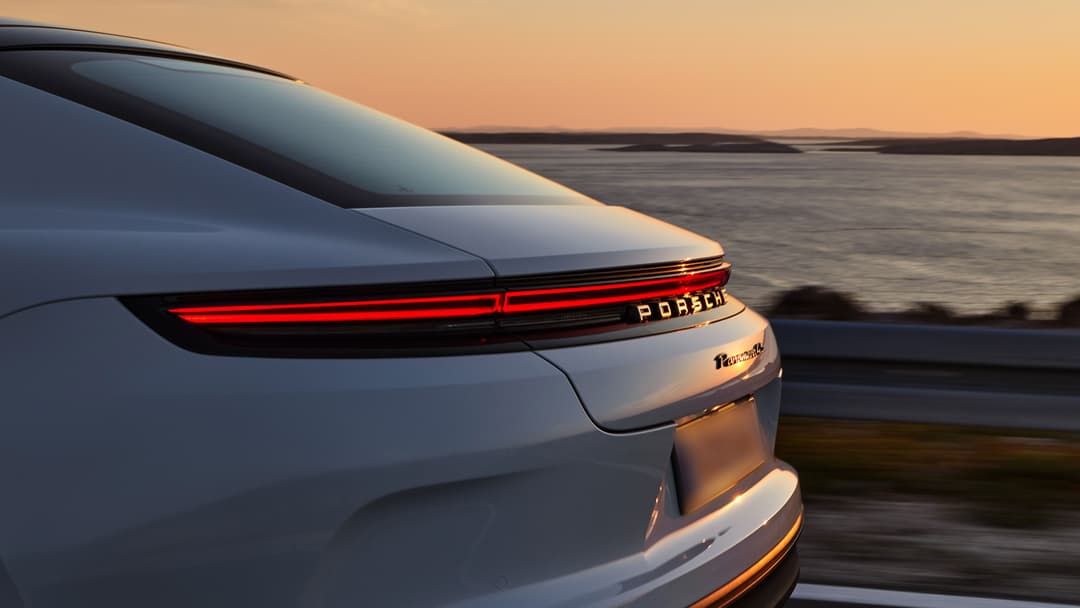
The third-generation Panamera was unveiled on 24 November 2023 and keeps the low, sloping four-door silhouette, with Matrix LED headlights as standard and a full-width light bar at the rear. Porsche offers HD Matrix LED headlights as an option, with more than 32,000 pixels per headlight and a range of up to 600 metres. The plug-in cars wear E-Hybrid badges and, on the 4S, light green brake calipers in the launch press images. The Turbo models add Turbonite accents, and carbon trim pieces are available.
The cabin follows the Porsche Driver Experience concept first used in the Taycan: a free-standing, curved 12.6-inch instrument display, a 12.3-inch central display and, for the first time in a Panamera, an optional 10.9-inch passenger display that is not visible from the driver's seat. The gear selector sits on the dashboard next to the steering wheel, the centre console carries a climate panel that mixes touch surfaces with physical switches, the air vents are finless and electrically adjustable, and ambient lighting runs the full width of the dashboard. The Executive version is 150 mm longer than the standard body.
Technology & Features
The driver-assistance suite is Porsche InnoDrive, which combines adaptive cruise control with lane keep assist, a crossroad assistant and an evasive manoeuvre assistant, alongside an Active Speed Assistant that reads traffic signs. Remote ParkAssist lets the driver park from a smartphone. Rear-axle steering and Porsche Active Ride are both options on the E-Hybrid models, and the Turbo S adds ceramic composite brakes as standard. Which of these features are standard depends on the market, so buyers should check the local specification.
Safety & ADAS
Porsche does not state an SAE automation level for these systems, which are driver-supervised. The standard and optional assistance functions Porsche lists for the third-generation Panamera are adaptive cruise control with lane keeping, a crossroad assistant, an evasive manoeuvre assistant, traffic-sign-based speed limiting and automated remote parking. We did not find a Euro NCAP or NHTSA rating for the 2027 Panamera, so no crash-test result is quoted here.
| ADAS LEVEL | Driver-supervised assistance (no SAE level stated by Porsche) |
|---|---|
| ADAS FEATURES | Porsche InnoDrive adaptive cruise control, lane keep assist, crossroad assistant, evasive manoeuvre assistant, Active Speed Assistant with traffic sign recognition, Remote ParkAssist (equipment varies by market) |
Available Versions
| VERSION | POWER | TORQUE | 0-100 | TOP SPEED | DRIVETRAIN | BATTERY | EV RANGE | COMBINED RANGE | PRICE | KEY DIFFERENCES |
|---|---|---|---|---|---|---|---|---|---|---|
| Panamera 4 E-Hybrid | 463 hp | 650 Nm | 4.1s | 280 km/h | AWD | 25.9 kWh | 96 km | — | $127,200 | 346 kW (470 PS), V6 304 PS; EUR 132,800 in Germany; Executive body available in some markets |
| Panamera 4S E-Hybrid | 536 hp | 750 Nm | 3.7s | 290 km/h | AWD | 25.9 kWh | 91 km | — | $139,100 | 400 kW (544 PS), V6 353 PS; EUR 147,600 in Germany |
| Panamera Turbo E-Hybrid | 670 hp | 930 Nm | 3.2s | 315 km/h | AWD | 25.9 kWh | 94 km | — | $207,900 | 500 kW (680 PS), V8 519 PS; EUR 208,900 in Germany |
| Panamera Turbo S E-Hybrid | 771 hp | 1,000 Nm | 2.9s | 325 km/h | AWD | 25.9 kWh | 85 km | — | $245,200 | 575 kW (782 PS), V8 599 PS, ceramic brakes standard; EUR 241,200 in Germany |
Pricing & Availability
All prices below are the manufacturer's list prices from Porsche's own model pages and configurators in October 2026, where the cars are labelled 2027 model year. In the US the Panamera 4 E-Hybrid starts at $127,200, the 4S E-Hybrid at $139,100, the Turbo E-Hybrid at $207,900 and the Turbo S E-Hybrid at $245,200, plus a $2,350 delivery, processing and handling fee. In Germany the same four cost €132,800, €147,600, €208,900 and €241,200 including 19% VAT, with delivery or factory pickup costs of up to €5,000 extra. At the ECB rate of 6 October 2026 (1 EUR = 1.1269 USD) the German entry price is about $149,700, roughly $22,500 above the US figure before the US delivery fee.
In Israel the importer is Orchid Sports Cars. A new Orchid price list reported by the Jerusalem Post on 24 April 2026 cut the Panamera plug-in hybrid by NIS 80,000 to NIS 1.057 million, which matches the 4 E-Hybrid price of NIS 1,057,000 on Israeli listings, and the Israeli outlet auto.co.il lists the 2026 Panamera 4S E-Hybrid at NIS 1,137,000. Israeli prices include VAT and local taxes, which is why they sit far above the US and German figures; at 3.0482 shekels to the dollar the 4 E-Hybrid works out to about $346,800. We did not find a confirmed post-cut Israeli price for the Turbo S, and older Israeli listings that show higher prices for the 4S, 4 E-Hybrid and Turbo S appear to predate that list. Israeli listings give the 4S as 25.9 kWh, 88 km WLTP and "544 hp"; that last figure is PS, which is 536 hp.
How It Compares
The two natural alternatives are electric four-door sports sedans we have covered separately. The Taycan 4S makes the same 536 hp (400 kW) as the Panamera 4S E-Hybrid in its standard form, 590 hp (440 kW) with the larger Performance Battery Plus, and also needs 3.7 seconds to 100 km/h, yet it costs €122,000 in Germany against €147,600, a gap of €25,600, and is rated for up to 645 km of WLTP range against the Panamera's 81 to 91 km of electric range. The Audi S e-tron GT is similar: 583 hp, 3.6 seconds, up to 609 km and €126,000. The Panamera's case is the engine: it can cover long trips on petrol, offers a V6 or V8 and has a 430-litre boot, but it cannot fast-charge, so long trips depend on petrol and the plug-in benefit depends on a home or workplace charger. In Israel the gap is wider still: the Taycan 4S is listed at NIS 937,000 (Orchid price list) against NIS 1,137,000 for the Panamera 4S E-Hybrid (auto.co.il), a NIS 200,000 difference.
- Four plug-in trims on one 25.9 kWh battery, from 463 hp (V6) to 771 hp (V8), with 0-100 km/h times of 4.1 to 2.9 seconds and top speeds up to 325 km/h
- Electric-only driving up to 140 km/h and 81–96 km WLTP, with a petrol engine behind it for long trips
- Practical for the class: 2,950 mm wheelbase, 430–1,264 L of luggage space and a long-wheelbase Executive version in some markets
- AC charging only: 11 kW and about 2 h 39 min for a full charge, with no DC fast charging listed by Porsche
- Heavy and expensive: 2,230 to 2,365 kg unladen and $127,200 to $245,200 in the US, €132,800 to €241,200 in Germany and from NIS 1,057,000 in Israel
The Panamera E-Hybrid is the right Porsche four-door for someone who wants real electric commuting range without giving up a petrol engine on long trips. The 4S E-Hybrid at 536 hp and 3.7 seconds is the sweet spot of the range, while the Turbo S at 771 hp and 2.9 seconds is a statement car with a price to match. The trade-offs are weight, no DC fast charging and a price that sits well above the equivalent Taycan 4S. If you can charge at home every night, it is a strong plug-in hybrid. If you cannot, the electric alternatives are quicker to refuel and cheaper to buy.