

The smart #2 is a battery-electric (BEV) two-seater city car that had its world premiere at the Paris Motor Show on 12 October 2026, thirty years after the original smart two-seater concept was shown in the same city. It rides on a new Electric Compact Architecture (ECA) platform, measures only 2,746 mm in length in the Pure, Pure+ and Premium versions, and uses a 60 kW (about 80 hp) rear-mounted motor powered by a 35.8 kWh lithium iron phosphate (LFP) battery. smart quotes up to 290 km of WLTP range as a target value, 65 kW DC charging and a 6.95 m curb-to-curb turning circle. The car is still in EU type approval, so every figure is preliminary and deliveries will start only after homologation. smart's press release gives no price, and outlets that covered the premiere report a European pre-order price just under EUR 20,000. Reports say the car is built in China, with a design led by Mercedes-Benz, and that European sales start in 2027.
Performance & Specs
The smart #2 is a rear-wheel-drive BEV with a single electric motor on the rear axle. smart gives its output as 60 kW, which is about 82 PS or 80 hp (PS is the metric horsepower, about 1.4 percent smaller than the imperial hp used here), and its torque as 130 Nm sent to the rear wheels. The rear tyres are wider than the front ones, which smart says helps stability and handling. The motor is not a performance unit, and smart does not publish an acceleration time in its release. Motor1 reports a 0-100 km/h time of 11.6 seconds and a top speed of 140 km/h, and electrive also cites 140 km/h from Chinese homologation documents.
The more unusual part is the chassis. smart describes the five-link rear suspension as a first in this class, and the 35.8 kWh battery sits in the floor, which keeps the centre of gravity low. smart says the combination gives direct steering geometry and a balance of sportier handling and comfort, and the car was tested on proving grounds, in wind tunnels and on public roads in different climates. The body uses the Tridion Cell Evo, the next generation of the safety cell that has been part of every smart since the first model. Weight is not in smart's release, but a Chinese regulatory filing reported by electrive and Electrifying lists a kerb weight of about 1,130 kg, and Motor1 gives 1,140 kg.
The range figure comes with caveats. smart quotes up to 290 km of combined WLTP range with consumption of 13.6 kWh/100 km, and calls both preliminary and a target value pending EU homologation. electrive rounds the range to about 300 km. Chinese reports say the car has up to 410 km on the more generous CLTC cycle, which is not comparable with WLTP. As a sanity check, 35.8 kWh over 290 km works out to about 12.3 kWh/100 km at the battery, and the official 13.6 kWh/100 km is roughly 10 percent higher, which is the normal size of charging losses.

| Powertrain | Single-motor RWD BEV |
|---|---|
| Power | 60 kW (82 PS / 80 hp) |
| Torque | 130 Nm |
| 0–100 km/h | 11.6 s (reported by Motor1) |
| Battery | 35.8 kWh LFP |
| Range | Up to 290 km WLTP (target) |
| POWERTRAIN TYPE | Battery electric (BEV), rear motor |
|---|---|
| HORSEPOWER | 60 kW (82 PS / 80 hp), 130 Nm |
| ACCELERATION | 0-100 km/h in 11.6 s (reported by Motor1; not in smart's release) |
| TOP SPEED | 140 km/h (Motor1; electrive citing Chinese homologation documents) |
| DRIVETRAIN | RWD |
| BATTERY | 35.8 kWh LFP (gross or net not stated by smart) |
| WLTP RANGE | Up to 290 km combined (preliminary target value) |
| WLTP CONSUMPTION | 13.6 kWh/100 km (preliminary) |
Dimensions & Practicality

| Length | 2,746 mm (Couture 2,764 mm) |
|---|---|
| Width | 1,669 mm (Chinese filing) |
| Height | 1,555 mm (Chinese filing) |
| Wheelbase | 1,875 mm (reported) |
| Boot | 305 L (up to 527 L reported) |
The #2 keeps the wheels-at-the-corners stance that has defined the smart two-seater since its first generation, which maximises interior space inside a footprint of 2,746 mm. That is 51 mm longer than the last fortwo, according to Carscoops, while the turning circle of 6.95 m curb-to-curb is the number that matters most for parking and tight streets. The Couture Edition is 18 mm longer at 2,764 mm because of its body add-ons. smart does not publish width, height, wheelbase or boot volume in the premiere release. A Chinese regulatory filing lists a width of about 1.67 m and a height of about 1.56 m, and Chinese reports give a wheelbase of 1,875 mm, so these are figures for the Chinese-market car that may differ slightly in Europe.
Two seats sit on a continuous bench-style arrangement in an S-shaped cockpit, and smart says the cabin is open and clearly structured. Motor1 and Carscoops give a boot of 305 litres, and Motor1 adds that it expands to 527 litres, although smart's release does not print either number. The split tailgate carried over from the fortwo is back: the glass can open on its own, so a bag can go in without opening the whole lower flap.
| LENGTH | 2,746 mm (Pure, Pure+, Premium); 2,764 mm (Couture Edition) |
|---|---|
| WIDTH | About 1,669 mm (Chinese filing, reported) |
| HEIGHT | About 1,555 mm (Chinese filing, reported) |
| WHEELBASE | 1,875 mm (reported) |
| TURNING CIRCLE | 6.95 m curb-to-curb |
| CARGO VOLUME | 305 L (527 L maximum, Motor1) |
| KERB WEIGHT | About 1,130 kg (Chinese filing); 1,140 kg (Motor1) |
| SEATS | 2 |
Charging & Battery
The 35.8 kWh LFP battery supports DC charging at up to 65 kW, and smart says 10 to 80 percent takes about 20 minutes under optimal conditions. AC charging is up to 11 kW on a three-phase supply, which smart rates at about 3 hours for 10 to 80 percent. The entry Pure is different: it has a 7.4 kW single-phase on-board charger and needs about 5 hours for the same 10 to 80 percent. Vehicle-to-load (V2L) is available with a separately sold accessory and works only with a type F socket, so smart warns that it may not be possible in some countries because of local standards. smart's release does not name the cell supplier or say whether 35.8 kWh is gross or net. electrive and CarNewsChina both say the cells come from CATL, and electrive adds that the pack is assembled by Geely.
| BATTERY | 35.8 kWh LFP (gross or net not stated) |
|---|---|
| AC CHARGING | 11 kW three-phase (Pure+, Premium, Couture), 10-80% in about 3 h; 7.4 kW single-phase (Pure), about 5 h |
| DC FAST CHARGING | Up to 65 kW |
| DC 10-80% TIME | About 20 min (optimal conditions) |
| V2L | With separate accessory, type F socket only |
Design & Interior
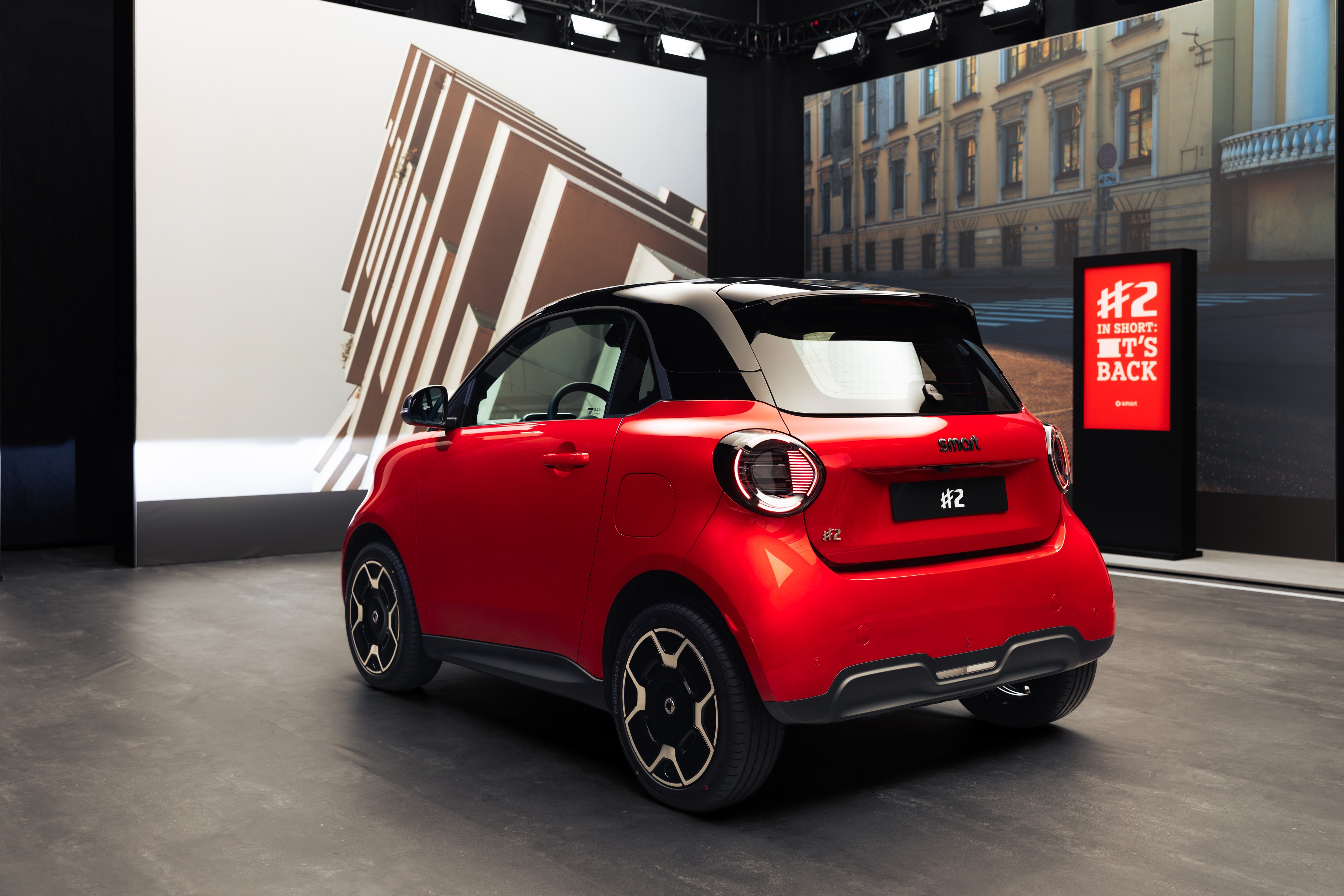
The design follows the fortwo recipe on purpose: a short body with the wheels pushed to the corners, a two-tone colour scheme and the split tailgate. The press photos show a short nose with a perforated grille panel that carries the number plate, slim LED headlights with a light signature, a glass-heavy rear with round tail lights and a contrasting roof colour. The Premium is shown in laser red and in gold metallic, the Pure in Digital White and the Pure+ in Cyber Silver Metallic. The Couture Edition is limited to 999 units in Europe, with Atelier White Matte paint, a Platinum Gold roof, 16-inch Lyra rims with gold details and a numbered interior badge.
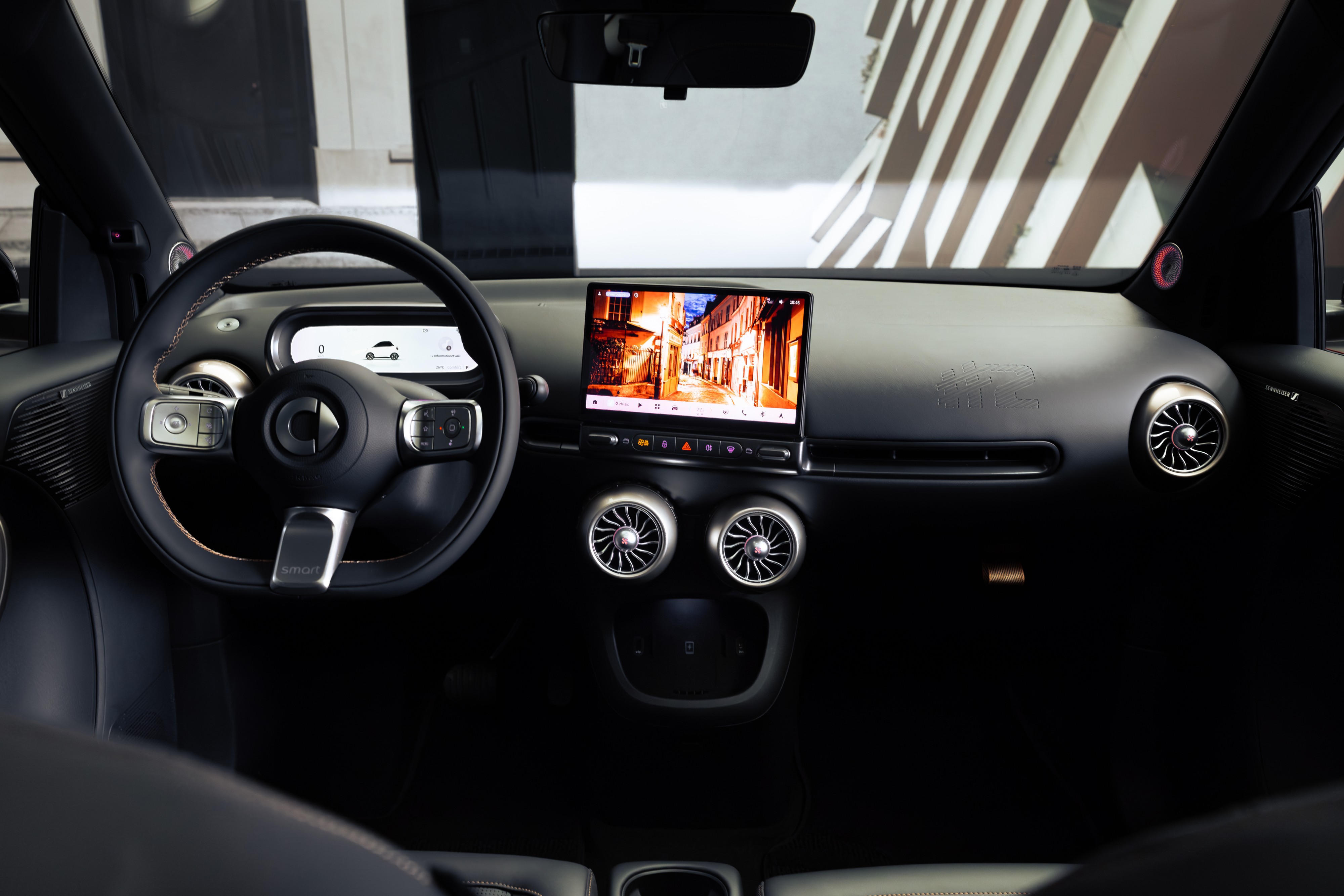
Inside, smart uses a continuous bench-style seat arrangement, a driver display of 8.8 inches and a central screen of 10.1 inches. The press photo of the Premium interior shows a compact steering wheel with the smart badge, round air vents and a clean horizontal dashboard. A feature called the smart Pillar in the dashboard gives owners a place to mount small gadgets. The trims separate mainly by equipment. The Pure+ adds 11 kW AC charging and a heated driver seat to the Pure, while the Premium adds a glass roof, heated man-made leather seats for both occupants, the Sennheiser sound system and extra colour combinations. The Couture Edition has the Premium specification plus ambient lighting, a heated steering wheel, wireless charging and navigation.
Technology & Features
All versions have 4G connectivity, Wi-Fi and Bluetooth through the two screens, and an eight-year Connectivity Package that keeps the car linked to smart's connected vehicle services. The Premium has a dedicated 7-speaker Sennheiser sound system. The Pure already has LED headlamps and tail lights with automatic high beam, and smart Pilot Assist is standard everywhere. Navigation and wireless charging are listed only for the Couture Edition in the release, so buyers of the other trims should check the final European equipment lists, which smart has not yet published.
Safety & ADAS
The Tridion Cell Evo body structure wraps a rigid cell around the cabin, and smart says it adds no length to the car. Driver assistance systems are standard on all trims, including smart Pilot Assist and Adaptive Cruise Control with Stop & Go and Highway Assist. smart lists Blind Spot Detection, Rear Collision Mitigation and Rear Cross Traffic Alert as standard on the Pure+, and its wording says the same package is fitted to the Pure. smart reminds drivers that these systems are aids and do not release the driver from responsibility. The car has no Euro NCAP rating yet, and smart does not state an SAE automation level.
| ADAS LEVEL | Not stated by smart (driver-assistance systems; driver remains responsible) |
|---|---|
| ADAS FEATURES | smart Pilot Assist, Adaptive Cruise Control with Stop & Go, Highway Assist, Blind Spot Detection, Rear Collision Mitigation, Rear Cross Traffic Alert (listed for Pure+; the release says the Pure has the same package) |
Available Versions
| VERSION | POWER | TORQUE | 0-100 | TOP SPEED | DRIVETRAIN | BATTERY | EV RANGE | COMBINED RANGE | PRICE | KEY DIFFERENCES |
|---|---|---|---|---|---|---|---|---|---|---|
| Pure | 80 hp | 130 Nm | — | 140 km/h (reported) | RWD | 35.8 kWh | 290 km | — | TBA | 7.4 kW single-phase AC, V2L, ACC, LED lights; reported entry price just under €20,000 |
| Pure+ | 80 hp | 130 Nm | — | 140 km/h (reported) | RWD | 35.8 kWh | 290 km | — | TBA | Adds 11 kW AC charging and a heated driver seat |
| Premium | 80 hp | 130 Nm | — | 140 km/h (reported) | RWD | 35.8 kWh | 290 km | — | TBA | Glass roof, heated seats, Sennheiser sound, more colours |
| Couture Edition | 80 hp | 130 Nm | — | 140 km/h (reported) | RWD | 35.8 kWh | 290 km | — | TBA | 999 units in Europe, 2,764 mm long, full Premium equipment; Motor1 reports about €25,500 |
Pricing & Availability
smart's press release of 12 October 2026 does not give a price, order date or delivery date. It says the car is in EU type approval, that delivery follows homologation and that smart will publish the official figures once approval is complete. Outlets that covered the premiere report a European pre-order price: CarNewsChina gives EUR 19,990, electrive gives EUR 19,999 and Motor1 says just under EUR 20,000 for Germany, France, Belgium, Austria, Portugal and other European markets, with the Couture Edition at around EUR 25,500. The exact figure, VAT status and trim prices should therefore be treated as reported rather than official. In June 2026, electrive quoted smart Europe chief Wolfgang Ufer as saying the entry price would be below the midpoint of a EUR 20,000 to 25,000 range.
Motor1 expects the European launch in the first half of 2027, and electrive says the car reaches the market in 2027. Production starts in China, according to electrive and Motor1, and electrive adds that smart has not ruled out building the car in Europe later. In the UK, Autocar reportedly expects a starting price of GBP 17,900, which is unofficial. For China, CarNewsChina reports a Couture Edition priced at CNY 112,999 and limited to 999 units, with other variants priced in November, while Chinese reports describe a market launch in mid-November.
How It Compares
The smart #2 sits in the price bracket of the cheapest European electric hatchbacks, but it makes a different argument. The BYD Dolphin Surf Active has 87 hp and a 30 kWh battery for up to 220 km WLTP at €19,990 in Spain, and it is 3,990 mm long with four seats. The Leapmotor T03 has 94 hp and 265 km WLTP for €18,900 in Germany, and it is 3,620 mm long. The smart is 874 mm shorter than the T03 and 1,244 mm shorter than the Dolphin Surf, and its target range of 290 km, if homologation confirms it, would be higher than both. In exchange it seats two, has less power than either and its price is reported, not confirmed. The rival figures are list prices and WLTP ranges from the rivals' own market data in each country, so the comparison is indicative until smart publishes its own price list.
- Tiny 2,746 mm body with a 6.95 m turning circle and a five-link rear suspension that smart calls a first in its class
- Up to 290 km WLTP target range from a 35.8 kWh LFP battery, with 65 kW DC charging and 10-80% in about 20 minutes
- Standard driver assistance on every trim, including Adaptive Cruise Control with Stop & Go and Highway Assist
- Only two seats and 60 kW (80 hp), less power than the Dolphin Surf Active and Leapmotor T03
- Price, delivery date and final range are not official yet, and the entry Pure charges on AC at only 7.4 kW
The smart #2 is a deliberate return to a small, two-seat city car, and its numbers fit that job: a short body, a tight turning circle, a 35.8 kWh LFP battery and a WLTP target of up to 290 km. It is not a quick car and it gives up space and power to cheap four-seat rivals, so it suits drivers who live and park in dense cities and want a second car for short trips. The open questions are the price, which is only reported at just under EUR 20,000, and the homologated range, which smart will publish later. Treat it as promising until those two numbers are official.