

Toyota has confirmed the 2027 lineup for the bZ, its compact-to-mid-size electric SUV, and the headline news is that there is barely any news at all — Toyota says the model “remains unchanged from the prior model year,” carrying over the same XLE and Limited trims, front- or all-wheel drive options, and the returning bZ Woodland off-road grade. Pricing starts at $34,980 for the base XLE FWD and climbs to $45,380 for the Limited AWD, with the rugged bZ Woodland AWD priced from $45,380 and a Premium grade at $47,480 (all figures exclude a $1,595 delivery fee). This is a pure battery-electric vehicle across every configuration, built on the same 57.7 kWh and 74.7 kWh lithium-ion packs introduced for the 2026 model year, with outputs ranging from 165 hp on the entry FWD trim to 338 hp on the top AWD grades and 375 hp on the Woodland. Toyota USA Newsroom posted the update on August 4-5, 2026, with dealership arrivals expected in September 2026 for the core bZ and later in 2026 for the Woodland. Buyers cross-shopping this SUV should not confuse it with the freshmotors-covered Toyota bZ7 — that is a separate, larger China-market electric sedan built on a different platform, while the bZ nameplate here is Toyota’s North America-focused compact/mid-size electric crossover. For shoppers who already liked the 2026 bZ, this update is essentially a straight continuation with the same pricing, powertrains and feature set carried into a new model year.
Performance & Specs
The 2027 bZ lineup spans five core configurations. The base XLE FWD pairs a 57.7 kWh battery with a single front motor making 165 hp, while stepping up to the 74.7 kWh pack unlocks 221 hp on FWD models (XLE FWD Plus and Limited FWD). Choosing AWD adds a second motor on the rear axle for a combined 338 hp on both the XLE AWD and Limited AWD, Toyota’s estimated 0-60 mph time for the AWD dual-motor layout is 4.9 seconds. The bZ Woodland goes further still, using the same 74.7 kWh battery with a dual-motor AWD system tuned for 375 hp combined and a claimed 4.5-second 0-60 mph run, plus a standard X-MODE traction system for light off-road use. Exact torque and top-speed figures have not been published by Toyota as of this writing, so those remain TBA rather than estimated. All bZ variants use a NACS (North American Charging Standard) port for both AC and DC charging.

| Powertrain | Dual-motor AWD BEV |
|---|---|
| Power | 338 hp (~252 kW combined) |
| Torque | TBA |
| 0–60 mph | 4.9 s |
| Battery | 74.7 kWh |
| Range | 299 mi (481 km) EPA |
| POWERTRAIN TYPE | Battery-electric (BEV) |
|---|---|
| HORSEPOWER | 165-338 hp (bZ) / 375 hp (bZ Woodland) |
| ACCELERATION | 4.9 s 0-60 mph (AWD) / 4.5 s (Woodland) |
| TOP SPEED | TBA |
| DRIVETRAIN | FWD or AWD (bZ); AWD only (Woodland) |
| BATTERY | 57.7 kWh or 74.7 kWh lithium-ion |
| ELECTRIC RANGE | 236-314 mi (bZ) / 260-281 mi (Woodland) |
| COMBINED RANGE | — |
Dimensions & Practicality

| Length | 4,690 mm (184.6 in) |
|---|---|
| Width | 1,860 mm (73.2 in) |
| Height | 1,650 mm (65.0 in) |
| Wheelbase | 2,850 mm (112.2 in) |
| Ground clearance | 208 mm (8.2 in) |
The bZ measures a little under 4.7 meters long on a 2.85-meter wheelbase, putting it in compact-to-mid-size crossover territory, close in footprint to something like a RAV4 but riding on a dedicated EV platform. Toyota quotes 27.7 cubic feet of cargo room behind the rear seats and 56.9 cubic feet with the second row folded flat, enough for typical family duty though not class-leading among electric SUVs. Ground clearance sits at 8.2 inches on the standard bZ; the bZ Woodland raises that to 8.4 inches and adds roughly six inches of cargo length and about an inch of extra height for a slightly larger load bay, along with a 3,500-pound towing rating that the standard bZ does not offer. Front legroom is rated at 42.1 inches with 35.3 inches in the rear, reasonable for adults on longer trips.
| LENGTH | 4,690 mm (184.6 in) |
|---|---|
| WIDTH | 1,860 mm (73.2 in) |
| HEIGHT | 1,650 mm (65.0 in) |
| WHEELBASE | 2,850 mm (112.2 in) |
| CARGO VOLUME | 784 L / 27.7 cu ft (1,611 L / 56.9 cu ft seats folded) |
| FRUNK | TBA |
Charging & Battery
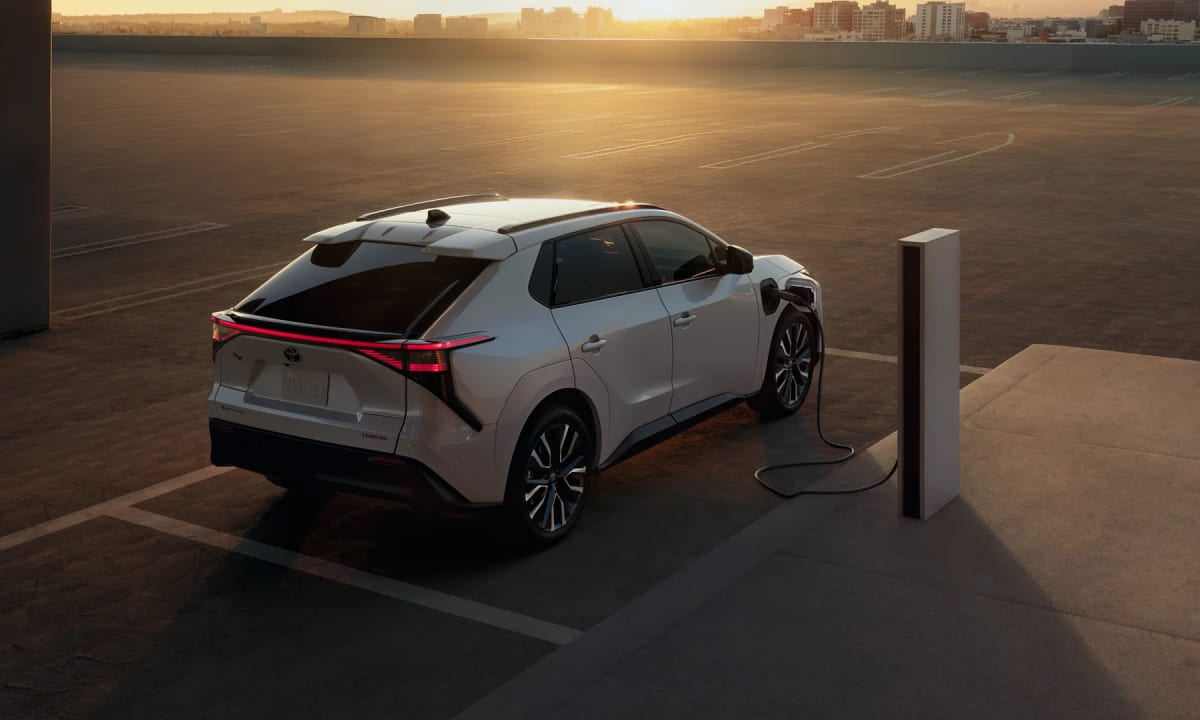
Every 2027 bZ uses a NACS port for both AC and DC charging, so no adapter is needed on Tesla Supercharger-compatible hardware in North America. The base XLE FWD carries a smaller 57.7 kWh lithium-ion pack good for a Toyota-estimated 236 miles, while every other trim — XLE FWD Plus, XLE AWD, Limited FWD, Limited AWD and both bZ Woodland grades — uses the larger 74.7 kWh pack. Toyota quotes a 10-80% DC fast-charge time of roughly 30 minutes under ideal conditions across the lineup, with an 11 kW onboard charger for Level 2 AC charging at home or at public AC stations. Range on the larger battery varies by drivetrain and trim, from 288 miles on the XLE AWD up to 314 miles on the front-wheel-drive XLE Plus, with the bZ Woodland rated at 281 miles on all-season tires or 260 miles when fitted with its optional all-terrain rubber.
| BATTERY | 57.7 kWh or 74.7 kWh lithium-ion |
|---|---|
| AC CHARGING | 11 kW onboard |
| DC FAST CHARGING | NACS port, rate not disclosed by Toyota |
| DC 10-80% TIME | ~30 min (ideal conditions) |
Design & Interior
Exterior-wise the 2027 bZ carries over the smoother, more conventional-SUV look Toyota introduced for the 2026 refresh, with a full-width LED light bar, body-color lower cladding and, on the Woodland, black wheel-arch trim, roof rails and a raised ride height that visually separate it from the standard grades. Exterior colors for the regular bZ include Wind Chill Pearl, Supersonic Red, Blueprint, Midnight Black Metallic and Heavy Metal, with the Woodland offered in its own Premium Bronze, Stone Brown and Steel finishes. Inside, Toyota uses a tiered dashboard with a digital instrument cluster set atop the dash, a floating central touchscreen ahead of the driver, and a wide center console with storage for two phones. The XLE gets fabric-and-SofTex mixed seating, heated front seats and dual-zone climate control, while stepping up to Limited adds SofTex-trimmed seating, heated and ventilated front seats, heated rear seats, radiant foot-and-leg heaters and 20-inch alloy wheels. A power panoramic glass roof is standard on Limited and optional on XLE, giving the cabin an airier feel that Toyota has leaned on as a signature Limited-grade touch since the 2026 model year.
Technology & Features
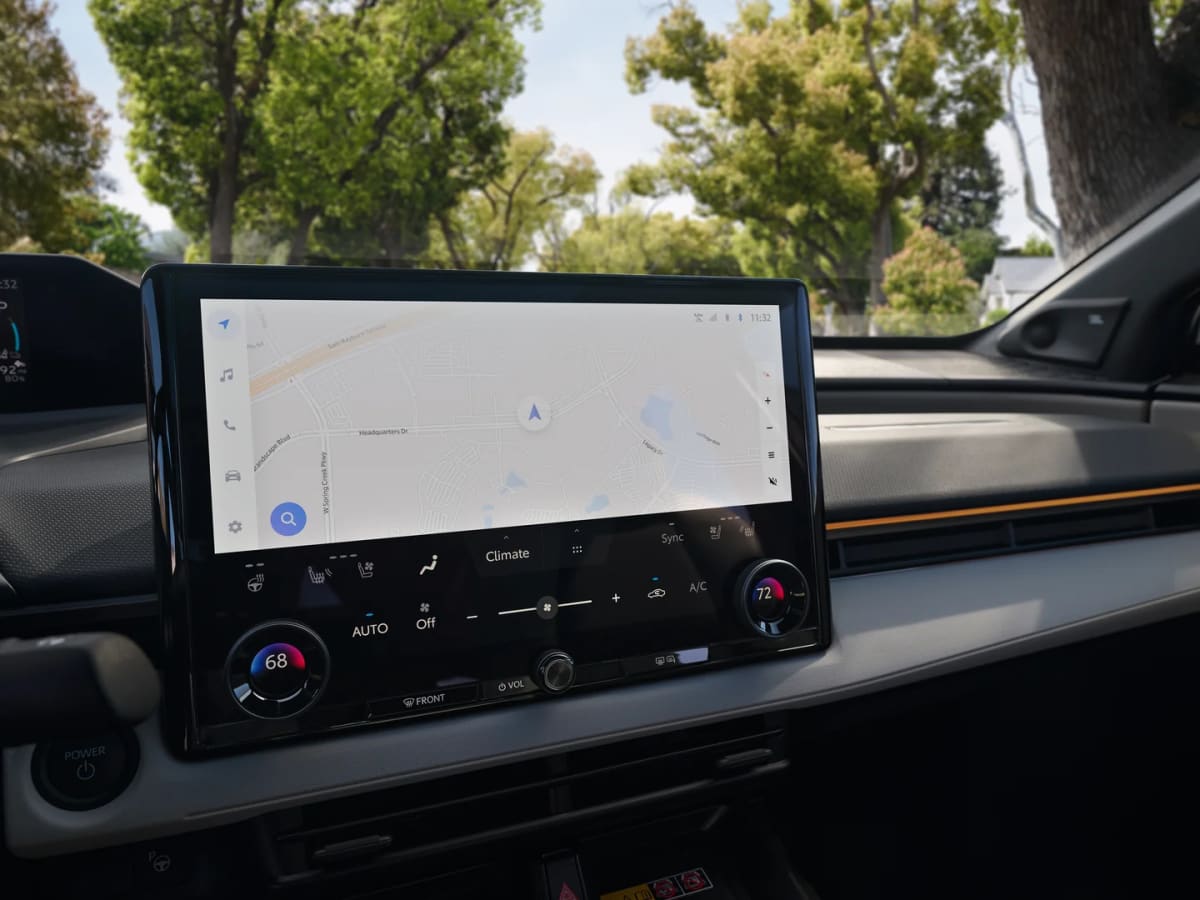
A 14-inch touchscreen running Toyota’s latest multimedia system is standard across the 2027 bZ range, paired with wireless Apple CarPlay and Android Auto, two wireless charging pads and four USB-C ports so front and rear passengers can all charge devices without cables. Toyota Digital Key capability lets owners use a smartphone in place of a physical key fob on supported trims. Bluetooth, satellite radio and a six-speaker audio system come standard, with the interface built around the same tiered dashboard layout across every grade. Because Toyota describes this generation as unchanged from 2026, none of this technology suite is new for 2027 — it is simply carried forward as the current standard for the nameplate.
Safety & ADAS
Toyota Safety Sense 3.0 is standard on every 2027 bZ trim, bundling a camera-and-radar Pre-Collision System with pedestrian detection, full-speed-range Dynamic Radar Cruise Control, Lane Departure Alert with steering assist, Lane Tracing Assist, Road Sign Assist, automatic high beams and Proactive Driving Assist. Limited grades add Traffic Jam Assist, Lane Change Assist, Front Cross-Traffic Alert and a Panoramic View Monitor with perimeter scan for tighter parking maneuvers. This is an L2 driver-assistance suite rather than a hands-off autonomous system — the driver remains responsible for the vehicle at all times, in line with how Toyota positions Safety Sense across its lineup.
| ADAS LEVEL | L2 (Toyota Safety Sense 3.0) |
|---|---|
| ADAS FEATURES | Pre-Collision System w/ pedestrian detection, Dynamic Radar Cruise Control, Lane Tracing Assist, Road Sign Assist, Traffic Jam Assist (Limited), Lane Change Assist (Limited), 360° Panoramic View Monitor (Limited) |
Available Versions
| VERSION | POWER | TORQUE | 0-100 | TOP SPEED | DRIVETRAIN | BATTERY | EV RANGE | COMBINED RANGE | PRICE | KEY DIFFERENCES |
|---|---|---|---|---|---|---|---|---|---|---|
| XLE FWD | 165 hp | TBA | TBA | TBA | FWD | 57.7 kWh | 236 mi | — | $34,980 | Entry grade, smaller battery |
| XLE FWD Plus | 221 hp | TBA | TBA | TBA | FWD | 74.7 kWh | 314 mi | — | $37,980 | Longest-range bZ trim |
| XLE AWD | 338 hp | TBA | TBA | TBA | AWD | 74.7 kWh | 288 mi | — | $39,980 | Dual-motor AWD on XLE trim |
| Limited FWD | 221 hp | TBA | TBA | TBA | FWD | 74.7 kWh | 299 mi | — | $43,380 | Premium interior, panoramic roof standard |
| Limited AWD | 338 hp | TBA | TBA | TBA | AWD | 74.7 kWh | 299 mi | — | $45,380 | Top standard bZ grade |
| bZ Woodland | 375 hp | TBA | TBA | TBA | AWD | 74.7 kWh | 260-281 mi | — | $45,380 | Raised ride height, X-MODE, 3,500 lb towing |
| bZ Woodland Premium | 375 hp | TBA | TBA | TBA | AWD | 74.7 kWh | 260-281 mi | — | $47,480 | Adds Premium interior/exterior package |
Pricing & Availability
The 2027 Toyota bZ starts at $34,980 for the XLE FWD before a $1,595 delivery fee, rising through $37,980 (XLE FWD Plus), $39,980 (XLE AWD) and $43,380 (Limited FWD) to $45,380 for the range-topping Limited AWD. The bZ Woodland starts at that same $45,380 mark for its base AWD grade and $47,480 for the Premium trim, also before delivery. Toyota expects the standard bZ to begin arriving at U.S. dealerships in September 2026, and it is already on sale in Canada; the bZ Woodland is expected to reach dealers later in 2026. Because Toyota has explicitly stated the 2027 model carries over unchanged from 2026, current 2026 bZ inventory and incoming 2027 stock should be functionally identical in specification, so shoppers are unlikely to see meaningful spec or price differences between the two model years at the dealership.
How It Compares
Against the Chevrolet Equinox EV, the closest price match at $34,995, the entry bZ trims trade some horsepower and EPA range for Toyota’s reputation for reliability and resale, though a fully loaded Limited AWD costs about $10,000 more than a base Equinox EV. The China-market ZEEKR 7X and ONVO L90 aren’t sold in North America, so they aren’t cross-shop options for most bZ buyers, but they illustrate what a similar sub-$45,000 EV budget buys in a market with faster EV price competition — both offer more horsepower than even the Woodland at a comparable dollar figure, underscoring how much of the bZ’s price still reflects the Toyota badge and dealer network rather than raw specification. For a buyer prioritizing Toyota Safety Sense standard equipment, NACS charging and dealer support across North America, the bZ remains a straightforward, low-drama choice even if it isn’t the most powerful or longest-range option at its price point.
- Native NACS port means Tesla Supercharger access with no adapter in North America
- Toyota Safety Sense 3.0 standard on every trim, including Lane Tracing Assist and Pre-Collision braking
- bZ Woodland adds real off-road-style ground clearance, X-MODE and a 3,500 lb tow rating other bZ trims lack
- Genuinely unchanged for 2027 — no new range, power, tech or price improvements over the 2026 model
- Torque and top speed figures remain unpublished by Toyota, and EPA range trails several rivals at similar prices
The 2027 Toyota bZ is not a new car so much as a confirmation that last year’s car is still the car Toyota is selling — and for a lot of mainstream EV buyers who just want a Toyota-badged electric SUV with standard active-safety tech, NACS charging and Toyota’s dealer network, that consistency is arguably the point. The Limited AWD at $45,380 is the pick of the standard range for anyone cross-shopping on power and features, while the bZ Woodland carves out a genuinely useful niche with its added ground clearance and towing capacity that the regular bZ can’t match. It won’t win a spec sheet fight against faster-moving EV rivals, but as a steady, low-risk electric SUV for a buyer who values brand trust over bragging rights, it does its job.