

Toyota has taken the C-HR nameplate—previously a gasoline-only, then hybrid-only, funky-looking crossover—and turned it into a fully electric model for the U.S. market. Detailed by Toyota's own pressroom on August 6, 2026 as the 2027 model year, the C-HR BEV is a genuinely new vehicle built on Toyota's dedicated EV architecture, not a battery swap into the old platform. It ships with standard dual-motor all-wheel drive, 338 hp of net combined system output, and a manufacturer-quoted 0-60 mph time of 4.9 seconds—figures that put it well ahead of most electric crossovers at this price point. This is strictly the battery-electric C-HR sold in North America; it should not be confused with the gasoline-hybrid C-HR (badged C-HR+ in some markets) that Toyota continues to sell in Europe, Japan, and other regions with a completely different powertrain. Pricing starts at $37,080 before destination, with deliveries beginning at U.S. dealers in September 2026.
Performance & Specs
Every C-HR BEV comes standard with a two-motor layout—one motor driving the front axle, one driving the rear—for electronic all-wheel drive with no lesser front-drive-only variant offered. Combined output is 338 hp, with the front motor contributing 198 lb-ft of torque and the rear motor adding 125 lb-ft, for 323 lb-ft total. Toyota's own manufacturer estimate puts 0-60 mph at 4.9 seconds, a genuinely quick number for a compact crossover and roughly on par with far pricier performance SUVs. The single 74.7-kWh lithium-ion battery pack is shared across both trims; what changes between SE and XSE is wheel size, which in turn shifts the EPA-estimated range from 287 miles on the 18-inch-wheel SE down to 273 miles on the 20-inch-wheel XSE.

| Powertrain | Dual-motor AWD BEV |
|---|---|
| Power | 338 hp |
| Torque | 323 lb–ft (198 lb–ft front / 125 lb–ft rear) |
| 0–60 mph | 4.9 s |
| Battery | 74.7 kWh |
| Range | Up to 287 mi (SE) / 273 mi (XSE) |
| POWERTRAIN TYPE | Dual-motor AWD BEV |
|---|---|
| HORSEPOWER | 338 hp |
| ACCELERATION | 0–60 mph in 4.9 s |
| TOP SPEED | TBA — not published by Toyota |
| DRIVETRAIN | AWD (standard on every grade) |
| BATTERY | 74.7 kWh |
| ELECTRIC RANGE | Up to 287 mi (SE) / 273 mi (XSE) |
| COMBINED RANGE | — (BEV, no combined range) |
Dimensions & Practicality

| Length | 177.9 in (4,519 mm) |
|---|---|
| Width | 73.6 in (1,869 mm) |
| Height | 63.8 in (1,621 mm) |
| Wheelbase | 108.3 in (2,751 mm) |
| Ground clearance | TBA — not yet officially published by Toyota |
| Seats | 5 |
At 177.9 inches long, 73.6 inches wide, and 63.8 inches tall on a 108.3-inch wheelbase, the C-HR BEV sits squarely in the compact-crossover class, close in footprint to the outgoing gasoline C-HR but built on a purpose-designed EV platform underneath. Toyota has not published an official curb weight at the time of this reveal; early first-drive coverage from before the formal announcement pegged similarly-equipped test cars in the 4,300-4,500 lb range, but that figure should be treated as unconfirmed until Toyota lists it directly. Seating is fixed at five across a single row of rear seats, with no three-row or six-seat variant offered. Cargo space behind the rear seats is rated at 25.3 cubic feet, expanding to a claimed 59.5 cubic feet with the 60/40-split rear seats folded flat—a meaningful jump over what the old hybrid C-HR offered, and enough for the C-HR BEV to compete on practicality rather than just styling.
| LENGTH | 177.9 in (4,519 mm) |
|---|---|
| WIDTH | 73.6 in (1,869 mm) |
| HEIGHT | 63.8 in (1,621 mm) |
| WHEELBASE | 108.3 in (2,751 mm) |
| CARGO VOLUME | 25.3 cu ft (59.5 cu ft seats folded) |
| FRUNK | TBA — not published by Toyota |
Charging & Battery
The C-HR BEV's single 74.7-kWh lithium-ion battery pack is shared across both the SE and XSE grades, with no smaller or larger pack offered on either trim. Charging runs through a native NACS port, giving direct access to the Tesla Supercharger network without an adapter—a genuine convenience advantage for U.S. owners over older CCS-only EVs. Toyota fits an 11-kW onboard AC charger for home and public Level 2 charging, and says the pack can go from 10 to 80 percent on a DC fast charger in around 30 minutes under ideal conditions. Toyota has not published a peak DC charging rate in kW as of this announcement, so that specific figure remains unconfirmed.
| BATTERY | 74.7 kWh |
|---|---|
| AC CHARGING | 11 kW |
| DC FAST CHARGING | TBA — peak kW not published by Toyota |
| DC 10-80% TIME | ~30 min (Toyota estimate, ideal conditions) |
Design & Interior
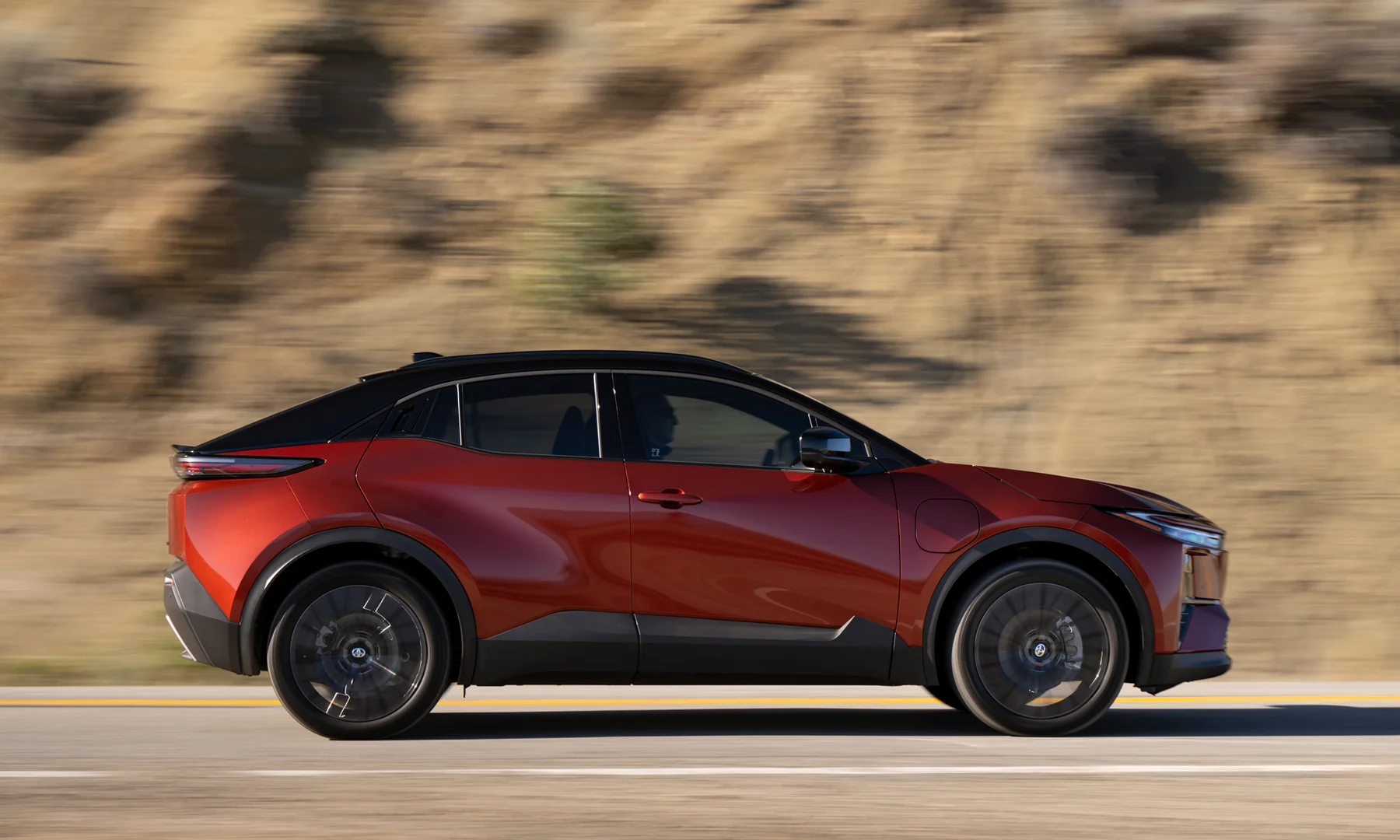
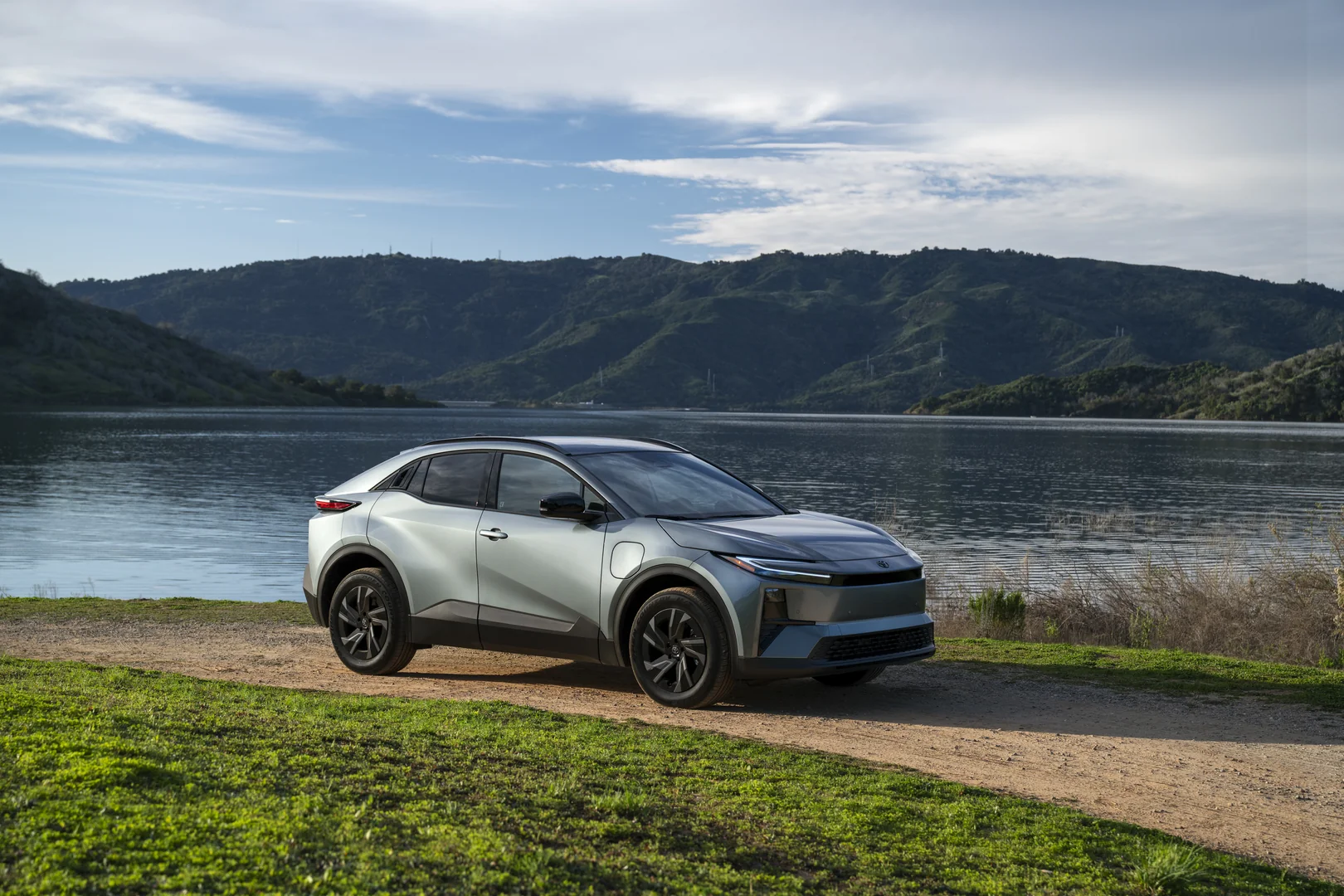
Toyota is leaning hard into the C-HR's original "Coupe High-Rider" design brief, keeping the swept-back roofline, hidden rear door handles, and aggressively sculpted flanks that made the nameplate distinctive when it first launched as a gas car. For the BEV, that silhouette carries over largely unchanged, now paired with a closed-off front fascia that ditches the traditional grille in favor of a smoother, more aerodynamic face typical of Toyota's dedicated EV models. Official press photography shows the XSE grade riding on 20-inch gunmetal-finished multi-spoke wheels, with the SE running smaller 18-inch wheels tuned partly for efficiency. Exterior colors shown in Toyota's press materials include a muted grey-green ("Overcast"), a warm tan ("Boulder"), and a bold red-orange ("Tandoori"), continuing the C-HR's history of leaning into more expressive paint options than the average compact crossover. Inside, the XSE grade adds SofTex and synthetic-suede-trimmed seating, while both grades get wireless smartphone charging and dual-zone automatic climate control as standard equipment. The cabin retains the C-HR's driver-focused layout, though Toyota carries over the same digital gauge cluster placement that drew some criticism on the outgoing model.
Technology & Features
The C-HR BEV's infotainment setup centers on Toyota's current-generation touchscreen software with standard wireless Apple CarPlay and Android Auto, paired with an over-the-air update capability so features can be refreshed without a dealer visit. Drivers can also select from four levels of regenerative braking through steering-wheel-mounted paddles, letting the car range from a light coast to a strong one-pedal-style feel depending on preference.
Safety & ADAS
Every C-HR BEV grade includes Toyota Safety Sense 3.0 as standard equipment, bundling pre-collision braking with pedestrian detection, full-speed-range dynamic radar cruise control, lane departure alert with steering assist, lane tracing assist, road sign assist, and automatic high beams. Blind Spot Monitor with Rear Cross-Traffic Alert, Safe Exit Alert, and the Toyota Star Safety System are also standard across the board, and the base SE grade adds front and rear parking sensors with automatic braking. Moving up to the XSE adds Traffic Jam Assist, Lane Change Assist, and a Panoramic View Monitor for a full 360-degree view while parking.
| ADAS LEVEL | L2 (Toyota Safety Sense 3.0, standard on every grade) |
|---|---|
| ADAS FEATURES | Pre-collision braking w/ pedestrian detection, dynamic radar cruise, lane departure alert w/ steering assist, lane tracing assist, road sign assist, automatic high beams, blind spot monitor w/ rear cross-traffic alert, safe exit alert, front/rear parking sensors w/ automatic braking (SE), Traffic Jam Assist & Lane Change Assist & Panoramic View Monitor (XSE) |
Available Versions
| VERSION | POWER | TORQUE | 0-60 MPH | TOP SPEED | DRIVETRAIN | BATTERY | EV RANGE | COMBINED RANGE | PRICE | KEY DIFFERENCES |
|---|---|---|---|---|---|---|---|---|---|---|
| SE | 338 hp | 323 lb-ft | 4.9 s | TBA | AWD | 74.7 kWh | Up to 287 mi (462 km) | — | $37,080 | 18-in wheels; standard front/rear parking sensors w/ automatic braking |
| XSE | 338 hp | 323 lb-ft | 4.9 s | TBA | AWD | 74.7 kWh | Up to 273 mi (439 km) | — | $39,080 | 20-in wheels; SofTex/suede-trimmed seating; adds Traffic Jam Assist, Lane Change Assist, Panoramic View Monitor |
Pricing & Availability
Toyota's own pressroom lists the SE grade starting at $37,080 and the XSE grade at $39,080, both figures excluding destination and handling fees; with Toyota's typical destination charge added, early independent coverage has consistently listed all-in starting prices around $38,450 for the SE and $40,450 for the XSE. Both grades share the same 338-hp dual-motor powertrain and 74.7-kWh battery, so the price gap buys larger wheels, upgraded interior trim, and the extra driver-assist and parking features listed above rather than a different motor or battery. Toyota says the 2027 C-HR is expected to begin arriving at U.S. dealerships in September 2026. It's worth noting this specific BEV configuration isn't brand new for 2027—Toyota first introduced the electric C-HR for the 2026 model year in early 2026, with dealer arrivals reported around March 2026, and journalists were already publishing first-drive reviews of it by February 2026. The August 6, 2026 announcement covered here is Toyota's confirmation that the 2027 model year carries the C-HR BEV forward essentially unchanged, not a mid-cycle redesign. As of August 2026, Toyota has not announced any export version of this North American BEV for other regions.
How It Compares
The Chevrolet Equinox EV undercuts the C-HR SE on price and is the closest thing to a direct same-market, same-segment rival, but its 300 hp trails the Toyota's 338 hp and it doesn't match the C-HR's sub-5-second 0-60 claim. China's ZEEKR 7X isn't sold in North America, but for context, at a price close to the C-HR XSE it offers a much larger power advantage (470 hp) and a claimed 550 km CLTC range, illustrating how far ahead Chinese electric SUVs can be on raw output at similar money. Another China-market-only reference point, the Li Auto i6, sits at nearly identical money to the C-HR SE but trades power (200 hp vs. 338 hp) for a claimed 400 km CLTC range, underscoring that the C-HR leans toward performance rather than maximizing range-per-dollar.
- Standard dual-motor AWD on every grade, with no lesser front-drive-only trim to upsell away from
- Sub-5-second 0-60 mph acceleration that's genuinely quick for a sub-$40,000 electric crossover
- Native NACS port gives direct Tesla Supercharger access without an adapter, plus a full Toyota Safety Sense 3.0 suite as standard
- 287-mile top range is solid but not class-leading against some rivals with larger battery options
- Curb weight, top speed, and peak DC charging rate remain officially unconfirmed as of this announcement
The 2027 Toyota C-HR BEV is a rare case of an EV that leads with driving character rather than just range or price. Standard all-wheel drive, 338 hp, and a genuine sub-5-second 0-60 time make it one of the quicker compact electric SUVs under $40,000, and the native NACS port removes a real point of charging friction for U.S. buyers. It's not the range champion of its class, and a few key numbers like curb weight are still pending official confirmation, but as a performance-first alternative to range-obsessed competitors, it's a strong pick for buyers who want an EV that's genuinely fun to drive.