
Tesla unveiled the second-generation Roadster on 15 October 2026 at a livestreamed event outside Waco, Texas, close to SpaceX's McGregor test site, almost nine years after the first prototype appeared in November 2017. The battery-electric (BEV) sports car comes in three versions, and every performance figure below is a claim made by Tesla, not a measured result: the two-seat Performance with 0-60 mph in under 1.6 seconds, the two-seat Thrust with rear-mounted cold-gas thrusters and under 0.9 seconds, and the one-seat Rocket with under 0.59 seconds. Tesla also claims more than 300 miles (about 480 km) of range, without naming a test cycle, and a top speed above 230 mph (370 km/h). No price has been announced, and Tesla has not published a power output, battery size, dimensions or weight. Reservations are open at $50,000 for the Performance, and Elon Musk said production will start in 2028.
Performance & Specs
Tesla describes the Roadster as a stack of three configurations, and it treats the Thrust and Rocket as add-ons ("augments") on top of the Performance car. The Performance is labelled road ready, seats two, and combines active aerodynamics with what Tesla calls a multi-mode suction system. Its claimed 0-60 mph time is under 1.6 seconds, which is quicker than the 1.9 seconds Tesla promised for the 2017 prototype. The Thrust is labelled race ready, also seats two, and adds rear-mounted cold-gas thrusters for a claimed 0-60 mph time of under 0.9 seconds, with a limited release. The Rocket seats one, adds thrusters around the perimeter of the body for upward and rotational movement, and is invite only, with a claimed 0-60 mph time of under 0.59 seconds. Tesla's own Roadster page says the Rocket is not approved for public road use.
The thrusters are the headline feature. They are cold-gas units adapted from SpaceX spacecraft hardware, so they use compressed gas rather than rocket fuel, and the gas is stored in carbon-fibre overwrapped pressure vessels (COPVs) packed into spare space in the body. Tesla claims the thrusters can produce four to five times the force the tyres can handle. TechCrunch, citing Tesla vice president of vehicle engineering Lars Moravy and a Tesla post on X, reports ten thrusters fed by about 600 litres of compressed air; Wikipedia also gives ten perimeter thrusters for the Rocket, while Tesla's own pages quoted by other outlets do not state a number. Tesla's multi-mode fan and ground-sealing system pulls air from under the car and, according to the company, can hold it upside down while stationary. In Track Mode the car lowers itself and deploys active wings driven by actuators developed for Tesla's Optimus robot, with downforce that Tesla says approaches Formula 1 levels.
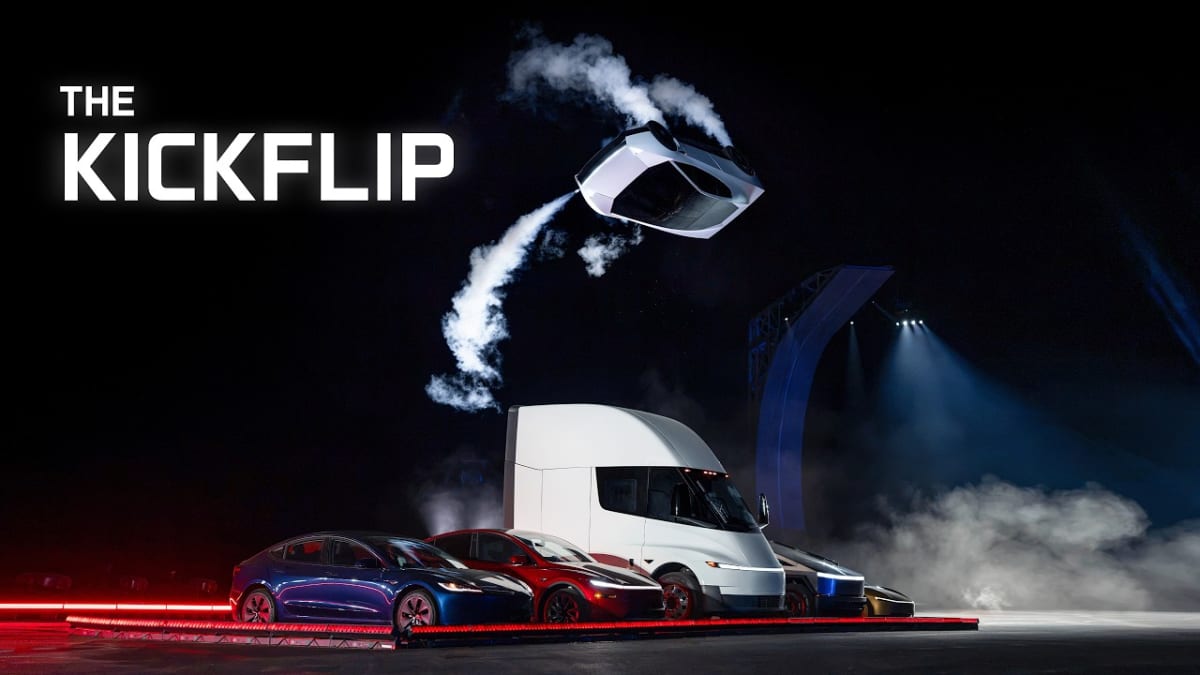
At the event Tesla showed three live demonstrations: the car climbing a curved ramp, a "kickflip" in which it flipped in mid-air and landed, and a 0-60 mph run. Tesla's own video of the run gives a time of 0.81 seconds, with 0.67 seconds quoted once the rollout is subtracted, and Tesla did not say which configuration made it. That one demo run is not a verified acceleration test, and the sub-1.6, sub-0.9 and sub-0.59 second figures remain Tesla's claims. Range of over 300 miles and a top speed above 230 mph are also claims: Electrek and Drive Tesla Canada attribute the top speed to the Rocket, while TechCrunch applies both figures to all three versions, so the per-version split is unclear.
Almost everything that would normally define the powertrain is missing. Tesla did not publish motor count, system power, torque, battery capacity, charging speed, curb weight or the drivetrain layout, so this article does not give any horsepower figure and the drivetrain diagram below is a generic illustration of a battery-electric car, not the Roadster's actual layout. The 2017 prototype was described with three motors and a 200 kWh battery, but Tesla did not repeat those numbers in 2026.

| Powertrain | BEV (motor layout not announced) |
|---|---|
| Power | Not announced |
| Torque | Not announced |
| 0–60 mph | Under 1.6 s (Performance, claimed) |
| Battery | Not announced |
| Range | Over 300 mi / about 480 km (claimed, cycle not stated) |
| POWERTRAIN TYPE | Battery electric (BEV); motor and battery details not announced |
|---|---|
| HORSEPOWER | Not announced |
| ACCELERATION | 0-60 mph: under 1.6 s (Performance), under 0.9 s (Thrust), under 0.59 s (Rocket); all claimed by Tesla |
| TOP SPEED | Above 230 mph (370 km/h), claimed; attributed to the Rocket by Electrek and Drive Tesla Canada |
| DRIVETRAIN | Not announced |
| BATTERY | Not announced |
| RANGE | Over 300 miles (about 480 km), claimed; test cycle not stated |
Dimensions & Practicality

| Length | Not announced |
|---|---|
| Width | Not announced |
| Height | Not announced |
| Wheelbase | Not announced |
| Seats | 2 (Performance, Thrust); 1 (Rocket) |
Tesla has not given a length, width, height, wheelbase or weight for the new Roadster. What it has confirmed is the seating: the Performance and Thrust carry two people, and the Rocket carries one, which is a step down from the four-seat 2+2 layout promised in 2017. Tesla says the seats are fixed in position and the controls are manual, both to save mass, so the cabin is built around one driving position rather than adjustability. The seats are finished in gray microsuede with extra-grip bolsters. Tesla gave no luggage or front-trunk capacity, and said that nearly all spare space in the body is used for compressed-gas storage. The pictures Tesla released show a closed glass cabin, and nothing in its material describes a removable roof, so the Roadster name should not be read as confirmation of an open-top body.
| LENGTH | Not announced |
|---|---|
| WIDTH | Not announced |
| HEIGHT | Not announced |
| WHEELBASE | Not announced |
| SEATS | 2 (Performance, Thrust); 1 (Rocket) |
| CARGO VOLUME | Not announced |
| FRUNK | Not announced |
Charging & Battery
Tesla gave no battery capacity, charging power or charge time for the Roadster at the reveal. The only energy-related figure is the claimed range of more than 300 miles (about 480 km), and outlets reported that Tesla did not specify whether it follows the EPA or another test cycle. That is less than half of the 620 miles (about 1,000 km) Tesla promised in 2017, and Electrek notes the gap. The 2017 prototype was described with a 200 kWh pack, but Tesla did not repeat that figure and no capacity should be assumed for the 2026 car. Charging hardware, connector and DC peak power will have to wait for a later announcement, probably closer to production in 2028.
| BATTERY | Not announced |
|---|---|
| RANGE | Over 300 miles (about 480 km), claimed; cycle not stated |
| AC CHARGING | Not announced |
| DC FAST CHARGING | Not announced |
| DC 10-80% TIME | Not announced |

Design & Interior
Tesla says the new design departs significantly from the 2017 prototype and draws on the SR-71 reconnaissance aircraft and the F-35 fighter. The body is angular and wedge-shaped, with concealed headlights, a full-length taillight and flush-mounted surfaces for what Tesla calls a minimalist, highly technical form. The paint is called Ano White and is described as an aerospace-derived finish with UV and cryogenic protection, electrostatic dissipation and corrosion resistance. The glass is Gold Glazed, tinted to mimic the copper coating of spacesuit visors, with subtle titanium accents, and the wheels are lightweight with thin spokes that Tesla says strengthen the structure.
Inside, the Ultrawhite interior has gray microsuede detailing, and the dashboard carries a yoke, a centre touchscreen and two smaller displays in front of the driver. Magnesium, titanium and carbon fibre are used throughout to cut weight, and Tesla's stated aim is for the car to respond to driver inputs almost instantly. Musk called it the best of the last of the human-driven cars, in a remark reported by TechCrunch, which fits the manual controls and the lack of any announced driver-assistance features.
Technology & Features
The Roadster is a showcase for technology that Tesla and SpaceX already use elsewhere. Steer-by-wire with a yoke follows the layout of the Cybertruck, the active wing actuators come from the Optimus programme, and the thrusters are adapted from spacecraft hardware. Tesla has not announced an infotainment system, voice assistant, connected services or software update policy for the car. Tesla also has not said whether the car will offer any Autopilot or Full Self-Driving functions, and Teslarati lists autonomy features among the details not announced.
Safety & ADAS
No crash-test rating, airbag layout or driver-assistance list has been published. The only regulatory statement is that the Rocket version is not approved for public road use, while the Performance is described as road ready. Tesla did not say in which regions the Performance will be homologated, and Teslarati reports that the Rocket will not be available in all regions. Safety details are likely to come when the car approaches production in 2028.
| ADAS LEVEL | Not announced |
|---|---|
| ADAS FEATURES | Not announced |
Available Versions
| VERSION | POWER | TORQUE | 0-60 MPH | TOP SPEED | DRIVETRAIN | BATTERY | EV RANGE | COMBINED RANGE | PRICE | KEY DIFFERENCES |
|---|---|---|---|---|---|---|---|---|---|---|
| Performance | — | — | Under 1.6s | — | — | — | Over 300 mi | — | Not announced | Two seats, road ready, active aero and suction system; reservation $50,000 |
| Thrust | — | — | Under 0.9s | — | — | — | Over 300 mi | — | Not announced | Two seats, race ready, rear cold-gas thrusters, limited release; reservation $250,000 (reported) |
| Rocket | — | — | Under 0.59s | Above 230 mph | — | — | Over 300 mi | — | Not announced | One seat, perimeter thrusters, invite only, not approved for public roads |
Pricing & Availability
Tesla has not announced a price for any version. Reservations are open through Tesla's website: the Performance needs $5,000 immediately, which Tesla calls fully refundable, and a further $45,000 within 10 days or the reservation is cancelled, for a total of $50,000. TechCrunch and Drive Tesla Canada report a US reservation of $250,000 for the Thrust, and Drive Tesla Canada lists Canadian reservations of CAD 70,000 for the Performance and CAD 350,000 for the Thrust. The Rocket is invite only, with no reservation amount listed. These are reservation payments, not selling prices, and Tesla has not said how they will be applied to the final price. Production is slated for 2028, according to Musk's comment at the event, and Tesla has missed every earlier target for this car, which was first promised for 2020 at a base price of $200,000 with a $250,000 Founders Series. The original Tesla Roadster, a Lotus Elise-based car built from 2008 to 2012 in roughly 2,450 units, was Tesla's first production car, and the new model does not use the Lotus chassis.
How It Compares
Our catalog has no direct rival for a car that has no price, power or battery figures, so the useful comparison is with the halo electric performance cars we already cover. The Denza Z is a four-seat triple-motor coupe with 1,582 hp, 0-100 km/h in 2.25 seconds, a 410 km WLTP range and a Chinese price of CNY 680,000, which is about $100,300. The Hyptec SSR is a 1,225 hp coupe with a 1.9 second 0-100 km/h time and a Chinese price of CNY 1,288,000, about $190,063. Both are priced, specified and in our catalog, which the Roadster is not yet. Tesla's under-1.6 second 0-60 mph claim for the Performance uses a slightly shorter benchmark than 0-100 km/h (60 mph is about 97 km/h), so it is not a like-for-like gap against either car, and the Roadster's 300-mile range claim is a different test basis from WLTP. The honest reading is that Tesla is claiming acceleration beyond anything in this group, with no power, price or weight to check the claim against. The rival figures are Chinese-market prices and the makers' own stated specs.
- Claimed 0-60 mph in under 1.6 seconds for the road-ready Performance, with under 0.9 seconds for the Thrust
- Over 300 miles (about 480 km) of range claimed for a car with suction fans, active wings and thrusters
- Lightweight construction with magnesium, titanium and carbon fibre, and a distinctive SR-71 and F-35 inspired design
- No price, power, battery, weight or dimensions announced, and production not until 2028
- Range and top speed are well below the 2017 promises of 620 miles and above 250 mph, and the Rocket is one-seat, invite only and not approved for public roads
The Roadster reveal was a strong demonstration and a thin specification: a flipping, hovering car with a claimed sub-1.6 second 0-60 mph time and more than 300 miles of range, but no price, power, battery or weight, and production two years away. Tesla has a record of missing its own dates for this car, so the 2028 timing and every claimed figure should be treated as targets. The $50,000 Performance reservation is a bet on the car, not a purchase price, and it only makes sense for buyers who accept years of waiting. Until Tesla publishes real numbers, the Roadster is best read as a promising halo project and not a car to compare on specs.