
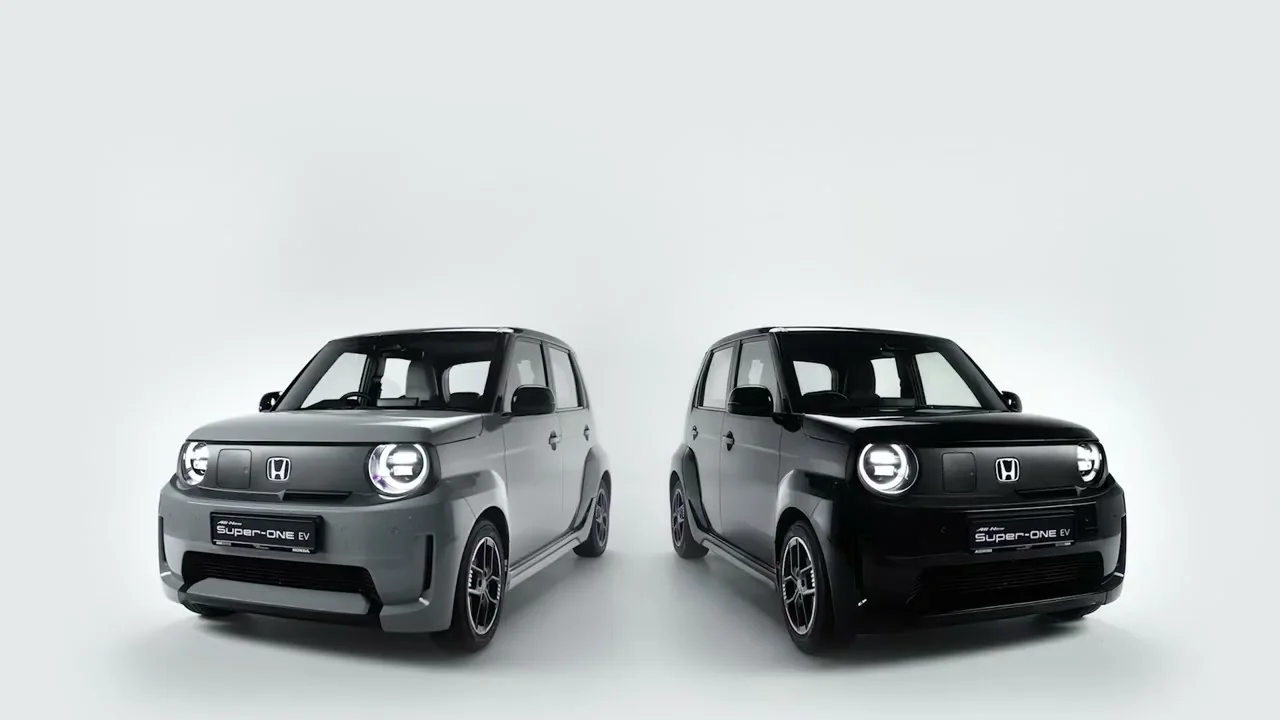
The Honda Super-ONE EV is proof that a tiny city car can still be fun. Sold as the Super-ONE across Japan, Australia and Asia (and as the Super-N in the UK), it's the production version of Honda's Super EV Concept that stole the show at Goodwood in 2025. Underneath it's based on the boxy Honda N-One kei car, but Honda has given it a wider, sportier "Bulldog" body inspired by the 1980s City Turbo II — plus a genuinely playful party trick. Press the Boost Mode button and the little Honda unlocks its full 70 kW (94 hp), complete with a simulated 7-speed gearbox, paddle shifters and a synthetic engine soundtrack. It's a proper enthusiast's answer to the electric city car, and it starts from around $21,000.
Performance & Specs
The Super-ONE uses a single front-mounted electric motor driving the front wheels. In its normal driving modes it makes a modest 47 kW (63 hp), but thumb the Boost Mode button on the steering wheel and output jumps to the full 70 kW (94 hp), with 162 Nm of torque available in every mode. That's enough to drop the 0–100 km/h time from a leisurely 14.5 seconds to around 10 seconds — not fast in absolute terms, but genuinely lively for a sub-1,100 kg city car. What makes it special is the theatre: Boost Mode activates a simulated 7-speed transmission with paddle-shifters and Active Sound Control that pipes an engine note (inspired by Honda's old City Turbo II and Integra Type R) into the cabin, while the ambient lighting glows purple. There are five drive modes in total — Econ, City, Normal, Sport and Boost — and at just 1,090 kg, Honda claims it's the lightest car in its class.

| Powertrain | Single front motor, front-wheel drive (BEV) |
|---|---|
| Normal power | 47 kW (63 hp) |
| Boost power | 70 kW (94 hp) |
| Torque | 162 Nm (all modes) |
| 0–100 km/h | ~10 s (Boost) / 14.5 s (Normal) |
| Kerb weight | 1,090 kg |
| POWERTRAIN | Single front motor, front-wheel drive (BEV) |
|---|---|
| NORMAL POWER | 47 kW (63 hp) |
| BOOST POWER | 70 kW (94 hp) |
| TORQUE | 162 Nm |
| ACCELERATION | 0–100 km/h ~10 s (Boost) |
| BATTERY | 29.6 kWh lithium-ion |
| RANGE | 205 km WLTP (up to 320 km city) |
Dimensions & Practicality

| Length | 3,590 mm |
|---|---|
| Width | 1,573 mm |
| Height | 1,616 mm |
| Wheelbase | 2,520 mm |
| Boot | 162 L (967 L folded) |
| Seats | 4 |
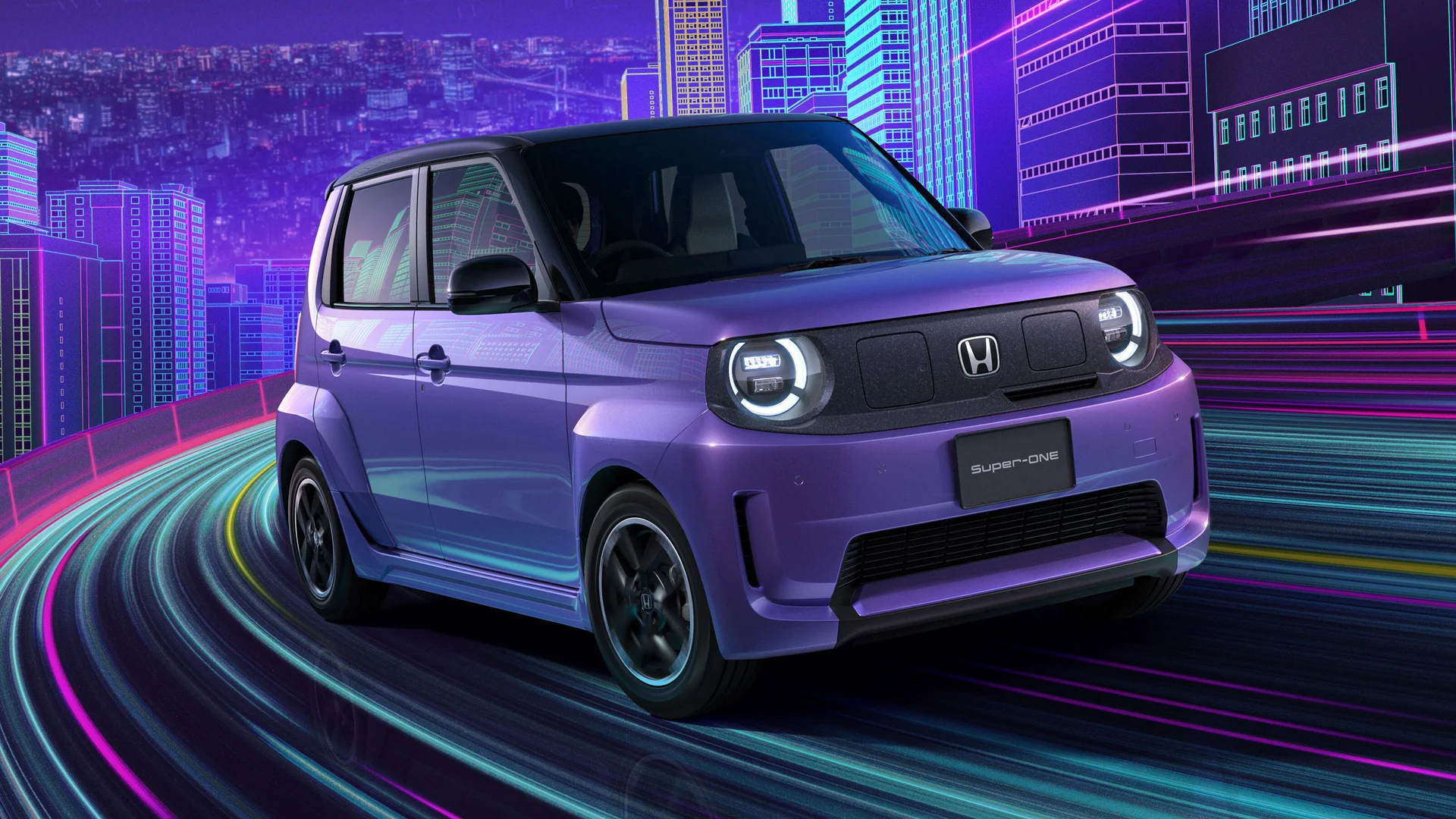
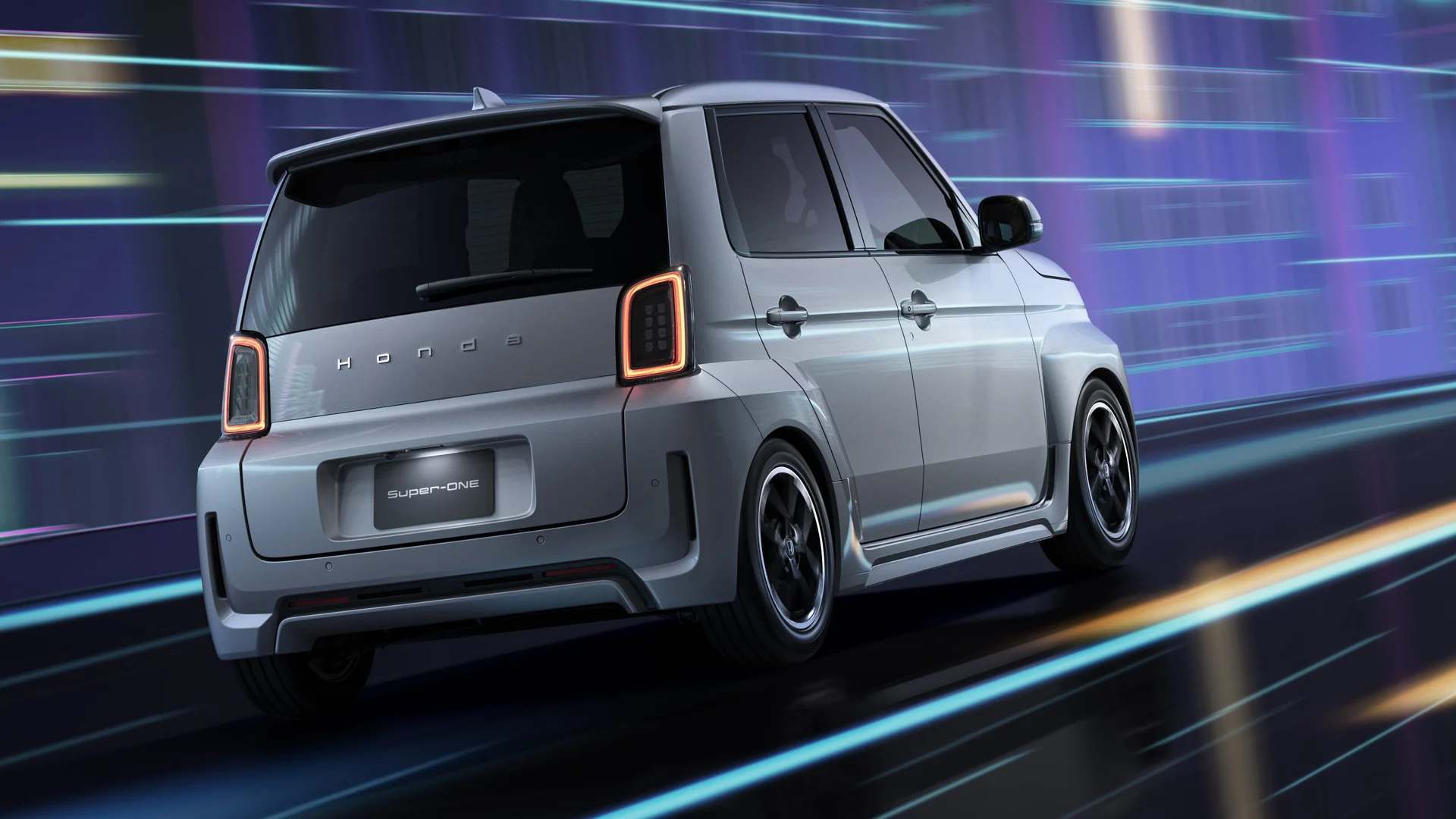
At just 3,590 mm long and 1,573 mm wide, the Super-ONE is a true city car — short enough to slot into the tightest urban parking, yet its tall 1,616 mm roof and 2,520 mm wheelbase free up a surprisingly airy four-seat cabin. Despite the sporty makeover, it keeps the practical honesty of the N-One it's based on: the rear Magic Seats dive down and tip up to expand the 162-litre boot to as much as 967 litres. The "Bulldog" styling adds proper visual muscle with blister-flared wheel arches over a widened track, round LED headlights, red brake calipers, a roof spoiler and a choice of cheerful colours led by the hero Boost Violet Pearl — there's even a black-roofed Kuro Edition. It's tiny, but it has real presence.
| LENGTH | 3,590 mm |
|---|---|
| WIDTH | 1,573 mm |
| HEIGHT | 1,616 mm |
| WHEELBASE | 2,520 mm |
| BOOT VOLUME | 162 L (967 L folded) |
| SEATING | 4 seats |
Charging & Battery
Power comes from a compact 29.6 kWh lithium-ion battery — the same pack as the Japanese N-One e: it's derived from — giving a WLTP range of around 205 km, or up to 320 km on the gentler WLTP city cycle (Japan's more lenient WLTC test quotes 274 km). That's modest, but perfectly judged for the short urban hops this car is built for. Charging is likewise city-friendly rather than record-breaking: a home wallbox tops the battery up in about 4.5 hours, while a 50 kW DC fast charger takes it from low to 80% in roughly 30 minutes. Export cars use the standard CCS2 connector (Japan keeps CHAdeMO), and there's a handy 1,500 W power-out function to run appliances or camping gear. With so little weight to haul around, the small battery goes further than the numbers suggest.
| BATTERY | 29.6 kWh lithium-ion |
|---|---|
| RANGE | 205 km WLTP (274 km WLTC Japan) |
| AC CHARGE | ~6 kW, ~4.5 h full |
| DC CHARGE | 50 kW, ~30 min to 80% |
Technology & ADAS
Inside, the Super-ONE mixes fun with genuine substance. The driver faces a 7-inch digital cluster — which switches to a triple-gauge "rev" display in Boost Mode — alongside a 9-inch Honda CONNECT touchscreen with Google built-in, plus wireless Apple CarPlay and Android Auto. Impressively for a car this small and this cheap, a Bose premium sound system with eight speakers and a boot-mounted subwoofer is standard, and the sport seats get a playful asymmetric blue trim. Honda has also kept physical knobs and buttons for the climate and volume — a welcome touch. On the safety side, the full Honda Sensing suite comes as standard, bundling autonomous emergency braking, adaptive cruise control, lane-keeping assist, traffic-sign recognition and more. It's a lot of kit and character for an entry-level EV.
| SCREENS | 7-inch cluster + 9-inch touchscreen (Google built-in) |
|---|---|
| ADAS | Honda Sensing (AEB, ACC, LKAS) standard |
Pricing & Availability
The Super-ONE went on sale in Japan in 2026 at ¥3,390,200 (about $21,000), having first launched in Singapore in January 2026. It reaches the UK as the Super-N from £18,995, with orders open and showroom cars arriving in July 2026, and lands in New Zealand from NZ$41,990 (the Kuro Edition costs NZ$44,990). Australia gets it in the second half of 2026, with continental Europe and further Asian markets to follow. Pricing varies widely by market thanks to local taxes — it's an affordable hero in Japan and the UK, but pricier where duties bite. Wherever it lands, though, the Super-ONE offers something rare: a genuinely characterful, enthusiast-flavoured electric city car from a mainstream maker.
How It Compares
On paper, the Super-ONE loses the numbers game. The Leapmotor T03 and Dacia Spring both undercut it on price and edge it on range, while the BYD Dolphin Surf offers more range, more power and more space for similar money. But none of those rivals offer anything like the Honda's sense of fun. The Boost Mode, simulated gearbox, synthetic soundtrack, Bose audio and cheeky retro styling make the Super-ONE feel like a scaled-down hot hatch rather than a penalty box on wheels. If you simply want the cheapest, longest-range city EV, look elsewhere — but if you want the one that makes you smile, the Honda is in a class of its own.
- Genuinely fun Boost Mode with simulated 7-speed and sound
- Light, nimble and charming retro "Bulldog" styling
- Standard Bose audio, Google built-in and Honda Sensing
- Compact, easy to park, with clever Magic Seats
- Modest 205 km WLTP range for longer trips
- Only 50 kW DC charging — slow by 2026 standards
- Cheaper rivals (T03, Spring) beat it on price and range
- Pricing balloons in high-tax markets like Singapore and NZ
The Honda Super-ONE EV is a reminder that electric cars don't have to be appliances. It won't win any range or value contests — 205 km WLTP and 50 kW charging are firmly city-car numbers, and budget rivals like the Leapmotor T03 and Dacia Spring cost less — but that misses the point. With its Boost Mode, paddle-shifted simulated 7-speed, synthetic engine note, standard Bose audio and adorable City Turbo-inspired styling, the Super-ONE injects real personality into a segment that badly needed some. It's light, well-equipped and, at around $21,000 in its home market, genuinely affordable. As a second car or a joyful city runabout for someone who still loves driving, this pint-sized Honda is one of the most likeable small EVs on sale.