
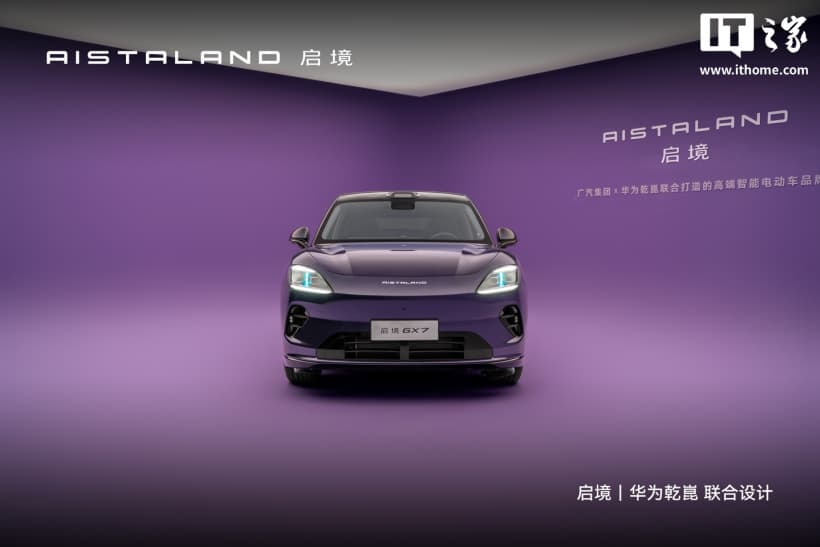
Aistaland, the premium electric-vehicle brand jointly built by GAC Group and Huawei, launched its second production model on September 23, 2026: the GX7, a five-seat extended-range SUV pitched as a "spacious" family flagship. It follows the GT7 shooting brake, Aistaland's first model, which arrived in June 2026 as a pure BEV; the GX7 switches to a range-extender (EREV) powertrain and a bigger footprint to chase the mid-size family SUV segment. Three trims are on sale — a single-motor RWD Ultra, a dual-motor AWD, and a range-topping tri-motor AWD — with limited-time launch pricing from 229,900 yuan (about $34,060) up to 291,900 yuan (about $43,240); official, non-promotional guide prices run from 239,900 to 301,900 yuan. Every trim gets four LiDAR units as standard, an unusually generous sensor count for this price bracket, feeding Huawei's Qiankun ADS 5 driver-assist stack. Inside, the GX7 debuts Huawei's newest HarmonySpace 6 cockpit software alongside a party trick borrowed from camping-focused SUVs: a 20-second one-touch flat-bed mode that folds the second row into a 180-degree flat sleeping platform.
Performance & Specs
The GX7 is built around a 1.5-liter turbocharged range-extender engine that runs as a generator only — it never drives the wheels directly — paired with one, two or three electric motors depending on trim. The entry RWD Ultra uses a single 200 kW (268 hp) rear motor good for a 7.6-second 0-100 km/h run. Stepping up to the dual-motor AWD adds a 140 kW front motor to a 200 kW rear unit for a combined 340 kW (456 hp) and a 4.9-second sprint. The range-topping tri-motor AWD splits 550 kW (738 hp) across a 150 kW front motor and two 200 kW rear motors, cutting the 0-100 km/h time to 3.9 seconds — supercar-adjacent numbers for a 5.1-meter family SUV. Only the tri-motor version rides on an 800-volt electrical architecture with 5C DC fast charging; the RWD and dual-motor trims use a conventional charging setup and take longer to top up.

| Powertrain | Single-motor RWD EREV |
|---|---|
| Power | 200 kW (268 hp) |
| Drivetrain | RWD |
| Battery | 52 kWh LFP (CATL) |
| 0–100 km/h | 7.6 s |
| Range | 340 km EV / 1,580 km combined (CLTC) |
| POWERTRAIN TYPE | EREV (range-extender) |
|---|---|
| HORSEPOWER | 200 kW (268 hp) to 550 kW (738 hp) depending on trim |
| ACCELERATION | 3.9–7.6 s (0–100 km/h depending on trim) |
| DRIVETRAIN | RWD / dual-motor AWD / tri-motor AWD |
| BATTERY | 52 kWh LFP or 67 kWh ternary lithium (CATL) |
| ELECTRIC RANGE | 325–385 km (CLTC) |
| COMBINED RANGE | 1,500–1,580 km (CLTC) |
Dimensions & Practicality

| Length | 5,099 mm |
|---|---|
| Width | 2,006 mm |
| Height | 1,750 mm |
| Wheelbase | 3,070 mm |
At 5,099 mm long on a 3,070 mm wheelbase, the GX7 sits squarely in the mid-to-large SUV class. Aistaland markets the cabin as a "spacious five-seat" layout rather than a cramped six- or seven-seater, prioritizing shoulder and legroom over a usable third row. The signature feature is a 20-second one-touch mode that reclines the second-row backrests into a 180-degree flat sleeping platform, part of what the brand describes as more than a dozen reconfigurable cabin layouts — a clear play for the same road-trip and camping crowd that has made flat-bed modes popular on rivals like the Li Auto lineup. Chinese-language coverage of the GX7's cargo volume has been inconsistent between outlets as of this writing, so we're not publishing a specific liter figure here rather than risk shipping a wrong one; we'll update this once Aistaland's own spec sheet is confirmed.
| LENGTH | 5,099 mm |
|---|---|
| WIDTH | 2,006 mm |
| HEIGHT | 1,750 mm |
| WHEELBASE | 3,070 mm |
Charging & Battery
Aistaland offers two CATL battery packs across the three-trim lineup: a 52 kWh lithium iron phosphate (LFP) pack on the RWD Ultra and dual-motor AWD, and a larger 67 kWh ternary-lithium pack reserved for the tri-motor flagship. CLTC-rated electric-only range spans 325 km on the dual-motor AWD to 385 km on the tri-motor AWD, with the RWD Ultra landing at 340 km; combined range with the 1.5T range-extender running tops out at 1,580 km on the RWD Ultra, versus 1,500 km on the dual-motor and 1,530 km on the tri-motor AWD. Only the tri-motor trim gets Aistaland's 800-volt architecture, which supports 5C DC fast charging and a 30-80% top-up in about 10 minutes; the RWD and dual-motor trims charge on a conventional system and need roughly 15 minutes for the same 30-80% window.
| BATTERY | 52 kWh LFP (RWD Ultra & dual-motor AWD) / 67 kWh ternary lithium (tri-motor AWD), CATL |
|---|---|
| DC FAST CHARGING | 800V / 5C on tri-motor AWD; standard architecture on other trims |
| DC 30-80% TIME | ~10 min (tri-motor AWD) / ~15 min (RWD Ultra & dual-motor AWD) |
Design & Interior
Aistaland revealed the GX7 in a striking "West Lake Smoke Purple" launch color, pairing a low, coupe-like roofline with a full-width light bar front and rear — a design signature it shares with the GT7 shooting brake. The nose carries slim split headlights and a clean fascia with the LiDAR housing integrated above the windshield rather than bolted on as an afterthought, while the tail gets a glowing light bar that bridges the rear pillars. Inside, Huawei's HarmonySpace 6 cockpit spans dual 15.6-inch displays plus the segment's largest augmented-reality head-up display at 88 inches, projected across most of the windscreen. Aistaland pairs the digital cockpit with a 21-speaker Huawei Sound audio system, and the cabin's headline trick — the 20-second flat-bed transformation — is backed by more than a dozen configurable seating layouts aimed at road-trip and camping buyers. Materials and trim finishes on the launch cars lean premium, consistent with Aistaland's positioning as GAC and Huawei's flagship joint-venture brand rather than a budget-focused nameplate.
Technology & Features
The GX7's headline tech story is its sensor suite: four LiDAR units — one 896-channel dual-optical-path, image-grade LiDAR plus three solid-state units — combine with 38 total perception sensors to run Huawei's Qiankun ADS 5 driver-assist platform. Aistaland says the architecture is the only one in its class built with redundancy across eight separate systems (power supply, steering, braking, communications, positioning, computing, perception and interaction), effectively pre-installing the hardware for a future Level 3 autonomous-driving upgrade — though L3 approval for private use remains pending in China as of September 2026 and isn't active at launch. Software runs on HarmonySpace 6, Huawei's newest in-car OS, tied into the automaker's broader HarmonyOS device ecosystem for phone-to-car handoff and smart-home connectivity.
Safety & ADAS
Every GX7 trim ships with the same four-LiDAR, 38-sensor hardware set and Huawei's Qiankun ADS 5 assisted-driving system, rather than reserving the full sensor suite for the range-topping trim — a departure from how many rivals gate advanced ADAS hardware behind the priciest configuration. Aistaland's eight-way redundancy claim covers the systems that matter most for higher levels of automation: duplicated power supplies, redundant steering and braking actuation, backup communications and positioning, and duplicated compute and perception paths. The brand frames this as an architecture "designed for" Level 3 autonomy rather than a car that is Level 3-capable today; current features operate at a supervised Level 2+ tier pending regulatory approval.
| ADAS LEVEL | L2+ (hardware architecture designed for future L3) |
|---|---|
| ADAS FEATURES | 4 LiDAR (1×896-channel dual-optical-path + 3 solid-state), 38 total sensors, Huawei Qiankun ADS 5, 8-way system redundancy |
Available Versions
| VERSION | POWER | 0-100 | DRIVETRAIN | BATTERY | EV RANGE | COMBINED RANGE | PRICE | KEY DIFFERENCES |
|---|---|---|---|---|---|---|---|---|
| RWD Ultra | 268 hp | 7.6s | RWD | 52 kWh LFP | 340 km | 1,580 km | $34,060 | Entry trim, single rear motor, standard 4-LiDAR ADAS suite, longest combined range |
| Dual-Motor AWD | 456 hp | 4.9s | AWD | 52 kWh LFP | 325 km | 1,500 km | $37,020 | Adds a front motor for AWD traction and stronger acceleration |
| Tri-Motor AWD | 738 hp | 3.9s | AWD | 67 kWh ternary lithium | 385 km | 1,530 km | $43,240 | Range-topping trim, 800V/5C fast charging, longest EV-only range |
Pricing & Availability
Aistaland opened GX7 pre-sales on September 4, 2026 with pricing from 249,900 to 311,900 yuan, then cut the launch-day figures on September 23 to a limited-time range of 229,900 to 291,900 yuan (about $34,060-$43,240), with official, non-promotional guide prices set at 239,900-301,900 yuan. An 8,000-yuan trade-in subsidy is available during the promotional window. The GX7 is sold exclusively in mainland China through Aistaland's own retail network alongside the GT7 shooting brake; GAC and Huawei have not announced export plans for either model as of this writing.
How It Compares
Against the AITO M7 REV — the other Huawei-ecosystem EREV SUV in this price band, running the older HarmonyOS cockpit generation — the GX7's entry RWD Ultra is actually cheaper while offering more power and a longer combined range on paper, plus a full four-LiDAR sensor suite the M7 REV doesn't match at this trim level. The AVATR 07 REV, which also leans on Huawei's ADS driver-assist software, undercuts the GX7 on total range but starts life with more standard power than the GX7's own base trim. The XPENG G7 EREV lands at essentially the same price as the GX7's mid-tier dual-motor version while quoting a higher combined range, making it the sharper on-paper value pick for buyers who don't care about the LiDAR count or Huawei's cockpit ecosystem specifically. The GX7's real differentiator against all three isn't raw range or price — it's sensor density and the Level-3-ready hardware architecture, which none of these rivals currently match trim-for-trim.
- Four LiDARs and 38 sensors standard on every trim, not reserved for the flagship
- Genuinely broad power spread, from a usable 268 hp RWD entry car to a 738 hp, 3.9-second tri-motor flagship
- Class-leading 88-inch AR head-up display and HarmonySpace 6 cockpit backed by Huawei's ecosystem
- Exact cargo volume and ground clearance haven't been consistently published, making real-world packing capacity hard to judge before independent test drives
- The Level 3-ready hardware architecture is pre-installed but not yet legally active, so early buyers pay for a capability they can't use at launch
The Aistaland GX7 is a confident second act for GAC and Huawei's joint-venture brand: it takes the GT7's Huawei-powered tech stack and repackages it into a more mainstream, family-friendly EREV SUV with genuinely differentiated hardware — four standard LiDARs and an 800V/5C flagship trim aren't typical at this price. The RWD Ultra is the one to watch, undercutting $35,000 while still carrying the full sensor suite and a class-competitive 1,580 km combined range. The trade-off is that some of the car's biggest selling points, from Level 3 readiness to exact cargo capacity, remain more promise than proven fact until independent reviewers get seat time. For shoppers comparing Huawei-ecosystem EREV SUVs on price and tech density, the GX7 earns a spot on the shortlist.