
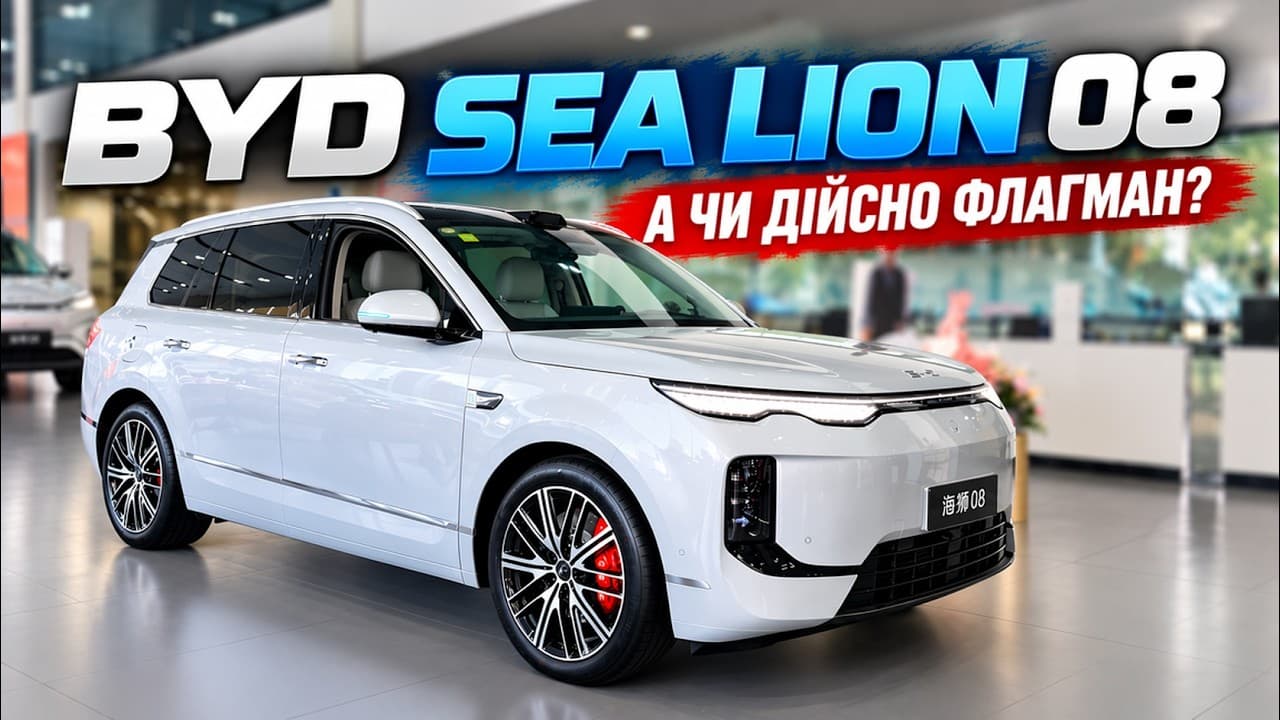
The BYD Sealion 08 is the biggest and most ambitious SUV in BYD's Ocean lineup, a 5,115 mm long flagship that went on sale in China on September 2, 2026. It is sold as a plug-in hybrid or a pure EV, with either five or six seats, and BYD has fitted the whole range with a dual-chamber air suspension, active rear-wheel steering and a roof-mounted LiDAR. Official prices run from 229,900 yuan (about $33,890) for the entry five-seat plug-in hybrid to 279,900 yuan (about $41,270) for the top six-seat AWD EV. Ukrainian reviewer Autosalon na Divane filmed the car on a dealer floor in China and described it as a machine that looks like a premium product but is priced like a mainstream one. He also noted that shoppers walking out of a showroom next door were arriving from a Maybach, which tells you who BYD is trying to tempt.
Performance & Specs
The plug-in hybrid uses a 1.5-liter turbocharged engine rated at 115 kW (154 hp) paired with a 55.843 kWh second-generation Blade battery. The entry model is front-wheel drive with a single 200 kW (268 hp) electric motor, and the AWD Flagship adds a second 200 kW motor for a combined 400 kW (536 hp). BYD rates the plug-in hybrid at 400 km of CLTC electric range in front-drive form and 350 km with AWD, with up to 1,650 km combined. Fuel consumption is quoted at 4.6 L/100 km on the NEDC cycle with the battery depleted.
The battery-electric Sealion 08 uses a much larger 115.072 kWh pack. The rear-drive version has a 370 kW (496 hp) motor, 900 km of CLTC range and a 0-100 km/h time of 5.9 seconds. The AWD Flagship pairs a 215 kW front motor with the 370 kW rear motor for 585 kW (784 hp), 800 km of CLTC range and a 3.9-second sprint. That 3.9 seconds is the number the reviewer read out while driving the flagship EV, and it matches BYD's launch figures.

| Powertrain | 1.5T plug-in hybrid, dual-motor AWD |
|---|---|
| Power | 400 kW (536 hp) |
| Drivetrain | AWD |
| Battery | 55.843 kWh Blade LFP |
| Electric range | 350 km (CLTC) |
| Combined range | Up to 1,650 km |
| POWERTRAIN TYPE | Plug-in hybrid (1.5T) or battery-electric |
|---|---|
| HORSEPOWER | PHEV 268 hp (FWD) / 536 hp (AWD); EV 496 hp (RWD) / 784 hp (AWD) |
| ACCELERATION | EV: 5.9 s (RWD) / 3.9 s (AWD), 0-100 km/h |
| DRIVETRAIN | FWD or AWD (PHEV); RWD or AWD (EV) |
| BATTERY | 55.843 kWh (PHEV) / 115.072 kWh (EV) |
| ELECTRIC RANGE | PHEV 350-400 km; EV 800-900 km (CLTC) |
| COMBINED RANGE | PHEV up to 1,650 km |
Dimensions & Practicality

| Length | 5,115 mm |
|---|---|
| Width | 1,999 mm |
| Height | 1,800 mm |
| Wheelbase | 3,030 mm |
| Ground clearance | ~200 mm (adjustable, per reviewer) |
The Sealion 08 measures 5,115 mm long, 1,999 mm wide and 1,800 mm high on a 3,030 mm wheelbase. The six-seat car has two captain's chairs in the second row with a zero-gravity recline function, and the reviewer spent real time in the third row. His verdict was that headroom and knee room are both better than a fist's width, that an adult could do a long trip back there, and that the seat backs adjust. The penalty is luggage space: behind the third row there are only 317 liters, growing to 1,173 liters with the last row folded. Choose the five-seat layout and the boot swells to 943 liters, and the reviewer quotes roughly 1,880 liters with the seats down. The electric version adds a 201-liter powered front trunk, which opens from a button and, on the demo car, sat under a large bonnet.
Ground clearance is around 20 centimeters in the middle air-suspension setting, according to the reviewer, although his showroom car was in test mode and could not be raised or lowered. The rear axle steers by up to 7 degrees, which he credited for the tiny 4.95 m turning radius, a number he called colossal for a car this long. The 21-inch wheels on the top trim hide ventilated brake discs with red calipers.
| LENGTH | 5,115 mm |
|---|---|
| WIDTH | 1,999 mm |
| HEIGHT | 1,800 mm |
| WHEELBASE | 3,030 mm |
| CARGO VOLUME | 943 L (5-seat) / 317 L (6-seat, 1,173 L seats folded) |
| FRUNK | 201 L (EV) |
Charging & Battery
Every Sealion 08 gets the second-generation Blade battery and BYD's flash-charging hardware. BYD states that the pack can go from 10% to 70% in about 5 minutes and from 10% to 97% in about 9 minutes on a compatible high-power charger, and the EV is quoted at a peak of up to 1,500 kW. Those figures only apply where a flash charger exists, so they remain a Chinese-market number for now. On ordinary chargers the story is more modest, and BYD has not published a fixed AC charging power for the car.
The plug-in hybrid's 55.843 kWh battery is small next to the EV's 115.072 kWh, but 350 to 400 km of electric range covers most daily driving, and the 1.5T engine takes care of the rest. The reviewer summarised the range table on camera as 400 km for front-drive and 350 km for AWD hybrids, and 900 km and 800 km for the rear-drive and AWD EV.
| BATTERY | 55.843 kWh (PHEV) / 115.072 kWh (EV) |
|---|---|
| AC CHARGING | Not published |
| DC FAST CHARGING | Flash charging; EV up to 1,500 kW |
| DC 10-70% TIME | ~5 min |
| DC 10-97% TIME | ~9 min |
Design & Interior
The design signature is the front end. The main headlight units are described by the reviewer as diamonds joined by a starry sky, and up close the crystal-like light guide is indeed striking, with the LED matrix beams tucked underneath. He called it one of the most expensive-looking lamp designs a Chinese brand has made and said the car looks more costly than it is. The grille is active and its louvers open while driving to cool the battery, and at the back there is a large BYD wordmark, a rear wiper and a hatch that sits over a small third-row boot. He was less taken with the shape as a whole, calling the rear plainly a normal BYD rather than the European style many fans had expected.
Inside, the cabin is light grey and beige with a pearlescent trim across the door cards and dashboard. The front seats offer ventilation, heating and massage, and the reviewer said this was the best seating position he had sat in, with generous headroom. He made clear that seat material depends on trim: microfiber rather than Alcantara, and genuine leather only in six-seat cars, while the five-seat versions use leatherette that felt no different to him.
Here the review turned critical. The new steering wheel has a thick upper rim that, even at its highest setting, blocks the instrument cluster, and he called this illogical and uncomfortable. The center air vents felt cheap to him, the switchgear in the third row is basic plastic, and the armrest cooler box is oddly positioned so that the driver cannot reach it from the front seats. Small details such as a loose chrome strip above the cluster on a car with only 726 km showed up during the drive, and the demo EV had a visible bubble in one headlight assembly, which he put down to early-build quality.
Technology & Features
The 17.3-inch central display runs BYD's DiLink system with an open Android base, so any app can be installed. It offers many languages including English but no Ukrainian, and the reviewer found it not especially quick and slightly muddy in brightness compared with more expensive BYD models. The six-seat cars also gain a 21.4-inch ceiling screen for rear passengers, but the reviewer noticed thick bezels on it that were visible in every mode.
Equipment differs sharply between layouts. The six-seat AWD Flagship gets a 25-speaker Devialet audio system, the rear screen, a hot-and-cold box and a head-up display, whereas the five-seat front-drive base car makes do with 20 speakers, no subwoofer, no head-up display, no rear screen and no cooler box. That is a large part of the 20,000 yuan (about $2,950) price step between five-seat and six-seat versions. Every car, whatever the trim, has a camera built into the interior mirror and a 50 W wireless phone charger.
Safety & ADAS
All trims share BYD's God's Eye 5.0 driver-assistance system, which supports navigation-assisted driving on highways and in cities, and a roof LiDAR. The reviewer counted 11 cameras, 12 ultrasonic sensors and three millimeter-wave radars on the car. The self-parking function worked without fuss when he asked the car to reverse into a bay beside the charger, and forward visibility from the mirrors was good in his opinion. The car also uses air-suspension road preview and active rear steering, both of which feed into the stability tuning.
| ADAS LEVEL | L2+ (God's Eye 5.0) |
|---|---|
| ADAS FEATURES | Roof LiDAR, navigation-assisted driving, automatic parking, 360° camera view, rear-wheel steering, road-preview air suspension |
Available Versions
| VERSION | POWER | TORQUE | 0-100 | TOP SPEED | DRIVETRAIN | BATTERY | EV RANGE | COMBINED RANGE | PRICE | KEY DIFFERENCES |
|---|---|---|---|---|---|---|---|---|---|---|
| PHEV 400 km Honour (5-seat) | 268 hp | — | — | — | FWD | 55.843 kWh | 400 km | 1,650 km | $33,890 | Entry model, 943 L boot, no rear screen or cooler box |
| PHEV 400 km Honour (6-seat) | 268 hp | — | — | — | FWD | 55.843 kWh | 400 km | 1,650 km | $36,840 | Captain's chairs, rear screen, 317 L boot |
| PHEV 350 km AWD Flagship (5-seat) | 536 hp | — | — | — | AWD | 55.843 kWh | 350 km | 1,650 km | $36,840 | Second 200 kW motor |
| PHEV 350 km AWD Flagship (6-seat) | 536 hp | — | — | — | AWD | 55.843 kWh | 350 km | 1,650 km | $39,790 | Top plug-in hybrid, six seats |
| EV 900 km Honour (5-seat) | 496 hp | — | 5.9s | — | RWD | 115.072 kWh | 900 km | — | $35,370 | Entry EV, 201 L frunk |
| EV 800 km AWD Flagship (5-seat) | 784 hp | — | 3.9s | — | AWD | 115.072 kWh | 800 km | — | $38,320 | Dual-motor AWD |
| EV 900 km Honour (6-seat) | 496 hp | — | 5.9s | — | RWD | 115.072 kWh | 900 km | — | $38,320 | Captain's chairs, rear screen |
| EV 800 km AWD Flagship (6-seat) | 784 hp | — | 3.9s | — | AWD | 115.072 kWh | 800 km | — | $41,270 | Top of the range |
Pricing & Availability
Pre-orders opened on August 13, and BYD launched the car on September 2 with eight variants. The plug-in hybrids cost 229,900 to 269,900 yuan, and the EVs cost 239,900 to 279,900 yuan. Dollar figures here use a rate of about 6.78 yuan per dollar. The pricing in the reviewer's video is BYD's official China price converted from yuan, not a Ukrainian import quote, and it should not be read as a landed cost anywhere outside China. BYD reported more than 12,000 firm orders in the first 24 hours, and shipments from its Jinan plant began within days.
How It Compares
The Denza N8L is the natural reference point in BYD's own stable. It lists 751 hp and about $41,300 in our database, roughly $7,000 above the Sealion 08's entry price, and the reviewer said the Sealion's handling is much like a BYD Datang or Denza but feels cheaper, with a firmer ride than either. The Leapmotor D19 and Onvo L90 both target the same large-family-SUV buyer at around $36,700, right in the middle of the Sealion 08's price spread, so the choice comes down to powertrain preference and how much the five-or-six-seat flexibility matters to you.
- Five- or six-seat layouts with a third row that fits an adult, plus plug-in hybrid and EV options on one body
- Air suspension, rear-wheel steering and roof LiDAR standard on all eight variants from about $33,890
- Flash charging and up to 1,650 km (PHEV) or 900 km (EV) of CLTC range
- The steering wheel rim blocks part of the instrument cluster even at its highest setting
- Air vents, third-row switchgear and the rear-screen bezels feel cheaper than the striking exterior promises
The Sealion 08 gets the big things right: a huge cabin with a usable third row, air suspension and rear steering on every trim, flash charging and a starting price around $33,890. It falls short on details, from the steering wheel that hides the dials to the cheap-feeling vents and a ride that seemed firmer than it should be, and our reviewer said he would not buy it himself. If those details are tolerable it remains a sensible large family SUV, and the six-seat EV AWD Flagship is the version that makes the strongest case.