
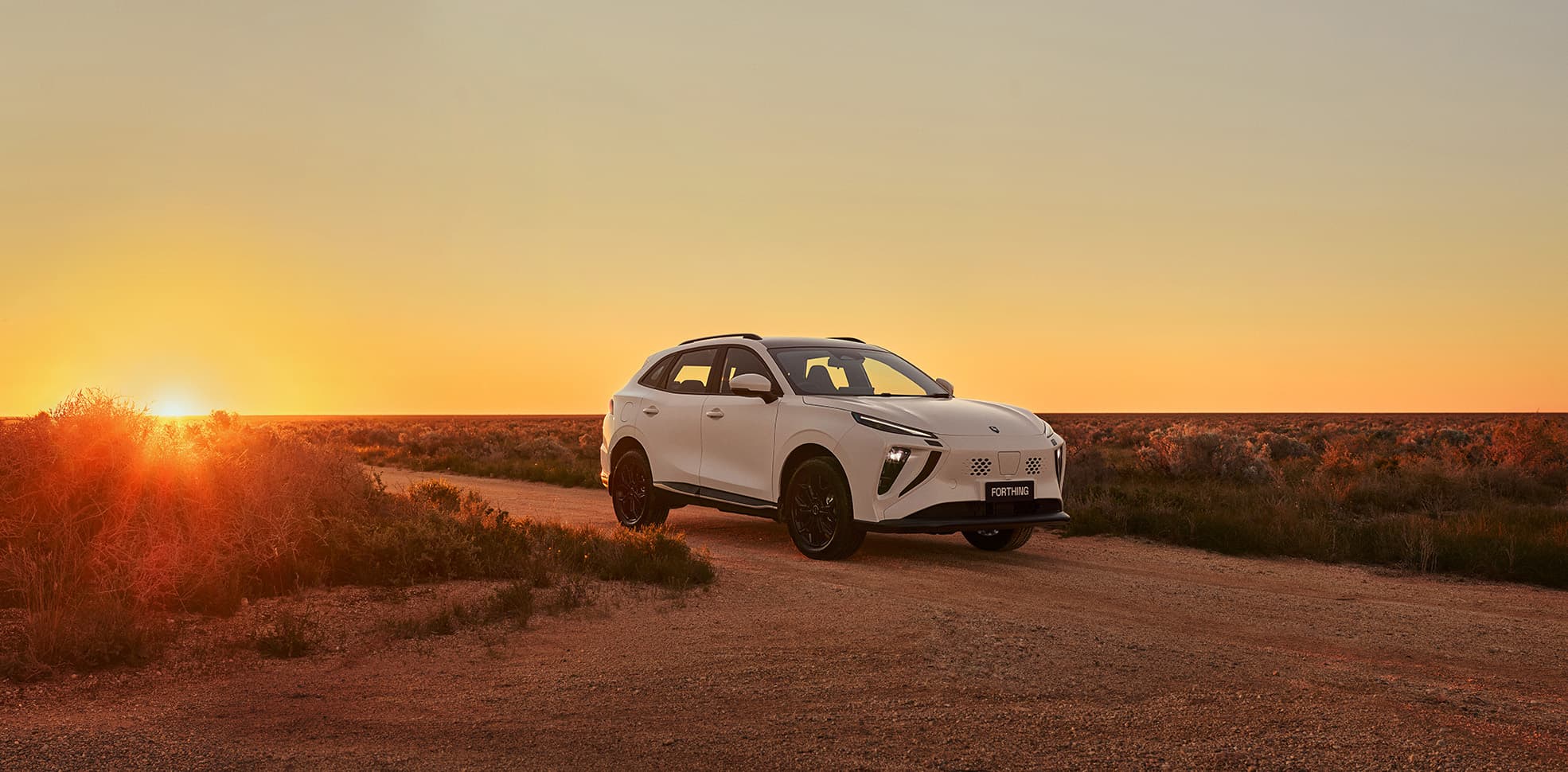
Forthing, a new-energy sub-brand backed by Chinese state-owned giant Dongfeng, has landed in Australia and New Zealand with the Taikon 5, a medium SUV sold as either a full battery-electric vehicle or a range-extender hybrid the brand calls "Super Hybrid." The BEV is good for an estimated 400-plus km on a single charge, while the range-extender version can run up to 183 km on electric power alone before its 1.5-litre petrol engine kicks in purely as a generator, stretching total range past 1,000 km. Pricing in Australia starts at $36,990 drive-away for the entry Range Extender Hybrid Luxury, undercutting the BYD Sealion 6 the brand has been positioned against. New Zealand buyers have been able to order since April 2026, with Australian deliveries following from June. Both powertrains share the same body, a 7-year/200,000 km warranty, and a 14.6-inch touchscreen, but reviewers in both markets have already flagged some rough edges beneath the aggressive pricing.
Performance & Specs
The Range Extender Hybrid ("Super Hybrid") pairs a rear-mounted electric motor making 120 kW (240 Nm, about 161 hp) with a 1.5-litre four-cylinder engine rated at 75 kW (130 Nm, about 101 hp). Crucially, that engine never drives the wheels — it only spins a generator to top up the 31 kWh LFP battery once it runs low, so the car always drives like an EV. Forthing quotes a 12.5-second 0-100 km/h time for this version. The fully electric Taikon 5 swaps in a larger 64 kWh LFP pack and a single front-mounted motor making 150 kW and 340 Nm (about 201 hp), driving the front wheels only. Forthing has not published an official 0-100 km/h figure for the BEV; independent Australian testers have estimated it in the region of 8 seconds, with a top speed listed around 180 km/h. Both versions ride on 235/55 R19 tyres and share a 1,500 kg braked towing rating.

| Powertrain | Range-extender EV (REEV) |
|---|---|
| Power | 120 kW (161 hp) |
| Torque | 240 Nm |
| 0–100 km/h | 12.5 s |
| Battery | 31 kWh LFP |
| Range | Up to 183 km EV / 1,000+ km combined |
| POWERTRAIN TYPE | BEV or Range-Extender EV (REEV) |
|---|---|
| HORSEPOWER | 161 hp (REEV) / 201 hp (BEV) |
| ACCELERATION | 12.5 s (REEV) / ~8 s est. (BEV) |
| TOP SPEED | Not confirmed (REEV) / ~180 km/h (BEV) |
| DRIVETRAIN | RWD (REEV) / FWD (BEV) |
| BATTERY | 31 kWh LFP (REEV) / 64 kWh LFP (BEV) |
| ELECTRIC RANGE | Up to 183 km (REEV) / 427 km (BEV), both WLTP |
| COMBINED RANGE | 1,000+ km (REEV) |
Dimensions & Practicality

| Length | 4,600 mm |
|---|---|
| Width | 1,860 mm |
| Height | 1,680–1,700 mm |
| Wheelbase | 2,715 mm |
| Ground clearance | 180 mm |
At 4,600 mm long on a 2,715 mm wheelbase, the Taikon 5 sits in the same medium-SUV bracket as the BYD Sealion 6 and Geely EX5. Boot space is quoted at 541 litres with the rear bench up, extending to a claimed 1,480 litres with the 60/40-split seats folded flat, and the car carries a 180 mm ground clearance figure typical of a road-biased crossover rather than an off-roader. Height varies slightly by powertrain — 1,700 mm for the REEV, 1,680 mm for the BEV — a byproduct of the underfloor battery packaging. Kerb weight is 1,820 kg for the REEV and 1,920 kg for the heavier-battery BEV, both riding on 19-inch wheels wrapped in 235/55 R19 rubber.
| LENGTH | 4,600 mm |
|---|---|
| WIDTH | 1,860 mm |
| HEIGHT | 1,680–1,700 mm |
| WHEELBASE | 2,715 mm |
| CARGO VOLUME | 541 L (1,480 L seats folded) |
| KERB WEIGHT | 1,820 kg (REEV) / 1,920 kg (BEV) |
Charging & Battery
Both powertrains use lithium iron phosphate (LFP) cells, which Forthing says have passed more than 90 individual safety tests across four protective layers, including a 24-hour water-submersion test. The BEV's 64 kWh pack (quoted at up to 427 km WLTP in Australian testing) accepts up to 11 kW on AC and 80 kW on DC, with a 30-80% top-up taking around 30 minutes on a suitable fast charger. The REEV's smaller 31 kWh pack charges at up to 40 kW DC, also around 30 minutes for a 30-80% top-up, and is backed by a 43-litre, 91RON petrol tank for the generator engine. Electric-only range for the REEV has been quoted at up to 183 km WLTP by Forthing and New Zealand outlets, though Australian-market WLTP testing reported by local reviewers has returned a more conservative 170 km for the same pack — both figures come from the same 31 kWh battery, just tested under each market's own local WLTP protocol. Combined range with a full tank and charge is marketed as "over 1,000 km," with Australian outlets citing a specific 937 km WLTP figure. The BEV also supports vehicle-to-load (V2L) discharge of up to 3.5 kW on the REEV variant, useful for powering tools or camping gear.
| BATTERY | 31 kWh LFP (REEV) / 64 kWh LFP (BEV) |
|---|---|
| AC CHARGING | 11 kW |
| DC FAST CHARGING | 40 kW (REEV) / 80 kW (BEV) |
| DC 30-80% TIME | ~30 min (both) |
Design & Interior
Forthing describes the Taikon 5's styling as shaped with German engineering input, aiming for a "dynamic" look built around a high beltline, slim split headlights, and a heavily sculpted front fascia with faux intake vents flanking a body-coloured lower grille. It is a clean, technology-forward shape rather than a dramatic one — some Australian reviewers have called the exterior design competent but generic, closer to a design-by-committee crossover than a standout. Inside, the cabin is built around twin displays: a 14.6-inch central touchscreen and an 8.8-inch digital driver's cluster, flanked by physical climate-control buttons and conventional indicator stalks, a deliberate departure from the touchscreen-only approach of some rivals. A "crystal"-style gear selector and chrome-effect trim lift the perceived quality, and every variant gets a ventilated and massaging driver's seat as standard, an unusual inclusion at this price point. Reviewers have been less complimentary about some of the harder cabin plastics and switchgear, describing them as behind established Japanese, Korean, and European rivals on tactile quality, though the fundamentals — screen placement, physical shortcuts, seat comfort — have been praised as sound.
Technology & Features
The 14.6-inch touchscreen runs Forthing's own infotainment software layered with wireless Apple CarPlay and Android Auto, so most buyers are expected to lean on phone mirroring rather than the native interface, which reviewers describe as functional but basic with no built-in satellite navigation. Standard equipment includes bi-LED headlights and an electronic parking brake, while the Exclusive grade on both powertrains adds a panoramic sunroof, a 360-degree camera, a wireless phone charger, and a leather-trimmed steering wheel. Forthing has confirmed that remote smartphone-app connectivity is not available at launch, with an over-the-air update expected to add it in 2027. A spare wheel is fitted standard on the BEV Exclusive, unusual for an EV at this price, though not confirmed across every other variant.
Safety & ADAS
Every Taikon 5 variant ships with autonomous emergency braking, lane keep assist with lane departure warning, blind-spot monitoring, front and rear cross-traffic alert, adaptive cruise control, traffic sign recognition, door exit warning, six airbags, and tyre pressure monitoring. New Zealand quotes a five-star VSSR safety rating, but the car has not yet been independently crash-tested by ANCAP in Australia or New Zealand at launch; Forthing has said it plans to add driver-monitoring hardware to support a future ANCAP submission. Reviewers have noted the lane keep and departure warning calibration as usably unobtrusive rather than the overly aggressive tuning sometimes seen on new Chinese-market entrants.
| ADAS LEVEL | L2 driver assistance |
|---|---|
| ADAS FEATURES | AEB, ACC, LKA, LDW, BSM, front/rear cross-traffic alert, traffic sign recognition, door exit warning |
Available Versions
| VERSION | POWER | TORQUE | 0-100 | TOP SPEED | DRIVETRAIN | BATTERY | EV RANGE | COMBINED RANGE | PRICE | KEY DIFFERENCES |
|---|---|---|---|---|---|---|---|---|---|---|
| Range Extender Hybrid Luxury | 161 hp | 240 Nm | 12.5s | — | RWD | 31 kWh | Up to 183 km | 1,000+ km | $36,990 AUD | Bi-LED headlights, 14.6in screen, ventilated/massage driver's seat |
| BEV Luxury | 201 hp | 340 Nm | ~8.0s est. | ~180 km/h | FWD | 64 kWh | 427 km | — | $38,990 AUD | Same equipment as REEV Luxury, full-electric powertrain |
| Range Extender Hybrid Exclusive | 161 hp | 240 Nm | 12.5s | — | RWD | 31 kWh | Up to 183 km | 1,000+ km | $40,490 AUD | Adds panoramic sunroof, 360° camera, wireless charger, leather wheel |
| BEV Exclusive | 201 hp | 340 Nm | ~8.0s est. | ~180 km/h | FWD | 64 kWh | 427 km | — | $42,490 AUD | Same Exclusive kit plus full-size spare wheel |
Pricing & Availability
Forthing entered New Zealand first, with the Taikon (marketed there without the "5" suffix) on sale for immediate delivery from April 17, 2026, priced from NZ$39,990 for the Super Hybrid Luxury up to NZ$47,990 for the EV Exclusive, plus on-road costs. Australia followed via distributor Ateco Group — which also imports RAM, Renault, Maserati, and LDV — with drive-away pricing announced ahead of showroom deliveries from June 2026: $36,990 for the Range Extender Hybrid Luxury, $38,990 for the BEV Luxury, $40,490 for the Range Extender Hybrid Exclusive, and $42,490 for the BEV Exclusive, with metallic paint adding $600 across the range. Every Taikon 5 carries a 7-year/200,000 km vehicle warranty and an 8-year/200,000 km battery warranty. Notably, the Taikon nameplate has drawn trademark pushback in at least one market: New Zealand reporting has noted objections from Porsche (over similarity to Taycan) and Volkswagen (over similarity to Tayron), and some Australian retail listings and the brand's own local website market the car simply as "Forthing Electric" or "Forthing Range Extender Hybrid" rather than using the Taikon 5 name, even though "Taikon" badging still appears on the cars themselves. In several export markets, including Israel (Capital Motors lists it at ₪194,990, about $64,570) and Pakistan, the BEV is sold simply as the "Forthing Friday" — the same car under yet another badge, not a different model.
How It Compares
Australian coverage has explicitly framed the Taikon 5 as an under-cutting rival to the BYD Sealion 6, our own catalog's closest EREV/PHEV match — on paper the Sealion 6 offers more power (200 hp vs. 161 hp) and a similar 1,000 km combined range, though its $28,628 figure reflects Chinese domestic pricing rather than an Australian drive-away price, so the two aren't a direct apples-to-apples currency comparison. Against pure-electric rivals from our catalog like the BYD Sealion 06 EV and XPENG G6 — both quicker and longer-range on paper, again at China-market pricing — the Taikon 5 BEV's case rests less on outright specs and more on landing in Australia and New Zealand at a genuinely low local drive-away price with a long warranty, at the cost of slower DC charging and a less refined driving experience than the more established players it's chasing.
- Aggressive drive-away pricing from $36,990 AUD, undercutting established EREV/BEV SUV rivals in the segment
- Genuine 1,000+ km combined range on the Range Extender Hybrid, with a strong 7-year/200,000 km vehicle warranty and 8-year/200,000 km battery cover
- Sensible interior layout with physical climate buttons plus a standard ventilated, massaging driver's seat rarely seen at this price
- DC charging tops out at a modest 80 kW (BEV) or 40 kW (REEV), well behind faster-charging rivals
- No ANCAP safety rating at launch, and reviewers have flagged vague steering, notable body roll, and harder interior plastics than segment leaders
The Taikon 5 is a car built entirely around a value pitch: two workable electrified powertrains, a long warranty, and pricing that undercuts the segment, wrapped in a new badge with zero track record. It largely delivers on that pitch — the Range Extender Hybrid's 1,000-km-plus combined range genuinely solves the range-anxiety argument against EVs, and the BEV's sub-$39,000 drive-away price is hard to match. But early independent testing in Australia has been consistent about where the corners were cut: slow DC charging, unsettled dynamics, and cabin materials that don't quite match the price-defying spec sheet. Recommended for buyers prioritizing warranty coverage and total range-per-dollar over outright polish, less so for anyone cross-shopping on driving feel or fast-charging convenience.