
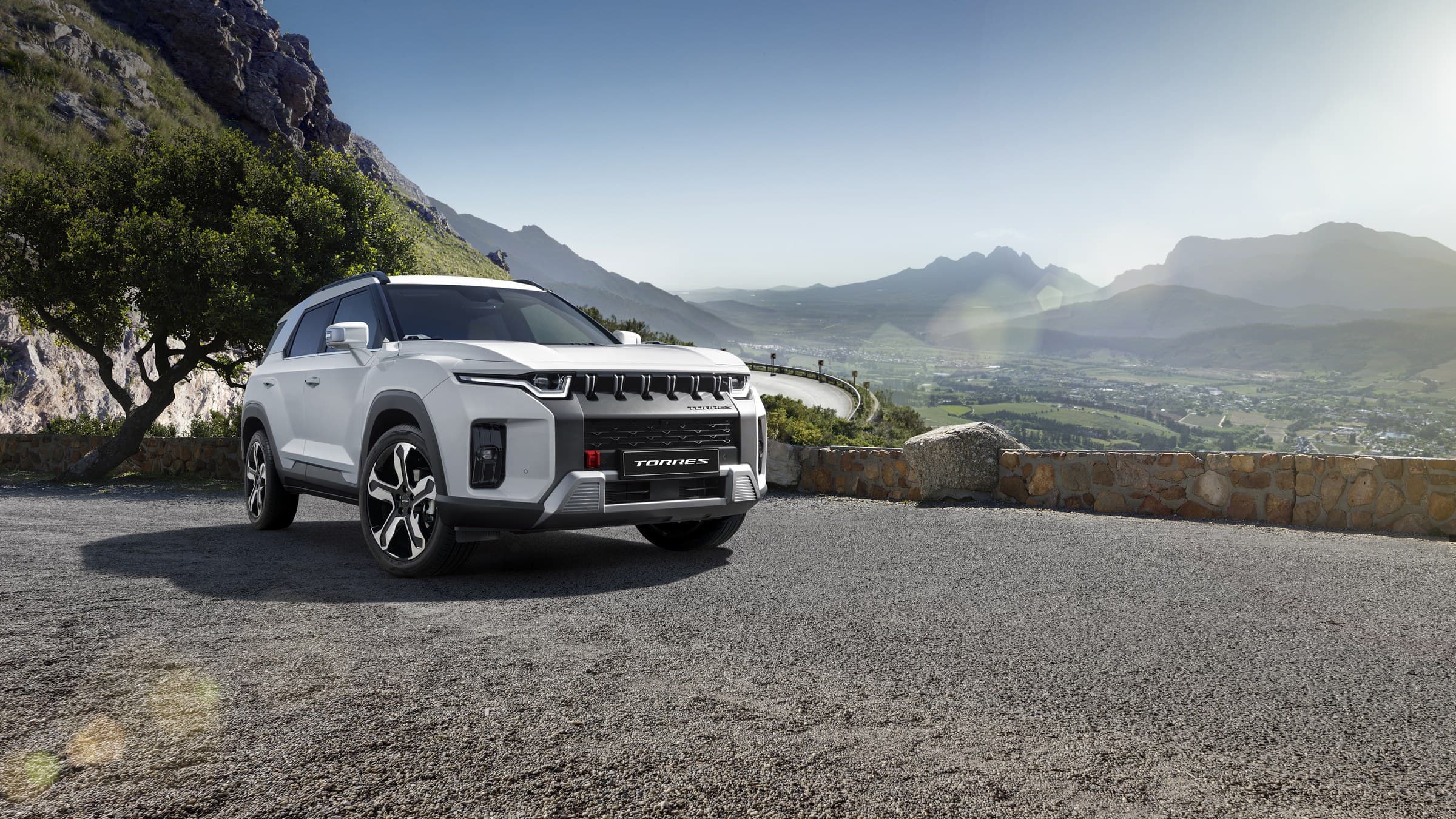
The 2026 KGM Torres Hybrid is the first electrified powertrain to reach KGM's mid-size SUV since the brand dropped the SsangYong name in 2023. It pairs a 1.5-litre turbo-petrol engine with a dual-motor hybrid system co-developed with BYD, giving the rugged, Patagonia-inspired Torres a combined 150 kW (201 hp) without a plug to worry about. KGM positions it as a cut-price alternative to the Toyota RAV4 Hybrid and Hyundai Tucson Hybrid, undercutting both on price in its home market while adding roughly 890 km of theoretical range from a single 50-litre tank. It is already on sale in South Korea, Australia, the UK and Israel, with pricing that varies sharply by market once local taxes are added. For a company that spent the last few years better known for budget pickups and boxy off-roaders, the Torres Hybrid is KGM's first real shot at the mainstream hybrid SUV buyer.
Performance & Specs
The Torres Hybrid uses what KGM calls its DualTech Hybrid system, developed in partnership with BYD — a notable detail for a brand launching its first-ever hybrid, since it borrows proven plug-in hybrid engineering rather than building a system from scratch. A 1.5-litre turbocharged four-cylinder petrol engine makes 110 kW (150 PS) and 220 Nm on its own, while a permanent-magnet synchronous motor sandwiched inside the dedicated hybrid transmission (e-DHT) adds 130 kW (177 PS) and 300 Nm. Combined system output is 150 kW (204 PS / 201 hp), driving the front wheels only — there is no all-wheel-drive Torres Hybrid variant. KGM quotes 0-100 km/h in around 9.0 seconds and a top speed of about 180 km/h (112 mph). The small 1.8 kWh lithium iron phosphate (LFP) battery is not a plug-in pack; it exists purely to enable EV-only driving at low speeds and around-town coasting, with KGM claiming the car can run on electric power alone up to 95% of typical city driving. Reviewers at CarExpert Australia found the hybrid system's software genuinely impressive in everyday use, shuffling between EV, hybrid and petrol-only modes smoothly, though they flagged slow steering response and wheelspin under hard acceleration on the standard tyres as real weaknesses.

| Powertrain | 1.5T petrol + e-motor, plugless HEV |
|---|---|
| Engine power | 110 kW (150 PS) / 220 Nm |
| Motor power | 130 kW (177 PS) / 300 Nm |
| Combined power | 150 kW (204 PS / 201 hp) |
| 0–100 km/h | ~9.0 s |
| Battery | 1.8 kWh LFP (non-plug-in) |
| POWERTRAIN TYPE | Plugless hybrid (HEV) |
|---|---|
| HORSEPOWER | 201 hp (204 PS / 150 kW) |
| ACCELERATION | ~9.0 s (0–100 km/h) |
| TOP SPEED | ~180 km/h (112 mph) |
| DRIVETRAIN | FWD |
| BATTERY | 1.8 kWh LFP (non-plug-in) |
| FUEL CONSUMPTION | 5.6 L/100km claimed; 6.3–7.0 L/100km tested (AU reviewers) |
| THEORETICAL RANGE | ~890 km on a 50 L tank |
Dimensions & Practicality

| Length | 4,705 mm |
|---|---|
| Width | 1,890 mm |
| Height | 1,720 mm |
| Wheelbase | 2,680 mm |
| Ground clearance | 180 mm |
KGM markets the Torres as sitting between the compact and mid-size SUV classes, and the cabin reflects that with genuinely spacious front and rear seating for a car under 4.71 metres long. Boot space is 465 litres with the rear seats up, rising to 703 litres loaded to the roofline and 1,526 litres with the 60:40 split rear seats folded flat — competitive with class rivals like the RAV4 Hybrid and Tucson Hybrid. There's no spare wheel, only a tyre repair kit, which frees up some underfloor storage but is worth knowing before a long road trip. Kerb weight sits at roughly 1,670 kg for the entry K30 grade, and the Torres Hybrid retains a braked towing capacity of 1,300 kg (500 kg unbraked), useful for a small caravan or trailer despite the plugless hybrid system adding some weight over the pure-petrol Torres.
| LENGTH | 4,705 mm |
|---|---|
| WIDTH | 1,890 mm |
| HEIGHT | 1,720 mm |
| WHEELBASE | 2,680 mm |
| CARGO VOLUME | 465 L seats up (1,526 L seats folded) |
| KERB WEIGHT | ~1,670 kg |
Charging & Battery
There is no plug on the Torres Hybrid — the 1.8 kWh LFP battery pack charges exclusively through regenerative braking and the petrol engine, the same way a Toyota RAV4 Hybrid or Honda CR-V Hybrid operates. That makes it a straightforward ownership proposition for anyone without home or workplace charging: fill the 50-litre tank with 95-octane premium unleaded and the hybrid system automatically manages when to run on electric power alone, in combined hybrid mode, or on the engine directly. KGM says the system can deliver pure-EV driving for up to 95% of typical city driving conditions and at speeds up to 100 km/h in short bursts, though real-world efficiency depends heavily on driving style — Australian testers recorded 6.3-7.0 L/100km against KGM's claimed 5.6 L/100km on the WLTP-style cycle.
| BATTERY | 1.8 kWh lithium iron phosphate (LFP), non-plug-in |
|---|---|
| CHARGING METHOD | Regenerative braking + engine only (no external charging) |
| FUEL TANK | 50 litres, 95 RON premium unleaded required |
| CO2 EMISSIONS | 127–139 g/km depending on market cycle |
Design & Interior
The Torres Hybrid keeps the rugged, boxy design language that has defined the Torres nameplate since its 2022 debut, with KGM's designers citing Patagonia's Torres del Paine mountains as the inspiration. The vertical-slat grille and Big Dipper constellation-inspired LED daytime running lights carry over largely unchanged, joined by a skid-plate-style front bumper, angular wheel arches and a side-mounted rear tailgate latch. Round the back, Korean flag-inspired taillight graphics and a discreet "KGM Hybrid" badge are the main visual cues separating it from the petrol and full-electric EVX versions. Inside, KGM has fitted twin 12.3-inch displays — one for the driver's instrument cluster, one for the touchscreen running the brand's Athena 2.0 UX software with TomTom navigation built in. Materials step up notably between grades: the entry K30 gets fabric seats with manual adjustment, while the K40 (the only grade offered in the UK) adds synthetic leather, heated front seats, a heated steering wheel and rear sunblinds. Ambient lighting, dual-zone climate control and a leather-wrapped steering wheel are standard across the range, and both grades get a retractable cargo blind and rain-sensing wipers.
Technology & Features
The Athena 2.0 UX infotainment platform runs across both displays and supports wired Apple CarPlay and Android Auto, though wireless smartphone mirroring and wireless phone charging are notably absent even on the range-topping K40 in Australian specification — a gap against Hyundai and Kia rivals at a similar price. A six-speaker sound system, USB-C ports throughout the cabin and a 32-colour ambient lighting system round out the tech offering. KGM has also fitted digital key functionality and over-the-air update capability is being progressively rolled out across newer KGM models, though it is not confirmed as standard on every Torres Hybrid market at launch. The infotainment system also displays real-time hybrid-mode status, showing the driver whether the car is running on EV, hybrid or petrol power at any given moment.
Safety & ADAS
The Torres Hybrid carries KGM's Level 2 driver-assistance suite as standard across both Australian grades, built around a body structure using 78% high-tensile steel. Eight airbags are fitted across all markets, and the ADAS package includes autonomous emergency braking, forward collision warning, lane keeping assist, lane departure warning, blind-spot detection, driver attention alert and adaptive cruise control. Rear cross-traffic alert and a 360-degree camera are reserved for higher grades in some markets and are not standard on the entry-level K30. CarExpert's Australian reviewers noted the active safety calibration still needs some refinement, citing occasional false lane-keep interventions and reporting a reversing incident traced to the Auto Hold function being buried in a touchscreen menu rather than controlled by a physical button.
| ADAS LEVEL | L2 (KGM driver-assistance suite) |
|---|---|
| ADAS FEATURES | AEB, FCW, ACC, LKA, LDW, BSM, driver attention alert; rear cross-traffic alert and 360° camera on higher grades |
| AIRBAGS | 8 |
Available Versions
| VERSION | POWER | TORQUE | 0-100 | TOP SPEED | DRIVETRAIN | BATTERY | EV RANGE | COMBINED RANGE | PRICE | KEY DIFFERENCES |
|---|---|---|---|---|---|---|---|---|---|---|
| K30 (Australia) | 201 hp | 220 Nm engine / 300 Nm motor | ~9.0s | ~180 km/h | FWD | 1.8 kWh LFP | — | ~890 km | $32,050 | Entry grade: 18-in alloys, fabric seats, dual 12.3-in screens, wired CarPlay/Android Auto, no wireless charging or rear cross-traffic alert |
| K40 (Australia) | 201 hp | 220 Nm engine / 300 Nm motor | ~9.0s | ~180 km/h | FWD | 1.8 kWh LFP | — | ~890 km | $34,190 | Adds synthetic leather seats, heated front seats, heated steering wheel, rear sunblinds, hands-free power tailgate, auto up/down front windows |
| Hybrid (UK, K40-equivalent) | 201 hp | 220 Nm engine / 300 Nm motor | ~9.0s | ~180 km/h | FWD | 1.8 kWh LFP | — | ~890 km | $48,070 | Single UK trim, sold only in higher-spec configuration; 5-year/100,000-mile warranty |
Pricing & Availability
The Torres Hybrid launched first in South Korea in November 2025 — KGM's home market, where the current model-year pricing runs from roughly 32.5 million to 37 million Korean won (about $24,100-$27,400). Australia followed with two grades, K30 from AU$45,000 and K40 from AU$48,000, both drive-away prices (about $32,050 and $34,190). In the UK, KGM sells the Torres Hybrid in a single, higher-specification trim from £35,995 (about $48,070), positioned as the brand's first hybrid in that market after the petrol Torres and Torres EVX. The car is also confirmed on sale in Israel, where the local importer lists a three-trim range — EX from ₪169,900, Premium from ₪179,900 and Executive from ₪189,900 (roughly $56,300-$62,950) — reflecting Israel's substantially higher vehicle purchase taxes rather than a different car. KGM backs the Torres Hybrid with a 7-year/unlimited-kilometre warranty in Australia (7 years/150,000 km on the hybrid battery) and a 5-year/100,000-mile warranty in the UK.
How It Compares
The Torres Hybrid's closest apples-to-apples rival in our own coverage is the Subaru Forester Hybrid — another plugless HEV SUV with no charge cable required, though the Subaru costs roughly $7,800 more for slightly less power. Against the BYD Sealion 6 and Song Plus DM-i, the value contrast is stark: both are PHEVs with a genuine plug-in EV range and combined totals well over 1,000 km, at a similar or even lower price than the KGM's entry grade. That's the trade-off buyers are making with the Torres Hybrid — simplicity and no home-charging requirement, versus the far larger combined range and lower running costs a plug-in competitor from BYD's catalog can offer for similar money. Where the Torres Hybrid clearly wins is brand-network maturity in markets like Australia and the UK, where KGM/SsangYong dealers and servicing are already established and BYD's PHEV SUVs are a newer, less familiar proposition.
- Smooth, well-calibrated hybrid system that shifts between EV, hybrid and petrol modes without drama, and genuinely useful low-speed EV-only driving
- Strong practicality for the class — 1,526 L of folded cargo space, 1,300 kg braked towing, and pricing that undercuts the Toyota RAV4 Hybrid and Hyundai Tucson Hybrid in Korea and Australia
- No plug required and a claimed ~890 km of total range on one tank, with a 7-year/unlimited-km warranty in Australia
- Slow steering response and wheelspin under hard acceleration in wet conditions, plus inconsistent brake feel noted by reviewers
- Entry K30 grade misses wireless CarPlay/Android Auto, wireless charging, digital radio and rear cross-traffic alert — standard on rival hybrid SUVs at this price
The 2026 KGM Torres Hybrid is a genuinely competent first attempt at a hybrid powertrain, helped considerably by leaning on BYD's proven hybrid engineering rather than building the system from a blank sheet. It nails the fundamentals buyers actually care about — real-world efficiency, a smooth power delivery, and pricing that's aggressive against the Toyota RAV4 Hybrid and Hyundai Tucson Hybrid in its home and Australian markets. The rough edges are in the details: chassis tuning that lags the powertrain, a safety-tech calibration that needs another pass, and an options list that's stingier than rivals at the same price. For buyers who want a straightforward, no-plug-required hybrid SUV and value KGM's long warranty over outright polish, it's an easy recommendation; for anyone cross-shopping a plug-in hybrid with genuinely huge combined range for similar money, the case is less clear-cut.