
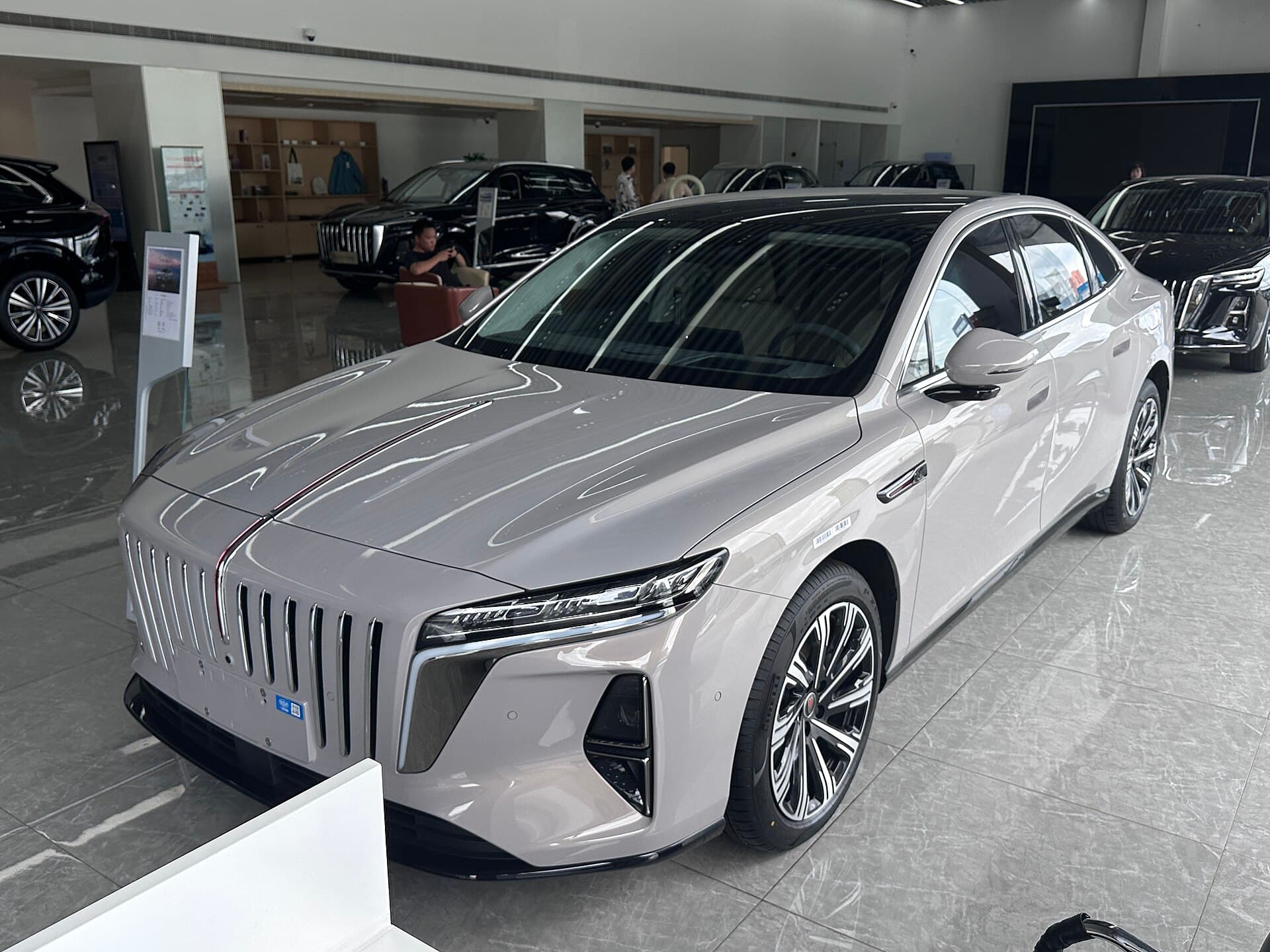
FAW's Hongqi brand put the second-generation H7 on sale in China on September 16, 2026, and the big change is under the hood: the mid-to-large sedan that once relied on petrol engines now comes exclusively as a plug-in hybrid. The 2026 Hongqi H7 PHEV pairs a 1.5-litre turbocharged hybrid-only engine with a 168 kW front motor and, in the 4WD flagship, a 201 kW rear motor, for up to 479 kW (651 PS / 642 hp) of combined system output and a 3.9-second 0-100 km/h time. Two battery packs are offered, a 23.9 kWh LFP unit and a 30.3 kWh ternary-lithium unit, which give a CLTC electric range of 180 to 240 km and a CLTC total range of up to 1,954 km with the 60-litre tank. Three trims are priced from ¥191,800 to ¥231,800 (about $28,000 to $33,839 at 6.85 CNY/USD), and a limited-time trade-in package lowers that to ¥168,800–¥208,800 (about $24,642 to $30,482). The H7 is a 5,060 mm-long, 1,910 mm-wide sedan on a 2,970 mm wheelbase, aimed at buyers who want Hongqi's formal presence, a 30-inch AR head-up display and 18-speaker Bose audio at family-car money. It is unrelated to the Haval H7 SUV from GWM.
Performance & Specs
Every H7 is built around the same 1.5-litre turbocharged engine, a unit designed specifically for hybrid duty. It makes 110 kW (150 PS / 148 hp) and 225 N·m, runs on 92-octane fuel and carries a claimed 45.21% thermal efficiency, driving through a single-speed dedicated hybrid transmission. The two-wheel-drive cars add one front permanent-magnet motor rated 168 kW (228 PS / 225 hp) and 340 N·m, for a combined 278 kW (378 PS / 373 hp). That is enough for a 0-100 km/h run in 7.4 seconds in the 180 and 6.9 seconds in the 240, respectable rather than sporty for a sedan of this size. The 210 4WD Smart Hybrid is the performance version: it adds a 201 kW (273 PS / 270 hp) rear motor, so the two electric motors together total 369 kW (502 PS / 495 hp). With the engine included, the combined system output reaches 479 kW (651 PS / 642 hp) and 871 N·m, and 0-100 km/h drops to 3.9 seconds. The number in each trim name is its CLTC electric range in kilometres, so “180”, “240” and “210” refer to range, not power. The 4WD car also gets a CDC damper setup with camera-based road preview, while the front-drive trims use adaptive FRD damping. Curb weight runs from roughly 1,970 kg for the 180 to about 2,090 kg for the 4WD, and Hongqi has not published a top speed for any version.

| Powertrain | 1.5T PHEV, dual-motor AWD |
|---|---|
| Power | 479 kW (651 PS / 642 hp) system |
| Torque | 871 N·m system |
| 0–100 km/h | 3.9 s |
| Battery | 30.3 kWh ternary lithium |
| Range | 210 km EV (CLTC) / 1,574 km total |
| POWERTRAIN TYPE | Plug-in hybrid (PHEV), 1.5T engine plus 1 or 2 motors |
|---|---|
| HORSEPOWER | 373 hp (278 kW) 2WD; 642 hp (479 kW) 4WD |
| ACCELERATION | 7.4 s / 6.9 s (2WD); 3.9 s (4WD) |
| TOP SPEED | Not published |
| DRIVETRAIN | FWD (2WD trims) or AWD (210 4WD) |
| BATTERY | 23.9 kWh LFP or 30.3 kWh ternary lithium |
| ELECTRIC RANGE | 180 / 240 km (2WD), 210 km (4WD), CLTC |
| COMBINED RANGE | 1,894 / 1,954 km (2WD), 1,574 km (4WD), CLTC |
Dimensions & Practicality

| Length | 5,060 mm |
|---|---|
| Width | 1,910 mm |
| Height | 1,480 mm |
| Wheelbase | 2,970 mm |
| Curb weight | 1,970–2,090 kg |
At 5,060 mm long and 1,910 mm wide, the H7 is a genuinely large C-segment sedan, and the 2,970 mm wheelbase is close to three metres. Hongqi quotes an 82.6% space-utilisation ratio, which it says translates into generous rear legroom, and the cabin is a five-seater. The boot is reported at about 500 litres, enough for a family's luggage. A panoramic sunroof of 1.921 square metres lightens the cabin, and the low 1,480 mm roofline gives the car a sleek, long-and-low profile. The showroom car in our photos rides on 245/45 R19 tyres, while the entry 180 trim is fitted with 18-inch wheels and Linglong tyres.
| LENGTH | 5,060 mm |
|---|---|
| WIDTH | 1,910 mm |
| HEIGHT | 1,480 mm |
| WHEELBASE | 2,970 mm |
| CURB WEIGHT | About 1,970–2,090 kg |
| CARGO VOLUME | About 500 L |
| FUEL TANK | 60 L |
Charging & Battery
The H7 uses two battery packs. The 180 trim carries a 23.9 kWh LFP pack good for 180 km of CLTC electric range and 1,894 km of total range. The 240 trim and the 210 4WD both use the larger 30.3 kWh ternary-lithium pack, which delivers 240 km of electric range in the front-drive car and 210 km in the heavier 4WD, with total ranges of 1,954 km and 1,574 km respectively. The battery-to-wheel math holds up, at roughly 12.6 to 14.4 kWh/100 km across the three trims on the CLTC cycle. The headline 1,954 km figure is a CLTC calculation from the 60-litre tank and the 240 km electric range, and it implies about 3.1 L/100 km, so real-world totals will be lower; once the battery is depleted, Hongqi quotes about 4.4 L/100 km on the WLTC cycle for the front-drive car. A production H7 also earned a Guinness World Record for the longest journey by a plug-in hybrid production sedan without refuelling or recharging, covering 2,916.171 km from Shangri-La to Shenzhen between September 2 and 7, 2026. On the DC side, reports give a peak of about 115 kW for the LFP pack and 100 kW for the ternary pack, with 20-80% in roughly 10.4 and 13.6 minutes respectively. Hongqi has not published an AC onboard-charger rating.
| BATTERY | 23.9 kWh LFP (180) / 30.3 kWh ternary lithium (240, 210 4WD) |
|---|---|
| DC FAST CHARGING | Up to 115 kW (LFP) / 100 kW (ternary) |
| DC 20-80% TIME | About 10.4 min (LFP) / 13.6 min (ternary) |
| FUEL TANK | 60 L, 92-octane |
Design & Interior
The H7 wears Hongqi's latest family face: a tall, closed-off grille built from vertical chrome slats, slim split LED headlamps and a thin red accent line that runs from the hood into the grille. The flanks are kept clean, with semi-hidden door handles and a sloping, fastback-style roofline that flows into a short boot lid. At the back, a slim full-width light bar and a lower reflector strip echo the front. Our showroom photos show multi-spoke alloy wheels and a rear badge reading “HQ-AWD” on the all-wheel-drive car. Inside, the driver faces an 8.88-inch digital cluster and a 15.6-inch floating touchscreen, with hidden air-conditioning vents and a wireless phone charger built into a wood-look centre console. The seats in the photographed car are trimmed in pale leather with perforated inserts, and a thin ambient light strip runs across the dash and doors. Equipment climbs with the trims: the 240 and 4WD add front seats with heating, ventilation and 10-point massage, heated and ventilated rear seats and rear privacy glass, while the 4WD flagship also gets a “queen” zero-gravity passenger seat and the 4-litre onboard fridge. The entry 180 trim skips most of that, along with the AR-HUD and Bose audio.
Technology & Features
The H7 runs Lingxi Cockpit 5.0 on a Qualcomm Snapdragon 8295P chip with 24 GB of RAM, and adds an AI large model for voice control. The 15.6-inch 2.5K central display is a floating unit, and it is joined by the 8.88-inch instrument panel and, on the 240 and 4WD trims, a 30-inch adaptive AR head-up display. The same two trims also get an 18-speaker Bose system with 7.1.4 Dolby Atmos support. Other features include a heated steering wheel, a single-sided wireless charging pad and, on the flagship, a cooling box in the centre console. For a car that starts around $28,000, the screen and audio hardware sits well above what the price would suggest, though the best of it is locked to the upper trims.
Safety & ADAS
Driver assistance comes from Hongqi's Sinan system, developed jointly with Zhuoyu and built around a vision-led sensor suite: 10 cameras (including an 8-megapixel triple-camera stereo unit), one millimetre-wave radar and 12 ultrasonic sensors, 23 sensors in total. It supports city and highway navigation-assisted driving and automated parking, and Hongqi is offering the driving-assist package free of charge at launch. The car ships with 22 standard active-safety functions, including forward-collision warning, a 360-degree camera view and a narrow-road assist, plus 9 airbags. The battery pack is IPX8-sealed and passed a 15.3-tonne crush test, and the car stops from 100 km/h in a claimed 35.8 metres.
| ADAS LEVEL | L2+ (Hongqi Sinan, developed with Zhuoyu) |
|---|---|
| ADAS FEATURES | City and highway navigation pilot, automated parking, 360° camera, forward-collision warning, 22 standard active-safety functions; 10 cameras, 1 radar, 12 ultrasonic sensors |
Available Versions
| VERSION | POWER | TORQUE | 0-100 | DRIVETRAIN | BATTERY | EV RANGE | COMBINED RANGE | PRICE | KEY DIFFERENCES |
|---|---|---|---|---|---|---|---|---|---|
| 180 Smart Hybrid | 373 hp | 340 Nm | 7.4s | FWD | 23.9 kWh LFP | 180 km | 1,894 km | $28,000 | Entry trim, 18-inch wheels, no AR-HUD or Bose audio; guide price ¥191,800, trade-in price ¥168,800 (about $24,642) |
| 240 Smart Hybrid | 373 hp | 340 Nm | 6.9s | FWD | 30.3 kWh ternary lithium | 240 km | 1,954 km | $30,190 | Longest range; adds AR-HUD, Bose audio and massage seats; guide price ¥206,800, trade-in price ¥183,800 (about $26,832) |
| 210 4WD Smart Hybrid | 642 hp | 871 Nm | 3.9s | AWD | 30.3 kWh ternary lithium | 210 km | 1,574 km | $33,839 | Dual-motor flagship, CDC suspension, zero-gravity passenger seat and fridge; guide price ¥231,800, trade-in price ¥208,800 (about $30,482) |
Pricing & Availability
Hongqi launched the H7 in China on September 16, 2026 at a track event at the Beijing Goldenport Circuit. Official guide prices are ¥191,800 for the 180 Smart Hybrid ($28,000), ¥206,800 for the 240 Smart Hybrid ($30,190) and ¥231,800 for the 210 4WD Smart Hybrid ($33,839), all converted at 6.85 CNY/USD. A limited-time trade-in package, tied to trading in a car and to launch incentives, takes ¥23,000 (about $3,358) off each trim, giving effective prices of ¥168,800 ($24,642), ¥183,800 ($26,832) and ¥208,800 ($30,482). The guide prices are the official sticker prices; the trade-in prices only apply to buyers who qualify for the package. The second-generation H7 was first shown at the Beijing auto show in April 2026 and succeeds the petrol-powered H7 of the same name; every version of the new car is a plug-in hybrid. Only the China market is confirmed for now.
How It Compares
Against the 2026 BYD Han DM-i Plug-in Hybrid in our catalog, the H7 offers about 85 mm more length (5,060 mm against the Han's 4,975 mm), a larger electric-only range on both battery options, and a total range of up to 1,954 km against the Han's 1,100 km, for roughly $2,900 more at the base price. The 2026 BYD Seal 08 PHEV starts at $29,400 for 268 hp and up to 1,660 km of total range, so the H7's 373 hp front-drive trims are stronger, and the 4WD flagship at $33,839 is the more powerful option at 642 hp. The pure-electric 2026 Hongqi Tiangong 07 800V sits in the same showroom at around $25,000 with 456 hp and up to 730 km of CLTC range, but it needs a charger every time, whereas the H7 can refuel at any petrol station. None of these are official cross-shop rivals confirmed by Hongqi; this is a value comparison within FreshMotors' own coverage of what similar money buys in China.
- Long range on paper: up to 240 km of CLTC electric range plus a 60-litre tank for up to 1,954 km in total, backed by a 2,916 km Guinness-certified record run
- Quick 4WD flagship: 479 kW (651 PS / 642 hp) and 871 N·m for 0-100 km/h in 3.9 seconds at about $33,839
- Upscale kit for the price: 15.6-inch 2.5K screen, Snapdragon 8295P, 30-inch AR-HUD, 18-speaker Bose audio and 10-point massage seats on the higher trims
- The best features (AR-HUD, Bose audio, massage seats) are reserved for the 240 and 4WD trims, and the front-drive cars need 6.9 to 7.4 seconds for 0-100 km/h
- A curb weight of roughly 1,970 to 2,090 kg, and the 1,954 km headline is a CLTC calculation rather than a real-world figure
- Currently China-only, with no confirmed export plans
The 2026 Hongqi H7 PHEV is FAW's answer to the plug-in hybrid sedans that have taken over China's mid-size market, and it is a convincing one. It gives up the old petrol-only formula for a hybrid system with 180 to 240 km of electric range, a claimed 1,954 km total range and a dual-motor 642 hp flagship for under $34,000. The cabin tech is strong for the money, and the big, formal-looking body still reads as a Hongqi. The trade-offs are that the equipment worth having sits on the pricier trims, the front-drive cars are only moderately quick, and range claims are CLTC figures. For a Chinese-market buyer who wants a large, comfortable hybrid sedan with real electric range, the 240 Smart Hybrid looks like the sweet spot.