
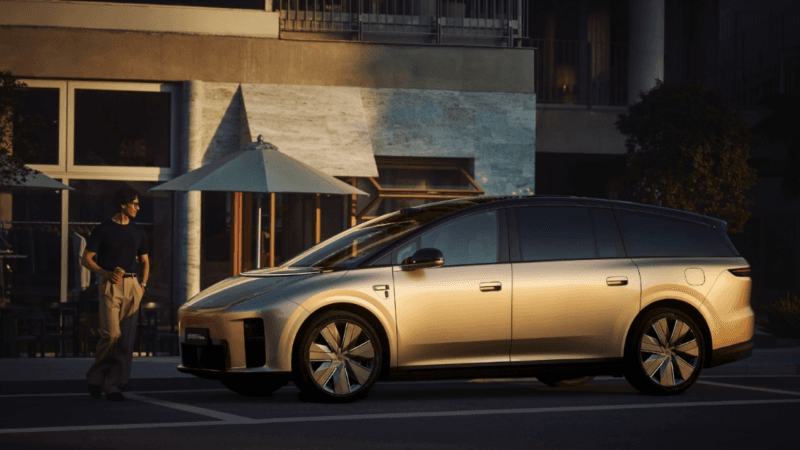
Li Auto just launched its most aerodynamically refined car yet -- and claims a genuine world record to prove it. The i9, a six-seat flagship battery-electric SUV, went on sale in China on September 16, 2026 with a drag coefficient of just 0.215, which Li Auto and multiple independent outlets describe as the lowest of any mass-production SUV built anywhere. Pair that with 536 hp, a 705 km CLTC range, and ultra-fast 5C charging, and the i9 is a genuinely serious flagship statement from a brand that built its reputation on extended-range hybrids rather than pure EVs.
A Genuine Aerodynamics Record, Not Just Marketing
Li Auto is leaning hard on one specific number: a 0.215 drag coefficient, which the brand and independent outlets both describe as the lowest ever achieved by a mass-production SUV. That's a genuinely difficult figure for a tall, six-seat family vehicle to hit -- drag coefficients that low are usually reserved for low-slung sedans -- and it directly explains how the i9 squeezes 705 km of CLTC range out of a 101 kWh battery that isn't dramatically larger than rivals with shorter range. The i9 sits alongside Li Auto's existing L-series extended-range hybrids as the brand's first genuinely flagship-tier pure-electric SUV, part of a broader strategic shift the company has been signaling for months as it builds out its own battery supply chain independent of CATL.
Tech Highlights
- 0.215 drag coefficient -- described by Li Auto and independent coverage as the lowest of any mass-production SUV in the world, directly enabling the car's efficiency and range.
- 101 kWh 5C ultra-fast-charging battery for 705 km of CLTC range, with the battery adding 500 km of range in just 10 minutes on a suitable high-power charger.
- Four simultaneous zero-gravity seats -- the second row uses full-size, bidirectional rotating captain's chairs that, combined with a fold-out table, Li Auto markets as turning the cabin into a living room, bedroom, cinema, or dressing room.
- Optional "Embodied Intelligence" package -- dual 1,280-TOPS chips and four lidar units running Li Auto's new Mach VLA driving model, aimed at more natural, comfortable behavior in both city and highway autonomous driving.
Design and Dimensions
At 5,225 mm long, 1,970 mm wide, and 1,752 mm tall on a 3,168 mm wheelbase, the i9 is a genuinely large flagship SUV -- longer and riding a longer wheelbase than most six-seat rivals in this price bracket. Despite that size, a steer-by-wire system paired with rear-wheel steering gives it a minimum turning diameter of just 10.6 metres, tighter than many compact crossovers. The exterior follows Li Auto's "i-series" design language introduced on the smaller i6 and i8, headlined by distinctive "Star Ring" LED headlights with adaptive high-beam support -- the same basic visual family, scaled up to flagship proportions rather than a one-off design exercise for this car alone. The flush door handles, active grille shutters, and smoothed underbody panels that help deliver the record-setting drag coefficient are largely invisible in casual photos -- the aerodynamic work here is functional rather than a styling statement, which is part of why Li Auto has had to lean so hard on the raw Cd number itself to get the achievement noticed.

| Layout | Dual motor, front + rear axle |
| Drive | All-wheel drive |
| Power | 400 kW (536 hp) combined |
| Torque | 660 Nm |

| Length | 5,225 mm (205.7 in) |
| Width | 1,970 mm (77.6 in) |
| Height | 1,752 mm (69.0 in) |
| Wheelbase | 3,168 mm (124.7 in) |
Performance and Specs
The i9 pairs a 150 kW front asynchronous-induction motor with a 250 kW rear permanent-magnet synchronous motor for 400 kW (536 hp) combined and 660 Nm of torque, good for a 4.9-second 0-100 km/h sprint despite the car's considerable size and weight. The 101 kWh ternary-lithium battery supports 5C charging -- meaning it can theoretically be fully replenished in roughly 12 minutes under ideal conditions -- and Li Auto specifically quotes 500 km of added range from a 10-minute fast-charge stop, genuinely competitive with the fastest-charging EVs sold anywhere. Initial production cars ship with CATL-supplied cells; Li Auto has stated a subsequent shift to in-house-developed batteries manufactured by Sunwoda, part of the company's broader move away from sole reliance on CATL across its lineup.
| Spec | Li i9 |
|---|---|
| Front Motor | 150 kW (asynchronous induction) |
| Rear Motor | 250 kW (permanent-magnet synchronous) |
| Combined Output | 400 kW (536 hp) |
| Torque | 660 Nm |
| Battery | 101 kWh (CATL, 5C-rated) |
| Range (CLTC) | 705 km |
| Fast Charging | +500 km in 10 min |
| 0-100 km/h | 4.9 sec |
| Drive | AWD, rear-wheel steering |
Interior and Technology
The i9's cabin is built around the idea that the second row, not the driver's seat, is the point of the car. Both second-row positions are full-size, independently rotating zero-gravity seats that can recline simultaneously, and when combined with a deployable table, Li Auto markets the space as flexible enough to function as a living room, bedroom, private cinema, or dressing room depending on the moment. The tech to back that up is genuinely substantial: a 29-inch, 6K-resolution panoramic front display, a separate 21-inch 4K rear entertainment screen, a 9.3.6-channel home-theater sound system spanning 29 speakers and rated at 4,960 watts peak power, and a 10-litre electric refrigerator with both cooling and heating modes. Material quality on the launch cars leans on quilted leather-look upholstery in light tones front and back, with a three-layer interior color scheme Li Auto says was chosen specifically to feel premium rather than merely spacious. Safety hardware includes 11 airbags, a 2,000 MPa integrated dual-door-ring structure, and a redundant power-supply system -- the kind of engineering emphasis Li Auto has built its reputation on across its hybrid lineup, now carried over to a pure-EV flagship.
Pricing and Availability
The Li i9 launched at 369,800 yuan (about $54,400) in China on September 16, 2026, with customer deliveries beginning the same week -- an unusually fast turnaround from launch to delivery by the standards of most new-model rollouts. As of this writing, the i9 is a China-market launch only, consistent with the rest of Li Auto's lineup, which has not historically been sold outside China. The optional Embodied Intelligence autonomous-driving package (dual 1,280-TOPS chips, four lidar units) is available as a cost option on top of the base price rather than standard equipment, though exact optional pricing wasn't published in the sources checked for this article.
How It Compares
Xiaomi YU7 Max
$51,648 | 400 hp | 600 km range
Cheaper and less powerful than the i9, with meaningfully less range -- a useful marker of just how much the i9's aerodynamic efficiency and larger battery buy over a well-regarded, similarly-positioned rival.
ZEEKR 7X Ultra 4WD EV
$51,648 | 544 hp | 650 km range
Nearly identical horsepower to the i9 at a lower price, though still short on range -- illustrates how competitive China's sub-$55,000 flagship EV SUV segment has become even against a genuine aerodynamics record-holder.
Pros and Cons
Pros
- 0.215 drag coefficient is a genuine, independently-reported world record for a mass-production SUV, not just a marketing claim
- 705 km CLTC range and 500 km added in 10 minutes of charging are both genuinely class-competitive figures
- Four simultaneous zero-gravity seats and a genuinely premium tech package (29-inch 6K display, 29-speaker sound system) justify the flagship positioning
- Deliveries starting the same week as launch is unusually fast for a genuinely new flagship model
Cons
- China-only launch, consistent with the rest of Li Auto's lineup -- no international availability
- Advanced "Embodied Intelligence" autonomous-driving hardware is a paid option, not standard, and its exact price wasn't published
- First-batch cars use CATL batteries that Li Auto plans to replace with in-house cells later, meaning early buyers may not get the company's long-term battery strategy
- At 5,225 mm long, the i9 is a genuinely large vehicle that some buyers will find unwieldy versus more compact flagship EVs
FAQs
Verdict
The i9 is a legitimately significant flagship launch for Li Auto -- a record-setting drag coefficient that isn't just a talking point but the actual engineering reason behind a 705 km range figure, paired with genuinely thoughtful second-row-focused interior tech and fast enough charging to make road trips realistic. It's a China-only story for now, and the fanciest autonomous-driving hardware costs extra, but as a statement that Li Auto can build a pure-EV flagship as convincingly as its hybrid bread-and-butter models, the i9 delivers -- and the 0.215 Cd figure alone makes it one of the more genuinely engineering-led flagship launches of the year, rather than one built purely around screen count and horsepower.