
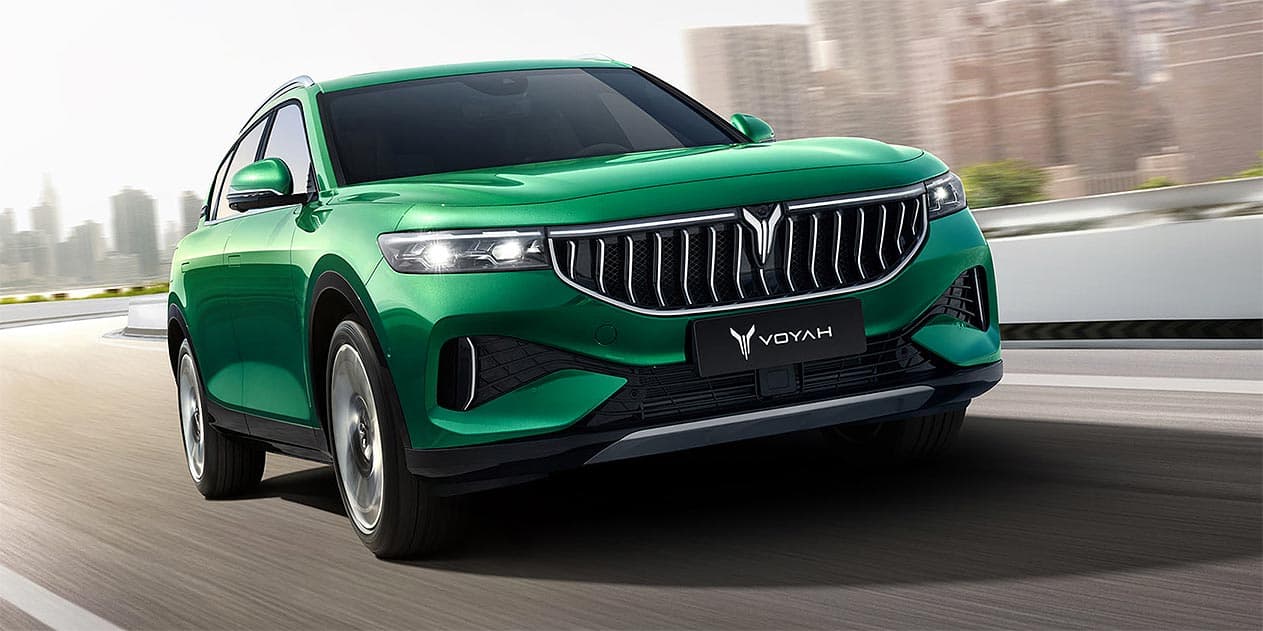
The 2026 Voyah Free is the model that started Dongfeng's premium EV brand, and in export markets it is still sold in its original form: a dual-motor, all-wheel-drive electric SUV built around one of the largest battery packs in its class. Co-designed with the Italian studio Italdesign Giugiaro — the same house behind design work for Maserati, Ferrari and Audi — the Free first appeared as the i-Free concept at the 2020 Beijing Auto Show before reaching production a year later. Today it is sold in Israel, Norway, the Netherlands, Denmark, Spain, Italy and Russia, positioned against the Tesla Model X, Audi's e-tron-badged SUVs, the Mercedes-Benz EQE SUV and the BMW iX. In Israel, where Voyah's official importer is Delek Motors, the Free arrives in a single, fully loaded configuration: a 106 kWh battery, 489 hp, and a 500 km WLTP range. This article covers that export-market battery-electric version, not the plug-in range-extender variant China now sells domestically under the same badge.
Performance & Specs
The export Voyah Free uses two permanently engaged electric motors — one on each axle — for full-time all-wheel drive. Combined output is 360 kW (489 hp) with 720 Nm of torque, enough to send the 2,310 kg SUV from 0 to 100 km/h in 4.4 seconds and on to a 200 km/h top speed, figures confirmed on both the Israeli importer's own spec sheet and independent European EV databases. Power delivery is backed by a double-wishbone front and multi-link rear suspension, both riding on adjustable air springs with electronically controlled dampers. Comfort mode softens the ride for daily driving, Sport firms up the dampers and sharpens steering weight, and an Outing mode raises ride height by roughly 100 mm over the standard 163 mm of ground clearance for rougher surfaces. The body itself, shaped with Italdesign, returns a 0.28 drag coefficient, a competitive figure for a vehicle this size.

| Powertrain | Dual-motor AWD BEV |
|---|---|
| Power | 360 kW (489 hp) |
| Torque | 720 Nm |
| 0–100 km/h | 4.4 s |
| Battery | 106 kWh |
| Range | 500 km (WLTP) |
| POWERTRAIN TYPE | Battery-electric (BEV) |
|---|---|
| HORSEPOWER | 360 kW (489 hp) |
| ACCELERATION | 4.4 s (0–100 km/h) |
| TOP SPEED | 200 km/h |
| DRIVETRAIN | Dual-motor AWD |
| BATTERY | 106 kWh (100 kWh usable) |
| ELECTRIC RANGE | 500 km (WLTP) |
| COMBINED RANGE | — |
Dimensions & Practicality

| Length | 4,905 mm |
|---|---|
| Width | 1,950 mm |
| Height | 1,645 mm |
| Wheelbase | 2,960 mm |
| Ground clearance | 163 mm |
At 4,905 mm long and 1,950 mm wide, the Free sits in the same footprint as a Mercedes-Benz EQE SUV or Audi Q8 e-tron, with a 2,960 mm wheelbase that opens up genuine rear legroom for a five-seat layout. Cargo volume is 560 litres with the rear bench in place, expanding to 1,320 litres when it's folded flat, plus a roughly 72-litre front trunk for charging cables or a soft bag. A panoramic glass roof stretches over both rows, and the standard air suspension's Outing mode adds extra clearance for gravel driveways or light off-tarmac use without switching to a dedicated off-road body style.
| LENGTH | 4,905 mm |
|---|---|
| WIDTH | 1,950 mm |
| HEIGHT | 1,645 mm |
| WHEELBASE | 2,960 mm |
| CARGO VOLUME | 560 L (1,320 L seats folded) |
| FRUNK | ~72 L |
Charging & Battery
The Free's 106 kWh CATL ternary-lithium pack (100 kWh usable) is one of the largest fitted to a mid-size electric SUV anywhere, which is how Voyah gets a 500 km WLTP rating despite the car's size and 2,310 kg curb weight. On AC power the onboard charger tops out at 11 kW, good for a full overnight charge at home. On a DC fast charger the Israeli importer's own figures show a 20-80% top-up in about 45 minutes, while independent European testing puts peak DC input at roughly 100 kW with a 10-80% charge closer to 55 minutes — both consistent with a car built more around range than ultra-fast charging speed. Energy consumption works out to roughly 20-21 kWh/100 km on the WLTP cycle, in line with the battery-to-wheel math for a 100 kWh usable pack and a 500 km rating.
| BATTERY | 106 kWh (100 kWh usable), CATL ternary-lithium |
|---|---|
| AC CHARGING | 11 kW |
| DC FAST CHARGING | up to ~100 kW |
| DC 20-80% TIME | ~45 min |
Design & Interior
The Free's exterior still shows its Italdesign roots: a tall, slim front grille with a fine vertical-slat pattern flanked by thin LED headlights, a coupe-like roofline that tapers toward a spoiler-capped tailgate, and a full-width light bar linking the rear lamps under a raised VOYAH wordmark. Flush door handles, a two-tone roof treatment on lighter colors and 20-inch multi-spoke wheels round out a shape that reads more like a premium crossover coupe than a boxy family SUV. Inside, the cabin leans on a blue-and-white or dark two-tone leather scheme with quilted stitching on the front and rear seats, a leather-wrapped multifunction steering wheel, and a floating center console with a rotary drive selector. Front seats are heated, ventilated and offer a massage function, and the panoramic glass roof brings natural light deep into the second row. A wide, curved instrument panel houses the driver display, central touchscreen and a dedicated front-passenger screen, wrapped in soft-touch material and finished with metallic trim strips that run the width of the dashboard. Ambient lighting traces the door panels, dash and center console, shifting color with the selected drive mode.
Technology & Features
The cockpit runs on a Qualcomm Snapdragon-class chipset with over-the-air update support, spreading its interface across the multi-screen layout rather than a single central tablet. A 50-watt wireless phone charger, an in-car WiFi hotspot and a dedicated Nap mode that reclines the front seats and dims the cabin are standard equipment. Voice control handles climate, navigation and media requests, and the sound system pipes through a multi-speaker setup tuned for the cabin's glass-heavy roofline. The 360-degree camera system adds a transparent-chassis view for parking over curbs or navigating tight underground garages, a feature more commonly found on cars well above this price point.
Safety & ADAS
The export Free runs a Level 2 driver-assistance suite built around three millimeter-wave radars, nine cameras and twelve ultrasonic sensors, covering full-speed adaptive cruise control, lane-keeping assist, automatic emergency braking, blind-spot monitoring and 360-degree parking assist. It's a camera-and-radar-only setup with no LiDAR — that hardware is reserved for the China-only Free+ generation built around Huawei's ADS driver-assist stack, which this export car does not share. For a car of this price the ADAS suite covers the essentials well but isn't cutting-edge next to newer LiDAR-equipped rivals.
| ADAS LEVEL | L2 (camera + radar + ultrasonic, no LiDAR) |
|---|---|
| ADAS FEATURES | AEB, ACC, LKA, BSM, 360° camera, transparent chassis view |
Available Versions
Unlike most freshmotors coverage, the export Voyah Free isn't sold in a spread of trims — in Israel, and in the other markets that carry the battery-electric version, it comes in one fully equipped AWD configuration. There is no lower-powered or single-motor version offered internationally.
| VERSION | POWER | TORQUE | 0-100 | TOP SPEED | DRIVETRAIN | BATTERY | EV RANGE | COMBINED RANGE | PRICE | KEY DIFFERENCES |
|---|---|---|---|---|---|---|---|---|---|---|
| AWD Long Range | 489 hp | 720 Nm | 4.4s | 200 km/h | AWD | 106 kWh | 500 km | — | $132,445 | Only export configuration; dual motor, air suspension and full tech package standard |
Pricing & Availability
In Israel, the Voyah Free currently lists from ₪399,985 plus a ₪5,365 registration fee, roughly $132,445 at current exchange rates for the list price alone, per dealer Capital Motors' live listing for the single AWD trim. Voyah's official importer for Israel is Delek Motors, which also handles BMW, MINI and NIO locally; Capital Motors is a multi-brand dealership selling the car, not the brand's importer. Pricing elsewhere in Voyah's export network has historically run lower before local taxes are added — the Netherlands listed the same battery-electric Free at €60,662 when it went on sale there in December 2023 — so the Israeli figure reflects this market's own purchase tax and VAT structure on top of the car's underlying cost, not a difference in specification. Genuinely confusing for anyone researching this car online: Voyah's home market of China no longer sells this battery-electric configuration. China's domestic Free+ range, relaunched in July 2025, is exclusively a range-extender (EREV) powertrain with a much smaller 43.2 kWh battery, Huawei's ADS driver-assist suite and LiDAR, and CLTC-rated combined range up to roughly 1,450 km — a different car under a similar name, priced from about ¥219,900 to the high ¥200,000s (roughly $32,800 to $48,700 at current exchange rates). Dongfeng's own sales figures show why: domestic BEV Free sales fell from 3,456 units in 2022 to just 17 in 2025 as Chinese buyers shifted to the range-extender version, while the battery-electric car continued shipping to Israel, Russia and several European markets where it remains the only Free variant sold.
How It Compares
Against freshmotors' own catalog, the Voyah Free isn't just pricier than its closest rivals — at $132,445 it's now the single most expensive vehicle in this comparison, ahead of even the Cadillac Escalade IQ 680. The NIO ES9 and AITO M9 undercut it dramatically, by roughly $54,500 and $57,200 respectively, while matching or beating its horsepower and WLTP-equivalent range. The Escalade IQ 680, itself no bargain at $130,300, still comes in about $2,150 cheaper than the Free despite offering more power (680 hp) and a third row. None of the three is a direct segment twin for the Free's coupe-SUV proportions, but together they show that at this price, Israeli buyers are paying a real premium for design pedigree and battery size rather than for horsepower or outright value — a premium almost certainly inflated further by Israel's own EV purchase-tax structure on top of the car's underlying cost. Against its named Western rivals, the picture softens only slightly: a Mercedes-Benz EQE SUV starts closer to $65,000-$67,000 (with the 617 hp AMG version around $97,400), a BMW iX opens at roughly $75,150, and even a Tesla Model X starts a bit lower, around $116,000, with considerably more power on tap. The Free's case isn't value at all at this Israeli price point — it rests entirely on a genuinely distinctive design pedigree, a bigger battery than most rivals carry, and a driving experience built around comfort-first air suspension rather than outright speed or spec-sheet efficiency.
- 106 kWh battery and 500 km WLTP range beat most rivals in this size and price class
- Italdesign-shaped body and cabin design stand out from typical Chinese-EV styling
- Adjustable air suspension with a genuine Outing mode for extra ground clearance
- Priced above every rival in its own comparison set — including cars with more power, more range, or a third row — with no cheaper trim available to soften that
- ADAS suite is camera-and-radar L2 only, no LiDAR, a step behind newer rivals with Huawei- or Xpeng-style stacks
The Voyah Free is the rare Chinese-brand EV that leads with big-battery range and European design credibility rather than screen count or acceleration bragging rights, and both the Italdesign-shaped body and the 106 kWh pack still hold up well against newer rivals. But in Israel it now carries a genuinely steep price tag: at roughly $132,445 it's the most expensive vehicle in its own freshmotors comparison set, ahead of in-house rivals by $54,000-$57,000 and even a shade past the far more powerful Cadillac Escalade IQ 680. That's a hard number to justify on spec-sheet value alone, and it turns this from an easy recommendation into one that only makes sense for a buyer who specifically wants the Free's look and range and is prepared to pay well above what comparable power and range cost elsewhere. The single, non-negotiable trim and the lack of LiDAR only add to that calculus. Worth a serious look, but shop it carefully against the competition before signing.