
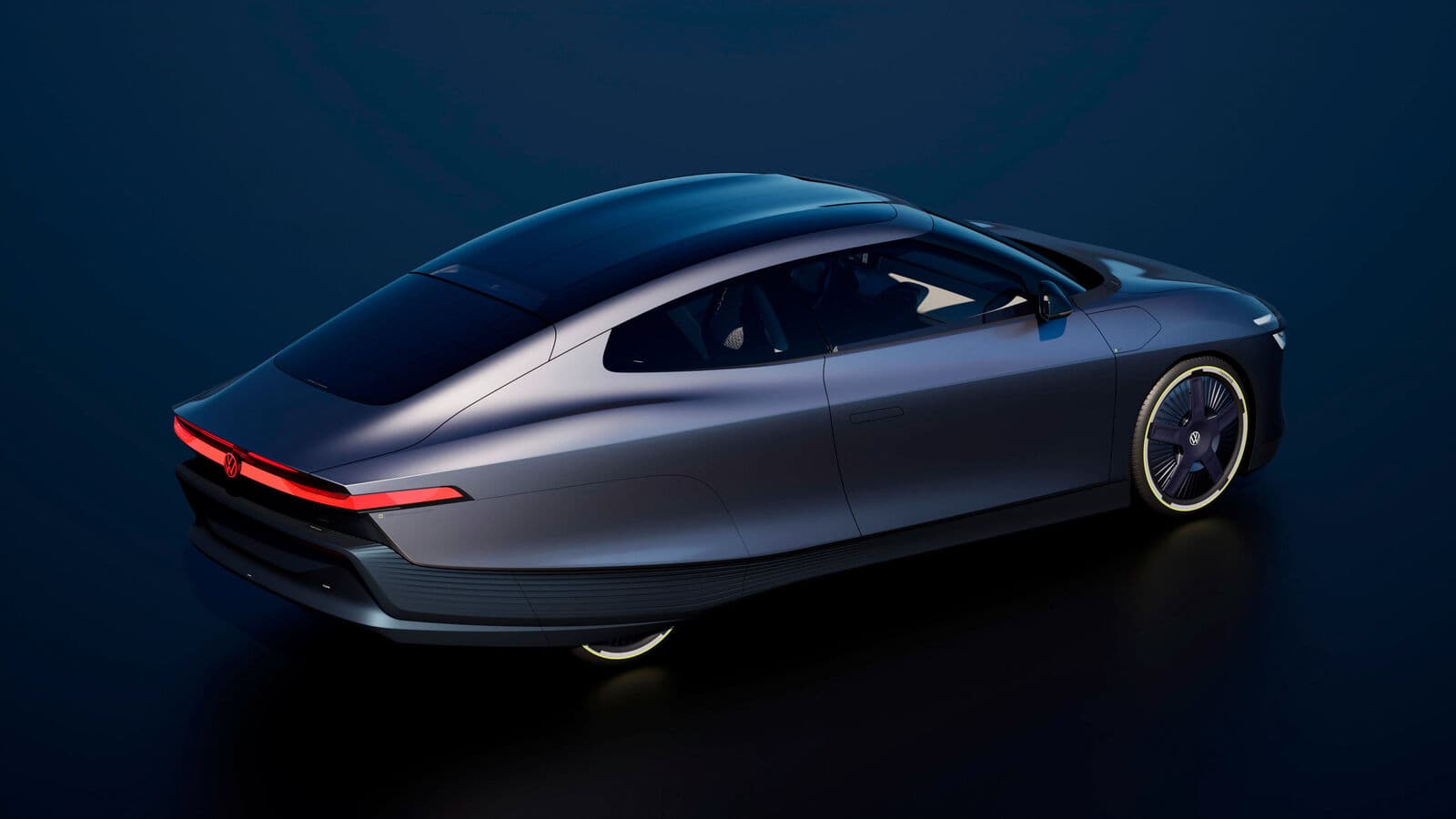
Volkswagen has built a modern answer to its XL1: the Mission Efficiency, a two-door, four-seat electric concept that VW says sets a new record for road-approved cars with a drag coefficient of 0.158. The Record Institute for Germany (RID) recognised three records for the car in its category for near-production, everyday-usable four-seat electric vehicles: drag coefficient, "ideal trip" consumption and real-world consumption. Revealed on September 14, 2026, it is built around production hardware: the 99 kW (135 PS / 133 hp) front motor of the ID.Polo range and the ID.Polo's production battery pack, on which VW unlocked 2.9 kWh of extra usable energy by software (54.9 kWh net). On a documented 1,278.36 km drive from Wolfsburg to Vienna it used 6.89 kWh/100 km (7.51 kWh/100 km including charging losses), with the battery charged once along the way. Volkswagen labels the car "not for sale" and has announced no production decision and no price.
A Modern XL1, Built on Production Hardware
Volkswagen's original XL1 was a carbon-fibre diesel plug-in hybrid from 2013, built in a run of 250 cars: a technical showcase that was never going to reach mass production. VW frames the Mission Efficiency differently, as a demonstration of what production technology can do for efficiency. It is based on the MEB+ platform with front-wheel drive, keeps the ID.Polo's motor, high-voltage battery and hydraulic front brakes, and adds concept-specific aerodynamic and weight-saving work on top. VW says that above 80 km/h its consumption is more than 30 percent lower than in the standard ID.Polo, and describes the car as a demonstration of technologies and development approaches for improving the efficiency of future electric vehicles.
The pairing of parts is worth spelling out. The motor is VW's 99 kW (135 PS / 133 hp) version of the APP290 unit used in the ID.Polo range. The battery corresponds to the ID.Polo's production NMC pack of 52 kWh net, and VW raised its usable energy by 2.9 kWh through software to reach 54.9 kWh net. In the ID.Polo range itself, the 99 kW motor comes with a 37 kWh LFP battery, while the 52 kWh NMC pack is paired with the 155 kW motor, so the concept combines parts from two different ID.Polo versions rather than copying any single one. It is not built from mass-market parts alone either: the body combines ID.Polo components with a self-supporting aluminium structure and doors, bonnet, boot lid and wings made of carbon-fibre-reinforced polymer and aramid composite.
Performance & Specs
Power comes from a single front motor rated at 99 kW (135 PS / 133 hp) with 264 Nm (195 lb-ft) of torque, driving the front wheels. VW quotes 0-100 km/h in 9.0 seconds and a top speed of 160 km/h, which are modest numbers by design: the car exists to show what efficiency can do, not to be quick. VW's WLTP consumption figure is 8.4 kWh/100 km. On an "ideal trip" at a constant 68 km/h, with no gradients and no auxiliary loads, the car recorded 6.48 kWh/100 km. On the real 1,278.36 km drive from Wolfsburg via Poznan and Olomouc to Vienna, at an average of 67.72 km/h and a top speed of 138 km/h, it recorded 6.89 kWh/100 km excluding charging losses and 7.51 kWh/100 km including them. VW says the 54.9 kWh battery was charged only once during the journey, so it was not a single-charge run, and it calculates that 164 km of range remained on arrival.
Volkswagen publishes no official single-charge range. As a rough guide, this site divided the battery's 54.9 kWh by the record drive's 6.89 kWh/100 km, which gives about 797 km (about 495 miles). That is the site's own arithmetic, not a VW figure, and it only holds for the record drive's gentle 67.72 km/h average speed; it will not hold at motorway speeds. On VW's WLTP consumption of 8.4 kWh/100 km the same battery works out at about 654 km on paper (also this site's arithmetic, not a VW figure), and Auto Express lists a maximum range of 406 miles without naming a test cycle. Auto Express also reports VW experts saying that under certain conditions the car could reach 500 miles (about 805 km) on a run.

| Powertrain | Single-motor FWD BEV |
|---|---|
| Power | 99 kW (135 PS / 133 hp) |
| Torque | 264 Nm (195 lb-ft) |
| 0–100 km/h | 9.0 s (VW figure) |
| Battery | 54.9 kWh net (NMC) |
| WLTP consumption | 8.4 kWh/100 km |
| POWERTRAIN TYPE | Battery-electric (BEV), single front motor (APP290) |
|---|---|
| HORSEPOWER | 99 kW (135 PS / 133 hp) |
| TORQUE | 264 Nm (195 lb-ft) |
| ACCELERATION | 0–100 km/h in 9.0 s (VW figure) |
| TOP SPEED | 160 km/h |
| DRIVETRAIN | Front-wheel drive (MEB+) |
| BATTERY | 54.9 kWh net (NMC) |
| DRAG COEFFICIENT | 0.158 Cd (VW; RID-recognised record) |
| FRONTAL AREA | 2.08 m² |
| WLTP CONSUMPTION | 8.4 kWh/100 km (VW) |
| IDEAL-TRIP CONSUMPTION | 6.48 kWh/100 km at a constant 68 km/h |
| RECORD-DRIVE CONSUMPTION | 6.89 kWh/100 km excl. charging losses; 7.51 kWh/100 km incl. |
| RANGE | Not published by VW; site's own arithmetic: about 797 km at the record drive's 6.89 kWh/100 km, about 654 km at the WLTP 8.4 kWh/100 km |
Dimensions & Practicality

| Length | 4,775 mm (188.0 in) |
|---|---|
| Width | 1,744 mm (excl. mirrors) |
| Height | 1,392 mm (54.8 in) |
| Wheelbase | 2,700 mm |
| Luggage | 481 L |
At 4,775 mm long, 1,744 mm wide (excluding mirrors) and just 1,392 mm tall on a 2,700 mm wheelbase, the Mission Efficiency is a long, low two-door 2+2. For scale, the ID.Polo it borrows from is 4,053 mm long and 1,530 mm high, so the concept is 722 mm longer and 138 mm lower. VW says the rear seats are intended for passengers up to about 1.60 m tall. The luggage compartment holds 481 litres, there are additional stowage compartments under the rear seats and in the sides of the body, and with the rear seats folded the load floor is about 1.80 m long. To reduce track width, the torsion-beam rear axle is 170 mm narrower than on the ID.Polo. VW has not published a kerb weight.
| LENGTH | 4,775 mm |
|---|---|
| WIDTH | 1,744 mm (excl. mirrors) |
| HEIGHT | 1,392 mm |
| WHEELBASE | 2,700 mm |
| CARGO VOLUME | 481 L |
| SEATING | 2+2 (rear seats for passengers up to about 1.60 m) |
| KERB WEIGHT | Not published |
Charging & Battery
The battery is a 54.9 kWh (net) NMC pack. AC charging is rated at 11 kW and DC fast charging peaks at 105 kW, the same DC peak VW quotes for the ID.Polo's 52 kWh pack. VW does not publish a 10-80% charging time for the concept. The 370 W solar system in the glass roof and boot lid feeds the car's on-board consumers, easing the load on the traction battery; VW's estimate of up to 30 km of extra range per day depends on season, region and weather. The record drive itself needed a single charging stop.
| BATTERY | 54.9 kWh net (NMC) |
|---|---|
| AC CHARGING | 11 kW |
| DC FAST CHARGING | up to 105 kW |
| SOLAR | 370 W (glass roof and boot lid); up to 30 km extra range per day (VW estimate) |
| DC 10-80% TIME | Not published |
Design & Interior
The exterior is built around airflow. VW describes a flow-optimised teardrop silhouette with a very long roofline that sweeps down towards the rear, as on the XL1, a fully clad underbody, fully enclosed rear wheels, lower airflow guides, patented rim deflectors and flat hubcaps. Three active cooling-air flaps sit in the nose and can be opened only when needed, the side windows are frameless, and the door handles are set into the skin and extend electrically, although the lock itself is still operated mechanically. The exterior mirrors are conventional in design but aerodynamically optimised.
Inside, the concept sheds weight and screens. There is no permanently installed infotainment display: under VW's "Bring your own device" concept, the driver's own Android or Apple phone or tablet is locked on a clamping rail and connected wirelessly to the car. A small driver's display sits behind the steering wheel (Auto Express says it is taken from older VW models), a small e-paper panel shows climate information, and a portable Bluetooth speaker replaces the fixed speaker system. The dash and door panelling is lightweight, with door-pull loops instead of conventional handles. VW says the multifunction steering wheel is adopted from the ID.Polo; in the press photos the rim is a rounded square with a flat top and bottom. The seats are trimmed in light grey and white with yellow-green accents, and the headrests use a 3D-printed TPU lattice structure that shows through cut-outs in the fabric.
Technology & Features
Beyond aerodynamics, VW went after rolling resistance and weight. Working with Continental, it developed a concept tyre derived from the EcoContact 7 with a rolling resistance of 4.9 kg per tonne, about 25% below the EU class A threshold. The rear brake is electromechanical, developed with AUMOVIO and used at the rear for the first time in this concept car, while the front brakes remain hydraulic and ID.Polo-derived. The 370 W solar system covers the glass roof and boot lid. VW says the prototype has EU road approval and meets the relevant requirements for protection, structural strength and crash safety. The records themselves are recognised in the Record Institute for Germany's near-production four-seater EV category.
Pricing & Availability
The Mission Efficiency is a concept vehicle. Volkswagen's own pages carry the line "Concept vehicle. Not for sale.", and VW has published no price, no production date and no market for it. Signals about a production version are limited: VW's Head of Product Communications, Stefan Voswinkel, told Auto Express, in a report published on September 14, 2026, that VW is still looking at making the car a production vehicle and that, if it came to market, buyers could expect around EUR 50,000 (about $57,000 at EUR/USD 1.1475 on 2026-09-21). That is one non-binding indication from one interview, not a price list or an announced plan; VW has announced no production decision.
The ID.Polo whose motor and battery the concept uses is on sale: pre-sales began in April 2026, and in Germany the entry Trend version with the 37 kWh battery is orderable from EUR 24,995, while the 155 kW Life version with the 52 kWh battery starts at EUR 33,795. Those prices belong to the ID.Polo, not to the Mission Efficiency.
How It Compares
This is a contrast with the car's own donor, not a cross-shopping list, because the Mission Efficiency cannot be bought and has no price. Against the 155 kW ID.Polo, VW's WLTP figure for the concept (8.4 kWh/100 km) is well below the ID.Polo's 14.6-13.3 kWh/100 km, while the concept has less power (99 kW against 155 kW) and a battery only slightly larger (54.9 kWh against 52 kWh). Against the 99 kW ID.Polo, the motor is the same, but the concept carries a much bigger pack (54.9 kWh against 37 kWh) and no official range figure. VW's own comparison is that above 80 km/h the concept uses more than 30 percent less energy than the standard ID.Polo.
Pros & Cons
- 0.158 Cd is a record recognised by the Record Institute for Germany in its near-production EV category, and VW says it is the best for any road-approved car
- Built on production MEB+ hardware, with the ID.Polo's motor, battery and front brakes, rather than one-off powertrain engineering
- A documented 1,278.36 km drive at 6.89 kWh/100 km backs the efficiency claims with a real road test
- Solar roof, ultra-low-rolling-resistance tyres and an electromechanical rear brake are shown working on a road-approved prototype
- Not for sale: VW calls it a concept and has announced no production decision
- No official single-charge range from VW; the ~797 km figure in this article is the site's own arithmetic at the record drive's 67.72 km/h average speed
- No price has been announced for any version
- 133 hp (135 PS) and 9.0 s to 100 km/h are modest by modern EV standards, and there is no built-in infotainment screen
The Mission Efficiency is a credible engineering statement rather than a styling exercise: a 0.158 drag coefficient recognised by the Record Institute for Germany, production ID.Polo hardware and a documented 1,278.36 km drive at 6.89 kWh/100 km. What it is not is a car you can order. VW has announced no production decision and no price, and its own materials describe it as a demonstration of technologies for future electric vehicles. Treat it as proof of how much efficiency production-derived EV hardware can deliver when aerodynamics gets this much attention, and watch VW's next announcements for any sign of what reaches a showroom.