
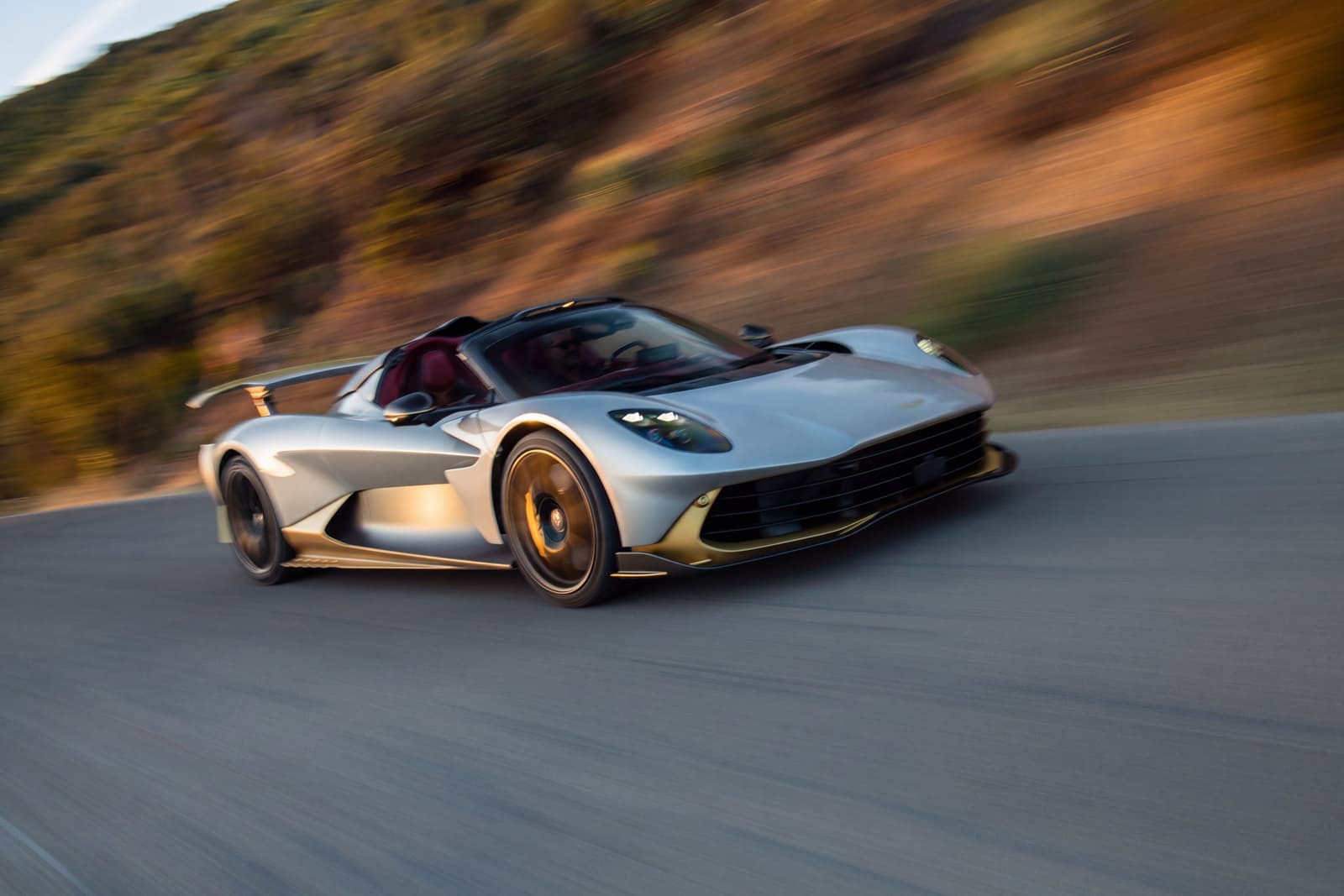
Aston Martin has unveiled the Valhalla Spider, an open-top version of its mid-engined plug-in hybrid supercar, and describes it as the brand's first mid-engined open-cockpit production supercar. The announcement came from Gaydon on 28 October 2026, with the car due to make its global debut this weekend at the 2026 Concours at Wynn in Las Vegas. Under the skin the Spider keeps the Valhalla Coupe's hybrid powertrain: a bespoke 4.0-litre twin-turbo V8 rated at 828 PS plus three electric motors adding another 251 PS, for a combined 1,079 PS (1,064 hp) and 1,100 Nm of torque.
The headline claim is that taking the roof off does not cost any top speed. Aston Martin quotes 350 km/h (217 mph), electronically limited, with the optional carbon fibre hard top fitted and also with the roof removed, which it calls the fastest open-cockpit Aston Martin ever. The standard fabric roof is the exception, capping the car at 200 km/h (124 mph). Customer deliveries are scheduled for the third quarter of 2027, and Aston Martin has not announced a price.
Performance & Specs
The hybrid system is unchanged from the coupe. The V8 uses a flat-plane crankshaft and is rated at 828 PS (about 817 hp, 609 kW), which Aston Martin says works out to 207 bhp per litre, the highest of any Aston Martin combustion engine. Three electric motors add 251 PS (about 248 hp, 185 kW): two drive the front axle through a dedicated e-axle that provides electric torque vectoring, and the third sits alongside the transmission and assists the V8 at the rear. Together they produce 1,079 PS, which is 1,064 hp or about 794 kW, and 1,100 Nm.
Power goes through an eight-speed dual-clutch transmission, and there is no mechanical link between the front and rear axles. Instead, Aston Martin's Integrated Vehicle Dynamics Control decides how much drive each wheel receives, and the driver can choose between four drive modes. The company has not published a 0–100 km/h time for the Spider. For reference, the Valhalla Coupe is listed at 2.5 seconds on Aston Martin's own model page.

| Powertrain | Plug-in hybrid, 4.0L twin-turbo V8 + 3 e-motors |
|---|---|
| Power | 794 kW (1,079 PS / 1,064 hp) |
| Torque | 1,100 Nm |
| Top speed | 350 km/h (200 km/h with fabric roof) |
| Battery | 6.1 kWh (Valhalla) |
| Drive | AWD, 8-speed DCT |
| POWERTRAIN TYPE | Plug-in hybrid (PHEV), mid-engine |
|---|---|
| HORSEPOWER | 794 kW (1,079 PS / 1,064 hp) combined |
| V8 OUTPUT | 828 PS (817 hp) |
| ELECTRIC MOTORS | 3 motors, 251 PS (248 hp) |
| TORQUE | 1,100 Nm |
| ACCELERATION | Not published for the Spider (Coupe: 2.5 s 0–100 km/h) |
| TOP SPEED | 350 km/h (217 mph) with hard top or roof removed; 200 km/h (124 mph) with fabric roof |
| DRIVETRAIN | AWD, 8-speed DCT, no mechanical link between axles |
| BATTERY | 6.1 kWh, 150 kW, 400 V (Valhalla) |
| ELECTRIC RANGE | Not quoted by Aston Martin |
Dimensions & Practicality

| Length (Coupe) | 4,727–4,748 mm (sources differ) |
|---|---|
| Width (Coupe, no mirrors) | 2,014 mm |
| Wheelbase (Coupe) | 2,760 mm |
| Front tyre (Valhalla) | 285/30 ZR20 |
| Rear tyre (Valhalla) | 335/30 ZR21 |
Aston Martin has not released dimensions or a weight for the Spider, so the table above uses the Valhalla Coupe as the reference. Published coupe figures put the length between 4,727 mm and 4,748 mm depending on the source, the width at 2,014 mm without mirrors and the wheelbase at 2,760 mm. The tyre sizes come from Aston Martin's Valhalla page: 285/30 ZR20 at the front and 335/30 ZR21 at the rear, both Michelin Pilot Sport S 5 AML.
On weight, evo reports about 1,680 kg dry for the Spider against 1,655 kg for the coupe, but treat that as unofficial until Aston Martin confirms a figure. Practicality is mostly about the roof. The fabric roof is removable and stowable, and a rain cover is supplied for static use. The bespoke wind deflector used for roof-off driving is stored in three parts in new 15-litre stowage apertures in the sills, so nothing needs to be left behind when the roof comes off.
| LENGTH | 4,727–4,748 mm (Coupe) |
|---|---|
| WIDTH | 2,014 mm without mirrors (Coupe) |
| WHEELBASE | 2,760 mm (Coupe) |
| DRY WEIGHT | About 1,680 kg (evo report); Coupe 1,655 kg |
| SILL STOWAGE | 15 L apertures for the wind deflector |
| WHEELS | 20-inch front, 21-inch rear (Valhalla) |
Charging & Battery
Aston Martin credits a High-Performance Battery with feeding the three e-motors, and its Valhalla page lists the pack at 6.1 kWh, 150 kW and 400 V. The Spider press release does not give a capacity, charging speed or electric range, so these figures come from the coupe, whose powertrain the Spider carries over. A pack of that size points to a battery built for performance rather than for long electric driving, and Aston Martin has not given an electric range for the open car; WLTP figures for the Valhalla are still being homologated.
| BATTERY | 6.1 kWh (Valhalla) |
|---|---|
| BATTERY POWER | 150 kW, 400 V (Valhalla) |
| ELECTRIC RANGE | Not quoted by Aston Martin (Valhalla WLTP figures still being homologated) |
| DC FAST CHARGING | Not published |
Design & Interior
The Spider shares the coupe's carbon fibre structure, designed and engineered by Aston Martin Performance Technologies. The upper and lower sections are made with resin-transfer moulding and Formula 1-derived autoclave technology, and Aston Martin describes the passenger cell as immensely stiff, strong and light. The dihedral carbon fibre doors are now frameless, with refined kinematics, and the top edge of the door glass is slightly curved to make getting in and out easier when the roof is fitted.
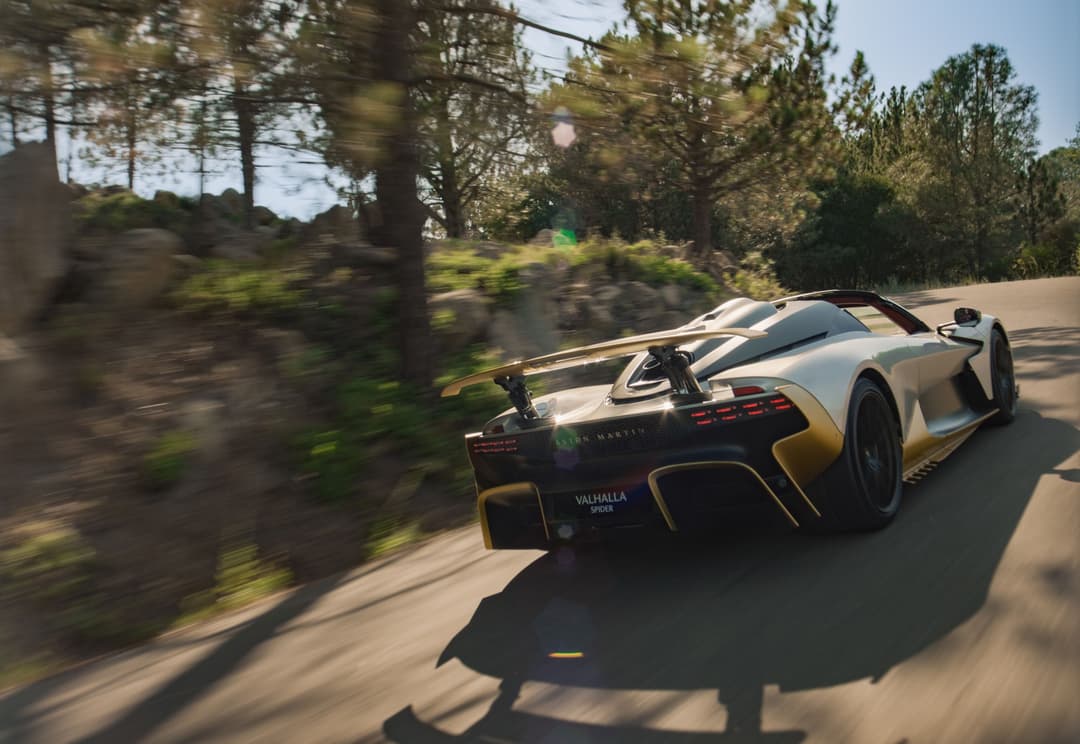
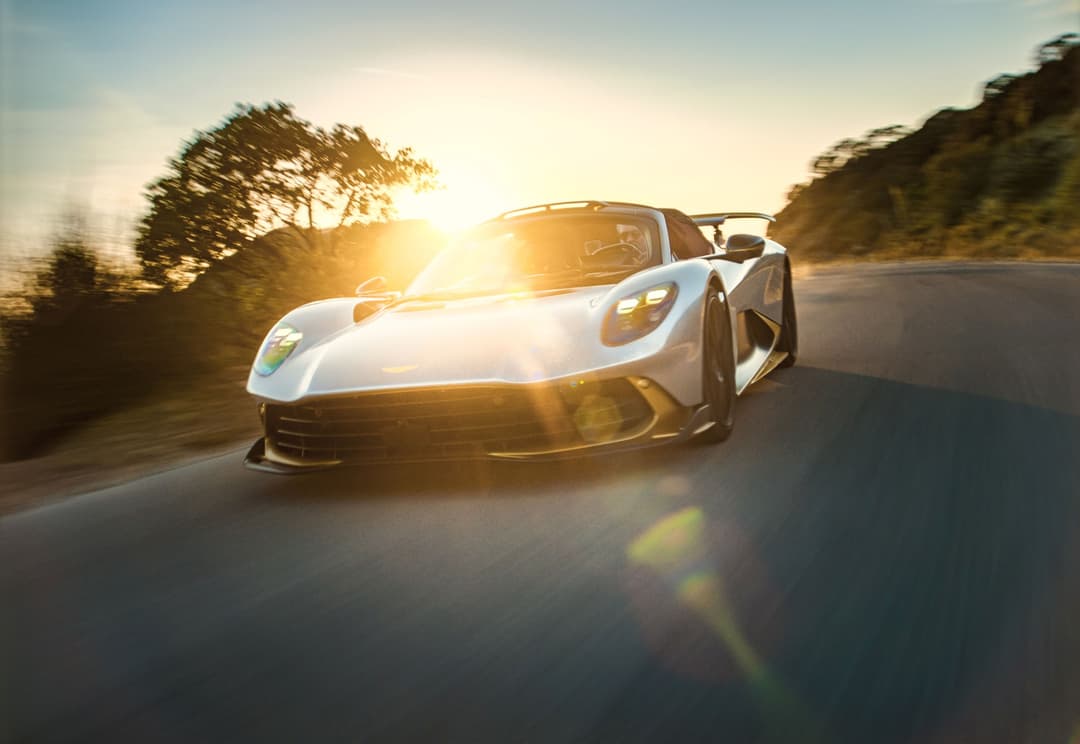
The aerodynamic package is carried over from the coupe, with moveable front and rear surfaces and managed underbody airflow, but several details change for open-air driving. The snorkel is reprofiled and sits 35 mm taller than on the Coupe, a bespoke wind deflector is added, and the stability control has separate calibrations for roof-on and roof-off driving. Inside, a new carbon fibre Touring Seat is standard, while the coupe's original seat, which gives more dynamic support, is available at no cost. The press photos show a silver car with gold aero elements and a red interior.
Technology & Features
Technology news from Aston Martin focuses on dynamics rather than screens. The Integrated Vehicle Dynamics Control manages drive to each wheel, the e-axle provides electric torque vectoring at the front, and four drive modes let the driver change the character of the car. The company has not detailed the infotainment system, driver displays or connected services for the Spider, so those will have to wait for the full specification.
Safety & ADAS
Aston Martin has not published safety or driver-assistance equipment for the Valhalla Spider. What it does say is that the carbon fibre passenger cell keeps the stiffness and strength of the coupe, and that the stability control is recalibrated for both roof-on and roof-off use.
| ADAS LEVEL | Not published |
|---|---|
| STRUCTURE | Carbon fibre tub (resin-transfer moulding and autoclave) |
| STABILITY CONTROL | Separate roof-on and roof-off calibrations |
Available Versions
| VERSION | POWER | TORQUE | 0-100 | TOP SPEED | DRIVETRAIN | BATTERY | EV RANGE | COMBINED RANGE | PRICE | KEY DIFFERENCES |
|---|---|---|---|---|---|---|---|---|---|---|
| Valhalla Spider | 1,064 hp | 1,100 Nm | — | 350 km/h | AWD | 6.1 kWh (Valhalla) | — | — | TBA | One powertrain. Standard fabric roof caps speed at 200 km/h; the optional carbon fibre hard top or roof removed allows the full 350 km/h. |
Pricing & Availability
Aston Martin has not announced a price for the Valhalla Spider. Press estimates vary widely: evo puts it at around £935,000, roughly 40 percent more than the coupe, while autoevolution suggests about $1.5 million against the $1,051,000 it says the coupe cost when new. Neither figure comes from Aston Martin. The car debuts at the 2026 Concours at Wynn in Las Vegas this weekend and customer deliveries start in the third quarter of 2027. The Valhalla Coupe was limited to 999 cars, and evo reports that the Spider will account for about one in four of them, although Aston Martin has not confirmed a split.
How It Compares
The closest like-for-like rival is the Ferrari 849 Testarossa Spider, another plug-in hybrid V8 open-top supercar. On paper the Aston has slightly more power (1,064 hp against 1,036 hp) and a higher claimed top speed (350 km/h against more than 330 km/h for the Ferrari), while Ferrari claims 0–100 km/h in under 2.3 seconds and 25 km of electric range, neither of which Aston Martin has published for the Spider. The Lamborghini Revuelto SV in our catalogue is rated at 1,050 hp and listed at $741,172, which gives a sense of the money in this class, although every press estimate for the Valhalla Spider is higher than that.
The Denza Z9 GT is not a rival in any cross-shopping sense, but it shows how far the power numbers have spread. This Chinese plug-in hybrid shooting brake makes 952 hp for $59,026 and claims 1,000 km of total range, so the Valhalla Spider's extra 112 hp sits in a completely different price league.
- 1,064 hp plug-in hybrid with 1,100 Nm and a claimed 350 km/h (217 mph) with the roof removed
- Choice of fabric roof or optional carbon fibre hard top, with stowage for the wind deflector in the sills
- Carbon fibre tub and active aerodynamics with over 600 kg of downforce with the roof fitted
- Price, 0–100 km/h time, electric range and dimensions have not been published yet
- The standard fabric roof limits roof-on speed to 200 km/h (124 mph)
The Valhalla Spider is the Valhalla Coupe with the roof taken off and, according to Aston Martin, the coupe's design purity and performance preserved: the same 1,064 hp hybrid powertrain, the same 350 km/h claim and a carbon structure that was designed to stay stiff. It is a car for collectors who want what Aston Martin calls its fastest open-cockpit car ever, and the main open questions are the price, the 0–100 km/h time and the electric range. Until those arrive it is a very strong announcement rather than a finished spec sheet.