

The Audi RS 5 is the first high-performance plug-in hybrid (PHEV) from Audi Sport, and it succeeds the RS 4 Avant while adding a second body style, the RS 5 Sedan. A 2.9-litre twin-turbo V6 and a 130 kW electric motor together make 470 kW (639 PS, about 630 hp) and 825 Nm, which Audi says is good for 0-100 km/h in 3.6 seconds. The 25.9 kWh gross battery (22.0 kWh net) gives an electric range of up to 84 km on the WLTP cycle, charged on AC only. Audi unveiled the car in February 2026, opened German orders in the first quarter and began deliveries in June 2026. Its Asia-Pacific showcase came at the Singapore Grand Prix weekend of 9-11 October 2026, where Audi started the overseas roll-out in Singapore, Australia, New Zealand and Japan. In Germany the RS 5 Sedan costs EUR 106,200 and the Avant EUR 107,850, including VAT.
Performance & Specs
The combustion half of the PHEV system is a 2,894 cc V6 with two turbochargers, rated at 375 kW (510 PS, about 503 hp) and 600 Nm, which Audi says is 44 kW more than in the previous generation. The electric motor adds 130 kW (177 PS, about 174 hp) at peak and 460 Nm, with a continuous rating of 70 kW, and the combined system output is 470 kW (639 PS, about 630 hp) and 825 Nm. (PS is the metric horsepower and is about 1.4 percent smaller than the imperial hp used here; Audi's English-language pages print the 639 PS figure as "hp".) Compared with the 331 kW (450 PS) and 600 Nm of the previous RS 5, quoted by one Australian outlet, the new system gains 139 kW and 225 Nm. Power goes through an eight-speed tiptronic with a torque converter to a new quattro system with a self-locking centre differential and a sport rear differential.
The headline chassis feature is Dynamic Torque Control, which Audi describes as the first electromechanical torque vectoring on the rear axle of a production car. An 8 kW, 40 Nm electric actuator shifts torque between the rear wheels, with differences of up to 2,000 Nm applied in 15 milliseconds and a control unit that recalculates every 5 milliseconds. The centre differential splits drive between 70/30 and 15/85 (front/rear). A boost function releases maximum system output for ten seconds at the press of a button or the steering-wheel satellite controls. Audi gives 0-100 km/h as 3.6 seconds for both body styles, and the UK launch material quotes 0-62 mph in the same time.
Top speed depends on equipment. Audi's German data sheet lists 250 km/h (electronically limited) as standard, and the optional Audi Sport package raises it to 285 km/h; the UK launch gives 155 mph for the standard cars and 177 mph for the RS 5 performance Vorsprung, and OneShift's Singapore launch coverage lists the 285 km/h Audi Sport package as standard on both body styles there. Electric-only top speed is 140 km/h. The unibody is 10 percent stiffer than the base A5's, both axles use five-link suspension, and the RS sport suspension adds two-valve dampers. Standard 20-inch forged wheels carry 285/35 R20 tyres behind 420 mm front and 400 mm rear steel discs, while 21-inch wheels and ceramic brakes of 440/410 mm are optional.

| Powertrain | PHEV, V6 twin-turbo + electric motor, quattro AWD |
|---|---|
| Power | 470 kW (639 PS / 630 hp) system |
| Torque | 825 Nm system |
| 0–100 km/h | 3.6 s |
| Battery | 25.9 kWh gross / 22.0 kWh net |
| Range | Up to 84 km WLTP electric (Sedan) |
| POWERTRAIN TYPE | Plug-in hybrid (PHEV): 2.9 V6 twin-turbo petrol + electric motor |
|---|---|
| HORSEPOWER | 470 kW (639 PS / 630 hp) system; V6 375 kW (510 PS / 503 hp); motor 130 kW peak (177 PS / 174 hp) |
| TORQUE | 825 Nm system; V6 600 Nm; motor 460 Nm |
| ACCELERATION | 0-100 km/h in 3.6 s (Sedan and Avant) |
| TOP SPEED | 250 km/h limited; 285 km/h with Audi Sport package; 140 km/h electric |
| DRIVETRAIN | quattro AWD, 8-speed tiptronic, rear torque vectoring |
| BATTERY | 25.9 kWh gross / 22.0 kWh net, lithium-ion, 102 cells, 400 V |
| ELECTRIC RANGE | Up to 84 km WLTP (Sedan), 76-83 km (Avant), 81-86 km in city |
| COMBINED RANGE | Not published; 48 L fuel tank |
Dimensions & Practicality

| Length | 4,896 mm |
|---|---|
| Width | 1,952 mm (2,099 mm with mirrors) |
| Height | 1,446–1,472 mm |
| Wheelbase | 2,906–2,907 mm |
| Boot | 361 L / 1,302 L seats folded |
The Avant is 4,896 mm long and 1,952 mm wide (2,099 mm with the mirrors), with a 2,906 mm wheelbase and a roof height of 1,446 to 1,472 mm depending on the chassis. Audi's German data sheet gives a boot of 361 L behind the rear seats and 1,302 L with the seats folded, and a load sill height of 663-666 mm. The Sedan has the same length, width and wheelbase, a height of 1,454 mm according to ADAC, and a boot of 331 L, or 1,170 L with the seats folded, which the UK launch figures confirm. The Avant seats five and has a drag coefficient of 0.36 with a frontal area of 2.39 square metres.
The hybrid hardware makes the RS 5 heavy. Audi lists 2,355 kg for the Sedan and 2,370 kg for the Avant without driver, or 2,445 kg with a driver for the Avant under the EU method. Braked towing capacity is 2,100 kg on an 8 percent gradient (1,900 kg at 12 percent), unbraked 750 kg, and the roof load is 90 kg.
| LENGTH | 4,896 mm |
|---|---|
| WIDTH | 1,952 mm (2,099 mm with mirrors) |
| HEIGHT | 1,446-1,472 mm (Avant); 1,454 mm (Sedan, ADAC) |
| WHEELBASE | 2,906-2,907 mm; track 1,673 mm front / 1,659 mm rear |
| CARGO VOLUME | Avant 361 L (1,302 L seats folded); Sedan 331 L (1,170 L seats folded) |
| KERB WEIGHT (no driver) | 2,355 kg (Sedan), 2,370 kg (Avant) |
| TOWING (braked / unbraked) | 2,100 kg / 750 kg |
Charging & Battery
The lithium-ion pack has 102 cells, a capacity of 25.9 kWh gross and 22.0 kWh net, and works on a 400 V system. Charging is AC only at up to 11 kW, which Audi's data sheet puts at 165 minutes for 0-100% on a three-phase 16 A supply, and the RS 5 has no DC fast-charging socket. A mode 3 Type 2 cable is standard. WLTP electric range is up to 84 km for the Sedan (87 km in city driving) and 76-83 km combined for the Avant (81-86 km in the city), depending on wheels and equipment. The weighted combined consumption of the Avant is 3.9-4.5 l/100 km and 17.8-18.7 kWh/100 km, with CO2 of 88-102 g/km; with a discharged battery Audi gives 9.6-10.2 l/100 km. The battery can send up to 8 kW to the torque-vectoring motor, and in the RS sport and RS torque rear modes the charge is held at 90 percent, while in dynamic mode it is never drawn below 20 percent.
| BATTERY | 25.9 kWh gross / 22.0 kWh net, 400 V |
|---|---|
| AC CHARGING | 11 kW, 0-100% in about 165 min (3-phase 16 A) |
| DC FAST CHARGING | Not available |
| WLTP CONSUMPTION (Avant, weighted) | 17.8-18.7 kWh/100 km and 3.9-4.5 l/100 km |

Design & Interior
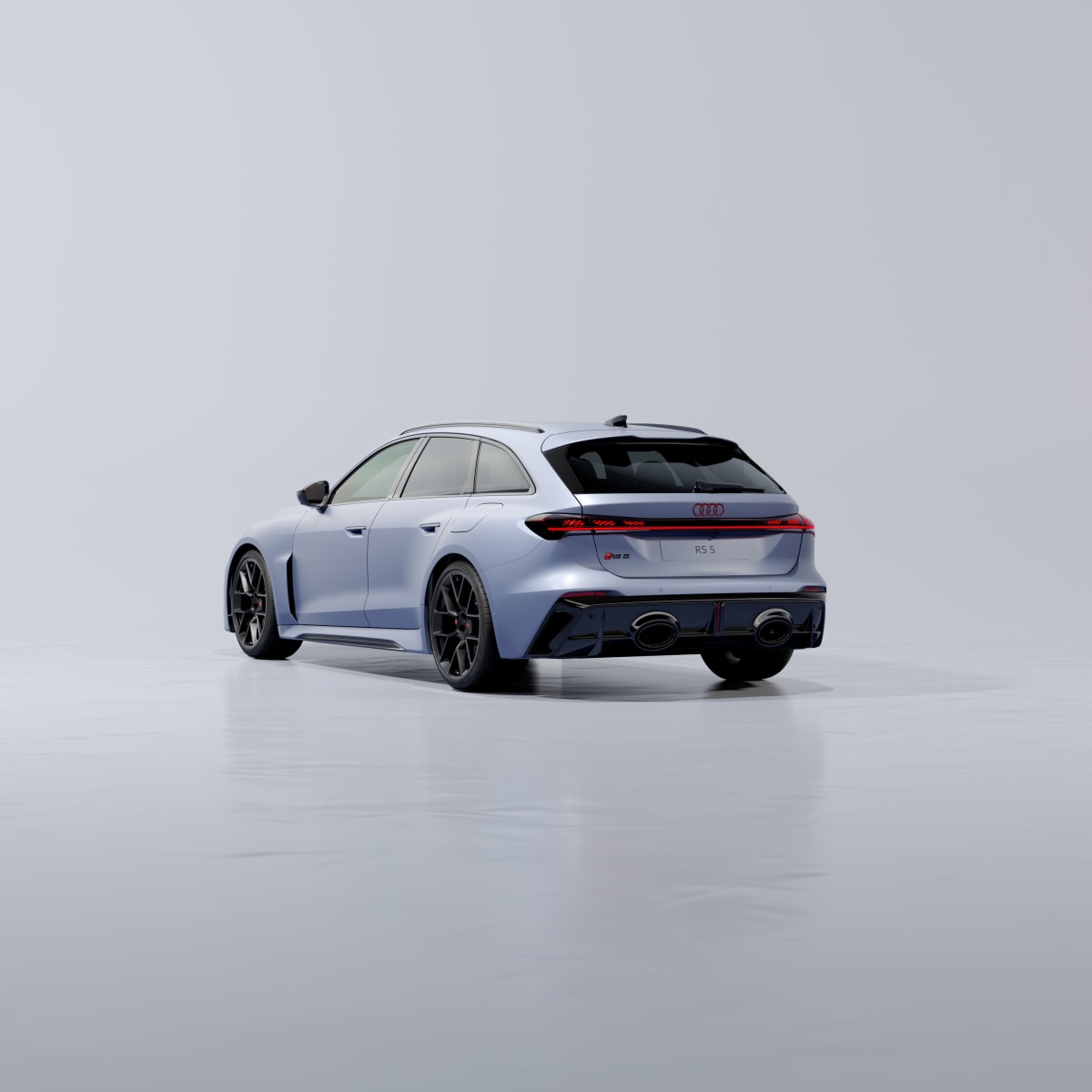
The RS 5 is about 9 cm wider than the base A5 and wears a three-dimensional Singleframe grille with a honeycomb pattern, air curtains at the front corners, a rear diffuser with vertical fins, and an RS sport exhaust with oval tailpipes. The Sedan adds a ducktail spoiler. Darkened Matrix LED headlights with a chequered-flag daytime signature are optional, and the second-generation digital OLED rear lights carry the same chequered-flag graphic. Nine paint colours are offered, including Ascari blue, Mythos black and Progressiv red, and Plateau grey matte is exclusive to the RS 5. The optional Audi Sport package adds Bedford green metallic, bronze ceramic brake calipers, carbon camouflage elements and Serpentine green contrast stitching.
Inside, there are five interior designs with sport seats plus and a massage function as standard, and a leather-free interior is the base choice, with red or grey leather optional. The driver faces an 11.9-inch virtual cockpit and a 14.5-inch MMI touch display, with a 10.9-inch passenger display as standard and a configurable head-up display as an option. The Audi driving experience function, standard on every car, logs lap and sector data on the central display.
Technology & Features
The RS 5 has several driving modes, including RS sport and RS torque rear, and Audi Sport's operating strategy changes how the battery is used in each. Audi UK lists the Bang & Olufsen 3D sound system, Matrix LED headlights and rear torque vectoring as part of the equipment, and the performance Vorsprung adds OLED rear lights, carbon camouflage trim, a panoramic sunroof and a sport exhaust. The Australian launch lists a 360-degree camera, an integrated dashcam, 21-inch forged wheels and RS red brake calipers. Equipment varies by market, so buyers should check the local price list.
Safety & ADAS
Audi's launch material describes adaptive cruise control with emergency assist, lane change assist and a 360-degree camera on the cars sold in Australia and the UK. Audi does not publish an automation level for the RS 5, and a Euro NCAP rating for this car was not found. The braking system uses an integrated brake control with ABS 2.0, and the optional ceramic discs stop the car from 100 km/h in 30.6 metres according to Audi. As on other Audi models, the scope of driver-assistance packages differs by market.
| ADAS LEVEL | Not stated by Audi |
|---|---|
| ADAS FEATURES | Adaptive cruise control with emergency assist, lane change assist, 360-degree camera (Australia/UK equipment lists) |
Available Versions
| VERSION | POWER | TORQUE | 0-100 | TOP SPEED | DRIVETRAIN | BATTERY | EV RANGE | COMBINED RANGE | PRICE | KEY DIFFERENCES |
|---|---|---|---|---|---|---|---|---|---|---|
| RS 5 Sedan (PHEV) | 630 hp | 825 Nm | 3.6s | 250 km/h | AWD | 25.9 kWh | 84 km | — | €106,200 | 639 PS, 2,355 kg, boot 331 / 1,170 L, 285 km/h with Audi Sport package |
| RS 5 Avant (PHEV) | 630 hp | 825 Nm | 3.6s | 250 km/h | AWD | 25.9 kWh | 83 km | — | €107,850 | 639 PS, 2,370 kg, boot 361 / 1,302 L, 285 km/h with Audi Sport package |
Pricing & Availability
Audi's launch release lists German starting prices of €106,200 for the RS 5 Sedan and €107,850 for the RS 5 Avant, including 19 percent VAT, and the ADAC catalogue repeats both. Audi opened European orders in the first quarter of 2026, says European demand ran at nearly twice its expectation, and says the 2026 production allocation is sold out. Deliveries began in June 2026 from the Neckarsulm plant. In the UK, Audi opened orders on 6 May 2026 at £89,400 for the Saloon and £91,300 for the Avant on the road, with the RS 5 Carbon Black at £95,486 and £97,385 and the RS 5 performance Vorsprung at £107,485 and £109,385; first UK deliveries were scheduled for summer 2026.
Overseas, Audi's Singapore Grand Prix release names Singapore, Australia and New Zealand, and Japan as the first launch markets, followed by Korea, Taiwan and other countries. In Australia the RS 5 Sedan is A$179,900 and the Avant A$182,900 before on-road costs, with arrival in the second half of 2026. In Singapore, OneShift reports S$713,999 for the Sedan and S$723,999 for the Avant including COE. In Israel, Champion Motors, the Audi importer, lists the RS5 Sedan e-hybrid quattro at ₪819,900 including VAT plus a ₪5,499 registration fee (price list 088 of 17 August 2026, before promotions). No official US price or on-sale date was found; US reports expect a 2027 model-year sedan only, and Audi has not announced the date.
How It Compares
The closest relative on our site is the Audi A5 Avant e-hybrid, which uses the same 25.9 kWh gross battery in a quattro PHEV with 362 hp; the RS 5 Avant adds about 268 hp and costs more, but its electric range is lower at up to 83 km. The BMW M5 Touring is the larger and pricier rival with a 717 hp V8 PHEV, 87 hp more than the RS 5 Avant. The Mercedes-AMG C 63 S E Performance is the RS 5's most direct rival in size. It makes 500 kW (680 PS, about 671 hp) and 1,020 Nm from a four-cylinder engine and a 6.1 kWh usable battery, with a WLTP electric range of roughly 12 km and 0-100 km/h in 3.4 seconds; Australian outlets list it above the RS 5 Sedan's A$179,900, but price bases differ. The RS 5's electric range is the edge; the AMG is faster on paper by 0.2 seconds. Power figures are manufacturer data and apply to the stated models.
- 470 kW (639 PS / 630 hp) and 825 Nm PHEV system, 0-100 km/h in 3.6 seconds, with a 10-second boost function
- Up to 84 km WLTP electric range from a 22.0 kWh net battery, far more than the C 63's roughly 12 km
- Rear torque vectoring and quattro give a distinct handling character, and the Avant keeps 361 L / 1,302 L of boot
- Heavy at 2,355-2,370 kg without driver, and the standard top speed is limited to 250 km/h unless the Audi Sport package is ordered
- AC-only charging at 11 kW takes about 165 minutes, with no DC option, and the 2026 allocation is already sold out
The RS 5 turns Audi Sport's first plug-in hybrid into a credible heir to the RS 4: 630 hp, quattro with rear torque vectoring, and a usable 84 km of electric range at EUR 106,200 in Germany. It is a heavy plug-in with no fast charging, so it suits buyers who can charge at home and want a daily-usable estate or sedan with real performance. Against the Mercedes-AMG C 63, it offers far more electric range and, according to one Australian outlet, a lower price, while the BMW M5 is the stronger choice for those who want more power and a bigger car. We recommend it to RS buyers who accept the added weight in exchange for the hybrid's flexibility.