

The BYD Shark is the Chinese maker's first pickup to be sold in Europe, and it brings the company's plug-in hybrid (PHEV) Super Hybrid DMO technology, short for Dual Mode Off-road, to a segment dominated by diesels. BYD gave the five-seat double cab its European debut at the Goodwood Festival of Speed in July 2026 and has put it on its Hall 6 stand at the Paris Motor Show, which runs from 12 to 18 October 2026. The PHEV system combines a 1.5-litre turbocharged petrol engine with two electric motors for a combined 436 PS (321 kW, about 430 hp) and 650 Nm, enough for 0-100 km/h in 5.7 seconds. A 32.2 kWh Blade Battery gives up to 90 km of WLTP electric range, and BYD quotes 675 km WLTP combined on a full charge and a full tank. The Shark tows 2,500 kg braked and carries up to 790 kg. In the United Kingdom, the first market, BYD UK is taking orders from £47,290 including VAT for a single trim level, while prices for continental Europe have not been announced.
Performance & Specs
The Shark's PHEV drivetrain is built around two electric motors, one on each axle, which makes it all-wheel drive without a mechanical link between the axles. The front motor produces 170 kW (231 PS) and 310 Nm and the rear motor 150 kW (204 PS) and 340 Nm, and BYD gives the combined maximum system output as 321 kW (436 PS, about 430 hp) and 650 Nm. (PS is the metric horsepower, about 1.4 percent smaller than the imperial hp used here.) BYD quotes 0-100 km/h in 5.7 seconds and a top speed of 180 km/h, and describes the acceleration as sports car-rivalling.
The 1.5-litre turbocharged four-cylinder petrol engine is mounted longitudinally and is rated at 110 kW (150 PS) and 240 Nm on its own. In normal driving it acts mainly as a generator, feeding the motors or the battery in what BYD calls HEV series mode. When hard acceleration is needed it switches to parallel mode, where engine and motors work together, and at a fast motorway cruise the engine can drive the wheels directly if that is the most efficient option. In EV mode the motors do all the work. The truck sits on a ladder-frame chassis with double-wishbone suspension front and rear, hill descent control as standard and an intelligent four-mode all-wheel-drive system for sand, mud, snow and gravel. BYD gives approach and departure angles of 31 and 19.3 degrees and a ground clearance of 230 mm unladen (210 mm fully laden).
Weight is the price of the big battery. BYD lists a kerb weight of 2,710 kg and a gross vehicle weight of 3,500 kg, which leaves the 790 kg maximum payload. The Blade Battery is mounted in the platform using cell-to-chassis (CTC) construction, and BYD says more than 50 percent of the body structure is high-strength steel.

| Powertrain | Dual-motor AWD PHEV (Super Hybrid DMO) |
|---|---|
| Power | 321 kW (436 PS / 430 hp) |
| Torque | 650 Nm |
| 0–100 km/h | 5.7 s |
| Battery | 32.2 kWh rated (LFP Blade Battery) |
| Range | 90 km WLTP electric / 675 km WLTP combined |
| POWERTRAIN TYPE | Plug-in hybrid (PHEV), Super Hybrid DMO |
|---|---|
| HORSEPOWER | 321 kW (436 PS / 430 hp) system output (PHEV) |
| TORQUE | 650 Nm system output; engine alone 150 PS / 240 Nm |
| ACCELERATION | 0-100 km/h in 5.7 s |
| TOP SPEED | 180 km/h |
| DRIVETRAIN | AWD (one electric motor per axle) |
| BATTERY | 32.2 kWh rated, BYD Blade Battery (LFP) |
| ELECTRIC RANGE | 90 km WLTP combined (PHEV) |
| COMBINED RANGE | 675 km WLTP, full charge and full 60 L tank (PHEV) |
Dimensions & Practicality

| Length | 5,457 mm |
|---|---|
| Width | 1,971 mm |
| Height | 1,925 mm |
| Wheelbase | 3,260 mm |
| Ground clearance | 230 mm unladen / 210 mm laden |
The Shark is a full-size double cab, 5,457 mm long, 1,971 mm wide and 1,925 mm high on a 3,260 mm wheelbase, with a 6.5 m minimum turning radius. BYD quotes a 1,200-litre load bay and a maximum payload of 790 kg, and the braked towing limit is 2,500 kg with 750 kg unbraked. Those numbers matter in two ways: the payload is below the one-tonne mark that many rivals use as a working benchmark, and, as explained under pricing, the truck's tax status in the UK differs from that of one-tonne-payload pickups.
For passengers the Shark leans toward SUV comfort. BYD says the flat rear floor leaves room for three sets of feet, with almost 90 cm of rear legroom and a car-like rear seat-back angle of 27 degrees, which is unusual in a pickup. The front cabin has prominent grab handles on the centre console for rough-road driving and a column-mounted gear selector, and BYD says the buttons are large enough to use with gloves on.
| LENGTH | 5,457 mm |
|---|---|
| WIDTH | 1,971 mm |
| HEIGHT | 1,925 mm |
| WHEELBASE | 3,260 mm |
| LOAD BAY | 1,200 L |
| KERB WEIGHT / GROSS WEIGHT | 2,710 kg / 3,500 kg |
| PAYLOAD | Up to 790 kg |
| TOWING (braked / unbraked) | 2,500 kg / 750 kg |
| APPROACH / DEPARTURE ANGLE | 31° / 19.3° |
Charging & Battery
The Shark's battery is a BYD Blade Battery using lithium iron phosphate (LFP) chemistry with a rated capacity of 32.2 kWh; BYD does not state a separate usable figure. That is almost three times the capacity of the only other plug-in hybrid pickup on the European market, according to BYD, and it is what delivers the 90 km WLTP electric range. BYD does not publish an electric consumption figure, but 90 km from a rated 32.2 kWh implies at most about 36 kWh/100 km, a high figure that fits a 2.7-tonne truck with a tall, boxy body.
Charging is modest by BYD's own standards. Standard DC charging peaks at 55 kW and takes the battery from 30 to 80 percent in 21 minutes, while an 11 kW three-phase AC charger refills it from 15 percent in just over three hours (3.2 hours from 15 to 100 percent). Once the battery is flat the Shark behaves as a conventional hybrid: BYD gives 9.6 L/100 km in the WLTP combined cycle with the battery at its lowest level, against a WLTP weighted combined figure of 3.5 L/100 km with a 60-litre fuel tank. The 675 km WLTP combined range assumes a full charge and a full tank.
| BATTERY | 32.2 kWh rated, LFP Blade Battery (usable capacity not stated) |
|---|---|
| AC CHARGING | 11 kW three-phase, 15-100% in 3.2 h |
| DC FAST CHARGING | 55 kW |
| DC 30-80% TIME | 21 min |
| FUEL CONSUMPTION (WLTP, PHEV) | 3.5 L/100 km weighted; 9.6 L/100 km battery depleted |
Design & Interior
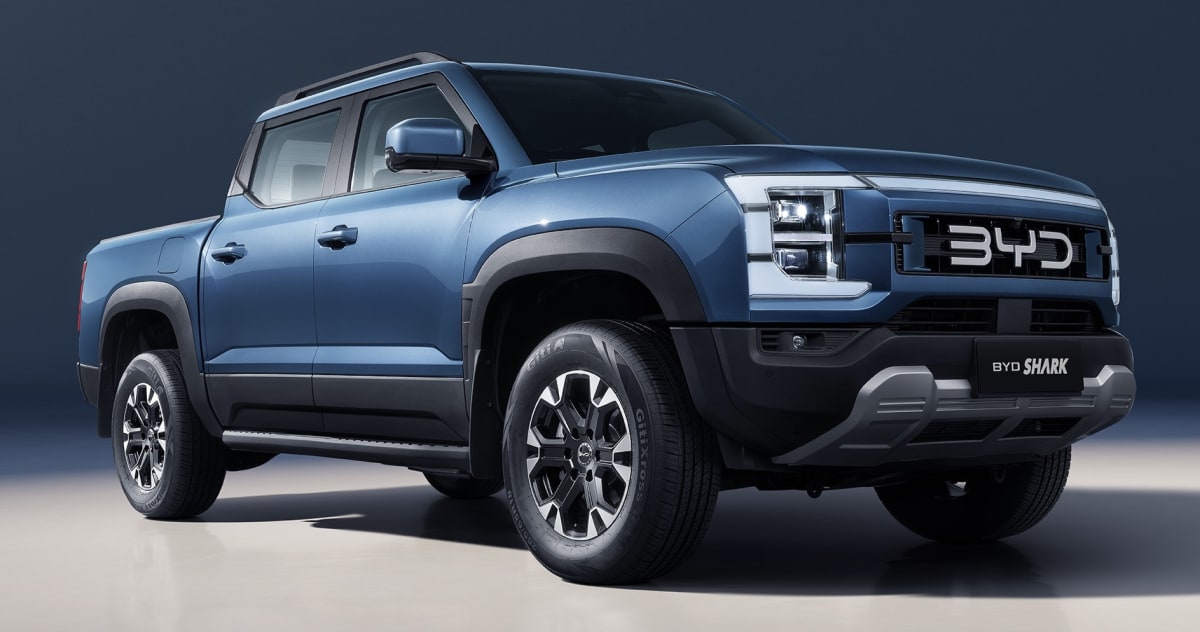
BYD names the Shark after the animal and says so in the design. The headlights sit high at the bonnet edge and are pulled to the far corners of a single full-width light line to mimic a shark's eyes, while the large grille and the lower bumper section echo an open mouth. In profile the arched roofline and the muscular suspended cabin are meant to recall a shark's upper body, and plastic cladding on the lower body and wheel arches, plus side steps, protect the paint and visually shorten the doors. The truck rides on 18-inch two-tone alloys, with all-black 18-inch wheels as an option, and at the rear a full-width light bar runs across the tailgate, which carries what BYD calls the biggest BYD logo on any of its passenger vehicles. Five colours are offered: Atlantis Blue as the standard shade, plus Obsidian Black, Polar White, Grey Green and Sunrise Orange.
Inside, the UK specification has vegan-leather upholstery, heated and ventilated front sports seats and softer materials in key areas. The dashboard uses BYD's usual two-screen layout, with a 10.25-inch digital instrument panel and a 15.6-inch infotainment screen that sits proud of the dashboard, and a 12-speaker Dynaudio sound system and a 50 W wireless phone charger are standard.
Technology & Features
The 15.6-inch screen carries navigation, a voice assistant and wireless Apple CarPlay and Android Auto, and BYD calls it the largest in the pickup class. A head-up display, front and rear parking sensors with a 360-degree camera, keyless entry and start, exterior puddle lights and remote control of cabin heating and cooling through the BYD app are all standard on the single UK trim. The headline feature for work sites is Vehicle-to-Load: two sockets, one accessed through the AC charging port and one in the wall of the load bed, supply up to 6 kW to external equipment such as power tools, a coffee machine or a pressure washer. BYD states that the equipment list applies to the UK specification and that EU market lists will be confirmed later.
Safety & ADAS
BYD fits the Shark with a full driver-assistance package and seven airbags: driver, front passenger, front centre, two front side and two side curtain. ISOFIX points on the rear seats, child presence detection, a mechanical child lock and tyre pressure monitoring are standard as well. BYD does not state an SAE automation level or a Euro NCAP rating for the Shark in the material reviewed here.
| ADAS LEVEL | Not stated by BYD; driver-assistance suite (UK specification) |
|---|---|
| ADAS FEATURES | Intelligent adaptive cruise control, front and rear cross traffic alert and brake, forward and rear collision warning, lane departure assistant with emergency lane keeping, blind spot detection, hill hold, 360° camera, front and rear parking sensors |
Available Versions
| VERSION | POWER | TORQUE | 0-100 | TOP SPEED | DRIVETRAIN | BATTERY | EV RANGE | COMBINED RANGE | PRICE | KEY DIFFERENCES |
|---|---|---|---|---|---|---|---|---|---|---|
| Shark (single trim, UK) | 430 hp | 650 Nm | 5.7s | 180 km/h | AWD | 32.2 kWh | 90 km | 675 km | £47,290 | PHEV, 321 kW (436 PS), 2,500 kg towing, 790 kg payload, WLTP ranges, price incl. 20% VAT |
Pricing & Availability
In the United Kingdom, BYD opened orders on 8 July 2026 at £47,290 including 20 percent VAT for the single trim level, which is about US$62,800 at the ECB rate of 6 October 2026 (1 GBP = 1.3276 USD). UK customer deliveries are due in the fourth quarter of 2026. According to EV Fleet World, the Shark counts as a passenger car for company-car tax (BiK) and capital allowances, and VAT-registered businesses cannot reclaim the 20 percent VAT, unlike one-tonne-payload pickups such as Ford Ranger PHEV variants. BYD says the Shark will go on sale first in the UK before reaching selected European markets in the second half of 2026, but as of 12 October 2026 it has not published prices or equipment lists for any EU country.
The European version differs from the Shark sold elsewhere. BYD's 2026 European data sheet gives a 32.2 kWh battery, 90 km of WLTP electric range and 675 km WLTP combined, while Australian press lists the Shark 6 with a 29.58 kWh battery, an electric range of about 100 km on the more lenient NEDC cycle and 2.0 L/100 km, so the two sets of range figures are not comparable. The 321 kW and 650 Nm outputs match between the two. Australian press also reports a more powerful 2.0-litre Performance variant of 350 kW and 700 Nm for that market, which is not part of the European line-up. The Shark has been on sale in Mexico and Brazil since 2024 and in Australia since late 2024.
How It Compares
The Shark's closest rival in Europe is the Ford Ranger PHEV, which UK trade press describes as a 2.3-litre petrol engine with a 75 kW motor and an 11.8 kWh battery, producing 281 PS combined with a 43 km WLTP electric range, a 3,500 kg towing limit and a 1,000 kg payload. On paper the BYD has the advantage in power (436 PS against 281 PS), battery size (32.2 kWh against 11.8 kWh) and electric range (90 km against about 43 km), while the Ford leads on towing and payload. Ford Pro lists the Ranger PHEV from £40,830 commercial on-the-road price (VAT status not confirmed), which is not directly comparable with the Shark's VAT-inclusive £47,290. Among pickups already in our catalogue, the KGM Musso EV is a pure battery-electric alternative with 204 hp and 419 km of WLTP range but far less power, and the Jetour Zongheng F700, a China-market PHEV pickup, claims 904 hp and 1,300 km of combined range at a China pre-sale price near $53,900, though it is not sold in Europe. The Shark sits between them as a European-market plug-in hybrid with a large battery.
- 436 PS (430 hp), 650 Nm and 0-100 km/h in 5.7 seconds from the PHEV system, with all-wheel drive and four terrain modes
- 32.2 kWh battery for 90 km WLTP electric range and 675 km WLTP combined, with 3.5 L/100 km weighted fuel consumption
- Vehicle-to-Load with up to 6 kW from two sockets, a 2,500 kg braked towing limit and a well-equipped single trim
- The 790 kg payload is under one tonne; in the UK the Shark is treated as a passenger car and VAT-registered businesses cannot reclaim the VAT (EV Fleet World), unlike one-tonne-payload pickups such as Ford Ranger PHEV variants
- DC charging peaks at 55 kW and the 2,500 kg towing limit trails the Ranger PHEV's 3,500 kg; EU prices and equipment lists are still to be announced
BYD claims the most power in the plug-in hybrid pickup class for the Shark, with 436 PS, a battery nearly three times the size of its only direct rival and a 90 km WLTP electric range that lets many daily trips run without petrol. It also arrives with a generous standard equipment list and Vehicle-to-Load for work sites. The trade-offs are a 790 kg payload, a passenger-car tax status that costs UK businesses the VAT reclaim, a lower towing limit than the Ranger PHEV and DC charging that tops out at 55 kW. For private buyers and company-car drivers who want an efficient pickup for lifestyle use, it is a compelling new option, and continental pricing will decide how far that appeal spreads.