
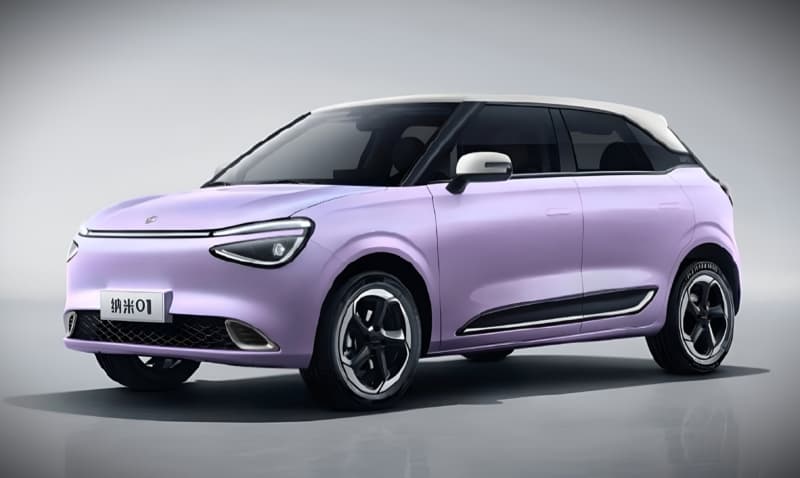
The 2026 Dongfeng Box is a subcompact electric hatchback that has just reached Israeli showrooms through importer Capital Motors, priced from ₪104,900 (about $34,600 at current exchange rates). In China, where the car is sold as the Dongfeng Nammi 01, the same hatchback starts at a fraction of that price — a gap that says more about import duties and local market economics than about the car itself. Built around a single front-mounted motor, a 42.3 kWh battery, and a boxy, European-flavored design, the Box is aimed squarely at city buyers who want an EV’s running costs without a premium price tag — even if, in Israel specifically, the sticker price is anything but budget. It comes as a single, fully-loaded trim in Israel, with no lower or higher variant to choose from.
Performance & Specs
Power comes from a single permanent-magnet synchronous motor on the front axle, rated at 70 kW (95 PS / 94 hp) and 160 Nm of torque — enough for gentle city and suburban driving rather than outright pace. Dongfeng has never published an official 0-100 km/h figure for the Box; third-party estimates from various markets range from roughly 12 to 14 seconds, reflecting the car’s priority on efficiency and low running costs over acceleration. Top speed is electronically capped at 140 km/h. The car is front-wheel drive only, with a single-speed reduction gear transmission, and there is no all-wheel-drive or dual-motor version offered anywhere in the lineup.

| Powertrain | Single-motor FWD BEV |
|---|---|
| Power | 70 kW (95 PS / 94 hp) |
| Torque | 160 Nm |
| Top speed | 140 km/h |
| Battery | 42.3 kWh (LFP) |
| Range | 310 km (WLTP) / up to 430 km (CLTC) |
| POWERTRAIN TYPE | Battery-electric (BEV) |
|---|---|
| HORSEPOWER | 94 hp (70 kW / 95 PS) |
| TORQUE | 160 Nm |
| TOP SPEED | 140 km/h |
| DRIVETRAIN | FWD, single motor |
| BATTERY | 42.3 kWh LFP |
| ELECTRIC RANGE | 310 km (WLTP) |
| MAX RANGE (CLTC) | Up to 430 km |
Dimensions & Practicality

| Length | 4,030 mm |
|---|---|
| Width | 1,810 mm |
| Height | 1,570 mm |
| Wheelbase | 2,660 mm |
| Curb weight | 1,312 kg |
At just over 4 meters long, the Box sits in the same footprint class as a supermini like a Volkswagen Polo, though its tall, boxy roofline is tuned for maximum cabin space rather than sportiness. The 2,660 mm wheelbase is generous for the car’s overall length, which translates into usable rear legroom for a five-door hatchback of this size, even if headroom for taller rear passengers is tighter under the sloping roofline toward the back. Boot capacity is a class-competitive 326 litres with the rear bench in place, expanding to 945 litres with the 60/40-split seats folded flat — enough for a weekly grocery run or a couple of soft bags for a weekend trip, though there is no dedicated front trunk.
| LENGTH | 4,030 mm |
|---|---|
| WIDTH | 1,810 mm |
| HEIGHT | 1,570 mm |
| WHEELBASE | 2,660 mm |
| CARGO VOLUME | 326 L (945 L seats folded) |
| CURB WEIGHT | 1,312 kg |
Charging & Battery
The Box uses a 42.3 kWh lithium iron phosphate (LFP) pack in its Israel-market form, the larger of two battery options Dongfeng offers globally (a smaller 31.45 kWh pack is sold in some other markets but is not the version imported to Israel). LFP chemistry trades a little energy density for lower cost, longer cycle life, and better tolerance of frequent fast charging and full 100% top-ups — a sensible choice for a car built around city-commuter economics rather than long highway range. On a DC fast charger, the Box can recharge from 30% to roughly 80% in about 30 minutes; on a home AC wallbox, Capital Motors quotes a full charge in around 7 hours 15 minutes. Dongfeng has not published a full-power DC charging figure specific to the Israel-spec car; third-party spec databases list a peak DC charge rate in the region of 70 kW for this battery, broadly consistent with the quoted 30-minute top-up time.
| BATTERY | 42.3 kWh LFP |
|---|---|
| DC FAST CHARGING | 30% – 80% in ≈30 min |
| AC HOME CHARGING | ≈7h 15min (full charge) |
Design & Interior
The Box leans into a deliberately simple, European-influenced design rather than the sharp, tech-forward look common on many Chinese EVs. A slim LED light bar spans the nose, hidden pop-out door handles keep the sides clean, and a contrasting roof color (offered in several two-tone combinations, including the pastel purple and forest green shown in official images) gives it a friendly, lifestyle-oriented look rather than a purely utilitarian one. Compact 17-inch alloy wheels and rounded proportions reinforce the small-city-car brief. Inside, the cabin is dominated by a single 12.8-inch central touchscreen paired with a smaller digital instrument cluster ahead of the driver, both running on a simplified interface built for quick, glanceable use rather than deep menus. Trim runs from cloth-and-vinyl to a diamond-quilted upholstery pattern on the doors and dash seen on higher-spec international cars, with an electrically adjustable driver’s seat with memory function, wireless phone charging, and a 32-color ambient lighting system rounding out the cabin. Four-seat and five-seat layouts have both been offered across markets, though the Israel-spec car is sold as a conventional five-seater.
Technology & Features
The 12.8-inch touchscreen runs Dongfeng’s in-house infotainment software with wired and wireless Apple CarPlay and Android Auto, a built-in voice assistant, and OTA software update capability. A 360-degree camera system helps with parking in tight European and Israeli city streets, backed by front and rear parking sensors on higher-spec markets. The steering wheel carries the Nammi sub-brand badge and houses the physical controls for cruise control and driver-assistance functions, keeping the core driving controls tactile even with the screen-heavy dashboard. There is no head-up display and no built-in navigation with live traffic in the Israel-market car; buyers rely on phone-mirrored navigation through CarPlay or Android Auto instead.
Safety & ADAS
The Box carries a Level 2 driver-assistance suite that is respectable for a car in this price bracket internationally, even if it is modest next to flagship Chinese EVs. Standard equipment includes autonomous emergency braking, lane departure warning, traffic sign recognition, and adaptive cruise control, backed by a 360-degree camera for low-speed maneuvering. Dongfeng has stated the car achieved a five-star C-NCAP safety rating in China’s domestic testing regime; it has not been independently tested by Euro NCAP, so buyers in Israel and Europe should treat that specific five-star result as a Chinese-market reference rather than a direct Euro NCAP equivalent. Six airbags and ISOFIX child-seat anchors are fitted as standard.
| ADAS LEVEL | L2 (driver-assist, not autonomous) |
|---|---|
| ADAS FEATURES | AEB, adaptive cruise control, lane departure warning, traffic sign recognition, 360° camera |
| SAFETY RATING | 5-star C-NCAP (China) |
| AIRBAGS | 6 |
Available Versions
| VERSION | POWER | TORQUE | 0-100 | TOP SPEED | DRIVETRAIN | BATTERY | EV RANGE | COMBINED RANGE | PRICE | KEY DIFFERENCES |
|---|---|---|---|---|---|---|---|---|---|---|
| 31.45 kWh (China entry) | 94 hp | 160 Nm | — | 140 km/h | FWD | 31.45 kWh | 330 km (CLTC) | — | $8,400 | Smaller battery, China-domestic entry trim, not sold in Israel |
| 42.3 kWh (Israel / export spec) | 94 hp | 160 Nm | — | 140 km/h | FWD | 42.3 kWh | 310 km (WLTP) / 430 km (CLTC) | — | $34,600 | Larger battery, single fully-equipped trim sold in Israel; same battery tops out around $13,070 in China |
Pricing & Availability
In Israel, the Dongfeng Box is sold as a single, fully-equipped trim through importer Capital Motors, priced at ₪104,900 (about $34,600). That price is dramatically higher than what the same car costs in its home market: in China, where it is badged the Dongfeng Nammi 01, the current lineup spans eight trims from about 59,800 yuan ($8,400) for the smaller-battery entry version up to 92,800 yuan ($13,070) for the range-topping 42.3 kWh trim, according to Chinese pricing published in late 2025. The roughly 3-4x price gap between China and Israel reflects import duties, homologation costs, and the absence of any local manufacturing or Chinese government EV subsidy outside China, rather than a different car underneath. The Box has also launched in Switzerland (from CHF 21,990, about $25,660) and is sold in several other European countries including Bulgaria, alongside earlier rollouts in Norway, Finland, Nepal, Bangladesh, Hong Kong, Malaysia, Vietnam, Singapore, and South Africa.
How It Compares
Against its true segment peers on freshmotors — the BYD Seagull, Geely EX2, and GAC Aion hatchback — the Dongfeng Box is essentially matched on power and range in its home Chinese pricing, with near-identical 94 hp output to the Geely EX2 and a range figure in the same band as the BYD Seagull. On the numbers alone at Chinese prices, the Box is a mainstream, competitive budget city EV rather than a standout. The story changes entirely once the car crosses into Israel: at $34,600, it costs roughly 3-4x what any of these three catalog rivals sell for, without gaining meaningfully more power, range, or technology to justify the jump. Shoppers comparing on pure value should recognize that the Box’s Israeli price reflects import economics rather than a more capable car than its Chinese-market segment mates.
- Genuinely compact, easy-to-park footprint with a usable 326 L boot for its class
- Durable, fast-charge-friendly LFP battery with a respectable 310 km WLTP range for a city car
- Comes fully loaded as standard in Israel — no stripped-out base trim to upsell from
- Israel’s $34,600 price is roughly 2.6x the China price of the same 42.3 kWh trim (about $13,070), with no added performance or range to match
- No official 0-100 km/h time from Dongfeng, and third-party estimates put acceleration on the slow side of the segment
The Dongfeng Box is a competent, honestly-specced budget city EV that does exactly what it promises: a compact, LFP-battery hatchback with a usable 310 km of real-world range, a well-equipped cabin, and a straightforward single-trim lineup. Judged purely against its Chinese-market segment mates, it is a solid, unremarkable value pick. Judged on its actual Israeli showroom price of $34,600 — roughly what buyers pay for a much larger, more powerful mainstream EV elsewhere — it is a much harder sell, and shoppers in that market should cross-shop carefully before assuming "affordable EV" applies locally. Recommended for city drivers seeking simplicity and low running costs, but only if the price gap to larger, similarly-priced alternatives is weighed first.