

The Ioniq 6 N is Hyundai N's electric four-door sedan, a dual-motor, all-wheel-drive car with 448 kW (609 PS, about 601 hp) in normal driving and 478 kW (650 PS, about 641 hp) when the driver presses the N Grin Boost button for a 10-second push. Hyundai quotes 770 Nm of torque with the boost, 0-100 km/h in 3.2 seconds with N Launch Control and a top speed of 257 km/h. The 84 kWh battery is rated at up to 487 km on the WLTP cycle and can charge from 10 to 80% in about 18 minutes on a 350 kW charger. The sedan was shown at the Goodwood Festival of Speed in July 2025, went on sale in South Korea on 1 October 2025, opened for UK orders on 22 January 2026 at £65,800 on the road, and has since reached Germany (€75,900), Australia (A$115,000) and Israel (NIS 399,900). Electrek reports that Hyundai's US website lists it as coming in 2026 with extremely limited availability. This article also covers the Ioniq 5 N, which returned to Israeli showrooms in June 2026 and received a $6,300 price cut in the US in July.
Performance & Specs
The Ioniq 6 N has a permanent-magnet synchronous motor on each axle. Hyundai's UK data sheet lists the maximum net output of the front motor at 175 kW (238 PS) and of the rear motor at 303 kW (412 PS), which add up to the 478 kW (650 PS) system figure with N Grin Boost. Without the boost the system makes 448 kW (609 PS), which is about 601 hp, and 740 Nm. With the boost it makes 478 kW (650 PS), which converts to about 641 hp, and 770 Nm. A note on units: Hyundai Czech Republic, Hyundai Germany and the UK data sheet all quote PS, the metric horsepower, and 650 PS is about 641 hp (478 kW x 1.341), not 650 hp. Hyundai Europe says N Grin Boost is available for up to 10 seconds, with a 10-second recharge time before it can be used again.
Hyundai quotes 0-100 km/h in 3.2 seconds with N Launch Control (0-62 mph in 3.2 seconds in the UK) and a limited top speed of 257 km/h (160 mph). Hyundai's UK and German model pages list 3.4 seconds without the boost and 3.3 seconds with N Grin Boost alone. The UK kerb weight is 2,166 to 2,201 kg. Hyundai's N division describes the car around three ideas, a corner rascal, racetrack capability and an everyday sports car, and the hardware list matches: electronically controlled dampers with stroke sensors, revised suspension geometry with a lower roll centre, an electronic limited-slip differential on the rear axle, and N Torque Distribution that varies the front-to-rear split across 11 levels.
The software side is just as important to the character. N e-Shift simulates gear changes with shorter virtual ratios, N Active Sound+ uses a stereo sound source and an acoustic design processor with several sound modes, and the customisable N Drift Optimizer lets the driver adjust how the car initiates a drift, the drift angle and the amount of wheel spin. An N Race mode, pre-loaded circuit maps with the option of creating your own circuit, and the N Track Manager data system are aimed at track days. Brakes are 400 mm discs with four-piston calipers at the front and 360 mm discs at the rear, with regenerative braking of up to 0.6 g, and the tyres are 275/35 R20 Pirelli P Zero units developed for this car.

| Powertrain | Dual-motor AWD BEV (front 175 kW, rear 303 kW net) |
|---|---|
| Power | 448 kW (609 PS / 601 hp); 478 kW (650 PS / 641 hp) with N Grin Boost |
| Torque | 740 Nm; 770 Nm with N Grin Boost |
| 0–100 km/h | 3.2 s with N Launch Control |
| Battery | 84.0 kWh, 800 V architecture |
| Range | Up to 487 km WLTP |
| POWERTRAIN TYPE | Dual-motor BEV, permanent-magnet synchronous motors on both axles |
|---|---|
| HORSEPOWER | 448 kW (609 PS / 601 hp) standard; 478 kW (650 PS / 641 hp) with N Grin Boost |
| TORQUE | 740 Nm standard; 770 Nm with N Grin Boost |
| ACCELERATION | 0-100 km/h in 3.2 s with N Launch Control (3.4 s without the boost and 3.3 s with N Grin Boost alone, per Hyundai UK and Hyundai Germany) |
| TOP SPEED | 257 km/h (160 mph) |
| DRIVETRAIN | AWD with rear electronic limited-slip differential |
| BATTERY | 84.0 kWh, 800 V |
| ELECTRIC RANGE | Up to 487 km WLTP combined (Hyundai's EU press material calls the figure provisional) |
Dimensions & Practicality

| Length | 4,935 mm |
|---|---|
| Width | 1,940 mm (2,144 mm with mirrors) |
| Height | 1,495 mm |
| Wheelbase | 2,965 mm |
| Luggage | 371 L (VDA) |
The Ioniq 6 N is 4,935 mm long, 1,940 mm wide without mirrors and 1,495 mm tall on a 2,965 mm wheelbase. Hyundai's UK data lists a luggage capacity of 371 litres (VDA) and a gross vehicle weight of 2,635 kg, which leaves a payload of 434 to 469 kg depending on the car. The rear seats split 60/40, and there is a heated tailgate window, a hands-free electric tailgate and a maximum roof load of 80 kg. Towing is listed as not available in the UK. Track widths are 1,665 mm at the front and 1,676 mm at the rear, and the turning circle is 12.58 metres.
| LENGTH | 4,935 mm |
|---|---|
| WIDTH | 1,940 mm (2,144 mm including mirrors) |
| HEIGHT | 1,495 mm |
| WHEELBASE | 2,965 mm |
| CARGO VOLUME | 371 L (VDA) |
| KERB WEIGHT | 2,166-2,201 kg (UK) |
| WHEELS AND TYRES | 20-inch alloys, 275/35 R20 Pirelli P Zero |
| TOWING | Not available (UK) |
Charging & Battery
The Ioniq 6 N uses an 84.0 kWh lithium-ion polymer battery with a nominal voltage of 697 V and a 535 kW power rating, and it supports both 800-volt and 400-volt charging. Hyundai UK's data sheet lists 10 to 80% in 18 minutes on a 350 kW charger and 1 hour 21 minutes on a 50 kW charger, and says the car can accept up to 240 kW in optimal conditions, so the 18-minute figure is a best case that depends on battery temperature and charger output. Hyundai's data does not say whether 84.0 kWh is gross or usable; one Czech outlet calls it usable, but the manufacturer sheet does not. At home, the 10.5 kW three-phase on-board charger takes 7 hours 35 minutes from 10 to 100% on an 11 kW wallbox and 11 hours 55 minutes on a 7 kW one (Hyundai UK estimates).
Hyundai rates the combined WLTP consumption at 18.7 kWh/100 km and the range at up to 487 km. That consumption is measured at the socket, which includes charging losses, so it sits above the 17.2 kWh/100 km you get from simply dividing 84 kWh by 487 km. The N Battery system pre-conditions the pack for fast charging and sustained output, and the car has a heat pump and vehicle-to-load outlets inside and outside the cabin. A CCS port is fitted on UK cars.
| BATTERY | 84.0 kWh (gross or usable not specified by Hyundai), 697 V nominal |
|---|---|
| AC CHARGING | 10.5 kW three-phase on-board charger (UK), 7 h 35 min from 10-100% on 11 kW |
| DC FAST CHARGING | Up to 240 kW in optimal conditions; 350 kW chargers supported |
| DC 10-80% TIME | About 18 min on a 350 kW charger; 1 h 21 min on 50 kW (Hyundai UK) |
| WLTP CONSUMPTION | 18.7 kWh/100 km combined |
Design & Interior
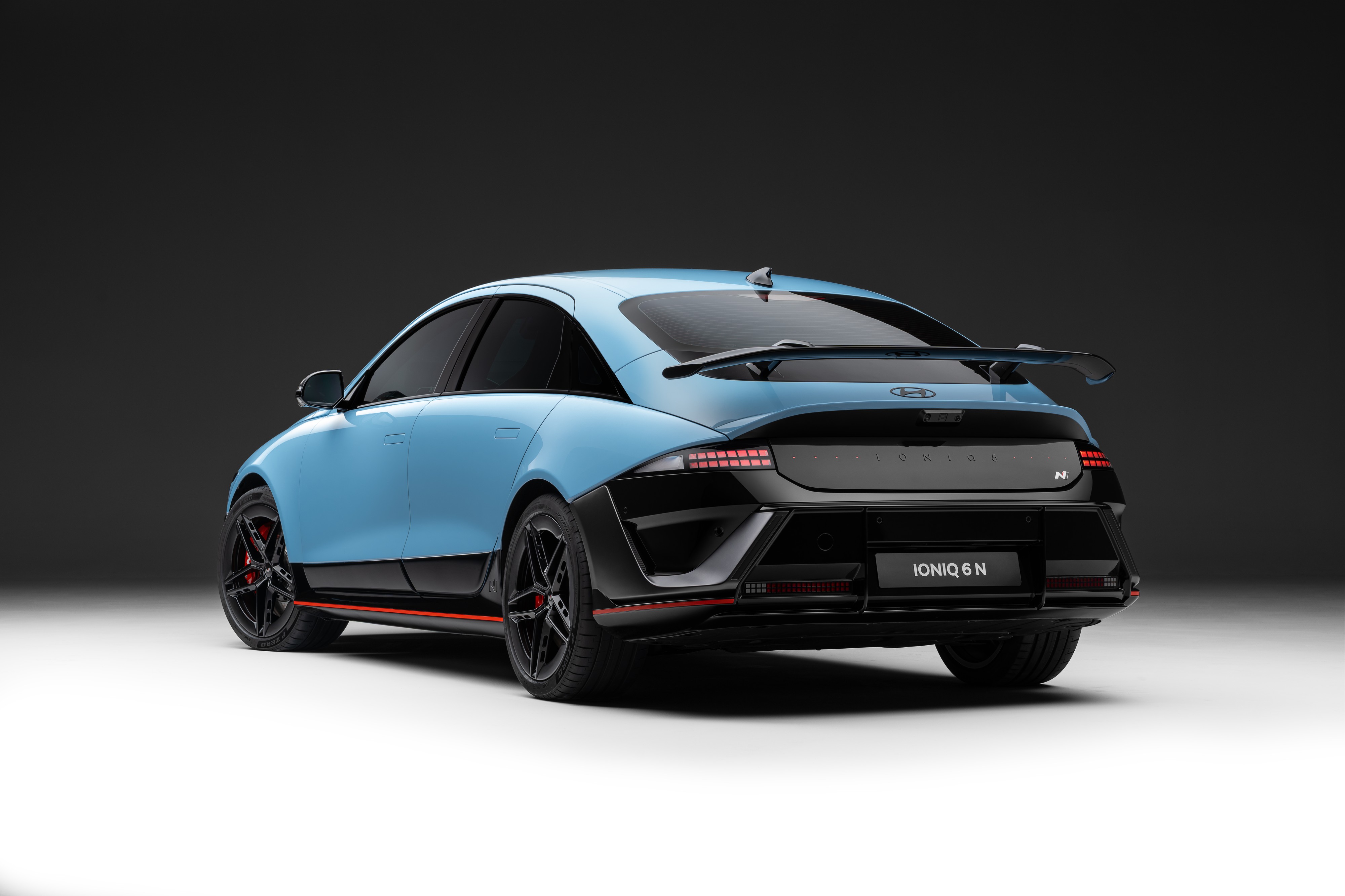
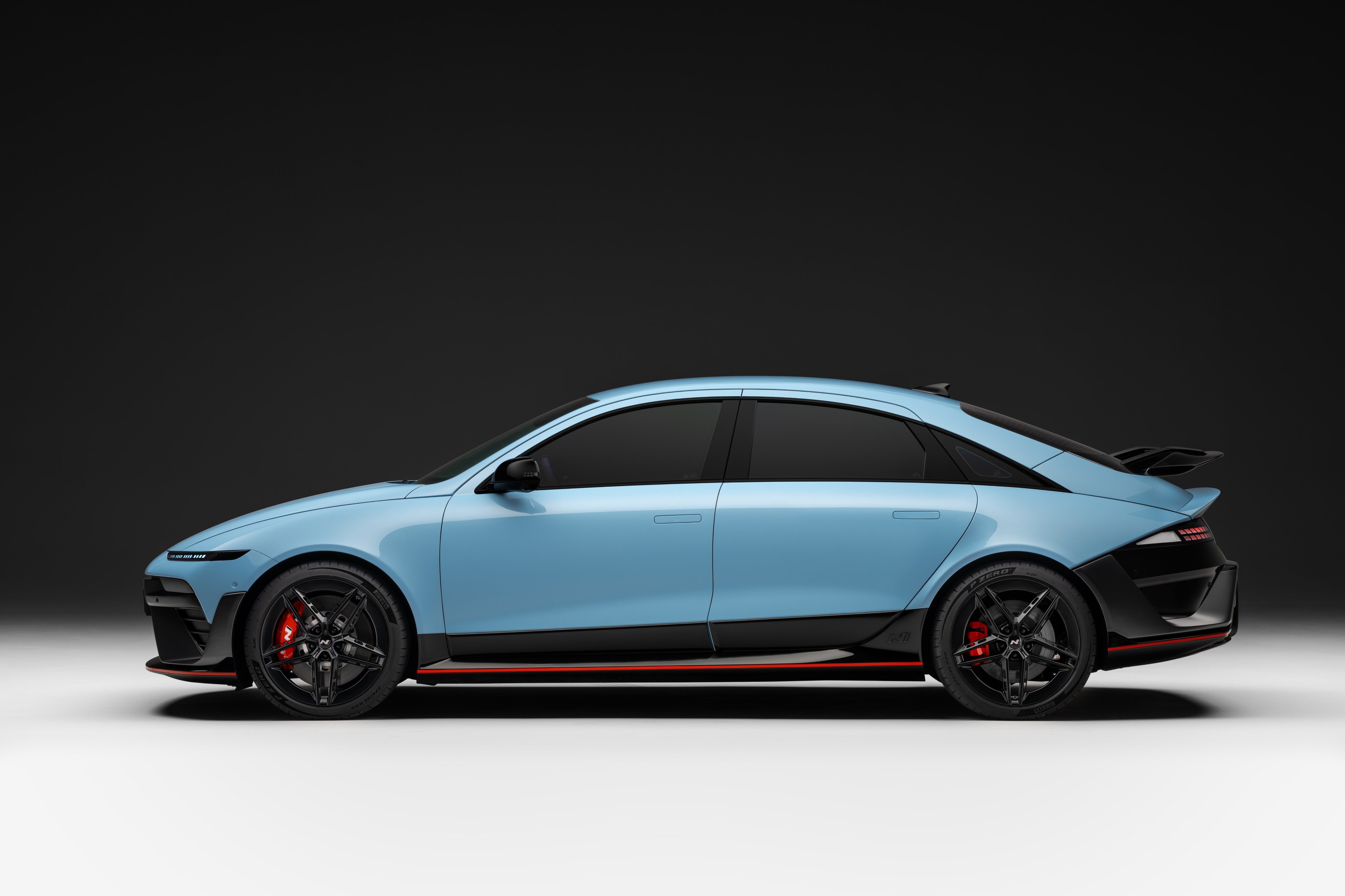
Outside, the Ioniq 6 N keeps the streamlined fastback sedan shape of the regular Ioniq 6 but adds a wider, more aggressive front end with a large lower intake, red accent lines along the lower edge, a swan-neck rear wing and 20-inch five-spoke wheels with large brake calipers. Door handles are flush, the headlights are hidden LED units, and Hyundai UK lists a glossy black beltline and mirror caps. Paint options in the UK are metallic or pearl at £795, matte at £1,295 and a Vision Roof at £1,380; the Performance Blue Pearl colour appears in Hyundai's press photos.
Inside, Hyundai uses a black cabin with Performance Blue accents, bucket-type front seats trimmed in Alcantara suede and leather, N-specific metal pedals, a perforated-leather N steering wheel and a knee support pad for cornering. The steering wheel carries the red N Grin Boost paddle and N1/N2 shortcut buttons. The UK specification adds heated and ventilated front seats, heated outer rear seats, a heated steering wheel, a suede roof lining, 64-colour ambient lighting linked to the N e-Shift system, a wireless phone charger and a Bose premium audio system. Hyundai Czech Republic says the N Everyday version, 50,000 CZK more than the base N, adds ventilated front seats with Alcantara upholstery and an interior suede package.
Technology & Features
The infotainment is Hyundai's CCNC platform with over-the-air updates, a 12.3-inch touchscreen for navigation and media and a 12.3-inch digital driver display. An augmented-reality head-up display, wireless Apple CarPlay and Android Auto, a digital key and three front plus two rear USB-C ports in the UK car round out the cabin tech. The N-specific layer includes an N Ambient Shift Light that shows the simulated shift points in the cabin lighting, a Track Manager for performance data, and pre-loaded circuit maps with the option to create custom circuits. Hyundai quotes a 10-year free Bluelink Lite period in the UK, after which a paid plan is needed.
Safety & ADAS
The UK specification lists Highway Drive Assist 2, Forward Collision-Avoidance Assist 2, Blind-Spot Collision-Avoidance Assist with a blind-spot view monitor, Lane Follow Assist, Lane Keep Assist, Intelligent Speed Limit Assist, a surround-view monitor, remote smart parking assist, rear occupancy alert and eCall. Airbags include front centre side airbags, thorax and pelvis airbags and curtain airbags. Highway Drive Assist is a Level 2 driver-supervised system. We did not find a Euro NCAP or NHTSA crash rating for the N version specifically, so no star rating is claimed here.
| ADAS LEVEL | Level 2 driver assistance (Highway Drive Assist 2) |
|---|---|
| ADAS FEATURES | Forward collision avoidance, blind-spot collision avoidance and view monitor, lane follow and lane keep assist, speed limit assist, surround view, remote smart parking, rear occupancy alert, eCall (UK specification) |
Available Versions
| VERSION | POWER | TORQUE | 0-100 | TOP SPEED | DRIVETRAIN | BATTERY | EV RANGE | COMBINED RANGE | PRICE | KEY DIFFERENCES |
|---|---|---|---|---|---|---|---|---|---|---|
| IONIQ 6 N (UK single specification) | 641 hp | 770 Nm | 3.2s | 257 km/h | AWD | 84 kWh | 487 km | — | £65,800 | 641 hp (478 kW / 650 PS) with N Grin Boost, 601 hp (448 kW / 609 PS) and 740 Nm without; €75,900 in Germany |
| IONIQ 6 N Everyday (Czech Republic) | 641 hp | 770 Nm | 3.2s | 257 km/h | AWD | 84 kWh | 487 km | — | CZK 1,849,990 | Same powertrain as the N at CZK 1,799,990; Hyundai Czech Republic says it adds ventilated Alcantara-and-leather seats and a suede package |
Pricing & Availability
Hyundai Motor UK opened orders on 22 January 2026 for a single specification at £65,800 on the road, and its price list effective from 1 October 2026 still shows that figure, made up of £54,175 plus £10,835 VAT (£65,010) and the on-the-road charges. UK press reports at launch said deliveries would begin in spring 2026. In Germany, orders opened in March 2026 at €75,900, according to electrive, AutoZeitung and elektroquatsch; Hyundai Germany's own page shows leasing from €609 a month rather than a list price, and elektroquatsch lists sports seats at €2,000, digital exterior mirrors at €1,400 and a glass roof at €700. Hyundai Czech Republic announced prices of CZK 1,799,990 for the N and CZK 1,849,990 for the N Everyday, including VAT, on 9 February 2026. In South Korea, sales began on 1 October 2025 at KRW 79.9 million after the 3.5% consumption tax and eco-vehicle tax benefits and before subsidies. In Australia the car costs A$115,000 before on-road costs, and the Australian outlet The Beep, citing Hyundai Australia, says the car is a "niche within a niche" and that after the initial allocation it will be available by custom order only, with about three months' lead time.
In Israel the importer Kalmobil began marketing the Ioniq 6 N on 17 June 2026 at NIS 399,900, a price that queenoftheroad.co.il lists and that auto.co.il rounds to NIS 400,000. Israeli outlets quote 601 hp normally and 641 hp in boost mode, 3.2 seconds to 100 km/h and 257 km/h, and 487 km of range. In the United States, Electrek reported in September 2026 that Hyundai's website lists the Ioniq 6 N as coming in 2026 with extremely limited availability at select dealers, and that a Hyundai Motor America manager said plans for the car have not changed; the car is expected as a 2027 model, and no official US price or EPA range has been announced.
Ioniq 5 N: Israeli Relaunch and US Price Cut
The Ioniq 5 N shares the Ioniq 6 N's 84 kWh battery and the same 478 kW (650 PS, about 641 hp) peak with N Grin Boost, with 448 kW (609 PS, about 601 hp) without it. Hyundai Europe's technical data lists 740 Nm without the boost and 770 Nm with it, 0-100 km/h in 3.5 seconds (3.4 with the boost), a 260 km/h top speed, 448 km of WLTP range and a peak DC rate of 239 kW, with 10-80% in about 18 minutes on a 350 kW charger. The crossover is 4,715 mm long and has a 3,000 mm wheelbase and 480 litres of luggage, so the sedan is about 39 km ahead on WLTP range and 0.1 seconds quicker to 100 km/h on Hyundai's own boost-only figures (3.3 s against 3.4 s), while the Ioniq 5 N has the larger boot and the taller body.
In the US, Hyundai Motor America cut the 2026 Ioniq 5 N's starting price by $6,300 to $59,900 before a $1,600 destination charge, which is $61,500 delivered. The 2026 model also gets a NACS charge port with CCS adapters, a ten-stage N Drift Optimizer, an in-cabin camera for the forward attention warning, automatic rear windows and a new Performance Blue Pearl paint; electrive reports that the technical specifications are unchanged. In Israel, Kalmobil relaunched marketing of the Ioniq 5 N on 17 June 2026 at NIS 409,900, which is NIS 10,000 more than the Ioniq 6 N. Cartube reports the new price is NIS 30,000 below the earlier one of NIS 439,990.
How It Compares
The closest like-for-like comparison is the new electric Mercedes-AMG CLA 45 4MATIC+ in Germany. The Ioniq 6 N costs €3,139 less at €75,900 against €79,039. The Mercedes has the stronger numbers on paper: 500 kW (680 PS, about 671 hp) from three axial-flux motors, a 94 kWh usable battery, up to 670 km of WLTP range and a charging peak of up to 330 kW, against the Ioniq 6 N's 641 hp, 487 km and 240 kW. Mercedes quotes 0-100 km/h in 2.7 seconds, a figure that ecomento notes uses a rollout convention, and about 3.0 seconds from a standstill, so the real gap to Hyundai's 3.2 seconds is small. The Ioniq 5 N is the in-house alternative: the same powertrain in a taller crossover body, with 39 km less WLTP range and a $59,900 US list price. That US price is a different market from the European prices of the other two cars, so treat it as context rather than a head-to-head price gap.
- 641 hp and 770 Nm with N Grin Boost, 0-100 km/h in 3.2 seconds, in a body with a 0.27 drag coefficient
- 800-volt architecture with 10-80% in about 18 minutes on a 350 kW charger and up to 487 km WLTP
- Real N hardware and software: 11-level torque distribution, electronic rear limited-slip differential, simulated shifts and a customisable drift mode
- Heavy and not very practical: 2,166 to 2,201 kg, a 371-litre boot and no towing rating in the UK
- Limited availability and a high price: Electrek reports extremely limited US availability, Australia moves to custom orders after the first allocation, and the car costs £65,800 in the UK and NIS 399,900 in Israel
The Ioniq 6 N is a serious performance sedan with a clear specification: 601 hp in normal driving, 641 hp with a 10-second boost, 770 Nm, 3.2 seconds to 100 km/h and an 18-minute 10-80% charge on a 350 kW charger. It is priced below the Mercedes-AMG CLA 45 in Germany and gives up range and peak power for that saving. The N-specific hardware, virtual gears and drift tools make it more of a driver's car than a simple speed demon. Buyers should treat the 18-minute and 3.2-second claims as best-case numbers, check availability in their market before ordering, and note that the sibling Ioniq 5 N now costs $59,900 in the US.