

Hyundai's streamlined electric sedan has been reworked with bigger batteries, a new face and a sporty trim line. The facelifted Ioniq 6 swaps the old 53 kWh and 77.4 kWh packs for 63 kWh and 84 kWh units (gross capacity), which lifts the maximum WLTP range from 614 km to up to 680 km. The 84 kWh car comes with a 168 kW (229 PS, about 226 hp) rear motor or a 239 kW (325 PS, about 321 hp) dual-motor all-wheel-drive system, and an 800-volt architecture accepts DC charging at up to 260 kW, good for 10-80% in 18 minutes on a suitable 350 kW charger. The body is about 7 cm longer than before, the drag coefficient stays at 0.21, and the new N Line and N Line X trims add 20-inch wheels and red interior accents without touching the powertrain. In Germany prices start at €45,550 for the 63 kWh entry car, in the Czech Republic at CZK 1,059,990 and in Israel at NIS 224,990. The high-performance Ioniq 6 N, which shares the 84 kWh battery size but is a separate car, has its own article on this site.
Performance & Specs
Hyundai offers the Ioniq 6 with three motors. The entry car has a single rear motor with 125 kW (170 PS, about 168 hp) and 350 Nm, takes 8.3 seconds from 0 to 100 km/h and is available only with the 63 kWh battery. The 84 kWh rear-wheel-drive version raises output to 168 kW (229 PS, about 226 hp), still with 350 Nm, and cuts the sprint to 7.4 seconds. At the top, the dual-motor all-wheel-drive version makes 239 kW (325 PS, about 321 hp) and 605 Nm and reaches 100 km/h in 5.1 seconds. Top speed is 185 km/h in every version. Hyundai quotes PS in Europe, which is the metric horsepower and about 1.4% smaller than the imperial hp, so the hp figures here are recalculated from the official kW and PS values.
The efficiency numbers are the car's strongest suit. Hyundai lists a drag coefficient of 0.21, and the WLTP range depends heavily on wheel size: the 84 kWh rear-drive car reaches up to 680 km on 18-inch wheels and up to 624 km on 20-inch wheels, while the all-wheel-drive car manages up to 650 km (18-inch) and 595 km (20-inch). The 63 kWh entry car is rated at up to 521 km. WLTP consumption is 13.4 to 15.9 kWh/100 km depending on the version. Those figures are measured at the socket, which is why 84 kWh divided by 680 km does not reproduce them. In its German test of the all-wheel-drive N Line, InsideEVs measured 14.6 to 19.8 kWh/100 km, averaging just over 16, and about 500 km on a long-distance run against Hyundai's 570 km claim.

| Powertrain | Single-motor rear-wheel-drive BEV, 800 V |
|---|---|
| Power | 168 kW (229 PS / 226 hp) |
| Torque | 350 Nm |
| 0–100 km/h | 7.4 s |
| Battery | 84 kWh gross |
| Range | Up to 680 km WLTP (18-inch wheels) |
| POWERTRAIN TYPE | BEV, single rear motor or dual-motor AWD |
|---|---|
| HORSEPOWER | 125 kW (170 PS / 168 hp); 168 kW (229 PS / 226 hp); 239 kW (325 PS / 321 hp) |
| TORQUE | 350 Nm; 350 Nm; 605 Nm |
| ACCELERATION | 0-100 km/h in 8.3 s; 7.4 s; 5.1 s |
| TOP SPEED | 185 km/h (all versions) |
| DRIVETRAIN | RWD (63 kWh and 84 kWh); AWD (84 kWh) |
| BATTERY | 63 kWh or 84 kWh gross, 800 V |
| ELECTRIC RANGE | Up to 521 km (63 kWh); up to 680 km (84 kWh RWD); up to 650 km (84 kWh AWD), WLTP |
Dimensions & Practicality

| Length | 4,925 mm (N Line 4,935 mm) |
|---|---|
| Width | 1,880 mm |
| Height | 1,495 mm |
| Wheelbase | 2,950 mm |
| Luggage | 401 L plus 45 L frunk (RWD) |
The facelift stretches the sedan to 4,925 mm, about 7 cm more than before, on an unchanged 2,950 mm wheelbase, with the N Line bumpers adding another 10 mm according to ADAC. Width is 1,880 mm and height 1,495 mm. The boot holds 401 litres, but its opening is small because the car is a notchback rather than a hatchback, and InsideEVs criticised the narrow hatch in its test. The front trunk adds 45 litres in rear-wheel-drive versions and shrinks to 14.5 litres in the all-wheel-drive car, which needs the space for the front motor. The same test praised rear legroom, with a flat floor, as comparable to a large saloon, while noting that tall passengers run into the sloping roofline. ADAC and InsideEVs list a braked towing capacity of 1,500 kg for the N Line.
| LENGTH | 4,925 mm (N Line 4,935 mm) |
|---|---|
| WIDTH | 1,880 mm |
| HEIGHT | 1,495 mm |
| WHEELBASE | 2,950 mm |
| CARGO VOLUME | 401 L |
| FRUNK | 45 L (RWD); 14.5 L (AWD) |
| KERB WEIGHT | 2,029 kg (N Line 84 kWh RWD, ADAC) |
| TOWING | 1,500 kg braked (N Line, ADAC and InsideEVs) |
Charging & Battery
Both batteries use Hyundai's 800-volt architecture, which can also charge at 400-volt stations. Hyundai Germany lists a maximum DC power of 260 kW and ties 10-80% in 18 minutes to a 350 kW charger, as do Hyundai Slovakia and Auto Express, so the 350 kW figure describes the charger and not the car. In InsideEVs' German test, the all-wheel-drive N Line did reach 260 kW briefly, averaged 184 kW and went from 31% to 80% in 14 minutes. At home the car takes 11 kW three-phase AC, and the vehicle-to-load function delivers up to 3.6 kW.
Hyundai's press kit gives 63.0 kWh and 84.0 kWh, up from 53 kWh and 77.4 kWh, without a net figure. InsideEVs says these are Hyundai's usual gross values and estimates about 60 kWh and 80 kWh net, and ADAC lists the 84 kWh pack as 84.0 kWh gross, so treat the net numbers as estimates. The 84 kWh battery therefore sits at the same nominal size as the pack in the separate Ioniq 6 N. The warranty is five years without a mileage limit in Germany, with the battery covered for eight years or 160,000 km.
| BATTERY | 63 kWh or 84 kWh gross, 800 V |
|---|---|
| AC CHARGING | 11 kW three-phase |
| DC FAST CHARGING | Up to 260 kW |
| DC 10-80% TIME | 18 min on a 350 kW charger (Hyundai); 31-80% in 14 min measured by InsideEVs |
| WLTP CONSUMPTION | 13.4-15.9 kWh/100 km depending on version, measured at the socket |
| BATTERY WARRANTY | 8 years or 160,000 km (Germany) |
Design & Interior
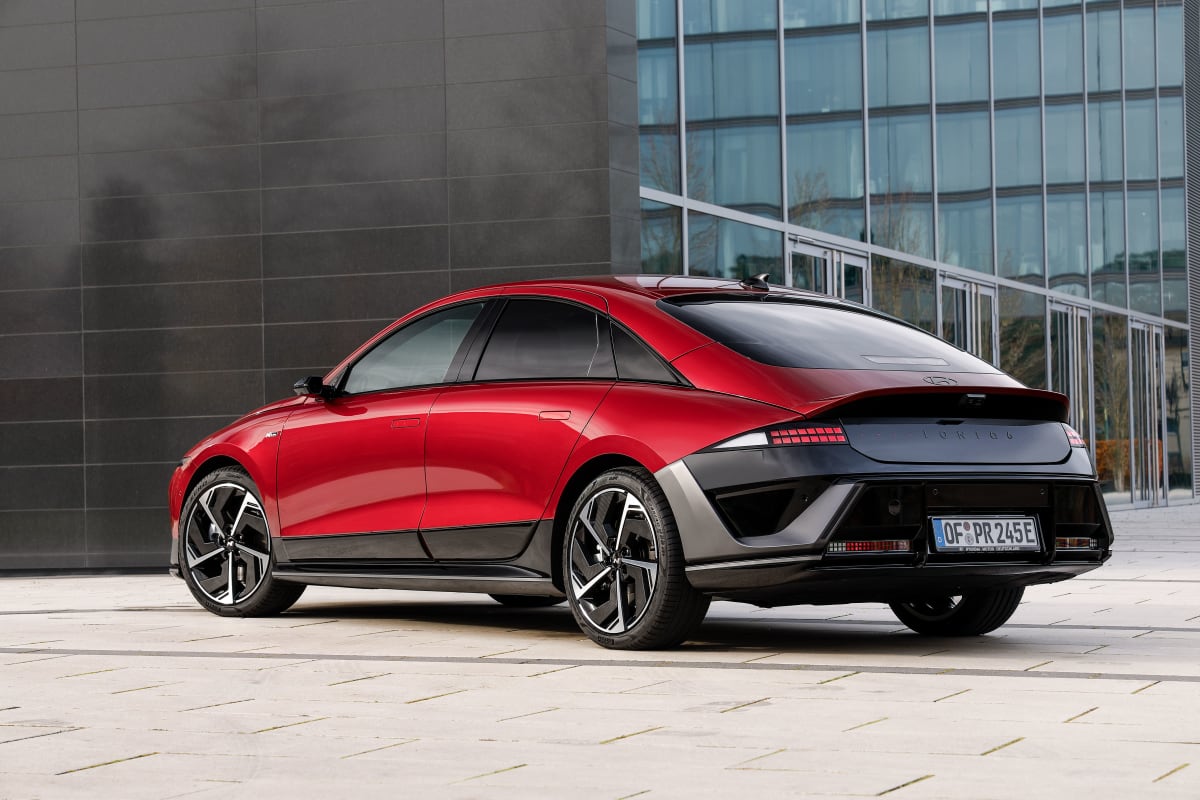
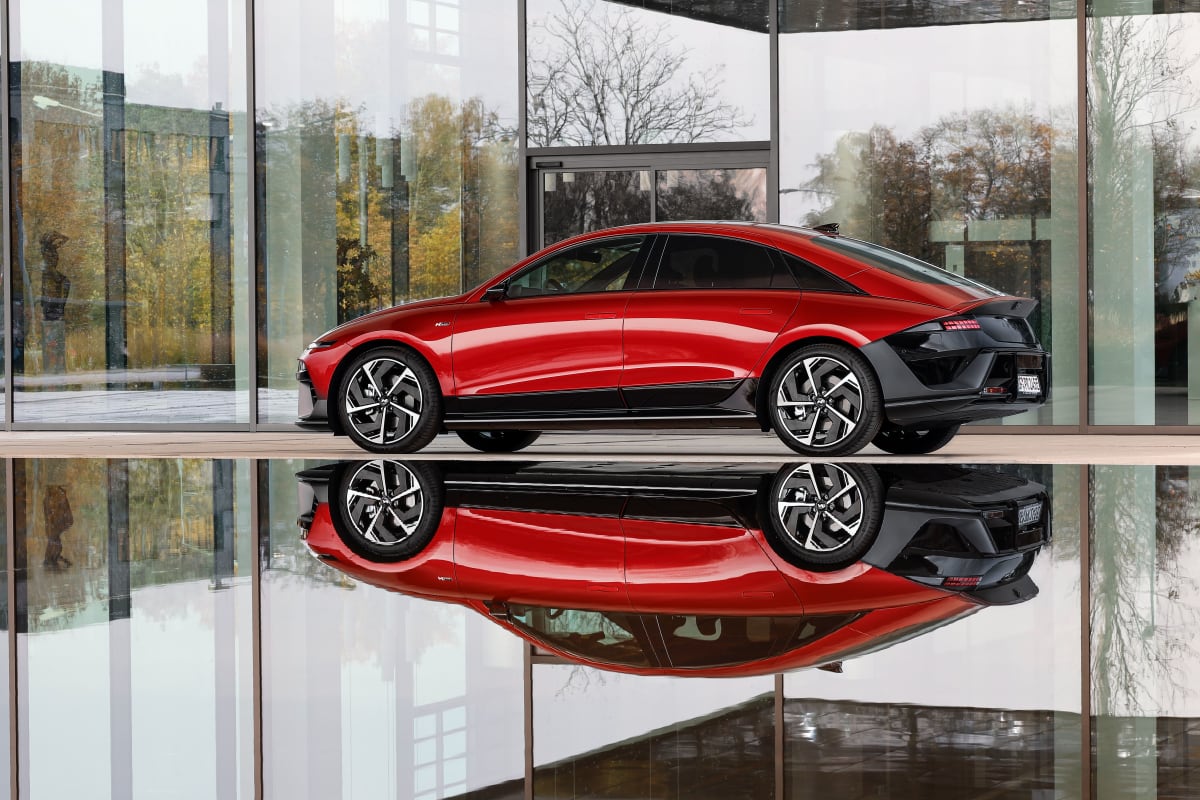
The new front end has slim light bars made of four elongated elements per side that continue the pixel motif, while the main headlights sit lower in the bumper. The bonnet is higher, the rear spoiler has been reshaped into a ducktail, and there are new wheel designs and a revised colour palette; the only paint that costs nothing extra in Germany is the bright Ultimate Red. The flush door handles remain. The N Line and N Line X trims add a sportier bumper and interior, 20-inch wheels, aluminium-look pedals, a steering wheel with the N logo and red accents inside and out. The N Line X adds Alcantara-leather seats and nearly the full equipment list.
Inside there is a new centre console, a new steering wheel, a larger climate display and extended ambient lighting. The dash keeps its two 12.3-inch screens side by side, and Hyundai's unusual layout of putting the window switches on the centre console, a wireless phone tray and two USB-C ports remains. Optional camera-based exterior mirrors cost €1,300 on the top trims. In Germany the Uniq adds Bose audio, a 360-degree camera, a head-up display, ventilated front seats and a steering wheel with illuminated LED pixels; the Centriq and N Line are available with the €2,600 Tech Package with head-up display and Digital Key 2.0.
Technology & Features
The system includes a 12.3-inch navigation touchscreen with Hyundai Bluelink and wireless Apple CarPlay and Android Auto, plus a 12.3-inch digital cluster, and Hyundai notes that Bluelink and over-the-air updates may require a paid subscription. Plug & Charge is supported at compatible chargers. Paddles behind the wheel set the regenerative braking level, and InsideEVs described the system as finely adjustable and well suited to one-pedal driving. Hyundai's Slovak material adds Digital Key 2 with ultra-wideband, 12-segment matrix LED headlights and a smart regeneration system that adapts to traffic. Hyundai Germany lists a heated steering wheel and battery pre-conditioning as standard even on the base car, and the €2,600 Tech Package adds remote smart parking assist and a 360-degree camera.
Safety & ADAS
Hyundai Germany lists Highway Driving Assist 2.0 with hands-on detection, navigation-based adaptive cruise control, Forward Collision-Avoidance Assist with pedestrian detection, an intersection assistant, lane change and blind-spot assist, remote smart parking, a 360-degree camera, rear cross-traffic collision-avoidance assist, a driver attention warning and a safe exit warning. The equipment list shows that the base Ioniq 6 has the simpler 1.5 generation of braking and highway assist, while the 2.0 versions arrive from Centriq upward. Hyundai does not state an SAE level in the material we checked; these are driver-supervised systems. Israel lists the car with seven airbags and driver aids including autonomous emergency braking and adaptive cruise control. We did not find a Euro NCAP result for the facelifted car.
| ADAS LEVEL | Driver-supervised assistance (no SAE level stated by Hyundai) |
|---|---|
| ADAS FEATURES | Highway Driving Assist 2.0, navigation-based cruise control, forward collision-avoidance assist, intersection assist, blind-spot assist, remote smart parking assist, 360° camera, rear cross-traffic assist, attention warning, safe exit warning (German specification, from Centriq upward) |
Available Versions
| VERSION | POWER | TORQUE | 0-100 | TOP SPEED | DRIVETRAIN | BATTERY | EV RANGE | COMBINED RANGE | PRICE | KEY DIFFERENCES |
|---|---|---|---|---|---|---|---|---|---|---|
| Ioniq 6 (base) 63 kWh | 168 hp | 350 Nm | 8.3s | 185 km/h | RWD | 63 kWh | 521 km | — | EUR 45,550 | 125 kW (170 PS), 18-inch wheels; heat pump €1,200 extra |
| Centriq 84 kWh | 226 hp | 350 Nm | 7.4s | 185 km/h | RWD | 84 kWh | 680 km | — | EUR 55,300 | 168 kW (229 PS), matrix LEDs, heat pump, Highway Assist 2.0 (Centriq 63 kWh: €52,050) |
| N Line 84 kWh | 226 hp | 350 Nm | 7.4s | 185 km/h | RWD | 84 kWh | 585 km | — | EUR 58,300 | 20-inch wheels, N Line design; AWD €61,550 |
| Uniq 84 kWh | 226 hp | 350 Nm | 7.4s | 185 km/h | RWD | 84 kWh | 680 km | — | EUR 60,500 | Bose, head-up display, 360 camera, leather; AWD €63,750 |
| N Line X 84 kWh AWD | 321 hp | 605 Nm | 5.1s | 185 km/h | AWD | 84 kWh | 570 km | — | EUR 65,250 | 239 kW (325 PS), 20-inch wheels, Alcantara-leather; RWD €62,000 |
Pricing & Availability
The facelift was shown at the Seoul Mobility Show in April 2025 and reached its home market of South Korea in December 2025, where Hyundai quotes up to 562 km on the Korean test cycle for the 84 kWh car and 437 km for the 63 kWh car. European orders followed in January 2026. Hyundai's German price list from February 2026 gives recommended retail prices excluding delivery charges: €45,550 for the 63 kWh base car, €52,050 for the Centriq with 63 kWh and €55,300 with 84 kWh, €58,300 for the N Line, €60,500 for the Uniq and €62,000 for the N Line X. All-wheel drive is available on the three top trims at €61,550, €63,750 and €65,250. A heat pump is a €1,200 option on the base car and a glass roof costs €700. InsideEVs reports that Hyundai sold about 1,000 Ioniq 6 cars in Germany in 2025 and 416 in the first half of 2026.
In the Czech Republic Hyundai's release of 9 February 2026 lists the Smart (63 kWh) at CZK 1,059,990, the Style (84 kWh) at CZK 1,279,990, the Premium from CZK 1,449,990 and the N Line Premium from CZK 1,469,990, all including VAT. In Israel the importer Kalmobil opened sales in February 2026 with a single rear-drive 84 kWh powertrain: the Ultra costs NIS 224,990 with up to 680 km WLTP, and the Excellence costs NIS 247,990 with up to 624 km on its 20-inch wheels; Carzone still showed the same list prices on 6 October 2026, together with a discount worth NIS 5,600. We could not confirm UK pricing or an on-sale date for the facelifted car, nor a US or Australian launch.
How It Compares
On German list prices the Ioniq 6 Centriq 84 kWh at €55,300 lands next to the Mercedes-Benz CLA 250+ at €55,859, and the CLA offers the longer rating, up to 792 km against 680 km, from an 85 kWh usable battery with more power at 268 hp against 226 hp. The BYD Seal Design is €49,990 with 308 hp but only up to 570 km, and the Tesla Model 3 Premium all-wheel-drive costs the same €49,990, with 434 hp (ADAC's 324 kW system figure, which other databases list differently) and up to 660 km. The Hyundai offers the most distinctive body of the four, but it has the least power at this price, and the nearest equivalent to the Tesla's output is the €61,550 to €65,250 all-wheel-drive N Line, with 321 hp and a shorter range of about 570 km. A caveat on the numbers: the CLA price is Mercedes' April 2025 launch list, and outlets show about €55,728 in 2026.
- Up to 680 km WLTP from an 84 kWh gross battery, helped by a 0.21 drag coefficient
- 800-volt charging at up to 260 kW and 10-80% in 18 minutes; InsideEVs measured 31-80% in 14 minutes with a 184 kW average
- Five-year warranty with no mileage limit and eight years or 160,000 km on the battery in Germany; the heat pump is standard from the Centriq trim
- Practicality compromises: a 401 L boot behind a small notchback opening, a roofline that limits rear headroom and window switches placed on the centre console
- Real range falls short of the claim, and 20-inch N Line versions are rated lower: 570 km for the all-wheel-drive N Line against 680 km for the 18-inch rear-drive car, and InsideEVs managed about 500 km on a long drive
The facelift fixes what the Ioniq 6 needed most: range and charging. Up to 680 km WLTP, a 63 kWh entry option and 260 kW charging make it a more competitive electric sedan, and it keeps the shape that sets it apart. The sweet spot looks like the 84 kWh Centriq at €55,300 in Germany with 18-inch wheels and a heat pump; the N Line is mostly a styling choice that costs range, and the all-wheel-drive versions give a real jump in performance for about €3,250 more. Against the Mercedes CLA, the Seal and the Model 3 it is not the cheapest or the most powerful, so it suits buyers who value the design and efficiency. In Israel it is a rear-drive-only car at NIS 224,990 to NIS 247,990.